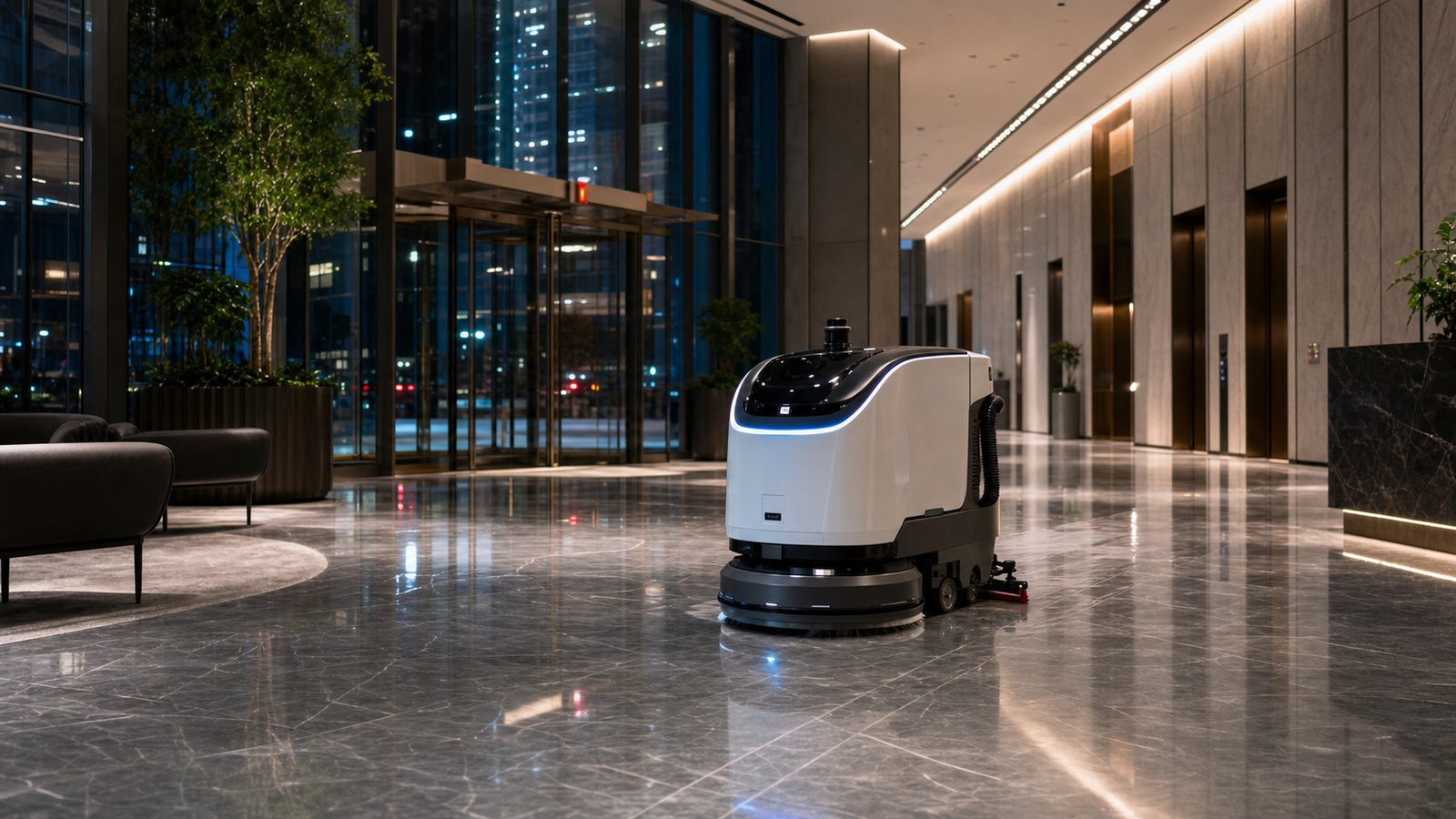
If you manage a Manhattan office tower, residential high-rise, hospital, or university facility, you already know the problem: hard-surface floors get dirty fast, labor is expensive, and complaints spike when lobbies and corridors look dull. Autonomous floor scrubbers can reduce repetitive labor, improve consistency, and create measurable cleaning proof—when they’re deployed with the right program. This guide explains what buyers searching for “autonomous floor scrubbers Manhattan” actually need: ROI math, safety and compliance, a deployment checklist, and how GreenPoint Maintenance Services verifies outcomes with JaniTrack (GPS-tagged photos, time stamps, and optional ATP testing). For a walkthrough and fixed-price quote, call 347-332-9348.
Why autonomous floor scrubbers are taking off in Manhattan buildings
Manhattan properties face unique operating pressure: high foot traffic around transit hubs (Grand Central, Penn Station, Port Authority), weather-driven soil load (salt, slush, rain), and tight overnight windows for work in lobbies, corridors, and amenity areas. Traditional ride-on scrubbers still require an operator for every pass. Autonomous units shift the operator role from “drive every minute” to “set routes, stage the machine, verify results, and spot-clean exceptions.” GreenPoint typically sees the best fit in long corridors, large lobby approaches, loading-dock paths, and garage ramps—areas where repeatable routes matter more than intricate hand work.
ROI benchmarks: what facility managers should measure (not marketing claims)
To evaluate ROI, separate three buckets: (1) labor minutes replaced, (2) quality/complaint reduction, and (3) risk reduction (slip-and-fall, chemical handling, and after-hours staffing exposure). A practical Manhattan benchmark is to start with routeable square footage: corridors and open hard-surface zones of 10,000–40,000 sq ft per shift are often where autonomy shines. If an operator historically spends 2.5–4.0 hours per night on repetitive scrub passes, autonomy can reallocate 60–80% of that driving time to edge work, detail cleaning, and inspections—without changing headcount. GreenPoint recommends capturing a baseline for two weeks: labor logs, complaint tickets, and appearance scores by zone. Then compare against a four-week pilot with the robot.
Safety and compliance in NYC: slip resistance, signage, and OSHA-ready practices
In Manhattan, safety isn’t optional—especially in lobbies, retail entrances, and healthcare corridors. Your program must control wet-floor risk with clear zoning, cones/signage, and route timing to avoid peak pedestrian flows. OSHA guidance emphasizes hazard communication, proper chemical labeling, and staff training when using cleaning chemicals; that still applies even if the machine is autonomous. GreenPoint standardizes chemical dilution, SDS access, and GHS labeling for any floor chemistry used with autoscrubbers (see our safety-focused guidance in [OSHA cleaning chemical safety and SDS](/blog/osha-cleaning-chemical-safety-ghs-sds/)). We also plan routes that avoid elevator thresholds and high-risk transitions unless you have the right mats and drying time.
Where autonomy works best in Manhattan (and where it usually doesn’t)
Best-fit zones are consistent, repeatable, and low-clutter: long office corridors, parking garage lanes, amenity hallways, and broad lobby approaches after-hours. Tough-fit zones include tight retail aisles during business hours, heavily furnished lounges, and construction-adjacent areas with constantly changing obstacles. A simple rule: if the space requires frequent chair movement and hand detailing, the robot won’t replace that work—it will complement it. GreenPoint designs hybrid programs: autonomy handles the predictable lane work while our team focuses on edges, corners, elevators, and high-touch points.
The Manhattan deployment checklist: power, water, storage, and route design
A successful deployment starts with facilities realities. You need: (1) a secure storage and charging location (often a janitor closet or back-of-house room), (2) access to a mop sink or fill station, and (3) a clear route plan that accounts for door schedules and security checkpoints. In high-rises, elevator logistics matter—many teams keep robots on a single primary floor set rather than moving them constantly. GreenPoint’s walkthrough process maps routes by zone, confirms floor type (VCT, LVT, terrazzo, polished concrete), and sets a cleaning frequency tied to soil load and appearance expectations. For frequency standards across facility types, reference [cleaning frequency standards](/blog/cleaning-frequency-standards-by-facility-type/).
Proof and verification: why JaniTrack matters more when you automate
Automation without verification becomes a “set it and hope” program—exactly what building managers can’t defend when leadership asks, “Are we actually getting what we pay for?” GreenPoint Maintenance Services uses JaniTrack to document completion with time-stamped, GPS-tagged photos, route confirmation, and optional ATP bioluminescence testing for objective hygiene checks in sensitive environments. That proof is especially valuable in Manhattan Class A properties where tenant expectations are high and management reports need evidence. We also use scoring checklists to compare zones before/after autonomy (see our metric framework in [cleaning audit checklist for facility managers](/blog/cleaning-audit-checklist-facility-managers/)).
Cost planning: subscription, maintenance, and the true cost of cleaning
Budgeting needs to include more than the unit price. Consider: software licensing, replacement pads/brushes, squeegees, battery life, and on-site support. The financial question is not “What does the robot cost?” but “What does my program cost per verified clean?” GreenPoint uses fixed pricing (no hourly billing, no hidden fees) and aligns technology choices to measurable outcomes. If you want a structured way to compare vendor options, start with [calculating true cleaning cost (TCO)](/blog/calculating-true-cleaning-cost-tco/) and [commercial cleaning cost per square foot](/blog/commercial-cleaning-cost-per-square-foot/). For a Manhattan-specific walkthrough and a line-item proposal, call 347-332-9348.
FAQ: Autonomous floor scrubbers in Manhattan commercial buildings
Q1: Do autonomous floor scrubbers replace janitorial staff? A: In most Manhattan facilities, they reallocate labor from repetitive driving to detail work, inspections, and higher-value tasks; quality usually improves when the crew is redeployed intelligently. Q2: Are they safe around pedestrians? A: They can be, but best practice is to run routes after-hours or in controlled zones with wet-floor signage and a defined safety plan. Q3: What floors work best—VCT or LVT? A: Both can work; route selection and the right pads/chemistry matter more than the label. GreenPoint confirms floor type and finish before recommending a program. Q4: How do we prove the robot actually cleaned the area? A: Use verification: route logs, time-stamped photos, and spot testing. GreenPoint’s JaniTrack system provides GPS-tagged photos and optional ATP testing. Q5: How long does a pilot take? A: Plan 2 weeks of baseline measurement and 4 weeks of pilot operations to see reliable trends in appearance scores and complaints.
Next steps: pilot plan and what to ask your vendor
Before you buy or lease, demand a clear scope: which zones, how often, what chemistry, what verification, and what happens when obstacles or special events interrupt routes. GreenPoint provides a pilot plan with measurable KPIs (appearance level targets, complaint response time, and completion proof). We’re MBE/MWBE certified and built for commercial standards—98% client retention and evidence-based QA. If you’re evaluating autonomous scrubbers for a Manhattan building, schedule a walkthrough by calling 347-332-9348 or emailing info@greenpointms.com.
Need an autonomous floor scrubber program in Manhattan that’s verified, not guessed? GreenPoint Maintenance Services will map your routes, set measurable KPIs, and document completion with JaniTrack time-stamped GPS-tagged photos (and optional ATP testing). Call 347-332-9348 for a walkthrough and fixed-price quote—no hourly billing, no hidden fees.