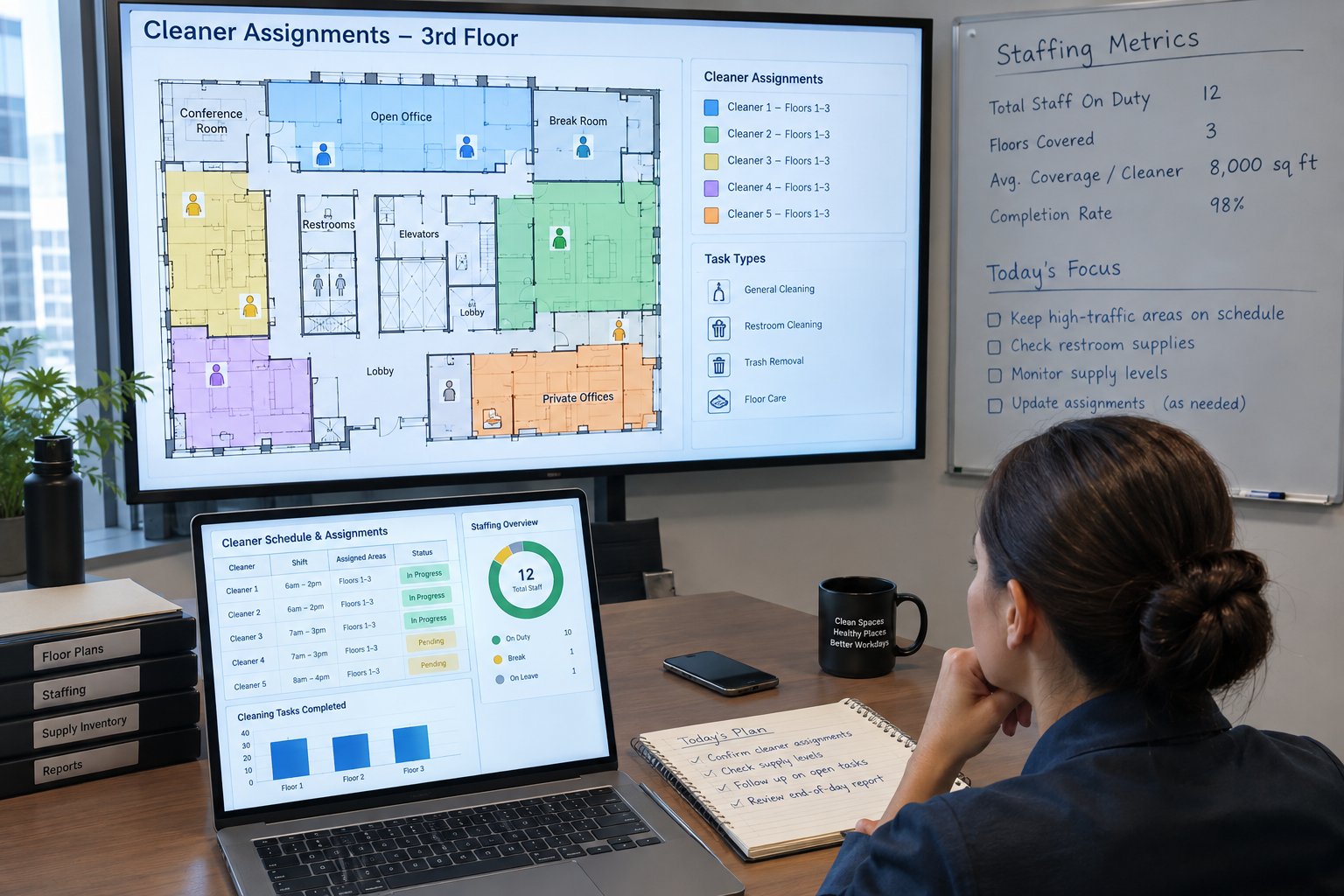
A commercial cleaning staffing ratio is a planning tool, not a promise that one cleaner can service any number of square feet. Productivity changes with restroom count, floor finish, clutter, security, elevators, waste distance, occupancy, frequency, and the quality standard. GreenPoint Maintenance Services estimates coverage from the actual building and service window instead of multiplying a low headline rate by square footage. This guide gives facility managers in NY, NJ, CT, PA, and FL a practical way to compare labor assumptions before signing a contract.
Why Square Footage Alone Misleads
Two 50,000-square-foot facilities can require very different labor. A mostly open office with two restroom banks and low evening occupancy is not equivalent to a medical suite with exam rooms, a school with classrooms and cafeterias, or a warehouse with long travel routes and loading docks. Count rooms, fixtures, sinks, waste points, stairs, elevators, carpet, resilient floors, stone, glass, and high-touch zones. The [cleaning staffing ratios square footage guide](/blog/cleaning-staffing-ratios-square-footage/) helps frame the variables; the walkthrough sets the actual scope.
A useful estimate separates productive cleaning minutes from nonproductive time: arrival, security screening, cart setup, travel, supply restock, waste staging, elevator waits, breaks, and supervisor handoff. If a cleaner spends 20 minutes of a 4-hour shift moving between floors, a ratio based only on floor area will overstate capacity. GreenPoint documents the route and access conditions before assigning a team size.
Start With Facility Type and Appearance Level
ISSA appearance levels can help a client describe whether the building should look orderly, presentable, or highly detailed, but the contract must turn that description into tasks. A Class A Midtown office with visitor-facing stone and glass may need more day-porter and touchpoint work than a back-office suite. A school or childcare facility may need different classroom, restroom, and floor frequencies. GreenPoint matches the staffing model to the risk and occupancy pattern, not to a generic industry label.
Medical offices also need clear boundaries for exam rooms, regulated waste, patient privacy, and infection-prevention procedures. A 15,000-square-foot practice may need more labor per square foot than a 60,000-square-foot office because rooms are smaller and touchpoints are denser. Call 347-332-9348 to schedule a walkthrough with a room inventory and service-window review.
Use a Simple Labor-Minute Model
Begin with task minutes by zone. For each room or area, estimate daily, weekly, and periodic tasks, then add travel and setup. If a 30,000-square-foot office needs 1,050 productive minutes per night and each cleaner provides 210 productive minutes in the approved window, the starting point is five cleaners before supervision and special access are considered. This is more defensible than claiming that one cleaner can always cover 10,000 square feet.
Track the estimate for four weeks and adjust based on completion, rework, complaints, supply use, and actual route time. BLS occupational data can provide broad labor-market context, but it does not know the building's elevators, clutter, or security rules. GreenPoint's supervisor reviews the assumptions and raises a scope issue when the client adds floors, events, or restrooms without adding time.
Office, School, and Medical Benchmarks
For a standard office, a planning range might be 3,500 to 6,500 gross square feet per cleaner per shift when the scope includes restrooms, kitchens, waste, floors, and normal access. High-touch, high-occupancy, or heavily furnished offices may fall below that range. A school with classrooms, cafeterias, gyms, and multiple restrooms often needs a lower ratio; a low-occupancy warehouse with long aisles may need a different route-based calculation rather than a pure area ratio.
Use the ratio as a starting band, not a guarantee. A 100,000-square-foot school might require 15 to 25 staff-equivalent shifts across opening, day, and closing coverage depending on rooms, calendar, and floor care, while a 100,000-square-foot open office might use a smaller evening team plus a day porter. GreenPoint can show the staffing assumption, frequency, and periodic work as separate line items.
Warehouses, Campuses, and Travel Time
Warehouses have large floor areas but may include docks, battery rooms, breakrooms, restrooms, production zones, racking, and safety restrictions. A cleaner who must walk 500 feet to a disposal point loses productive time. Campuses add exterior paths, inter-building travel, weather exposure, and keys. In Westchester, Long Island, New Jersey, Connecticut, or Pennsylvania, parking and building separation can change the shift calculation more than another 5,000 square feet.
GreenPoint maps routes, waste staging, charging points, and access contacts during a walkthrough. For a Queens or Brooklyn site near heavy transit, the issue may be elevator scheduling and visitor flow; for a Florida campus, humidity and storm response can add floor and entry work. Phone 347-332-9348 before a bid deadline so staffing is based on a measurable route rather than a sales average.
Day Porters and Peak Occupancy
Evening cleaners and day porters solve different problems. An evening team can complete a larger reset after occupants leave; a day porter protects high-traffic restrooms, lobbies, spills, supplies, and event areas while the building is open. A 40,000-square-foot office near Grand Central may need one day porter during peak hours even if the night ratio looks adequate. A school may need day coverage around lunch, arrival, and dismissal.
Price day-portering by defined zones and response windows, not an unbounded “as needed” promise. GreenPoint uses fixed pricing with no hourly billing and no hidden fees, while optional storm, event, or emergency work is listed separately. JaniTrack can show rounds and exceptions so a manager can decide whether the coverage is sufficient. Call 347-332-9348 to review peak periods.
Quality, Training, and Turnover
More labor does not automatically mean better cleaning if routes, tools, training, and supervision are weak. Use color-coded microfiber, product-specific training, floor-care methods, and a clear handoff between shifts. OSHA hazard communication, SDS access, PPE, and safe chemical storage should be part of onboarding. GreenPoint Maintenance Services supports MBE/MWBE and SAM.gov procurement requirements while keeping the operating plan focused on trained people and measurable tasks.
Turnover also changes the ratio. A contractor that constantly replaces staff may spend more time retraining and correcting missed work. GreenPoint's 98% client retention reflects continuity, supervisor review, and a documented scope. JaniTrack's timestamped GPS-tagged photos and checklist fields can help identify whether a problem is labor capacity, access, training, or an unrealistic task list.
Build a Staffing Review Cadence
Review the first week for obvious gaps, the first month for repeat patterns, and each quarter for building changes. Measure completed task percentage, rework, complaint rate, overtime or added visits, supply use, safety incidents, and supervisor observations. If the team misses a floor because an elevator is unavailable, adding another cleaner may not fix the root cause. If restrooms fail during lunch, a day-porter adjustment may be better than increasing the night crew.
A clear review makes vendor comparison easier. Ask each bidder to show labor minutes, team size, supervisor ratio, service frequency, periodic work, and assumptions about access. The [commercial cleaning cost per square foot guide](/blog/commercial-cleaning-cost-per-square-foot/) can help separate price from scope. GreenPoint can produce a fixed-price proposal after a walkthrough and explain which assumptions would trigger a change.
A useful operating record is concise enough to review and detailed enough to act on. GreenPoint uses a zone map, approved scope, supervisor review, and an exception owner so the client does not have to reconstruct a service event from scattered texts. For a multi-floor Manhattan office, a Bronx campus, or a New Jersey distribution site, the record should identify the exact area, time, task, condition, and next action. GreenPoint Maintenance Services keeps the service conversation tied to evidence instead of vague assurances.
Review the first 30 days as a pilot, even when the contract is intended to run for years. Compare planned labor with actual minutes, look at repeat exceptions, ask occupants which areas fail first, and verify that supplies and access are adequate. If the facility changes its hours, tenant mix, floor finish, or event calendar, schedule a walkthrough rather than asking the crew to absorb new work. Call 347-332-9348 or email info@greenpointms.com when a scope needs to change.
GreenPoint can also separate routine cleaning from periodic work such as carpet extraction, VCT maintenance, high dusting, glass, post-event recovery, and emergency response. That distinction protects the budget and helps a facility manager compare vendors on the same basis. Fixed pricing means the agreed scope is visible, with no hourly billing and no hidden fees. GreenPoint's MBE/MWBE certifications, SAM.gov registration, and Green Seal certified product options can be documented during procurement.
For quality assurance, GreenPoint uses JaniTrack where the site approves it: timestamped GPS-tagged photos, selected ATP testing, checklist completion, supervisor review, and a live dashboard. The system is not a substitute for a trained person or a manufacturer instruction, but it gives a manager a practical way to see exceptions and closure. GreenPoint's 98% client retention is supported by this feedback loop and by correcting recurring conditions instead of merely closing tickets.
Frequently Asked Questions
What is a good commercial cleaning staffing ratio? There is no universal ratio. A standard office may begin around 3,500–6,500 gross square feet per cleaner per shift, but restrooms, occupancy, floor types, access, and quality level can move the number substantially.
Does square footage include travel time? It should not be treated as productive cleaning time. Add setup, security, elevator waits, waste travel, restocking, and handoff time to the labor model.
How many cleaners does a 50,000-square-foot office need? A starting estimate may be 8–14 cleaner shifts depending on scope and service window, but a walkthrough and route study are needed before committing to a number.
When does an office need a day porter? Day coverage is useful when occupancy creates midday restroom, spill, lobby, supply, or event demands that an evening crew cannot address. Use observed peaks rather than a generic rule.
How can GreenPoint quote staffing? Call 347-332-9348 or email info@greenpointms.com. GreenPoint will map the facility, estimate labor minutes, separate periodic work, and provide fixed pricing with no hidden fees.
Call GreenPoint Maintenance Services at 347-332-9348 or email info@greenpointms.com to schedule a facility walkthrough and fixed-price quote. GreenPoint combines trained local teams, Green Seal certified product options, and JaniTrack verification with a 98% client retention rate.