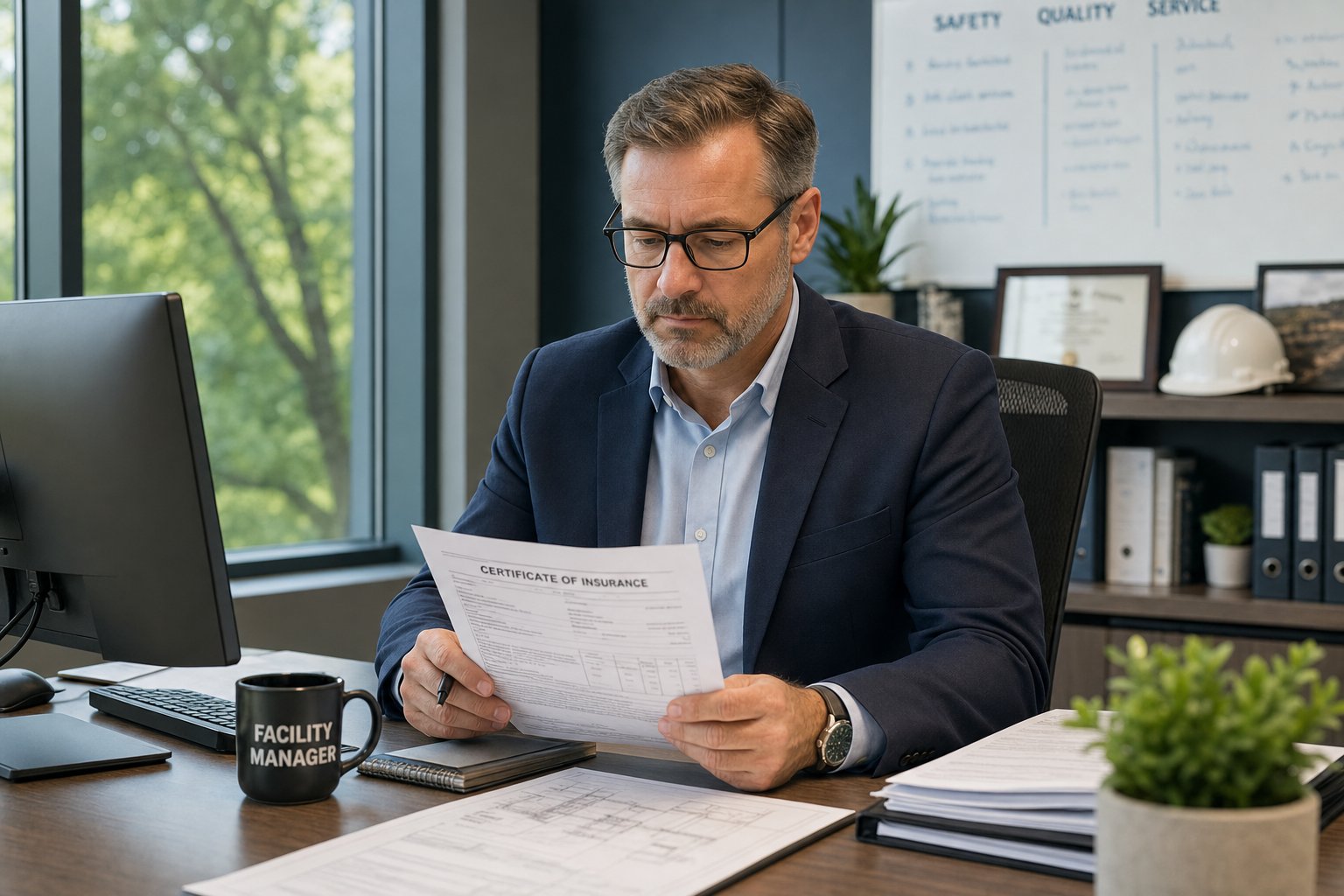
If you manage a commercial property in New York City, North Jersey, or Fairfield/Westchester, you’ve probably been asked to “just send the COI” before a janitorial vendor can step on site. The problem: many Certificates of Insurance (COIs) are incomplete, outdated, or written in a way that leaves the building owner and manager exposed. At GreenPoint Maintenance Services, we help facility teams eliminate that risk with documented compliance, clear contract language, and proof-driven quality controls like JaniTrack verification (timestamped, GPS-tagged photos and performance dashboards). For a walkthrough and a compliant cleaning proposal, call 347-332-9348 and we’ll review your COI requirements upfront.
Why COIs matter in tri-state commercial cleaning (and what they actually do)
A COI is evidence that a vendor has active insurance coverage—typically General Liability, Workers’ Compensation, and sometimes Umbrella/Excess. It’s not the policy itself, and it does not automatically grant you “additional insured” status. In tri-state markets, COIs are often the gatekeeper for access: loading dock permissions, freight elevator badges, after-hours keys, and union building rules can all hinge on proof of coverage. GreenPoint Maintenance Services treats COI review as a safety and risk-management step, not a paperwork formality.
For building owners and managers, the goal is simple: reduce the chance you pay for someone else’s injury, property damage, or operational disruption. COIs also help validate that a cleaning vendor is structurally sound enough to keep staffing consistent—one reason GreenPoint has maintained about a 98% client retention rate across commercial accounts.
Minimum insurance limits facility managers commonly require (NYC, NJ, CT)
Limits vary by asset class, tenant profile, and landlord counsel, but many tri-state properties set a floor such as: Commercial General Liability (CGL) at "$1,000,000 each occurrence / $2,000,000 aggregate", Workers’ Compensation per statutory requirements, and Employers’ Liability at "$1,000,000". Many contracts add Umbrella/Excess Liability of $2,000,000 to $5,000,000 for higher-risk environments like healthcare, schools, or multi-tenant Class A towers.
If your building has specialty exposures—construction, labs, food service, or high-traffic retail—you may also see requirements for Professional Liability (rare for standard janitorial), Pollution Liability (common when chemicals are stored or handled), or Auto Liability if the vendor uses vehicles for supply transport. When in doubt, treat limits as a decision about severity: what is the plausible worst-case cost of a slip-and-fall, water intrusion from restroom overflow, or an injury involving a wet floor sign that wasn’t placed? GreenPoint can align scope, staffing, and safety controls to the level of risk your property actually has; call 347-332-9348 to discuss.
Additional insured: the wording that makes or breaks protection
The most common COI failure is missing or incorrect Additional Insured wording. Many certificates simply list the building owner or management company as “certificate holder,” which does not provide additional insured status. Your contract should specify that the owner/manager (and sometimes the tenant) must be named as Additional Insured on the vendor’s CGL policy for ongoing and completed operations.
Practical checks facility managers can do: confirm the COI lists Additional Insured (not only certificate holder), confirm the endorsement forms are referenced (e.g., CG 20 10 and CG 20 37 or equivalents), and confirm the legal entity name matches your lease and ownership records (LLC vs Inc matters). GreenPoint’s compliance process includes validating the exact entity naming and providing documentation packages so your property team is not chasing corrections during onboarding.
Workers’ Compensation and Employers’ Liability: why cleaning is a high-frequency exposure
Janitorial work includes repetitive motion, chemical handling, wet surfaces, and ladder/step-stool use—risks that can create claims even in well-managed sites. Workers’ Compensation should be active and compliant for the state where the work is performed (NY, NJ, CT). Employers’ Liability limits (often $1,000,000) help address lawsuits by employees that fall outside traditional workers’ comp benefits.
If your vendor uses subcontractors, insist on written policy language requiring subs to carry equal or greater coverage and to list the same additional insureds. GreenPoint’s model is built around consistent staffing and proof-driven oversight; we do not rely on ad-hoc subcontracting to cover routine shifts, which reduces the compliance noise that facility managers hate.
NYC-specific pitfalls: Local Law paperwork, DOE requirements, and building rules
In New York City, compliance expectations can extend beyond insurance. Certain sites require documentation tied to building operations and city rules: for example, safety data sheets (SDS) for chemicals, proper labeling per OSHA’s Hazard Communication standard, and documented storage that aligns with fire code requirements. If you manage a school or education-adjacent facility, you may also face vendor approval processes that require background checks, specific coverage limits, and strict on-site conduct protocols.
For compliance planning, it helps to pair insurance verification with operational controls. GreenPoint uses Green Seal-certified products where appropriate and can incorporate ATP testing and digital verification to prove that high-touch areas are being cleaned to your defined standards. If you want a cleaning program that is easy to audit and defend, schedule a walkthrough by calling 347-332-9348.
Common COI red flags (quick checklist)
When a COI hits your inbox, look for these issues before approving access badges: (1) expired effective dates or a policy expiring within 30 days, (2) missing Umbrella/Excess when the contract requires it, (3) Additional Insured not explicitly indicated, (4) incorrect named insured (a different company name than the vendor on your contract), (5) no Workers’ Comp shown for the correct state, and (6) language that says "for information only" with no endorsement evidence when you requested it.
Another red flag is a COI that appears “generic” across multiple clients—same certificate holder, vague description of operations, and no reference to the specific location. Your COI request should include: building address, scope of work (nightly cleaning, porter, day matinee), and whether the vendor stores supplies on-site. GreenPoint builds these details into our onboarding packet so the documentation matches your real risk profile.
How COIs connect to contract terms (and why fixed pricing helps compliance)
Insurance is a financial backstop, but contracts define how risk is allocated day-to-day. The cleanest approach is to align COI requirements with the contract’s indemnification language, safety responsibilities, and quality assurance process. If your janitorial agreement is vague, you’ll end up negotiating under pressure when something goes wrong.
GreenPoint’s commercial agreements are built for facility managers who want predictability: fixed pricing (no hourly billing, no hidden fees), clear scope, and transparent QA. Pair that with a verification layer—like JaniTrack dashboards and timestamped photo evidence—and you have documentation that helps prevent disputes and supports claims defense if incidents occur. For a proposal and compliance review, call 347-332-9348.
Documented quality reduces insurance risk: JaniTrack + ATP testing
From a risk perspective, many incidents start as “minor” service issues: a wet area left unmarked, an entrance mat not placed, a spill not addressed quickly. Digital verification systems help reduce these preventable events by making performance measurable and auditable. GreenPoint’s JaniTrack verification provides GPS-tagged, timestamped photos and live dashboards that show completion and exceptions in near real time.
For higher-risk environments—medical offices, clinics, shared restrooms with heavy traffic—ATP testing can add objective evidence to validate cleaning effectiveness. This pairs well with our broader compliance resources, including [OSHA cleaning chemical safety (GHS/SDS)](/blog/osha-cleaning-chemical-safety-ghs-sds/) and [quality assurance programs for commercial cleaning](/blog/quality-assurance-commercial-cleaning-program/).
FAQ: cleaning vendor insurance and COIs
Q: Is being listed as “certificate holder” the same as being Additional Insured? A: No. Certificate holder status means you receive the certificate; Additional Insured status is granted by endorsement on the policy and is what extends coverage to you for certain claims.
Q: What limits should I require for a Manhattan office building? A: Many properties start at $1M/$2M CGL plus statutory Workers’ Comp, and add $2M+ umbrella for larger towers or higher traffic. Your tenant profile and building counsel may push limits higher.
Q: Should I request proof of the Additional Insured endorsement, not just the COI? A: If your risk tolerance is low, yes. A COI can contain disclaimers; endorsements are stronger evidence of coverage terms.
Q: What if my cleaning vendor’s policy expires mid-contract? A: Require updated COIs before expiry and include contract language that work cannot continue without active coverage. Many facility teams set reminders 30–45 days before renewal.
Q: Do I need separate COIs for each location? A: Often yes, especially if different legal entities own different assets. At a minimum, ensure the description of operations and locations includes the correct site address.
Want a cleaning vendor that makes compliance easy? GreenPoint Maintenance Services provides COI-ready documentation packages, fixed-price commercial cleaning (no hourly billing), and proof-driven QA with JaniTrack verification. Call 347-332-9348 or email info@greenpointms.com to schedule a walkthrough and get a quote for NYC, NJ, CT, and the wider tri-state area.