A college campus is a collection of different operating environments connected by shared schedules, paths, and expectations. A classroom turns over between lectures, a residence hall runs all day and night, a laboratory has controlled access, and an arena can move thousands of people through a short event window. Selecting a college campus cleaning company requires more than a square-foot price. GreenPoint Maintenance Services Corp helps institutional buyers plan zone-based janitorial scopes across New York, New Jersey, Connecticut, Pennsylvania, and Florida, with fixed pricing, supervisor review, and service evidence through JaniTrack.
Divide the campus into service zones
Begin with a current building list and floor plans, then group spaces by use, risk, access, and schedule. Typical zones include lecture halls, seminar rooms, libraries, public corridors, faculty offices, dining areas, fitness facilities, residence halls, locker rooms, laboratories, clinics, and event venues. Record cleanable square footage and fixtures, but also include room capacity, class-change peaks, after-hours access, and custodial closets. A 20,000-square-foot teaching building with frequent room turnover may need a different staffing pattern from a larger office building with predictable evening occupancy.
Mark restricted rooms and tasks that remain under campus staff or specialist control. Labs, vivaria, medical clinics, chemical stores, maker spaces, and research suites may have unique PPE, training, waste, or escort requirements. The contract should state who authorizes access and what happens when a room cannot be entered. GreenPoint Maintenance Services does not treat a generic janitorial checklist as authorization to handle research materials, regulated waste, or sensitive equipment. The department owner should approve room-specific instructions before a cleaner is assigned.
Use a building appendix to record opening hours, custodial closet locations, elevator or loading-dock restrictions, alarm contacts, and any rooms that require an escort. For a campus with dozens of buildings, these details reduce wasted travel and missed service when a class schedule or event changes. GreenPoint can convert the approved map into site-specific task instructions and provide a revision date so supervisors know which version is current.
Match classroom and high-traffic service to the academic calendar
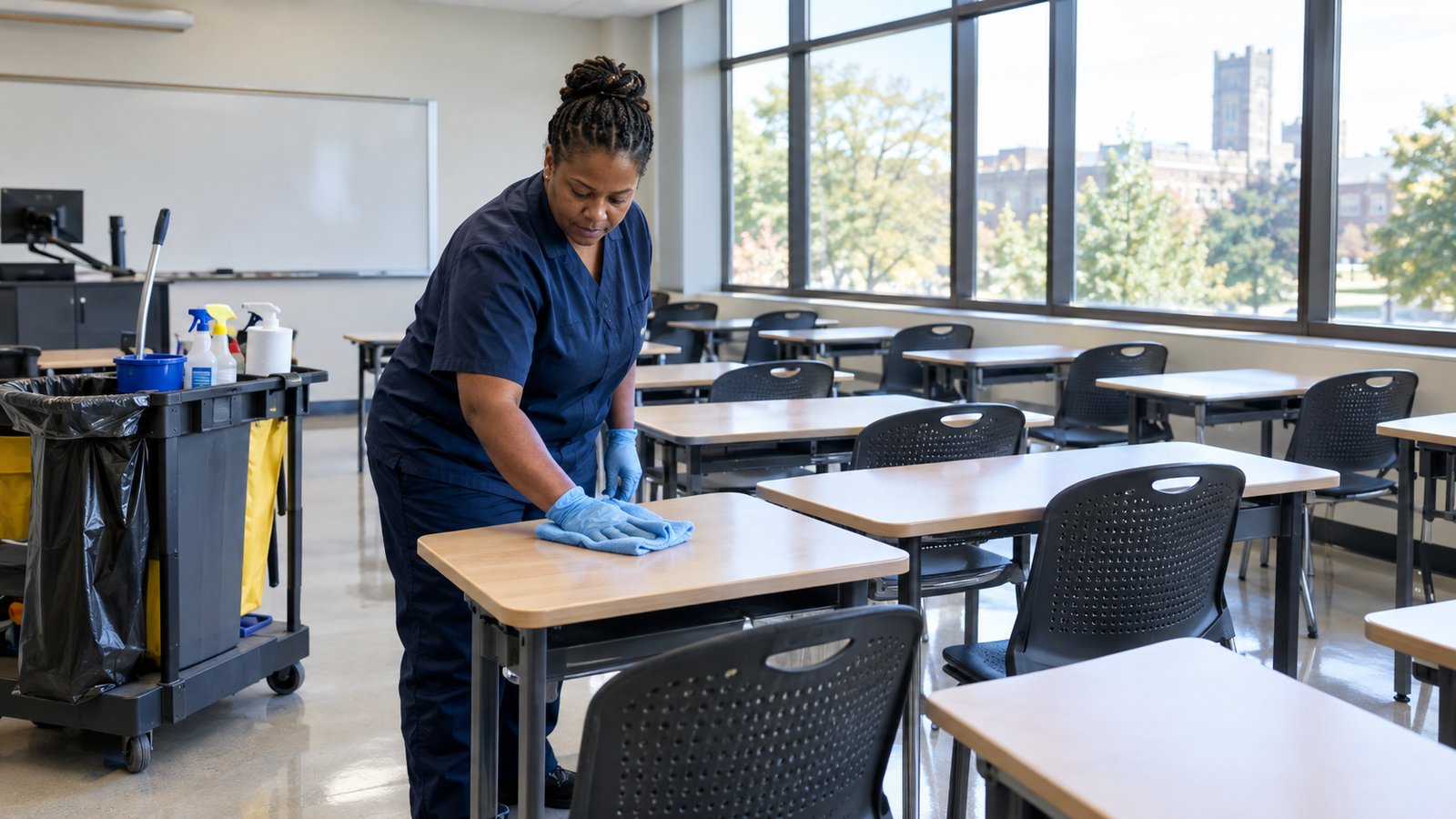
Classrooms need a repeatable reset: visible litter and waste removal, approved touchpoint cleaning, spot cleaning of desks, attention to door glass, and floor care suited to carpet, resilient tile, or polished concrete. Not every room needs the same frequency. A room used for consecutive lectures may need a day porter or quick response, while a lightly used seminar room can receive its main service after the academic day. Set expectations for exam weeks, registration days, orientation, graduation, and weekend programs in the service calendar.
Entrances and vertical circulation carry soil across campus. Provide matting and frequent checks at doors near subway or commuter rail stops, shuttle drop-offs, and parking structures. In Manhattan, campuses around Washington Square, Morningside Heights, and the East 20s have different pedestrian patterns than a Bronx campus near Fordham Road or a Brooklyn site near Downtown Brooklyn. Newark, Jersey City, New Brunswick, and Hoboken institutions may need evening service coordinated with PATH, NJ Transit, or commuter rail schedules. GreenPoint can align work windows to class changes and campus event calendars.
Use the registrar’s schedule and event calendar to identify the busiest buildings and room-turnover windows. A day porter may be valuable near dining, student services, and large lecture halls, while evening crews can handle less time-sensitive detail work. Specify how staff report an urgent spill, the expected acknowledgement time, and the campus contact who can close a room temporarily. Reviewing these assumptions each semester helps the cleaning plan keep pace with enrollment and use.
Set stronger boundaries for laboratories and specialty spaces
A laboratory cleaning plan must come from the lab owner, environmental health and safety office, and applicable institutional procedures. Specify who moves or covers materials, which surfaces are approved, required PPE, handwashing or gowning steps, waste boundaries, and whether cleaning is limited to floors and non-laboratory surfaces. A contractor should not touch experimental apparatus, biological material, chemical containers, or lab waste without explicit authorization, training, and a scope that permits it. OSHA standards and the university’s hazard communication and exposure-control programs may apply depending on the work.
The same specificity matters in clinics, athletic training rooms, dining operations, and childcare spaces. The campus should disclose applicable public-health and food-service procedures, while the vendor should document training and approved products. GreenPoint uses Green Seal certified products when suitable and approved, but product certification alone does not establish fit for every surface or protocol. For chemical handling questions, use the [OSHA cleaning chemical safety and GHS/SDS guide](/blog/osha-cleaning-chemical-safety-ghs-sds/). GreenPoint can build room-specific task cards and require supervisor sign-off before a new space enters routine service.
Keep laboratory and specialty-space access records separate from ordinary attendance records. The campus should be able to verify that assigned personnel completed the correct orientation and that access was removed when a worker left the account. If a room changes from research to classroom use, the department should formally update the approved surfaces, tools, and cleaning schedule rather than relying on a hallway conversation.
Plan residence halls, dining rooms, and event surges
Residence halls are occupied spaces, so service should protect student privacy and maintain safe access. Define which common areas are included, quiet hours, room-entry restrictions, key or card controls, incident reporting, and move-in or move-out projects. Dining rooms and food-service back-of-house areas need clear boundaries between common janitorial tasks and kitchen sanitation assigned to food-service staff. For events, document the pre-event reset, restroom checks, waste staging, post-event cleanup, and who authorizes overtime or expanded coverage.
Academic calendars create predictable peaks that should be priced transparently. Summer work may include floor refinishing, carpet extraction, classroom detailing, and residence-hall turnover; welcome week and graduation may require temporary staffing increases. A campus should not assume these are included in the nightly routine unless the contract says so. GreenPoint Maintenance offers fixed pricing for the agreed baseline and written authorization for out-of-scope work, avoiding surprise hourly charges. A [school cleaning checklist for custodial staff](/blog/school-cleaning-checklist-custodial-staff/) can help campus teams build a task matrix for shared academic spaces.
Residence-hall scopes should spell out privacy expectations, procedures for finding lost property, and what staff do when a student is present during common-area service. Move-in and move-out work should have separate quantities, dates, and acceptance checks, including whether furniture is moved and who handles abandoned belongings. For dining areas, agree on the point where the janitorial team stops and the food-service operator resumes responsibility for utensils, food-contact equipment, and kitchen sanitation.
Define labor, coverage, and quality evidence
A reliable proposal identifies the account manager, site supervisor, regular crew, backup plan, training, language access, and escalation contact. Ask how absences are covered and how the vendor ensures that a substitute knows restricted rooms and campus-specific procedures. Staffing should reflect room turnover and travel time between buildings, not only a simple square-foot ratio. Specify a building-level schedule and response standard for spills, restroom complaints, or missed tasks. The [cleaning staffing ratios and square-footage guide](/blog/cleaning-staffing-ratios-square-footage/) can inform initial planning, but a site walkthrough should validate the assumptions.
JaniTrack supports GreenPoint’s quality program with timestamped GPS-tagged photos, a live dashboard, and ATP testing where appropriate under a defined sampling plan. An ATP result is a supplemental hygiene indicator, not a pathogen test or sterility guarantee. The university should define what a pass, re-clean, and escalation look like and receive reports in a consistent cadence. GreenPoint Maintenance Services Corp reports 98% client retention; buyers should also request campus references, sample reporting, insurance evidence, and a clear corrective-action process. Call 347-332-9348 to schedule a walkthrough and scope review.
A contract scorecard can track inspection results by building, response time, repeated defects, missed shifts, and corrective actions closed by the agreed due date. The goal is to find patterns early, such as a high-complaint restroom or a classroom that is repeatedly inaccessible. GreenPoint can review the scorecard with campus facilities staff and document an agreed next step, while the institution keeps final authority over building access and service acceptance.
At kickoff, agree on a single request channel and a named decision-maker for each shift. That channel should distinguish a routine task request from a safety concern, a restricted-room access issue, and a request to change the recurring scope. Facilities teams can review an open-issues list weekly and close each item only after a responsible person confirms the remedy. This process makes reporting useful to campus leadership instead of creating a second, untracked stream of informal messages.
Before the award, compare total contract value across the full academic year rather than a single month. Ask bidders to disclose start-up tasks, transition staffing, consumables, periodic projects, and any assumptions about campus-provided storage or equipment. GreenPoint Maintenance Services can prepare a written walkthrough summary and scope matrix so procurement, facilities, and department stakeholders can review the same assumptions before final pricing.
Frequently asked questions
Q: Should a college outsource all campus cleaning? A: Not necessarily. Many institutions combine in-house and contracted teams. Compare total cost, supervision, coverage, specialized training, procurement requirements, and accountability by zone before choosing a model.
Q: Can a janitorial contractor clean research laboratories? A: Only when the institution authorizes the tasks and provides required training, PPE, access controls, and room-specific procedures. Cleaning staff should not handle research materials or regulated waste by assumption.
Q: What should be included in a campus cleaning RFP? A: Provide a building inventory, room uses, cleanable areas, schedules, restricted-space rules, event calendar, staffing assumptions, products, verification method, insurance, and separately priced project work.
Q: When should a New York or New Jersey college request a walkthrough? A: Before finalizing bid assumptions, especially when the campus has multiple buildings, transit-adjacent entrances, labs, residence halls, or frequent events. Call GreenPoint at 347-332-9348.
Planning university janitorial services in New York or New Jersey? Call GreenPoint Maintenance at 347-332-9348 or email info@greenpointms.com to schedule a campus walkthrough. GreenPoint offers fixed pricing, MBE/MWBE credentials, and JaniTrack verification with timestamped, GPS-tagged service records.