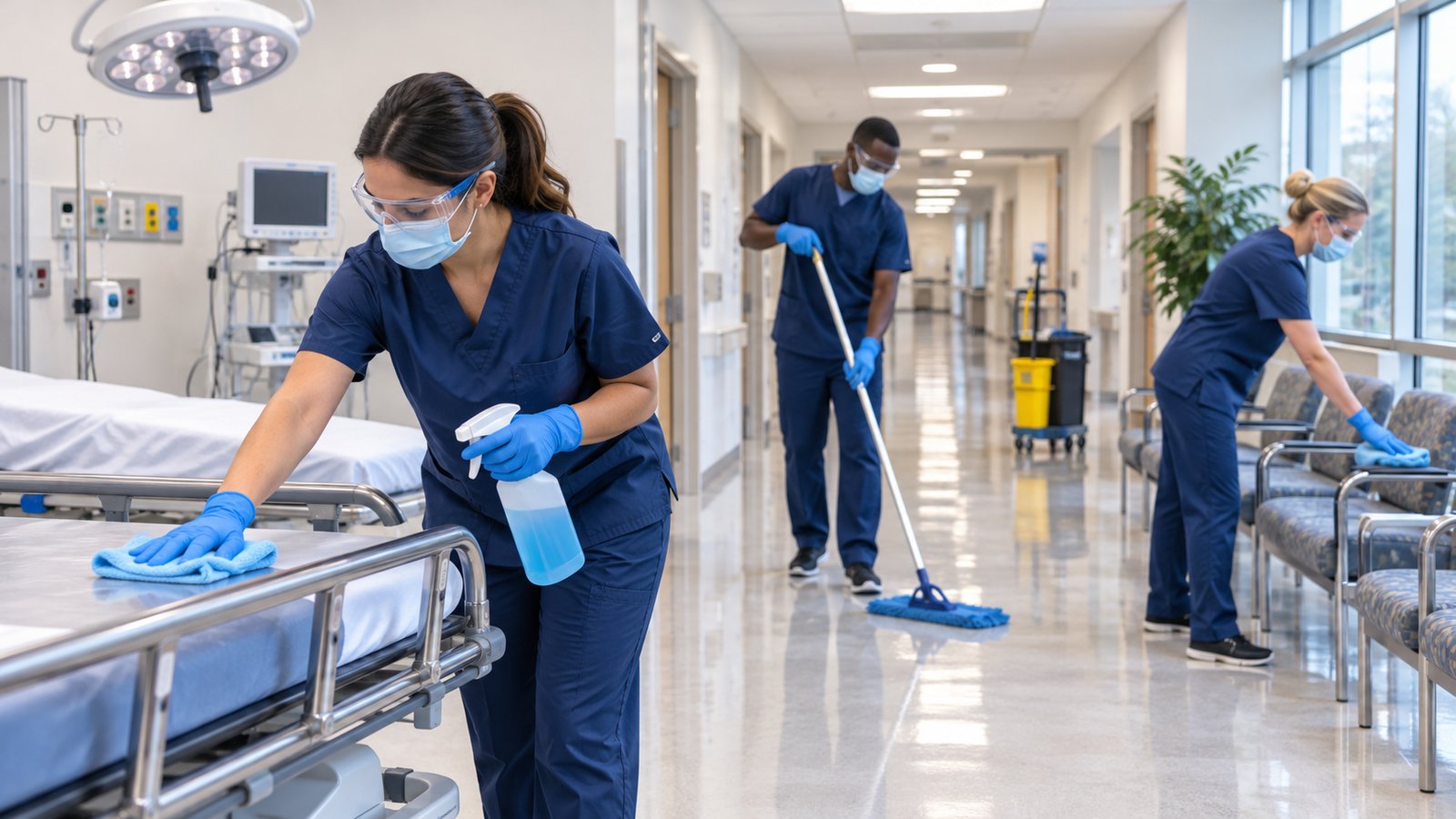
Ambulatory surgery centers run a high-stakes daily schedule: patients arrive, procedures turn over, clinical teams prepare rooms, and environmental services must work around controlled access and infection-prevention rules. Outsourced commercial cleaning can support nonclinical facility care, but it cannot replace the center's clinical environmental-services program or infection-control decisions. GreenPoint Maintenance Services works with facility managers to define the boundaries, approved procedures, evidence, and escalation paths before service starts. This guide covers what tri-state ASC leaders should include in a vendor scope, how to document performance, and how to compare a cleaning proposal without confusing routine janitorial work with terminal or between-case cleaning.
Separate janitorial service from clinical environmental services
Regional buyers should document who has authority to release each room. A center near Mount Sinai, NewYork-Presbyterian, Columbia, or a major New Jersey hospital campus may share corridors, loading areas, and elevators with other clinical tenants. Assign those shared zones to a named party and confirm the property manager's infection-control and contractor requirements. A janitorial vendor can follow the center's direction, but only the center can define clinical readiness and patient-care boundaries.
An ASC should classify every room and task before issuing an RFP. Public corridors, administrative offices, staff break areas, exterior entry zones, and some waiting spaces may fit an outsourced janitorial scope. Operating rooms, procedure rooms, recovery bays, sterile processing, and any area governed by clinical protocols require explicit direction from the center's infection preventionist and leadership. The vendor must not infer that a room is safe to enter just because it appears unoccupied.
The facility's policies should identify who authorizes access, who performs between-case cleaning, who performs terminal cleaning, which products are approved, and how completion is released to the next clinical team. GreenPoint Maintenance Services can document assigned nonclinical tasks while leaving clinical decisions to ASC leadership. For background on environmental cleaning principles and healthcare-associated infection prevention or OSHA chemical safety and SDS requirements, review the related guides and validate policies against your governing requirements.
Build a room-by-room scope and access matrix
A room matrix is most useful when it includes the authority behind each instruction: facility policy, product label, equipment manufacturer, or a clinical lead. Note the revision date and provide a change-control contact. For sites near Grand Central, Penn Station, Newark Penn, or Stamford Transportation Center, account for crowded building arrivals and security screening that can shorten an after-hours service window. The supervisor should know the approved contact when a room is unexpectedly occupied or inaccessible.
Create a matrix listing each room, access window, task owner, approved product, required PPE, completion evidence, and escalation contact. A waiting room may require floor care, waste removal, seating checks, and approved touchpoint cleaning at defined intervals. An administrative suite may need evening service only. A staff corridor could have a restricted service window during shift change. Label restricted zones clearly and train cleaners to stop and call rather than enter when signage, staff instructions, or a lockout condition conflicts with the schedule.
In New York, New Jersey, and Connecticut, centers may operate in dense medical buildings with freight-elevator reservations, badge access, contractor registration, and limited loading. Include parking, supply storage, waste handling, alarm procedures, and emergency contacts in onboarding. Do not put patient names, case schedules, or other sensitive data on cleaning checklists. A vendor should receive only the minimum location and access information needed to perform its scope, with credentials revoked promptly when staff change.
Products, training, and occupational safety
During onboarding, test the procedure with a sample room and confirm the label's directions can be met within the available service window. If required wet contact time conflicts with the next planned use, the center must change timing or task assignment rather than ask workers to shorten it. Keep the product list and SDS access current, and record who approves substitutions. These controls help prevent a purchasing change from silently altering the infection-prevention plan.
A product list should identify the exact product, intended surface, dilution or ready-to-use form, label contact time where disinfection is authorized, storage location, and current safety data sheet. Do not let cleaning staff mix incompatible chemicals or bring unapproved products into clinical zones. Green Seal-certified products may support a facility's sustainability goals for selected routine tasks, but certification does not make a product appropriate for every clinical use. The center's infection-prevention team must approve products and procedures for clinical areas.
OSHA's Hazard Communication Standard requires employers to communicate chemical hazards through labels, safety data sheets, and training. Employers also need to assess hazards and provide appropriate controls and protective equipment. Where workers may have occupational exposure to blood or other potentially infectious materials, the applicable Bloodborne Pathogens Standard and employer exposure-control plan matter; ordinary janitorial staff should not be assigned regulated exposure tasks without the required training and controls. Document initial and refresher training, incident reporting, and stop-work authority.
Audit the work without overstating what a metric proves
State and federal oversight can apply differently depending on an ASC's ownership, services, certifications, and payer participation. The center should identify its current New York, New Jersey, or Connecticut Department of Health requirements, applicable CMS conditions, accreditation standards, and internal policies, then translate them into staff responsibilities. Do not ask a contractor to interpret requirements from a generic checklist. A scope change should be reviewed by the administrator and infection preventionist before it becomes an operating instruction.
Use a quality program with defined observation points, scoring rules, corrective-action deadlines, and repeat-failure escalation. Visual inspection is useful for visible soil, replenishment, floor condition, and missed waste. ATP bioluminescence can provide a rapid indicator of organic residue on selected surfaces, but it does not identify pathogens or certify a room as sterile. If the center uses ATP, establish consistent sites, timing, instrument controls, threshold interpretation, and a response plan before collecting readings.
JaniTrack can support GreenPoint's assigned checkpoints through time-stamped, GPS-tagged photos and a live dashboard. The ASC should define which nonclinical views are allowed and ensure photos exclude patients, medical records, screens, whiteboards, and restricted clinical activity. A dashboard is evidence of a workflow, not a substitute for clinical release or infection-prevention approval. For more on cleaning audit design and digital cleaning verification, use the facility's own validated standards as the final authority.
Staffing and service windows around the surgical schedule
Establish one service lead for each shift and a backup contact for weekends or holiday schedules. If a procedure runs late, cleaners should wait for an approved release rather than enter a room because the posted end time has passed. Facilities near major transit corridors can experience late arrivals and security queues, so include a grace period and a notification rule in the service plan. To discuss staffing windows for a tri-state center, call GreenPoint Maintenance at 347-332-9348.
Staffing should reflect footprint, room types, service window, and travel between floors, not a single square-foot-per-worker promise. A center with 12,000 square feet, a 10-hour operating day, multiple suites, and strict badge controls may require staggered coverage and a supervisor who can respond during turnover. Specify which shifts include restocking and periodic floor work, how absences are covered, and whether the vendor can supply trained backup personnel. A schedule that depends on one cleaner with a single key is a continuity risk.
The ASC should share only the operational calendar necessary to coordinate access, and it should update the cleaning lead when procedure volume or construction changes. Set blackout periods, restricted routes, and quiet-zone expectations for patient recovery. GreenPoint Maintenance Services recommends a pre-launch walkthrough with the center's administrator, facilities contact, and infection preventionist so the service plan maps to actual traffic. Call 347-332-9348 to discuss an assessment in Manhattan, the Bronx, Brooklyn, Queens, Staten Island, Westchester, Long Island, New Jersey, or Connecticut.
Procurement, accountability, and fixed-price proposals
For a decision-ready comparison, ask each bidder to price the same service calendar and identify separate optional lines for high dusting, project work, or additional coverage. Examine how a supervisor handles an unplanned case delay, badge failure, or urgent restroom issue. A low monthly price is not comparable if it omits backup staffing or consumes the center's clinical supplies. GreenPoint Maintenance can review the facility map and arrange a walkthrough at 347-332-9348 before preparing a fixed-scope proposal.
A strong procurement packet includes a detailed scope, insurance limits, references from healthcare settings, supervisor credentials, background and access-control practices where permitted, product documentation, training records, incident reporting, subcontractor disclosure, and a business-continuity plan. Ask how the provider handles missed access, staff replacement, spill escalation, service complaints, and corrective actions. Require a sample report and confirm data retention, photo rules, and who can see the dashboard. The proposal should distinguish routine nightly work from special projects and clinical procedures.
Compare like with like. A fixed monthly price should name included labor, days, tasks, consumables, periodic floor work, exclusions, emergency coverage, and change-order terms. GreenPoint Maintenance Services Corp is MBE-certified in relevant New York programs and registered in SAM.gov; verify the exact certification and procurement eligibility required by your organization. GreenPoint reports 98% client retention and uses JaniTrack to record agreed service checkpoints. Schedule a walkthrough and request a written, fixed-price scope by calling 347-332-9348 or emailing info@greenpointms.com.
Ambulatory surgery center cleaning FAQs
Q: Can an outside janitorial company clean an operating room? A: It depends on the center's policies, clinical oversight, training, and contract. Never assume routine janitorial staff can perform between-case or terminal cleaning; the ASC must define the approved personnel and procedure.
Q: What should an ASC include in a cleaning RFP? A: Include room-by-room tasks, access rules, approved products, training, PPE expectations, documentation, photo privacy, audit methods, escalation contacts, insurance, references, backup staffing, and explicit clinical exclusions.
Q: Does an ATP reading show that a surgical suite is pathogen-free? A: No. ATP is a surface-residue indicator and does not identify organisms or establish sterility. Use it only within a defined quality program alongside required clinical procedures and inspections.
Q: How do we protect patient privacy during service verification? A: Prohibit images of patients, records, screens, and active clinical areas; set approved photo angles and access roles; and keep the vendor's checklist limited to necessary facility information. Call 347-332-9348 to schedule a scope walkthrough.
For a carefully bounded, documented ASC janitorial scope in NY, NJ, or CT, call GreenPoint Maintenance Services at 347-332-9348 to schedule a walkthrough. JaniTrack can record agreed checkpoints, and GreenPoint reports 98% client retention; clinical cleaning protocols remain under your center's direction.