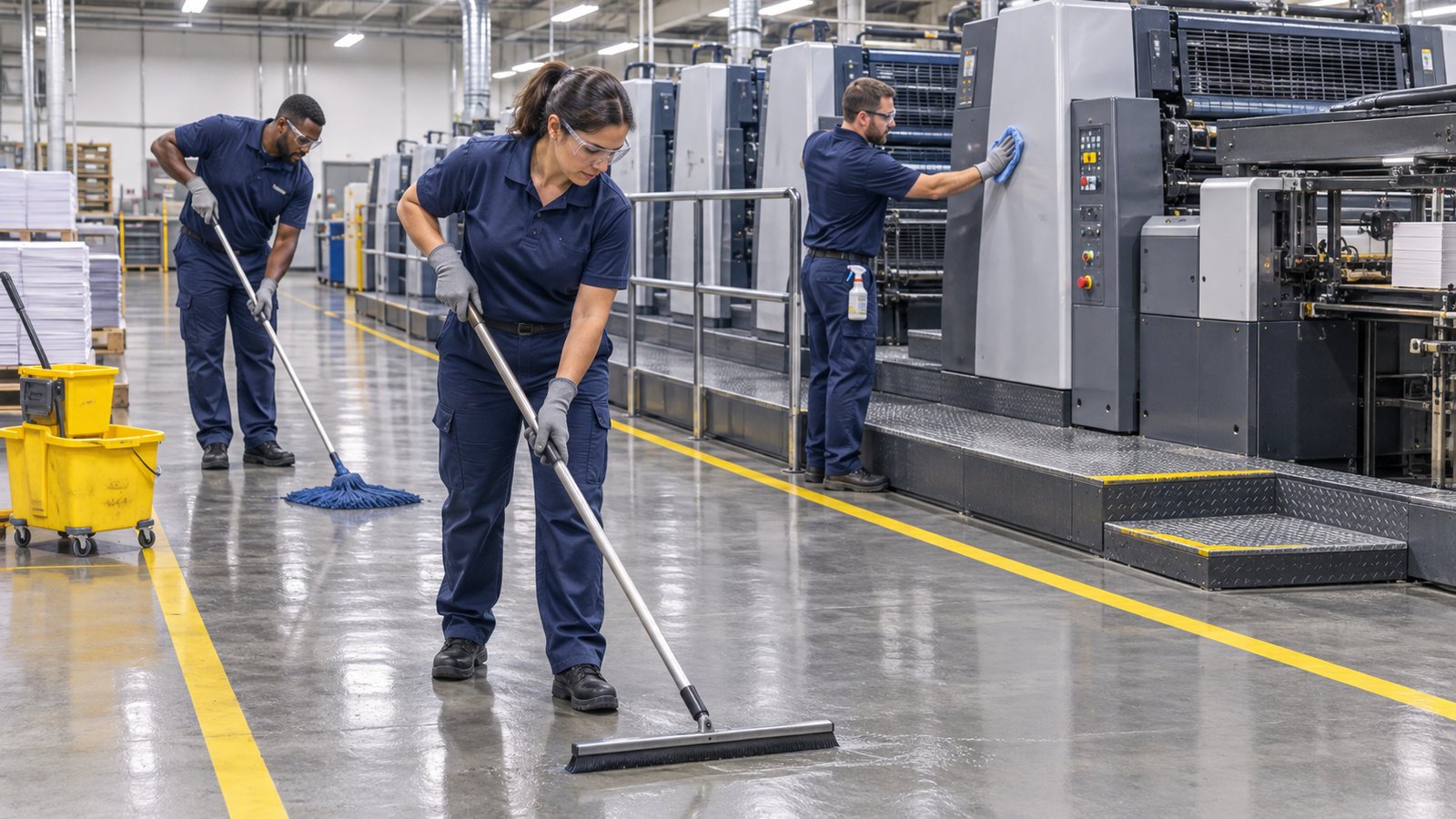
A printing plant needs reliable facility cleaning, but the janitorial scope must stay separate from servicing a press or handling process chemicals. Production floors, paper storage, bindery and finishing areas, shipping docks, offices, and employee facilities carry different debris, traffic, and safety conditions. Buyers should look for a vendor that understands controlled access, spill escalation, machine boundaries, and written proof of service. GreenPoint Maintenance Services Corp provides commercial cleaning across New York, New Jersey, and neighboring states. To schedule a printing-plant walkthrough and fixed-price quote, call 347-332-9348.
Map the production process before assigning cleaning tasks
A print facility may combine offset or digital presses, prepress rooms, plate-making, bindery, cutting, folding, packaging, paper storage, shipping, and front-office space. Draw a zone map and identify who owns each machine, chemical station, waste stream, and access-controlled room. A contractor can typically scope floors, common surfaces, restrooms, break areas, office space, and agreed production-adjacent tasks. It should not assume authority to clean rollers, remove guards, clear jams, or work inside equipment. GreenPoint Maintenance Services begins with an operating walkthrough and a boundary list approved by the plant manager.
Ask production staff when a route can safely enter and how they will notify the crew about a changeover, active lift, delivery, or maintenance event. A 20,000-square-foot shop with two presses and a small finishing area is not equivalent to a 60,000-square-foot plant with high-bay paper storage and multiple shifts; those are examples, not productivity standards. Record square footage by surface and process zone, then add machine density, aisle length, restroom count, shift overlap, and dust or scrap patterns. GreenPoint can quote a realistic coverage window only after observing these work conditions.
Separate floor and housekeeping work from press servicing
OSHA’s printing-industry materials call attention to machine guarding and hazardous-energy controls during servicing. Its printing-press servicing guidance distinguishes normal production from maintenance activities that can expose workers to unexpected start-up or stored energy. A janitorial specification should say that cleaners do not reach into nip points, handle press rollers, defeat guards, clear jams, or perform lockout/tagout unless the employer has formally assigned and trained them for that role. GreenPoint’s crew should keep to agreed surfaces and report a condition to the plant’s authorized operator.
A printing floor can collect paper dust, trim waste, tracked-in grit, and occasional liquid residue, but the correct removal method depends on the material and the plant’s process. Do not dry sweep a substance that could become airborne, spread ink or solvent residue, or create a combustible-dust concern. Plant EHS should identify the material, isolate the area, and direct a spill response. For routine floors, specify equipment, edge detail, debris containers, signs, and the way a wet-cleaning window will be protected from forklifts and carts. GreenPoint can flag a hazard; it does not replace a plant emergency response team.
Control chemical exposure, labels, and incompatible products
Printing businesses may use inks, washes, fountain solutions, coatings, adhesives, and cleaning agents that are not part of a routine janitorial kit. OSHA’s printing-industry safety resources and solvent guidance point employers to hazard recognition, ventilation, and applicable standards. The facility should provide a current chemical inventory, designated storage, safety data sheets, secondary-container rules, and spill instructions. A contractor should never pour an unidentified liquid into a drain or use a general-purpose cleaner on a process surface without written compatibility approval.
For offices, washrooms, and other ordinary building surfaces, GreenPoint uses Green Seal certified products where suitable for the task and material. That preference does not mean a certified product is automatically approved for a press, ink, sensitive coating, or plant drain. Keep janitorial products segregated from production chemicals; label and secure every container; train the team not to mix products; and document who can authorize a substitute. A buying team can review the OSHA cleaning chemical safety guide alongside its own hazard communication program. Call 347-332-9348 to review chemical boundaries during a plant walkthrough.
Build a schedule around shifts, production changeovers, and square footage
Set service frequency by use and soil load, not a single square-foot-per-cleaner promise. For an illustrative 20,000-square-foot plant, the office wing, two restrooms, break area, press aisles, and loading zone should each have their own task count and timing. A floor may require daily debris pickup while high ledges or interior glass belong on a periodic schedule. Record the expected number of shifts, access window, production calendar, washroom traffic, and whether the plant has a weekend run. GreenPoint can establish fixed pricing around those defined frequencies rather than leaving the buyer exposed to open-ended hourly billing.
Plan the route so the crew is not crossing active material movement or blocking egress. An evening route may be practical for offices and restrooms but not for a pressroom that runs overnight. The plant can designate an area-release signal, a contact for temporary barriers, and a no-entry list for equipment under service. Add a clear procedure for unscheduled spills, severe weather, overtime production, and special shutdown work. GreenPoint Maintenance Services will state which of those responses are included, which require written authorization, and what notice the facility must provide to prevent a pricing or coverage dispute.
Verify work with inspections that reflect production risk
A useful inspection checks the outcomes the plant actually needs: clear egress, no residue on agreed walking surfaces, restroom supplies, clean break surfaces, waste in the right containers, and visible completion of scheduled tasks. GreenPoint’s JaniTrack system can record timestamps, GPS-tagged task evidence, approved photos, ATP checks where appropriate, and a live dashboard. ATP is a quality-monitoring tool, not a test for ink, solvent, or every form of contamination. The ISSA Cleaning Industry Management Standard describes site-specific scopes, documented performance measures, and inspection practices that buyers can adapt.
Agree what a photo may show before service begins. Images should not expose customer artwork, unreleased packaging, proprietary production information, control panels, security systems, or restricted employee data. A dashboard can verify a floor-zone check without photographing the production line. Define how the vendor reports a blocked aisle, wet-floor issue, broken dispenser, chemical residue, or task that production had not released. GreenPoint Maintenance Services can send exception alerts to named contacts and review trends with the account manager; the plant’s safety lead retains authority over hazard classification and production restart.
Compare bids on qualifications, exclusions, and all-in cost
A comparable proposal lists buildings and zones, tasks, frequencies, shift windows, consumables, equipment, supervision, backup coverage, insurance, training, escalation, and exclusions. Ask whether price includes periodic floor work, high dusting, break-area detailing, post-shutdown cleanup, and emergency response. Confirm whether the plant supplies specialty PPE or an approved chemical list. GreenPoint reports 98% client retention and offers fixed pricing with no hidden fees; a fixed fee is only useful when the scope describes access assumptions and what counts as added work. Ask each bidder to price the same operating calendar and task schedule.
Request a sample inspection report and a named supervisor, not just a sales contact. The commercial cleaning contract terms guide and industrial warehouse cleaning best practices help buyers frame coverage and reporting questions. GreenPoint Maintenance Services is MBE/MWBE certified with New York State, New York City, and NYC DOE, and registered in SAM.gov. For a plant in Queens, the Bronx, Brooklyn, Long Island City, Yonkers, Newark, Jersey City, or elsewhere in NY or NJ, call 347-332-9348 to schedule a walkthrough and request a fixed-scope quote. During that visit, ask the vendor to walk one complete route with the plant contact, note the exact surfaces included, and show how an exception reaches a supervisor. A signed scope should distinguish routine recurring work from a shutdown clean, post-maintenance cleanup, or production spill response so purchasing can compare annual cost without treating unlike services as equivalent.
Plan local logistics and environmental controls before launch
Print facilities near Hunts Point, the Brooklyn waterfront, Long Island City, Newark, Elizabeth, or the Meadowlands can face tight truck schedules, shared loading zones, and shift changes that affect a cleaning route. Map parking, badge access, freight elevators, deliveries, and the process for closing an aisle. Winter salt and tracked-in water need an entry-mat plan; summer humidity or open loading doors can change floor-drying time. Agree who can authorize a temporary closure and how the crew will keep exits and fire equipment accessible. GreenPoint can coordinate its arrival window with the site contact and production schedule.
Before a bid is accepted, the plant’s EHS representative should identify applicable fire, stormwater, waste, and chemical-storage requirements for that address and activity. Rules may differ between New York City, Long Island, Westchester, and New Jersey municipalities, and a cleaning vendor should not make a blanket compliance promise for the facility. Document which drains may be used, what waste containers are approved, and how spills are escalated. If a task is not in the approved scope, stop and contact the plant lead rather than improvising. GreenPoint can put those local site rules into the work instructions and supervisor checklist. Include a named alternate for nights, weekends, and planned shutdowns; utilities often have different personnel on duty outside normal procurement hours. A clear escalation tree helps the cleaner report a blocked route or damaged dispenser without contacting an unavailable manager or entering a restricted room to finish the checklist.
Frequently asked questions
Can a janitorial contractor clean printing press rollers? Not as part of ordinary facility cleaning. Press servicing, guarded areas, and hazardous energy require the plant’s own authorization and training; a standard janitorial scope should exclude rollers, nip points, jams, and machine interiors.
How should a printing plant estimate cleaning coverage? Start with square footage by zone, surface type, shift schedule, aisle and restroom counts, production release windows, and the frequency of each task. A single square-foot productivity ratio cannot represent different press layouts or live production conditions.
Can GreenPoint use its own cleaners on ink or solvent residues? Only after the plant identifies the substance and approves a compatible method. Unknown liquids and process spills should be isolated and escalated to the plant’s EHS or spill-response lead, not treated as ordinary janitorial soil.
What should be included in a print-shop cleaning quote? Require a task and frequency matrix, shift assumptions, consumables, supervision, inspections, backup coverage, chemical boundaries, exclusions, spill escalation, and pricing for shutdown or event work.
How do we arrange a New York or New Jersey walkthrough? Prepare a zone map, operating hours, access rules, chemical restrictions, and any available floor plans. Call GreenPoint Maintenance Services at 347-332-9348 to schedule a walkthrough and request fixed pricing.
Request a pressroom and finishing-area cleaning walkthrough from GreenPoint Maintenance Services at 347-332-9348. GreenPoint reports 98% client retention and can document approved facility tasks in JaniTrack while keeping machine servicing under plant control.