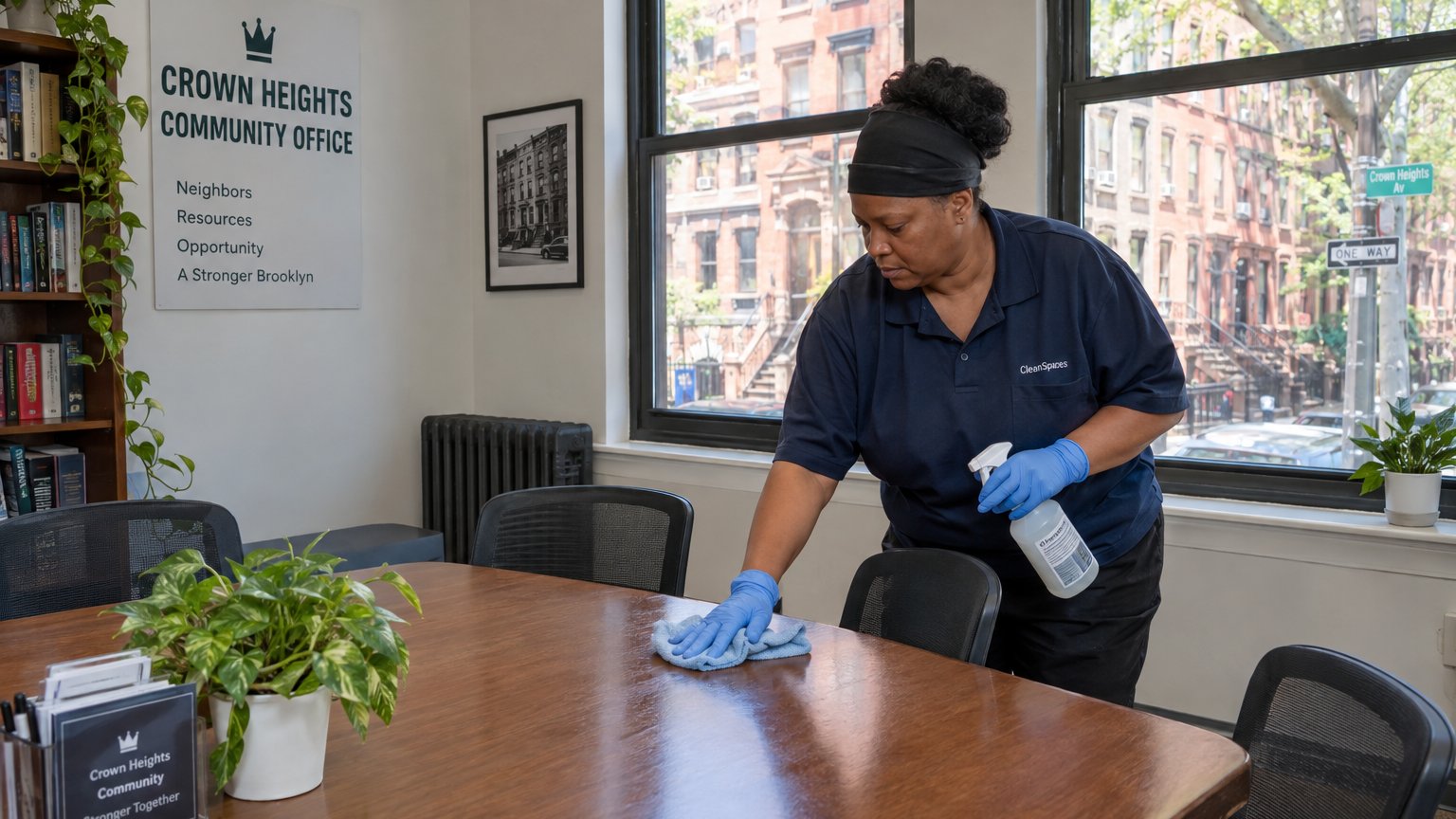
Commercial cleaning in Crown Heights has to serve a varied mix of professional offices, storefronts, nonprofit and community spaces, schools, clinics, and shared-use buildings. The right vendor plan accounts for public foot traffic, room schedules, entrances, waste routes, security procedures, and the materials being cleaned. This guide helps Brooklyn owners and property managers define a useful scope, compare bids, and measure performance without assuming every site needs the same routine. GreenPoint Maintenance Services provides fixed-price commercial cleaning with documented work through JaniTrack. To arrange a Crown Heights walkthrough and written quote, call 347-332-9348.
Understand the operating pattern of your Crown Heights building
Ask whether events or seasonal programs change the site's normal occupancy. A multi-purpose room used for a weekend gathering may need furniture reset and an additional restroom check, while a professional office may need a consistent quiet window before appointments begin. Establish who confirms the event calendar and whether the cleaner is expected to move chairs, tables, or equipment. GreenPoint can distinguish a routine visit from an event reset in the written scope, helping the buyer avoid assumptions about labor and timing.
Crown Heights includes busy commercial corridors along Eastern Parkway, Nostrand Avenue, Kingston Avenue, and Franklin Avenue, as well as quieter side streets and community-serving facilities. Subway access around Franklin Avenue, Nostrand Avenue, Eastern Parkway-Brooklyn Museum, and Crown Heights-Utica Avenue can make staff arrival predictable while leaving delivery and loading needs site-specific. A building near the Brooklyn Museum or Prospect Park may have visitor peaks different from a small office or a faith-based community room. The [MTA subway map](https://www.mta.info/map/5256) can help site contacts coordinate transit access. During a walkthrough, map where visitors enter, where deliveries arrive, which doors must remain clear, and when rooms are occupied.
Do not infer labor or price from neighborhood alone. Document the cleanable floor area, number of restrooms, kitchens, meeting rooms, elevators, staircases, glass doors, floor materials, and site-specific storage. Note whether a property has separate tenant suites, shared lobbies, event spaces, childcare rooms, or sensitive equipment. GreenPoint Maintenance Services uses a task-and-frequency plan so a property manager can see what is covered, what is excluded, and which contact authorizes changes.
Create a task list that matches public and shared spaces
For sensitive or high-use rooms, set the cleaning boundary with the site contact before the first shift. Identify computer stations that must not be touched, displays that require a specific product, rooms that remain locked, and furniture that cannot be moved. If the building has a shared kitchen, name who handles dishes, refrigerator contents, and food waste so the janitorial scope does not conflict with tenant expectations. GreenPoint documents the handoff and can use zone-based task records to make exceptions visible.
For an office, typical recurring tasks may include emptying waste and recycling, cleaning touchpoints, dusting reachable surfaces, vacuuming traffic lanes, damp-mopping hard floors, wiping breakroom surfaces, and cleaning restrooms. A community building may add chair and table resets, a room-use log, entrance glass, event cleanup, and extra checks of shared bathrooms. Write each action in plain terms and identify its frequency. Separate routine work from periodic services such as carpet extraction, strip-and-finish floor care, high dusting, exterior glass, or post-construction cleanup.
Match frequency to occupancy and soil, then revisit it using inspection data. A room used for one weekly meeting does not necessarily need the same daily detail as an entrance used by hundreds of people. A practical startup can include daily cleaning for essential shared areas, less frequent detail tasks for low-use rooms, and event-based resets; these are examples rather than universal standards. GreenPoint can schedule those tasks in JaniTrack and report completed work. See [cleaning frequency standards by facility type](/blog/cleaning-frequency-standards-by-facility-type/) and [ISSAs appearance-level guide](/blog/issa-clean-standards-appearance-levels/) for ways to define expected condition.
Plan around events, access, and service hours
Record a site contact and backup contact for nights when the usual manager is unavailable. State where keys are stored, who can authorize entry, and how a cleaner should respond if an alarm activates or a room appears unsafe. If the property serves children, older adults, or people with mobility needs, keep paths, exits, and accessible restroom fixtures clear after the work. These instructions belong in the account plan and should be reviewed whenever the building's use or security procedure changes.
Crown Heights buildings may share a lobby with tenants, operate community events after business hours, or limit vendor access to certain doors. Put the approved schedule in writing, including service days, start and finish windows, alarm steps, key or badge controls, elevator use, and a procedure for reporting a locked room. For event-driven facilities, define the point at which a standard visit becomes an additional reset, what furniture the team may move, and who approves the extra work. The cleaning team should never guess about access to a private office or a restricted room.
A service calendar should also cover holidays, inclement weather, maintenance shutdowns, and building construction. Eastern Parkway's traffic and event activity can affect arrival time, but service expectations should be managed through a communications plan rather than informal assumptions. Identify a primary and backup site contact, an escalation number, and the response expected for an urgent spill or missed visit. GreenPoint offers scheduled walkthroughs in Brooklyn and nearby New York boroughs; call 347-332-9348 to review actual access conditions, storage, and waste handling.
Compare pricing without overlooking labor or project costs
A commercial cleaning proposal is only comparable when the bidders price the same area, days, room list, tasks, supplies, and service window. Ask whether the measurement is gross area or cleanable area and whether tenant-only suites are included. Require a recurring monthly or annual total and a separate price schedule for periodic work. Clarify who supplies liners, paper goods, hand soap, and cleaning chemicals. If a vendor prices by the hour, ask what happens if the planned work takes longer; if the proposal is fixed-price, ask what documented change in service triggers a revised fee.
Cost decisions should account for training, backup coverage, supervision, insurance, equipment, and reporting as well as the invoice. The Bureau of Labor Statistics reports a national median hourly wage of $17.71 for janitors and building cleaners in May 2025; that occupation-wide figure is not a local contract price, because a vendor's contract also covers non-wage operating costs and site requirements. Review the original [BLS occupation data](https://www.bls.gov/ooh/building-and-grounds-cleaning/janitors-and-building-cleaners.htm) for context. GreenPoint uses fixed pricing and presents optional work separately. For more, compare [cleaning cost per square foot](/blog/commercial-cleaning-cost-per-square-foot/) and [the total cost of in-house custodial service](/blog/calculating-true-cleaning-cost-tco/).
Set inspection and corrective-action standards
Before service begins, agree on what an acceptable opening condition looks like in the lobby, restrooms, floors, and high-touch areas. Use a repeatable checklist with a simple rating, dates, observations, and a corrective-action owner. Ask how often a supervisor inspects, how tenants can report an issue, how quickly the provider acknowledges it, and how a repeat issue changes the work plan. GreenPoint's JaniTrack platform can display task completion, timestamped GPS-tagged photo records, and live dashboard data to authorized client contacts.
Documentation should make a service decision easier, not bury managers in metrics. A good report distinguishes a missed task from a one-time spill, shows whether a correction was completed, and reveals recurring patterns by room or shift. ATP testing may be used at selected sites as a hygiene-indicator tool, but no ATP reading alone proves that a surface is safe or free of pathogens. Combine measurement with visual review, product-label compliance, and an appropriate response to findings. GreenPoint reports a 98 percent client-retention rate; still, request references and define performance terms for your own building.
Review chemical safety, products, and vendor qualifications
In New York City, commercial waste and recycling must follow DSNY requirements and the building's approved collection plan. Keep recyclables out of trash bags and use the property's labeled containers; the [DSNY business recycling page](https://home4.nyc.gov/site/dsny/businesses/materials-handling/businesses-recycling.page) describes the rules and manager responsibilities. A cleaner should know the waste-room route and should report overflowing bins instead of leaving bags in corridors or at an unapproved curb location.
Ask vendors for their current chemical inventory, safety data sheets, product labels, dilution controls, and worker training process. OSHA's Hazard Communication Standard addresses hazard information, labels, safety data sheets, and training for workers exposed to hazardous chemicals. The [OSHA Hazard Communication page](https://www.osha.gov/hazcom) is a primary reference. Avoid a vendor that cannot explain how it prevents chemical mixing, secures products, or makes safety information available to staff. GreenPoint uses Green Seal certified products where suitable, and its supervisors review task-specific product instructions and protective equipment.
Check insurance certificates, workers' compensation, employee screening or access policies, supervisor coverage, and substitute staffing. If the property has a school, clinic, or public procurement requirement, confirm the exact credential and contract terms rather than accepting a general claim of eligibility. GreenPoint Maintenance Services is MBE/MWBE certified through NYS, NYC, and NYC DOE and is registered with SAM.gov. Those credentials can be helpful for supplier diversity and public procurement, but service fit, safety, and documented performance remain essential.
A buyer checklist and frequently asked questions
What if tenant schedules or access rules are still being negotiated? Arrange a site review before locking in the service start date. GreenPoint can document open decisions, identify the property contact who will resolve them, and prepare a revised written quote. For a Jackson Heights walkthrough, call 347-332-9348.
Use a one-page comparison sheet that records site area, work zones, visit frequency, access time, event coverage, supplies, exclusions, total recurring price, insurance, inspections, and escalation contacts. Ask each bidder the same questions and review the walk-through notes against the written proposal. For local Brooklyn context, see the [Brooklyn commercial cleaning vendor guide](/blog/commercial-cleaning-brooklyn-vendor-guide/) and [quality assurance program guide](/blog/quality-assurance-commercial-cleaning-program/). A thorough vendor conversation should leave a manager able to explain exactly what staff will see after each visit.
How often should a Crown Heights office or community building be cleaned? Choose a starting schedule based on occupancy, restroom traffic, food use, public access, and required opening condition. Increase checks where inspection records show repeated soil or complaints, and reduce or shift low-value work when rooms are rarely used.
Can the vendor clean around evening programs or weekend events? Yes, when the contract distinguishes recurring service from event resets and lists the notice, access, staffing, and approval process. Ask for a written rate for extra work before the first event.
What does JaniTrack verification show? GreenPoint's JaniTrack system can provide task records, timestamps, GPS-tagged photos where appropriate, and dashboard reporting. Managers should use those records alongside site inspections and an agreed correction process.
Is Green Seal certification the same as a guarantee that a product is harmless? No. Certification can help buyers identify products meeting specified environmental criteria, but products still require correct use, label compliance, training, and suitable protective measures. Ask for the product list and SDSs.
How can I get a Crown Heights quote? Share your address, approximate area, room list, service hours, and any event or access requirements, then schedule an on-site walkthrough. GreenPoint Maintenance Services can prepare a fixed-price proposal; call 347-332-9348 or email info@greenpointms.com.
Request a Crown Heights walkthrough with GreenPoint Maintenance Services at 347-332-9348 or info@greenpointms.com. Compare a fixed-price scope with JaniTrack task verification, timestamped GPS-tagged photos where appropriate, and a live client dashboard.