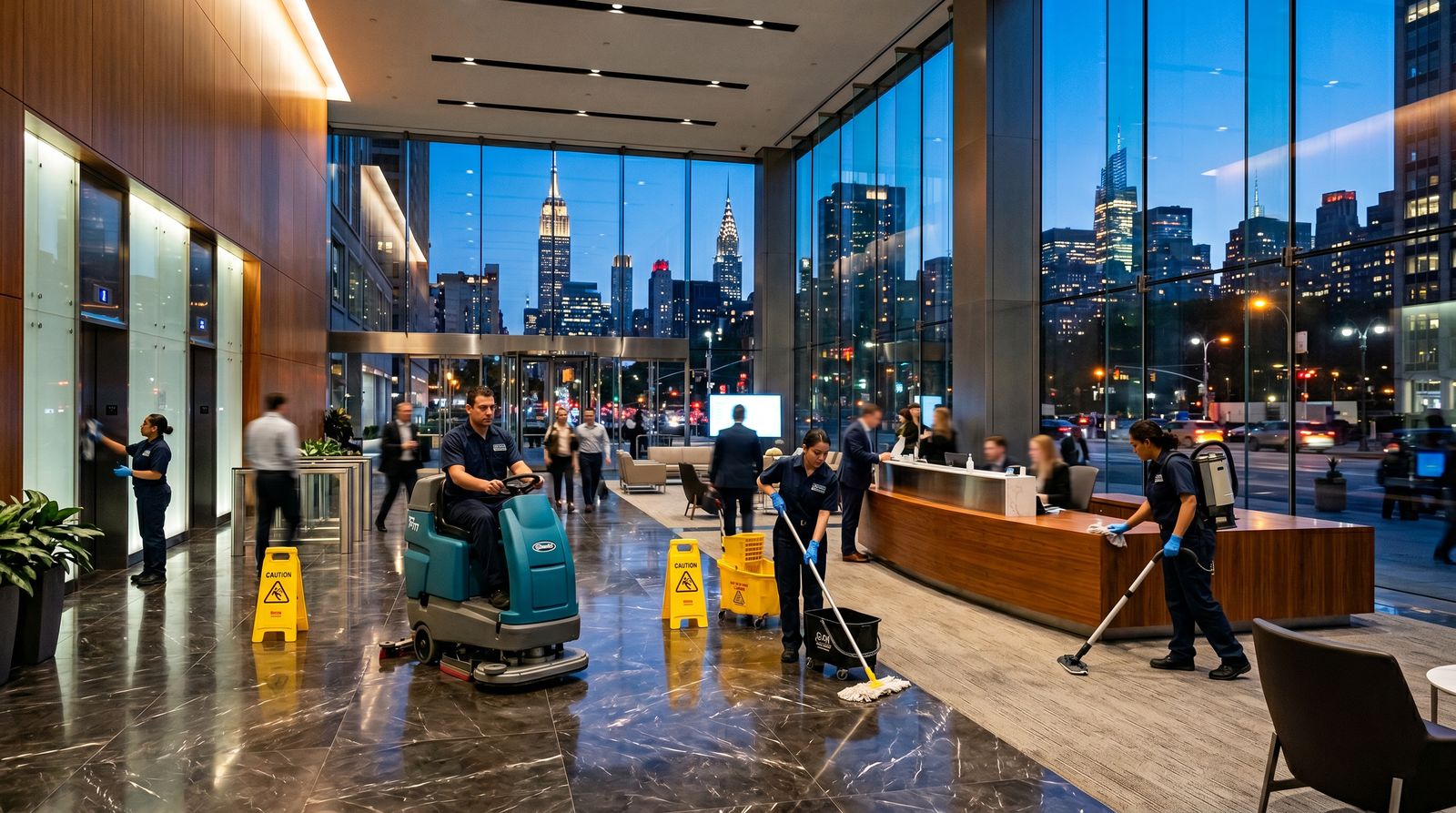
If you manage a facility in Manhattan, you already know that commercial cleaning is less about “mopping and trash” and more about risk control: tenant expectations, union and building rules, Local Law requirements, and the reality of 24/7 foot traffic from lobbies to elevators. GreenPoint Maintenance Services helps Manhattan facility teams choose and manage janitorial partners using objective proof — timestamped, GPS-tagged photos, ATP testing, and live reporting through our StockPoint verification system. This vendor guide breaks down what to specify, what to verify, and what to ask before you sign a contract — from Midtown Class A towers near Grand Central to mixed-use assets in SoHo and the Financial District.
Why “commercial cleaning Manhattan” is a different job than the suburbs
In Manhattan, the operational constraints are unique: loading dock windows, freight elevator reservations, trash rules, and high-visibility public areas that can’t be “closed for cleaning.” Buildings around Penn Station, Port Authority, and Times Square often require day porter coverage because lobby and restroom demand spikes with commuter surges. In neighborhoods like Hudson Yards, Chelsea, and Tribeca, tenants expect a higher ISSA appearance level in common areas because their lobby is part of their brand.
A vendor that is excellent in a low-density campus can fail in Manhattan if they don’t manage access control, supply logistics, and quality assurance. GreenPoint’s approach is to treat Manhattan cleaning as a measurable service system: documented scope, documented outcomes, and continuous verification — not “trust us.” If you want the baseline standards behind a good scope, start with our reference guide on [cleaning frequency standards by facility type](/blog/cleaning-frequency-standards-by-facility-type/).
Neighborhood-level considerations: Midtown, FiDi, SoHo, Harlem, and the Upper East/West
Local SEO buyers search by neighborhood because conditions change block by block. Midtown (Bryant Park to Grand Central) tends to have high elevator volume, heavy lobby traffic, and restroom use tied to office density. The Financial District has early-morning surges and heavy stone flooring that shows streaking if chemistry and pad choice are wrong. SoHo and NoHo often have retail + office mixes where glass, chrome, and entryway mats need more frequent attention.
North of 96th Street, buildings in Harlem, Washington Heights, and Inwood may have different trash staging realities and narrower service corridors. On the Upper East Side and Upper West Side, medical offices and professional suites often need higher-touch disinfection and careful patient-area protocols. The right vendor should walk your building and talk specifics: lobby material, elevator finish, restroom fixture types, and whether your tenants require green products or low-odor cleaning.
What to put in the scope of work (and what to leave out)
A Manhattan cleaning contract should be a performance document, not a vague checklist. Define zones (lobby, elevator cabs, stairwells, tenant corridors, restrooms, pantry areas, loading dock, refuse room) and match each zone to a target appearance level. ISSA Clean Standards provide an evidence-based way to define what “clean” looks like across five levels; most buildings need a higher level in reception and public spaces than in back-of-house areas. If you want to align your contract language, see our breakdown of [ISSA Clean Standards appearance levels](/blog/issa-clean-standards-appearance-levels/).
Avoid scope language that sounds strong but can’t be verified (for example: “sanitize all areas thoroughly”). Instead, specify high-touch points by category (door hardware, elevator buttons, push plates, breakroom touch points) and tie them to frequency. Also specify consumables (liners, soap, paper) and whether they are included — fixed pricing prevents “surprise” add-ons that show up as hidden fees.
Compliance and safety: OSHA, NYC building rules, and chemical documentation
Any legitimate Manhattan janitorial vendor should have a chemical safety program aligned with OSHA’s Hazard Communication Standard (GHS labels, Safety Data Sheets, and documented training). In high-rise environments, you also need safe ladder use, controlled chemical storage, and clear access rules for mechanical rooms and fire egress paths. Ask how the vendor handles SDS access, dilution control, and staff training — and whether supervisors conduct routine safety checks.
If your asset has public-facing occupancy requirements or school-adjacent uses, you’ll want stronger documentation and faster response. GreenPoint supports property teams with written protocols, on-site orientation for building rules, and Green Seal–certified products where required — important for buildings pursuing sustainability goals. If you are evaluating vendors across NYC, it can help to understand local building maintenance requirements; our overview of [NYC local law building maintenance](/blog/nyc-local-law-building-maintenance/) provides context for how compliance pressure shows up in facilities.
Staffing, turnover, and why proof beats promises
The cleaning industry’s labor dynamics are a leading indicator of service stability. The U.S. Bureau of Labor Statistics tracks janitors and building cleaners as one of the largest facility occupations, and ISSA benchmarking repeatedly highlights high turnover as a core operational risk. High turnover means inconsistent results, because new staff members don’t know your building, your tenant expectations, or your access procedures.
GreenPoint is structured to reduce that risk: we maintain a 98% client retention rate and invest in training, supervision, and documented procedures so outcomes are consistent even when staffing changes. If you want to quantify why turnover matters for your building, our article on [janitorial employee turnover impact](/blog/janitorial-employee-turnover-impact/) explains what it does to quality and management time.
Verification systems: why StockPoint matters in Manhattan
Manhattan buildings move fast — you often need proof for tenants, property ownership, or internal audits. GreenPoint uses StockPoint to document service delivery with timestamped, GPS-tagged photos and cleaning logs tied to the areas that matter most (lobby, restrooms, elevators, and high-touch points). For facilities that want objective hygiene measurement, we can also deploy ATP testing to validate that cleaning isn’t just cosmetic.
This verification layer changes the vendor relationship. Instead of “we cleaned it,” you get evidence that cleaning happened, where it happened, and when it happened. That makes it easier to resolve tenant issues quickly, identify patterns (for example, a specific restroom that needs mid-day service), and continuously improve without constant manual supervision.
How to evaluate proposals: a Manhattan-specific shortlist
When you receive proposals for commercial cleaning in Manhattan, compare them against the same scope and ask for the same proof. Key questions: Do they offer fixed pricing (no hourly billing)? Do they include insurance certificates that match your building requirements? Can they provide a documented staffing plan and supervision cadence? Do they have a verification system (photos, audit scoring, ATP where appropriate)?
Also ask about response time for issues in high-visibility areas, and how they handle day porter services around transit hubs like Grand Central, Penn Station, Fulton Center, and the PATH connection at World Trade Center. If a vendor can’t explain how they’ll keep lobbies and restrooms consistent during peak flow, you may end up paying twice — once for the contract, and again in management time.
When to schedule a walkthrough (and what to expect)
A serious vendor won’t quote Manhattan cleaning without a walkthrough. GreenPoint schedules a facility assessment to confirm square footage, flooring types, traffic patterns, access rules, and your target appearance level for each zone. We then build a scope that is measurable and priced as a fixed monthly investment — no hidden fees, no surprise “extra hours.”
If you’re ready to compare vendors or rebid an existing contract, call 844-814-0810 to schedule a walkthrough. You can also email info@greenpointms.com and we’ll coordinate around building access requirements. GreenPoint can support Manhattan, Brooklyn, Queens, the Bronx, Staten Island, Westchester, Long Island, plus NJ and CT — with the same proof-driven StockPoint verification across all sites.
Need a Manhattan commercial cleaning proposal you can defend to ownership and tenants? Call GreenPoint Maintenance Services at 844-814-0810 to schedule a walkthrough and fixed-price quote. We back our work with StockPoint verification (timestamped, GPS-tagged photos and optional ATP testing) and a 98% client retention rate.