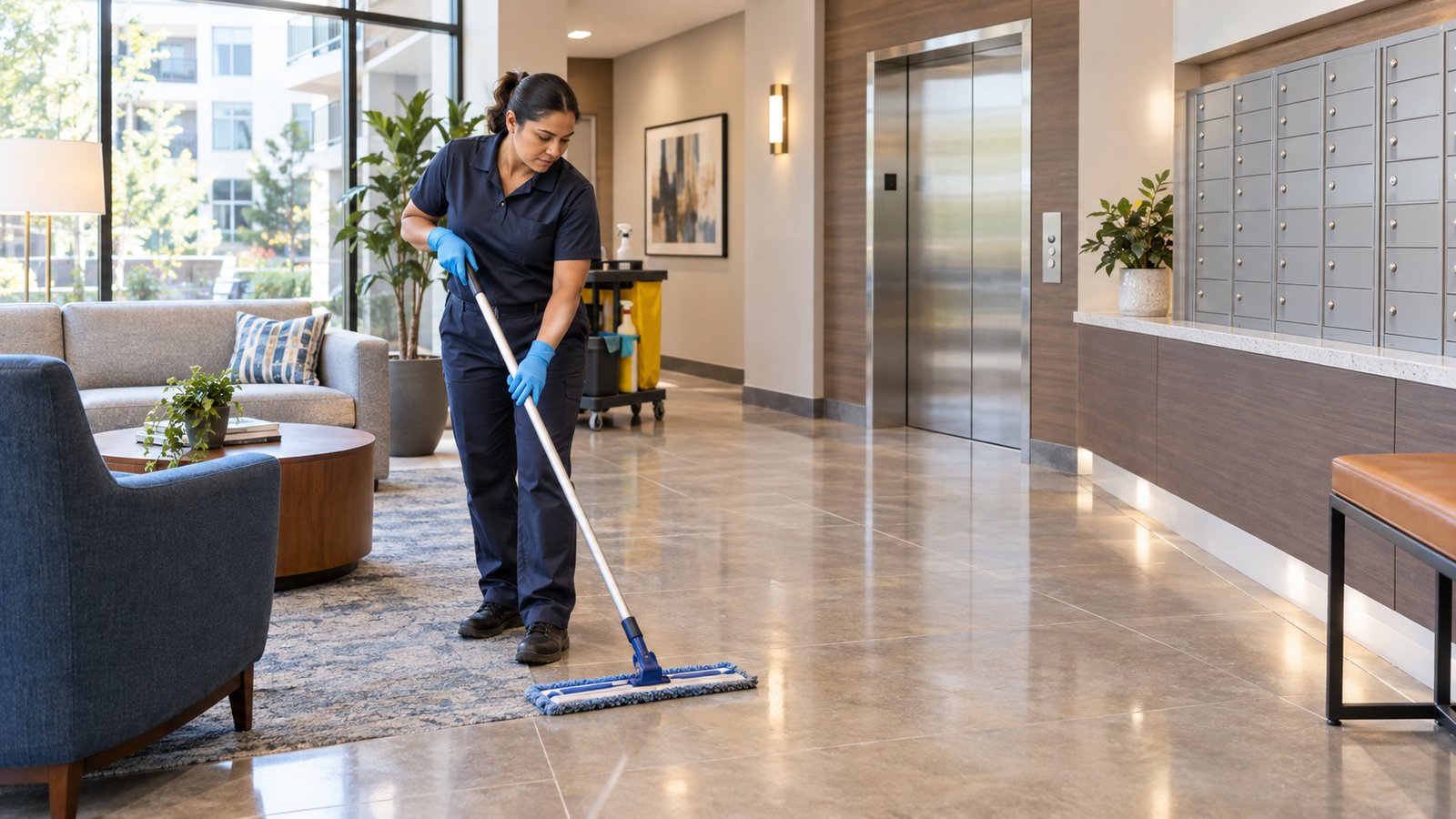
In a multi-tenant residential building, the common areas are part of the resident experience and a daily operating system. A lobby may receive deliveries, guests, strollers, and wet-weather soil within the same hour; elevators and mailrooms create repeated touchpoints; corridors must remain passable and quiet. The cleaning plan must protect resident privacy and belongings while keeping shared spaces visibly maintained. GreenPoint Maintenance Services prepares scopes for multifamily properties that define the areas, access rules, service windows, response times, and verification method instead of relying on a generic “clean common areas” line. This guide is for owners, condo boards, property managers, and management companies comparing cleaning vendors across New York, New Jersey, Connecticut, Pennsylvania, and Florida.
Map the property’s shared spaces and boundaries
Walk the full resident route: sidewalk or garage entry, vestibule, lobby, mail and package area, elevator cab, stairs, corridors, laundry room, fitness room, community room, and waste/recycling area. Mark which spaces are included, which belong to a commercial tenant or amenity operator, and which require an attendant. Identify surfaces such as stone, carpet, wood, glass, stainless steel, and painted finishes because each needs its own method. The scope should state that staff do not enter apartments, open resident packages, move personal property, or handle items left in hallways except under a written property procedure.
For larger portfolios, create a floor-by-floor route with building hours and key controls. Record where supplies are stored, which doors alarm, how elevator service is coordinated, and who receives an urgent report. A 12-story building with one service elevator has a different route plan from a garden-style community with several walk-up buildings. Do not put resident names, apartment details, or door codes in an unsecured log. GreenPoint Maintenance Services can translate the walkthrough into a zone list that property staff can approve before the service starts.
Set frequencies by traffic and resident use
Frequency should reflect how quickly a space becomes dirty, not just how many square feet it contains. A front lobby and mail area may need daily cleaning plus one daytime check; a fitness room may need daily touchpoint and floor care; a low-traffic stairwell may need scheduled attention and immediate response to a spill. A service calendar can specify daily, three-times-weekly, weekly, and monthly tasks, then list event-driven work such as a move-in, contractor debris, or a broken container. Treat those intervals as a property-specific planning choice rather than a legal minimum.
Build service around known peaks: morning departures, evening returns, package delivery windows, weekends, and amenity bookings. A building near a commuter rail or subway entrance may see a pronounced morning soil spike, while a full-service residential tower may experience heavier lobby use during package delivery periods. Measure complaint patterns over several weeks and adjust the route. For restrooms or shared amenity bathrooms, specify fixture cleaning, replenishment, floor checks, and a mid-shift inspection if traffic is high. The [high-traffic restroom cleaning guide](/blog/restroom-cleaning-best-practices-high-traffic/) provides a task-level reference for this part of the scope.
Keep resident routes accessible and slip-resistant
Wet floors, unsecured mats, cords, unattended carts, and trash bags can create hazards in shared routes. Use equipment suited to narrow corridors, keep exits and accessible routes clear, place signs before wet work, and remove signs promptly after the floor is dry. Plan cleaning around elevator traffic and avoid leaving equipment where residents must step around it. The property manager should identify any accessibility accommodations, resident communication needs, and building-specific emergency procedures. Review [ADA facility-maintenance considerations](/blog/ada-compliance-facility-maintenance/) when assessing routes, although the property’s legal obligations should be reviewed with qualified counsel or accessibility professionals.
Use a wet-weather response plan with entry mats, visible floor checks, and prompt cleanup of tracked water or slush. In cold-weather regions, salt residue can damage some finishes and create a rough appearance; use a floor-compatible process and increase inspection where traffic warrants it. In warm or humid climates, communicate leaks, standing water, or musty odors to property operations rather than attempting an unapproved chemical treatment. Cleaning teams should report a problem with location, time, and photo when approved, then leave repair and building-system decisions to the property’s designated staff.
Protect privacy, packages, and resident property
A written resident-property rule prevents small cleaning tasks from becoming serious disputes. Staff should not open packages, read mail, move valuables, handle medications, enter units, or discard belongings. Define how to report a spill near a parcel, an abandoned item, broken glass, or a leak. If property staff request an item be moved, make sure authority is documented and the procedure meets the building’s policy. Cleaners should avoid photographing faces, unit identifiers, package labels, or private documents; use pictures only for approved common-area verification and frame them to minimize incidental personal information.
For move-in and move-out days, state whether the janitorial vendor is responsible for common-area protection, elevator cab touch-ups, or post-move cleaning. The property team should coordinate elevator pads, contractor debris, and resident notices. Make sure the vendor knows the process for reporting damage without accepting responsibility for a contractor’s work. A separate work order can list the affected area, authorized time, work requested, and who approves charges. Fixed pricing for routine common areas should remain separate from extraordinary move-related work so the building can budget and audit both.
Specify safer products and material compatibility
Residential common areas often contain mixed surfaces and may be occupied during cleaning. Choose products for the surface and soil, use correct dilution, and follow label directions for ventilation and personal protective equipment. Never mix chemicals or leave unlabeled secondary containers in a janitor closet. Keep Safety Data Sheets available to employees when required and establish a product-approval process that covers resident communication, surface compatibility, fragrance sensitivity, and performance. GreenPoint Maintenance Services uses Green Seal-certified products where appropriate, while maintaining a product list approved for each surface rather than treating one product as universal.
Disinfection is not a substitute for routine cleaning. If the building requires a disinfectant for a defined reason, identify the surface, approved product, label contact time, and who authorizes the work. Avoid broad, unexplained spraying in occupied spaces. The client and contractor should agree how a chemical change is reviewed before use and how a resident complaint about odor or residue is escalated. Include chemical storage, dilution equipment, inventory responsibility, and prohibited substitutions in the contract so the property manager can verify what is being used.
Compare vendor proposals on scope, coverage, and cost
Ask each bidder to quote the same areas, frequencies, consumables, day-porter hours, periodic tasks, and exclusions. Cost drivers include building count, number of floors, elevator count, restroom count, amenity hours, corridor length, surface type, staffing window, supply storage, parking, and travel between properties. For a 200-unit building, per-unit price may be a useful comparison metric, but it cannot replace a task-level scope because buildings with the same unit count can have very different lobbies and amenity footprints. Require a monthly fixed price for routine service and a pre-approved rate schedule for extras.
Ask how absences are covered, who supervises the route, how quickly urgent issues are acknowledged, and what proof is provided after a correction. Confirm insurance, references, training, background-screening practices where lawful, and required MBE/MWBE credentials when procurement calls for them. GreenPoint Maintenance Services is MBE/MWBE certified with NYS, NYC, and NYC DOE and is SAM.gov registered; confirm the certification relevant to your buyer and contract. A buyer can also review [how to choose a commercial cleaning company](/blog/how-to-choose-commercial-cleaning-company/) and [commercial cleaning contract key terms](/blog/commercial-cleaning-contract-key-terms/) before issuing a scope.
Use a simple inspection and resident-feedback loop
Create a weekly route that checks the lobby, mailroom, elevator cab, one representative corridor per building, trash/recycling area, and shared restroom or amenity. Record the condition, missed task, damage report, responsible party, and correction time. Use a short rating scale residents and staff can understand, such as pass, needs touch-up, or maintenance referral. Pair inspections with work-order and complaint data; a clean photograph does not erase a pattern of late-night noise or repeated package-area spills. Give residents one designated contact path and tell them what information to include: location, time, and the problem observed.
JaniTrack can show GreenPoint clients completion records, selected timestamped GPS-tagged photos, and a live dashboard for agreed areas. The client should set photo boundaries to protect resident privacy. ATP testing may be used for selected high-touch checks when it fits the scope, but it is not a substitute for visible-condition inspections or a test for every pathogen. GreenPoint reports 98% client retention; a property manager should still define its own service levels and quarterly review. Use the review to adjust frequencies, discuss seasonal matting, confirm supply use, and approve any changes to the contract.
A practical onboarding meeting should include the property manager, building engineer, vendor supervisor, and any amenity representative whose space is included. Confirm the first-week route, resident-facing service window, work-order contact, emergency process, photo boundaries, and the standard for closing a complaint. GreenPoint Maintenance Services can schedule this walkthrough and provide a written quote for the approved common-area scope; call 347-332-9348 to begin. Revisit the route after the first 30 days so actual package volume, elevator use, and resident feedback can inform the service plan.
Frequently asked questions about multifamily common-area cleaning
Q: Does a common-area cleaning contract include apartment interiors? A: Not unless the contract explicitly says so and the property has an authorized access and consent procedure. Routine janitorial scopes should identify shared areas and prohibit unauthorized unit entry. Q: How often should a residential lobby be cleaned? A: Many occupied buildings schedule daily service and may add a daytime check based on package traffic, weather, and resident volume. Set the actual frequency after a walkthrough and review it against inspection and complaint data.
Q: Should cleaning staff move packages or resident belongings? A: No, unless the property’s written procedure authorizes a specific action. Staff should protect privacy, avoid opening or discarding items, and report hazards or obstructions to management. Q: What should a property manager include in a cleaning RFP? A: Include a property map, area list, frequencies, access rules, privacy requirements, product approvals, day-porter expectations, proof method, correction times, and separate pricing for extras. Call GreenPoint Maintenance Services at 347-332-9348 to schedule a walkthrough.
Give residents clean, safe shared spaces without compromising privacy or access. Call GreenPoint Maintenance Services at 347-332-9348 to schedule a property walkthrough and fixed-price quote. GreenPoint supports MBE/MWBE procurement and verifies agreed service tasks through JaniTrack’s dashboard and approved photo records.