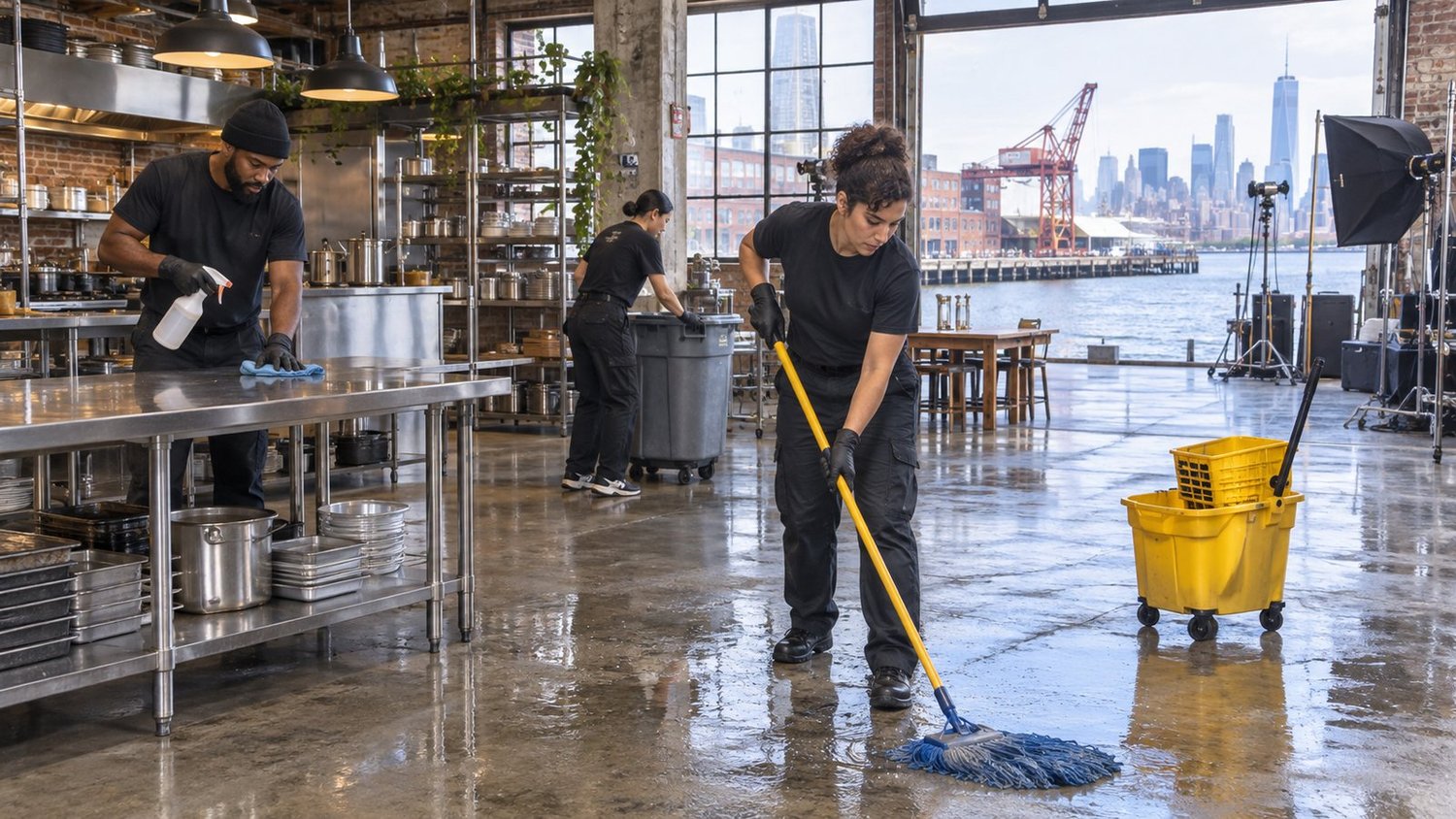
Red Hook facilities often mix offices and studios with warehouses, food businesses, waterfront operations, and service areas that have more complicated access than a conventional office tower. A cleaning plan near Van Brunt Street may focus on customer-facing rooms, while a site closer to the Brooklyn Cruise Terminal or Atlantic Basin may need clear rules for loading areas, employee entrances, and high-traffic floors. Buyers should define where janitorial work stops and where specialized sanitation or industrial cleaning begins. GreenPoint Maintenance Services helps commercial clients create written scopes, fixed pricing, and service verification around their actual operations. This Red Hook buyer guide covers local access planning, safe work boundaries, waste responsibilities, and the questions to ask before selecting a vendor.
Separate office, visitor, production, and support areas
Begin with a site map that separates reception, offices, conference rooms, public restrooms, staff rooms, corridors, loading vestibules, warehouse aisles, and any production or food-handling zone. A 7,500-square-foot mixed-use building can have a few thousand square feet of ordinary office space and a much larger floor area that requires separate equipment, training, or controls. Identify which spaces are included in routine janitorial service and which need an engineered or regulated cleaning procedure. GreenPoint Maintenance Services uses the walkthrough to establish the boundary, task list, floor materials, occupancy, and any access restrictions before issuing a price.
Do not use one line that says clean entire facility when the work includes different hazards and materials. State whether warehouse sweeping, office waste removal, restroom service, dock housekeeping, spill response, and equipment cleaning are included or excluded. A cleaner should not be expected to enter an active process area, move stock, or handle unknown residue without the owner's review and a defined method. The warehouse industrial cleaning best practices guide helps buyers distinguish general facility care from specialized production work. Call 347-332-9348 to schedule a Red Hook walkthrough and define a realistic service boundary.
Plan for waterfront access, B61 service, and loading constraints
Red Hook's street layout, industrial blocks, waterfront destinations, and limited direct subway access can make crew arrival and material movement site-specific. Van Brunt Street, Beard Street, Lorraine Street, the B61 corridor, Atlantic Basin, Red Hook Park, and the Brooklyn Cruise Terminal are recognizable local reference points, but they do not share identical parking or loading conditions. The New York City Ferry Red Hook landing and nearby piers add another access option for some staff, subject to current schedules. Confirm routes and service changes with the relevant transit operators, and make building entry instructions more detailed than simply providing a street address.
During the site review, document the gate, badge requirement, loading-dock rules, vehicle height limits, sign-in desk, freight elevator, and storage location for supplies. List who escorts a contractor into restricted zones and whether service may continue when a truck is unloading. Establish a process for delayed entry due to weather, a port or event security restriction, or a building alarm issue. GreenPoint Maintenance records the approved route and customer contact so a missed access window is reported. If you manage multiple Red Hook buildings, make a separate access sheet for each address instead of relying on one neighborhood-wide set of instructions.
Set cleaning frequency around shifts, soil, and public traffic
A useful schedule starts with shift changes, visitor volume, restrooms, break areas, food use, and the condition of floors at each entrance. A 2,000-square-foot office may need a few scheduled visits per week, while a customer-facing food business could require daily floor and restroom work. A warehouse may need high-dust or machine-scrub work on a separate plan. Count the areas that produce soil, not only the square footage, and keep daily tasks distinct from weekly and monthly detail work. This makes a proposal easier to compare and shows what a facility manager should inspect.
Use the cleaning frequency standards by facility type guide as a planning prompt, then validate the schedule against real operations. Ask each bidder how they will cover a restroom after a busy shift, respond to a spill outside the regular route, and document a scheduled machine-cleaning task. GreenPoint Maintenance offers fixed-price service for an agreed scope instead of unplanned hourly billing. The commercial cleaning cost per square foot guide can help explain why loading access, floor type, and specialized zones affect the quote. Request a walkthrough at 347-332-9348.
Keep food, waste, and industrial materials in separate streams
A Red Hook business should tell its janitorial vendor exactly what can be placed in routine trash and recycling. NYC businesses have separate commercial-waste and recycling obligations; DSNY's business waste guidance explains how businesses arrange collection and how materials are handled. The cleaning contract should identify the approved waste room, labeled containers, and whether workers consolidate ordinary office refuse, clean container exteriors, or move bags to a collection point. It should also exclude regulated medical, laboratory, chemical, or process waste unless a separate qualified service and site procedure cover that material.
For food businesses, align janitorial timing with the site's food-safety plan and local health requirements. A general-purpose cleaning company should not claim that wiping a floor or restroom substitutes for a food establishment's required sanitation program. Keep clean and soiled tools separate, use site-approved products, and identify any areas where staff handle ingredients or packaging. For warehouses, tell the vendor whether dust, pallet debris, or damaged packaging must be reported rather than swept into a mixed bin. GreenPoint Maintenance can follow the client's approved labeling and reporting plan, but each business remains responsible for ensuring its waste stream and special materials are handled through the proper provider.
Protect crews and facility occupants with written safety controls
Red Hook facilities may have forklifts, vehicle traffic, uneven transitions, wet loading areas, equipment, and cleaning chemicals in close proximity. Define pedestrian routes, safety vests or other site PPE, lockout boundaries, restricted areas, spill reporting, and rules for working around deliveries. OSHA's Hazard Communication Standard addresses workplace chemical labels, safety data sheets, and employee training for hazardous chemicals. Ask the vendor how staff identify a product, follow its dilution and contact instructions, and avoid mixing incompatible chemicals. Facility orientation should occur before the first shift, not after an incident.
GreenPoint Maintenance uses Green Seal certified products where appropriate and selects tools according to the work area. The client should provide known material hazards, floor-care restrictions, and any rule about radios, cameras, photography, or visitor privacy. Do not assign a cleaning worker to handle unknown spills or move machine guards. Set clear limits for routine cleaning and a stop-work escalation path when the site condition changes. The OSHA cleaning chemical safety guide is a useful reference for evaluating chemical communication, while the warehouse cleaning guide can help structure a safe facility checklist.
Measure service with area-specific evidence and corrective action
A quality plan should not use the same checklist for a reception desk, loading corridor, restroom, and warehouse floor. Define three to five checkpoints for each zone, such as visible soil, debris at floor edges, spill sign removal after drying, restroom restocking, and waste-room condition. Record the date, location, result, and correction owner. GreenPoint's JaniTrack supports timestamped GPS-tagged photos and a live dashboard, with ATP testing where the site and task make it appropriate. ATP is an operational indicator of biological residue; it is not a pathogen test, a sterility guarantee, or a substitute for specialized food or healthcare controls.
Ask for an example service report and how exceptions are escalated outside business hours. An industrial property may need a facilities contact to distinguish a janitorial concern from a maintenance hazard, and a visitor-facing space may need quicker notification for a restroom issue. GreenPoint Maintenance Services reports 98% client retention, but a buyer should still request comparable references and agree on a response time. The cleaning audit checklist for facility managers helps set a repeatable baseline. To include JaniTrack checkpoints in a Red Hook proposal, call 347-332-9348 and identify the areas that matter most.
Compare bids by risk, schedule, and total service scope
Compare the same service map across all proposals. Check who supplies equipment and consumables, what shift the price assumes, how holiday coverage works, whether periodic floor care is separate, and which services require a change order. For a 10,000-square-foot facility, ask bidders to separate office tasks from warehouse or loading-zone tasks so each cost can be evaluated against the correct scope. A low number that excludes the dock, stairs, or restroom replenishment is not comparable to a full-coverage proposal. GreenPoint Maintenance uses fixed pricing with no hidden fees for the approved route and documents changes when use or area changes.
GreenPoint Maintenance Services Corp is MBE/MWBE certified in New York State, New York City, and NYC DOE and is registered in SAM.gov. Procurement teams can request current certificates, insurance, staffing details, references, and a sample quality report. Certification may support supplier-diversity objectives, but it does not replace a safety review or a walkthrough of any industrial site. For Red Hook commercial cleaning quotes, call 347-332-9348 or write to info@greenpointms.com. Share the operating schedule, access rules, square footage by zone, restroom count, and any restricted area so the proposal accurately describes the work.
Frequently asked questions about Red Hook cleaning services
Q: Can one janitorial vendor cover both a Red Hook office and warehouse? A: Possibly, if each zone is evaluated separately and the contractor has the training, equipment, and access approval for the work. Do not assume routine office cleaning includes production or regulated spaces.
Q: Does an office cleaning company remove commercial waste from a Red Hook business? A: The contract should specify any consolidation or movement to an approved holding area. Confirm the building's DSNY and carter arrangements separately, especially for food, regulated, or industrial waste.
Q: What local access details should a Red Hook buyer provide? A: Include the exact entrance, badge or escort process, loading restrictions, freight-elevator hours, parking limitations, safety orientation, and after-hours contact.
Q: How can a manager confirm that recurring work was completed? A: Use a written task calendar, inspection logs, supervisor follow-up, and agreed site evidence. JaniTrack can support timestamped photos and dashboard checks; ATP should be treated as an operational indicator only.
Q: How do I request a Red Hook walkthrough? A: Call GreenPoint Maintenance at 347-332-9348 or email info@greenpointms.com. Provide separate square-foot estimates for office, support, and warehouse areas and note any restricted operations.
Need commercial cleaning for a Red Hook office, studio, or industrial support area? Call GreenPoint Maintenance at 347-332-9348 to schedule a site walkthrough and fixed-price quote. GreenPoint Maintenance Services offers JaniTrack verification options, MBE/MWBE credentials, and a reported 98% client retention rate.