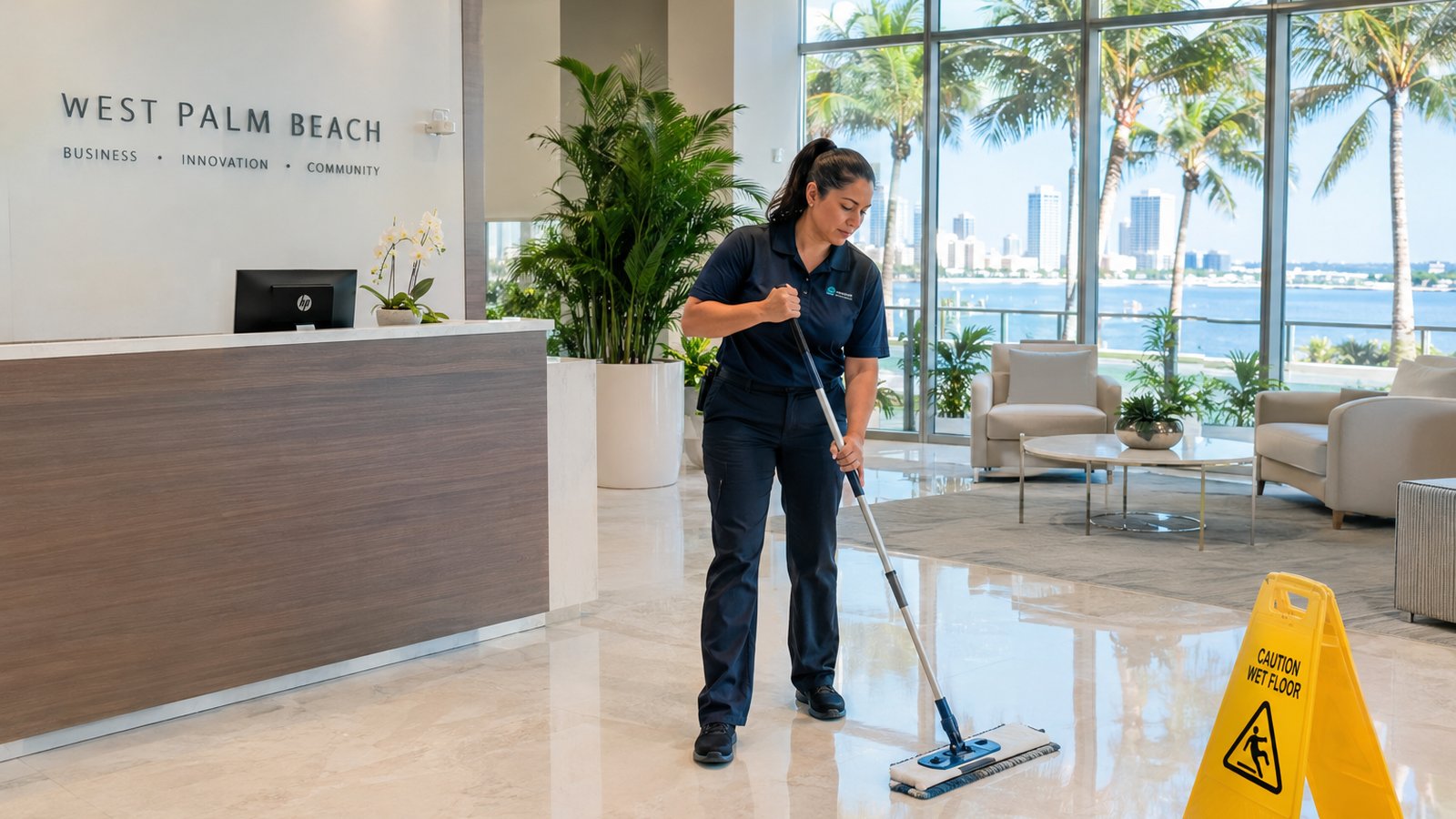
Commercial cleaning in West Palm Beach and Boca Raton must account for heat, humidity, rain, visitor traffic, and buildings that serve office, retail, hospitality, health, and education users. A dependable janitorial contract starts with a walkthrough and translates each facility's needs into scheduled tasks, approved products, trained staffing, and inspectable service records. GreenPoint Maintenance Services serves customers across its multi-state service area, including Florida, with fixed-price scopes and JaniTrack verification. This guide offers Palm Beach County buyers practical questions for assessing vendors, planning seasonal conditions, and maintaining a consistent standard.
Scope the building for Florida's climate and occupancy
West Palm Beach offices near Clematis Street, CityPlace, the Brightline station, or Palm Beach International Airport face different visitor patterns than a Boca Raton office near Mizner Park, Town Center at Boca Raton, or the FAU campus. Humid air and frequent rain can increase tracked-in moisture and make entrance mats, lobby floors, and restroom checks more important. During a walkthrough, list entrances, floor types, glass, restrooms, kitchens, elevators, and high-use meeting spaces. GreenPoint Maintenance Services reviews how the property is used before recommending a cleaning schedule.
A complete scope identifies tasks and frequency for each area. It should state who supplies liners, soap, paper goods, and floor mats; how spills are reported; and whether high dusting, carpet extraction, or post-storm cleanup is included. Do not assume a standard square-foot price covers every need, especially when the property includes public areas or specialized rooms. GreenPoint provides fixed pricing with no hourly billing or hidden fees for the agreed work. Call 347-332-9348 to request a walkthrough and a site-specific quote.
Manage moisture, entrances, and indoor air
Rainwater and humidity create practical maintenance issues. Use properly sized entrance mats, check transitions for standing water, maintain a documented spill response, and schedule floor care that matches the surface and finish. Facility teams should not allow damp materials to remain stored in closed areas; report leaks or condensation to building engineering rather than treating them as ordinary soil. Vacuum and dusting methods should fit the building's ventilation and occupancy. Cleaning can support indoor environmental quality, but it does not replace HVAC inspection or humidity control.
Set cleaning frequencies for lobbies and restrooms based on traffic and service hours. A lobby near an active retail or transit corridor may need repeated spot attention, while a low-traffic suite may need fewer visits. ISSA appearance-level guidance can help define expected conditions, and a walkthrough can establish a baseline for inspections. GreenPoint uses JaniTrack to make agreed service records visible, including timestamped GPS-tagged photos and a live dashboard. Compare standards in [indoor air quality and commercial cleaning](/blog/indoor-air-quality-commercial-cleaning/) and [cleaning frequency by facility type](/blog/cleaning-frequency-standards-by-facility-type/).
Use a written rainy-day procedure that says who places warning signs, how a spill is reported, when saturated mats are replaced, and when a wet floor should be closed to visitors. In an occupied lobby, do not simply increase chemical use; choose an appropriate method for the surface and follow product directions. Have building engineering inspect persistent condensation or water intrusion because janitorial work cannot correct a building-envelope or HVAC problem. GreenPoint can include the response sequence and reporting contact in the site plan, giving the front desk and cleaning team the same instructions.
Prepare cleaning operations for storm disruptions
A cleaning contract should distinguish routine service from storm response. Before hurricane season, identify the facility decision-maker, emergency contacts, priority zones, supply storage, flood-sensitive areas, and the process for confirming whether the building is safe to enter after a weather event. Clarify that cleaners do not perform hazardous flood remediation, electrical work, mold remediation, or other specialized recovery unless appropriately qualified, equipped, and separately contracted. Follow local emergency management instructions and the building's approved reopening plan.
After a storm, document visible water intrusion, damaged materials, access restrictions, and any areas withheld pending inspection by qualified professionals. Do not mix routine janitorial tasks with cleanup of unknown contaminants or standing water. GreenPoint can define ordinary service restoration and escalation boundaries in advance, but the property owner remains responsible for emergency decisions and specialist remediation. Review [hurricane preparedness for Florida commercial facilities](/blog/hurricane-preparedness-florida-commercial-facilities/) and [commercial cleaning contract key terms](/blog/commercial-cleaning-contract-key-terms/) before storm season.
Verify products, labels, and worker protections
Ask vendors to list the products they will use, provide current labels and safety data sheets, explain dilution and storage, and describe employee hazard-communication training. OSHA requirements apply to worker safety and chemical hazard communication; the contract should identify how site rules, personal protective equipment, secondary-container labels, and spill reporting are managed. For disinfectants, follow the EPA-registered product label for target use, surfaces, and contact time. GreenPoint uses Green Seal-certified products where appropriate, but product selection still depends on the task, surface, and approved method.
Facility managers should also review insurance, background-screening expectations, key handling, ladder rules, wet-floor controls, and equipment charging or storage. Request a written substitution-approval process so the product used on site matches what the client reviewed. For mixed-use properties, keep the janitorial closet secured and the approved product register accessible to authorized managers. GreenPoint Maintenance Services can review these controls during a walkthrough and include responsibility boundaries in the proposal.
Measure service and compare fixed-price proposals
Compare vendors on scope completeness, staffing coverage, supervisor visits, supplies, periodic services, emergency response, insurance, termination language, and quality reporting. Ask for a sample inspection and a written plan for missed service: who receives the complaint, when it is acknowledged, how quickly the issue is corrected, and how closure is documented. A fixed monthly price is useful when included tasks and exclusions are explicit. GreenPoint offers fixed-price contracts without hourly billing or hidden fees and reviews any material scope change with the client.
JaniTrack can provide GreenPoint clients with time-stamped GPS-tagged photos, visit records, a live dashboard, and selected ATP results when a defined verification program calls for them. ATP is not a pathogen test, so treat it as one indicator in a broader quality plan. GreenPoint reports 98% client retention and can explain its corrective-action process during a walkthrough. Review [commercial cleaning audit checklists](/blog/cleaning-audit-checklist-facility-managers/) and [commercial cleaning cost per square foot](/blog/commercial-cleaning-cost-per-square-foot/) to prepare for a fair comparison.
Separate routine janitorial service from specialist recovery
Florida properties should write down what happens when a leak, storm, or building shutdown interrupts routine work. The regular janitorial scope can identify who receives a call, how the contractor confirms site access, and how normal service resumes after management authorizes reopening. It should not imply that cleaning staff will enter unsafe areas, operate electrical equipment in water, remove damaged building materials, or diagnose mold. Those activities may require trained specialists and the property owner's safety approval.
Identify priority areas before an event: public entrances, restrooms, tenant service points, and any room with sensitive equipment. Keep a current contact tree and note where approved supplies and protective equipment are stored. After the building is cleared, document the condition of affected spaces and agree on any additional cleaning as a separately priced service. GreenPoint Maintenance Services can define this boundary in the contract and help restore the ordinary schedule after authorization. For storm-specific planning, see [hurricane preparedness for Florida commercial facilities](/blog/hurricane-preparedness-florida-commercial-facilities/).
Include a restart checklist for the first regular shift after a closure: confirm the building is open, identify rooms that remain restricted, inspect entry mats and floors, check that normal supplies are available, and notify the facility contact about visible damage. Any work outside the approved cleaning scope should be paused until management approves a safe plan. This keeps routine service distinct from restoration and gives the property owner a clear record of what was handled. GreenPoint can add the checklist to the site's operating instructions and review it during a walkthrough.
Create a practical property-level sustainability checklist
Sustainability goals become actionable when the contract describes the evidence the buyer expects. State whether Green Seal-certified products are preferred, which paper goods or liners must meet procurement criteria, how dilution is controlled, and whether the building tracks waste diversion or chemical inventory. Ask the vendor to identify exceptions when a specialized product is needed for a specific surface or label-directed disinfection task. GreenPoint uses Green Seal-certified products where appropriate and can list approved products in the site plan so substitutions are visible.
Avoid equating a green product claim with an indoor-air-quality outcome or universal safety guarantee. Ventilation, occupant behavior, building maintenance, and the correct use of a product all matter. Review the product label and safety data sheet, ask how staff are trained, and periodically reconcile the products stored in the janitorial closet with the approved inventory. GreenPoint can provide documentation during a walkthrough and discuss how the cleaning plan supports your building's sustainability policy. Call 347-332-9348 or email info@greenpointms.com to schedule a Florida facility review.
Ask for a simple monthly record covering approved products, substitutions, training changes, and unresolved supply questions. Keep that record with the facility's purchasing and safety documents so an operations manager can confirm that the program is consistent across shifts. If a client has a sustainability certification or internal policy, identify which records must be retained and who signs off on exceptions. GreenPoint Maintenance Services can align its site reporting with the facility's documented process, while the client remains responsible for confirming its own certification criteria and building-wide performance.
Frequently asked questions about Palm Beach County cleaning
Q: How often should a West Palm Beach office be cleaned? A: Use occupancy, public traffic, restroom demand, floor conditions, and operating hours to set the schedule. Many offices choose weekday service, while high-traffic lobbies may need additional checks. Q: Does humidity change the cleaning scope? A: It can change the attention needed for entrances, damp floors, and visible soil, but leaks or indoor humidity problems should be referred to building engineering. Q: Can the janitorial company handle hurricane cleanup? A: Routine cleaning after reopening may be scoped, but hazardous water damage, mold remediation, and specialist recovery require qualified providers and an approved safety plan.
Q: What does a fixed-price cleaning contract cover? A: It covers only the tasks, frequencies, supplies, and exclusions stated in the agreement; ask the vendor to put them in a room-level schedule. Q: How can I request service in Boca Raton? A: Call GreenPoint Maintenance Services at 347-332-9348 or email info@greenpointms.com with your address, approximate area, hours, and facility type. GreenPoint can schedule a walkthrough and prepare a quote based on the property rather than an assumption.
For commercial cleaning in West Palm Beach or Boca Raton, call GreenPoint Maintenance Services at 347-332-9348 to schedule a walkthrough. GreenPoint's 98% client retention and JaniTrack service records support a measurable, fixed-price program tailored to your Florida facility.