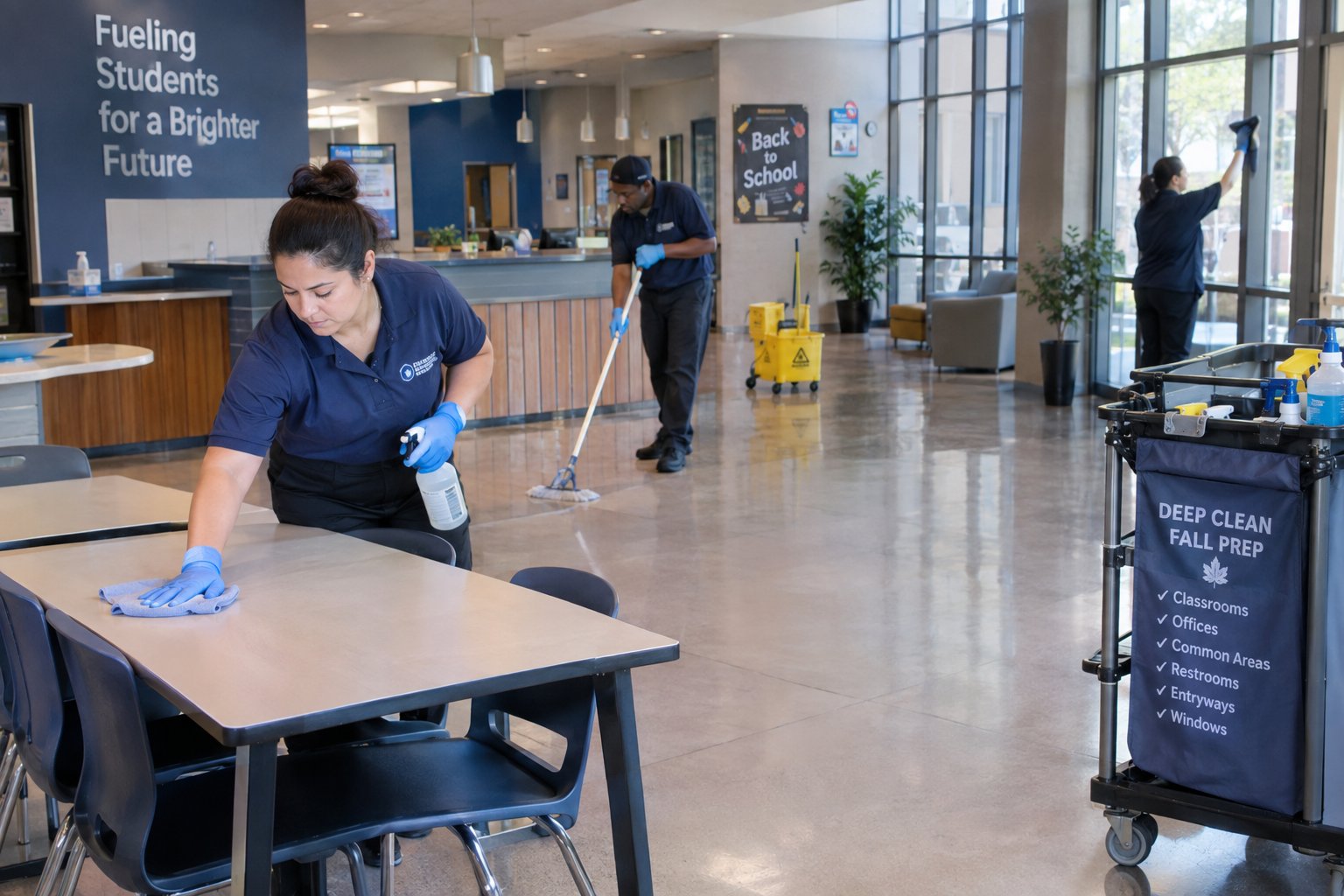
The weeks before school resumes are a high-leverage cleaning window for offices, childcare centers, tutoring sites, and school-adjacent facilities. A fall reset should remove accumulated soil, restore floors, verify restroom and hand-hygiene supplies, and establish a practical routine for the first busy month. It should not be a rushed promise to “sanitize everything.” GreenPoint Maintenance Services builds back-to-school scopes around occupancy, touchpoints, floor types, food areas, and documentation. That matters in a Queens childcare center, a Bronx school office, a Midtown tenant suite, or a Westchester campus where families, staff, and visitors expect the building to be ready on day one.
Why the Fall Reset Is Different From Routine Cleaning
Routine cleaning maintains a known baseline; a fall reset re-establishes the baseline after summer projects, stored furniture, low occupancy, dust migration, and construction or maintenance work. Start by checking ceiling edges, vents, corners, baseboards, classroom storage, cubbies, chair legs, and areas behind movable equipment. Carpets may need extraction, VCT may need finish work, and high-touch points may need a documented first-day inspection. The [summer deep-cleaning checklist for schools](/blog/summer-deep-cleaning-checklist-schools/) is a useful companion for planning tasks before the first bell.
For a 30,000-square-foot childcare or school-adjacent facility, separate pre-opening detail work from daily operations. A 2- to 4-person project team might need one or more nights for high and low dusting, floor care, restrooms, kitchen-adjacent surfaces, and supply setup. A simple production estimate is safer than a generic promise: map the rooms, count restrooms and sinks, measure carpet and hard floor areas, and identify which rooms can be released to the cleaning crew.
Zone the Building by Risk and Occupancy
Classrooms, nap rooms, playrooms, restrooms, food-preparation areas, staff lounges, entry vestibules, and administrative offices do not need identical frequencies. Childcare rooms often require daily floor cleaning and frequent toy or surface sanitation; classrooms may need daily desks, touchpoints, trash, and floors; restrooms need a full clean plus checks during the occupancy period; and low-use storage needs planned periodic work. The CDC emphasizes cleaning high-touch surfaces and following product label directions, while OSHA requires safe chemical communication and worker protection.
GreenPoint recommends a written zone matrix showing task, frequency, product, responsible role, and verification. For a 120-child center, specify the opening condition, mid-day check, closing clean, and incident response rather than writing “sanitize as needed.” In an office returning from summer leave, focus on shared conference rooms, kitchens, elevators, badge readers, and high-use restrooms without applying childcare-level chemical use to every private office.
Classrooms, Childcare Rooms, and Shared Materials
A room reset should include desks or tables, chair backs, handles, light switches, storage pulls, cubbies, and floor edges. In infant and toddler rooms, document crib or mat turnover, floor-level dust, washable toys, and diaper-changing boundaries. Follow the facility’s health plan for toys that cannot be immersed, fabrics that require laundering, and surfaces that need a contact time. GreenPoint never substitutes a stronger chemical for a missing process; the product, dilution, dwell time, ventilation, and wipe method all matter.
Shared materials need an owner. Teachers and caregivers may handle certain toys or food-contact items, while the janitorial team handles floors, restrooms, waste, and approved touchpoints. The handoff should be written so no area is assumed to be someone else’s job. GreenPoint Maintenance Services can provide a color-coded microfiber system, supply map, and supervisor check that distinguishes classroom work from food-service and restroom tools.
NYC DOE, Tri-State, and Local Site Context
NYC DOE vendors and school operators work within site access, security, and procurement rules that can be more restrictive than a private office. A school near Fordham, Flushing, Crown Heights, or Staten Island may have different arrival windows, playground traffic, and custodial handoffs. Childcare sites in Astoria, Long Island City, Jersey City, Stamford, Westchester, or Nassau County may operate in smaller footprints with more concentrated touchpoints. Build the schedule around the actual calendar, not a generic Monday-through-Friday assumption.
GreenPoint serves NY, NJ, CT, PA, and FL, so weather and local operating conditions also belong in the plan. Ask whether the facility expects parent traffic, school-bus loading, evening programs, or weekend events. Call 347-332-9348 before the reset window closes; a walkthrough lets GreenPoint schedule crews, order supplies, and set a fixed price without hourly billing or hidden fees.
Products, Indoor Air, and Safe Chemical Handling
A fall cleaning plan should specify Green Seal certified or other approved products where they meet the facility’s needs, but “green” does not mean risk-free. Read the label, keep current SDS records, train staff on dilution and contact time, and prevent chemical storage in child-accessible areas. OSHA hazard communication applies to the work environment, and ventilation matters when a team is cleaning many rooms in a compressed window. HEPA vacuuming and damp methods can reduce dust migration compared with uncontrolled dry sweeping.
Do not fog or spray occupied rooms as a shortcut. A cleaner should use the method appropriate for the surface and the product label, protect food-contact areas, and allow the space to return only after the required time and ventilation steps. GreenPoint can document product lists, SDS access, and supervisor checks in the scope. The goal is a ready facility that smells neutral, looks maintained, and has a defensible process.
Staffing and the First Four Weeks
Back-to-school success depends on the first month, not just the opening night. For a 40,000-square-foot school office or childcare portfolio, plan an opening team, a routine crew, and a supervisor who can respond to access or supply issues. Daily touchpoints should be prioritized by occupancy. Restrooms, entrances, shared tables, kitchenettes, and high-touch hardware may need multiple checks; private offices and low-use storage can follow the baseline frequency. Use [cleaning frequency standards by facility type](/blog/cleaning-frequency-standards-by-facility-type/) to compare frequencies, then adjust for the site’s traffic and health plan.
Set a 7-day, 14-day, and 30-day review. At each review, look at missed rooms, recurring soil, supply consumption, incident calls, and the time needed for each zone. If a team cannot finish the scope in the approved window, change staffing or frequency instead of quietly skipping detail work. GreenPoint’s 98% client retention is built on this feedback loop and on correcting patterns early.
Prove Readiness With JaniTrack
A readiness report should be readable by a principal, property manager, or childcare director who was not on site. Include the room list, completion time, exceptions, supervisor sign-off, and any follow-up owner. JaniTrack can add timestamped GPS-tagged photos for approved areas, selected ATP testing where appropriate, and a live dashboard for open items. Avoid photographing children, private records, or restricted areas; verification must support trust rather than create a privacy problem.
GreenPoint can also provide a short first-month summary showing the top recurring exception by zone, the corrective action, and whether the issue stayed closed. That evidence helps a facility manager decide if a restroom needs an extra round, if a classroom needs a different floor method, or if supplies are being used faster than expected. It is more actionable than a claim that the whole building was “deep cleaned.”
Budget Benchmarks for a Fall Reset
Standard recurring office cleaning may range around $0.06 to $0.16 per square foot per visit, while childcare, school, or high-touch programs can run about $0.10 to $0.24 when they include extra restrooms, food areas, frequent checks, and more detailed documentation. A one-time reset may be priced by floor area and task list: carpet extraction, VCT work, high dusting, interior glass, and fixture detail should be visible line items. Prices vary by region; Manhattan access and labor conditions are not the same as a suburban Pennsylvania campus or a South Florida facility.
Ask for fixed pricing that states what is included, what is periodic, and what triggers a change order. GreenPoint Maintenance Services provides a written scope, trained staff, and no hidden fees. Schedule a walkthrough by calling 347-332-9348 or emailing info@greenpointms.com so the team can quote the actual rooms, calendar, and handoffs.
Implementation note: open every room with a short readiness walk. Check that furniture is back in place, floors are dry, supplies are stocked, doors and exits are unobstructed, and the teacher or site lead knows which items remain outside the janitorial scope. A ten-minute handoff can prevent a full day of avoidable confusion once children or employees return. Keep the first-week contact list visible so a site lead can reach the supervisor, facilities contact, or product approver quickly.
Manager checklist: confirm the service window, access contact, approved products, safety controls, exception owner, and review date before work starts. During the first month, compare the planned scope with actual labor, occupant feedback, supply use, and repeat exceptions. If the building changes—new tenant, renovation, event calendar, floor finish, or operating hours—update the zone map and quote rather than letting the crew absorb new work informally. This small governance step keeps a local cleaning program consistent across multiple shifts and properties.
A clear handoff is also a local-service advantage. The building manager knows which GreenPoint supervisor is responsible, the crew knows which areas are priority, and occupants receive one consistent answer when conditions change. Keep phone, email, after-hours access, and emergency escalation details with the scope so the program remains usable after a holiday, storm, event, or staffing change.
At the end of each review, retain the decision, not just the complaint. Note whether the team changed a frequency, added a supply, repaired an access problem, retrained an employee, or referred the issue to another contractor. That short record lets GreenPoint and the client measure improvement over time and keeps the next walkthrough focused on facts, budget, and occupant needs.
Before the program starts, ask who can approve a product change, who can release a room, who receives an incident report, and who can authorize an added visit. Clear answers prevent a cleaner from making a safety decision alone and prevent a manager from assuming that a technology purchase solves a process gap. GreenPoint documents these handoffs in the scope and reviews them with the site contact.
Frequently Asked Questions
How far in advance should a back-to-school cleaning be scheduled? Aim for at least two to four weeks when possible, especially if floors, carpets, supply deliveries, or background checks are involved. Earlier planning gives the facility time to approve products and access windows.
How often should childcare rooms be cleaned? Floors, restrooms, food areas, and high-touch surfaces generally need daily or more frequent attention, while toys and mats follow the facility health plan and manufacturer instructions. Frequency should match age group and occupancy.
Can GreenPoint clean while teachers are setting up? Yes, if the scope divides occupied and unoccupied zones, coordinates access, controls wet floors, and protects materials. A walkthrough at 347-332-9348 helps set realistic release times.
Does GreenPoint use green cleaning products? GreenPoint can specify Green Seal certified products when they fit the surface, health plan, and contract. The plan also includes SDS access, dilution, contact time, ventilation, and secure storage.
How is a fall reset verified? JaniTrack can record task completion, supervisor inspections, approved timestamped GPS-tagged photos, and selected ATP testing. The facility receives an exception list instead of an uncheckable blanket claim.
Call GreenPoint Maintenance Services at 347-332-9348 or email info@greenpointms.com to schedule a facility walkthrough and fixed-price quote. GreenPoint combines trained local teams with JaniTrack verification, including timestamped GPS-tagged photos, supervisor checks, and a live dashboard. The proof point is a 98% client retention rate across commercial programs.