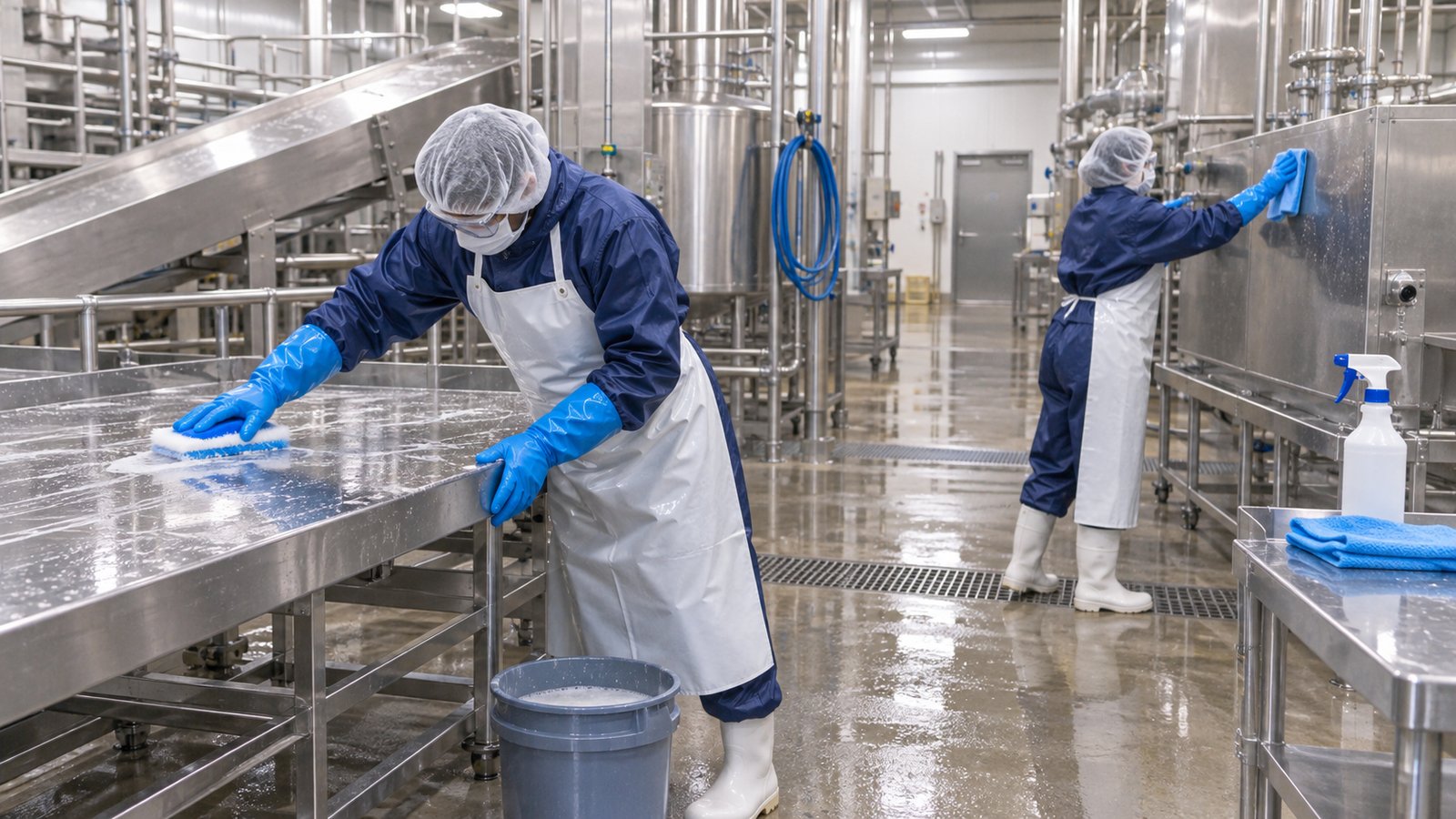
Food manufacturing cleaning is a controlled production activity, not a generic janitorial visit. A New Jersey facility may need different procedures for production rooms, packaging areas, employee welfare spaces, offices, loading zones, and non-production floors. The plant's food-safety team must define which tasks are part of its sanitation program and which are ordinary facility cleaning, then approve the contractor, methods, chemicals, access, and records accordingly. GreenPoint Maintenance Services can support defined commercial cleaning scopes, but the facility's qualified food-safety leadership remains responsible for approving controls and determining whether work meets applicable requirements.
Separate sanitation controls from general janitorial work
Before requesting a bid, draw a clear boundary between food-contact and non-food-contact equipment, production zones, support areas, and public or administrative spaces. A janitorial contractor might clean offices, break rooms, restrooms, corridors, and designated exterior surfaces, while production sanitation may require specialized qualifications, validated procedures, line-release controls, or equipment-specific knowledge. Do not assume a general commercial cleaning vendor is authorized to enter exposed-product areas or clean equipment. The plant's food-safety plan, standard operating procedures, and site rules must govern access and task approval.
The facility should name a responsible approver for every room and procedure. Identify who grants access, who isolates production lines, who verifies a pre-operational condition, and who can release the area back to production. A contract should state exclusions as clearly as included tasks, particularly for allergen changeovers, food-contact surfaces, drains, high-risk zones, and equipment disassembly. GreenPoint's proposal process starts with a scope review and walkthrough; GreenPoint Maintenance Services will not treat an unapproved cleaning method as a substitute for the plant's own food-safety decision.
Build vendor requirements around the plant's approved program
The buyer's written requirements should identify facility zones, approved work windows, training prerequisites, hygiene and gowning rules, movement between zones, tools allowed in each area, chemical restrictions, and the documentation needed at closeout. The FDA's current food-safety regulations, including 21 CFR Part 117 for covered facilities, may be relevant to a site's preventive controls and sanitation procedures; applicability and implementation must be assessed by the facility's qualified compliance team. A cleaning contractor should follow the site's approved program, not interpret regulatory obligations on the plant's behalf.
Request a site orientation before staff begin work and document competency for each assigned task. Training may cover hand hygiene, protective clothing, restricted areas, foreign-material prevention, incident reporting, product handling, and emergency response, depending on the facility's rules. The vendor should know that a damaged seal, chemical spill, unexplained residue, or possible contamination event must be reported immediately rather than cleaned over without authorization. GreenPoint can align a contracted non-production scope with the facility's access and reporting process and provide named supervision for follow-up.
Control chemicals, tools, and cross-contamination risks
A buyer should ask for the exact product list, label directions, safety data sheets, dilution controls, storage plan, and approval pathway before a cleaner brings chemicals on site. OSHA's Hazard Communication Standard addresses communication of chemical hazards, labels, and safety data sheets; the facility should coordinate contractor training with its own program and emergency procedures. Never substitute a product based only on a marketing claim such as 'food safe.' The food-safety team must approve the product and use for the intended surface and process.
Color-coded tools and dedicated storage can help a plant enforce separation between areas when they are part of the facility's approved plan. The scope should identify where mops, cloths, vacuums, carts, and waste containers may travel, how they are cleaned or changed, and how tool condition is checked. Avoid vague instructions such as 'sanitize everything'; specify the approved method and responsible owner. GreenPoint offers Green Seal-certified products for appropriate commercial cleaning tasks, but food-production use is subject to the plant's product approval and process controls. See the chemical safety and SDS guide for procurement questions.
Document the job in an audit-ready way
Records should make it possible to determine what was scheduled, who completed it, when the work occurred, which approved procedure applied, what exception was found, and who reviewed the result. A practical package can include training signoffs, current product information, daily task sheets, supervisor inspections, incident reports, and corrective-action records required by the facility. Records must match the site's retention and access rules. Do not make a contractor's photo log or dashboard the sole food-safety record unless the plant has formally approved that system and determined it meets its program needs.
JaniTrack can support GreenPoint's commercial service documentation with timestamped GPS-tagged photos, task completion records, selected ATP test entries when a site-approved protocol calls for them, and a live dashboard. ATP testing measures adenosine triphosphate as an indicator of residual organic material; results depend on sampling technique and do not independently prove pathogen absence, allergen removal, or regulatory compliance. The plant's food-safety team should choose methods, sampling points, thresholds, and corrective actions. For a general discussion of surface verification, review what ATP bioluminescence testing can and cannot show.
Price the scope without hiding critical assumptions
Food plants often have multiple shifts, production windows, controlled access, and different levels of risk by room. Give bidders the same area map, task frequency, orientation requirement, training burden, access windows, waste instructions, and documentation expectation. Ask the vendor to distinguish a recurring office and welfare-area scope from any specialized production sanitation that requires separate approval or credentials. GreenPoint uses fixed pricing rather than hourly billing and lists scope assumptions in writing, so a buyer can see what is included, what is excluded, and how an approved change would be priced.
Do not compare proposals on square footage alone. A 10,000-square-foot office and a 10,000-square-foot plant area can differ significantly in access controls, shift timing, task restrictions, and documentation. Ask how labor coverage, supervision, substitutions, missed-task corrections, insurance, and emergency contact are handled. Confirm whether consumables are included and who supplies approved chemicals and tools. GreenPoint Maintenance Services can walk through a New Jersey facility with the buyer and prepare a fixed-price scope for approved commercial areas; call 347-332-9348 to arrange a review.
Evaluate safety, access, and contractor readiness
Request evidence of insurance, written safety practices, relevant training, supervision, and a clear process for incident reporting. Confirm that the contractor can follow site-specific traffic routes, hygiene barriers, badge rules, restricted-device policies, and shutdown instructions. If work involves powered equipment or maintenance activities, the facility must determine whether specialized authorization, lockout/tagout controls, or other site procedures apply. Ordinary janitorial scope should not be expanded informally into equipment servicing, confined-space work, or any task for which the contractor is not trained and authorized.
New Jersey plants may operate in industrial corridors around Newark, Elizabeth, Edison, Piscataway, or the Meadowlands, with different access and shift patterns. Local facility rules and state or federal requirements can depend on the operation, products, and process. Have the plant's EHS and food-safety leaders review the scope and relevant obligations before award; a cleaning vendor should not promise that a general cleaning contract makes a facility compliant. GreenPoint's role is to document and perform the specifically approved work, report exceptions, and maintain the service evidence agreed in the contract.
Use a disciplined walkthrough and corrective-action loop
A useful walkthrough includes the production manager, food-safety representative, EHS contact, facilities buyer, and contractor supervisor as appropriate. Review each room's status, approved tasks, cleaning window, product and tool restrictions, access route, waste handling, verification method, and stop-work conditions. Then test the communication chain with a realistic example: a cleaner notices an unlabelled container, a leak, or an unexpected production change. The vendor should know who to contact and should not improvise a procedure while waiting for direction.
After launch, review completion and exceptions at a cadence that fits the site's risk and operating rhythm. Track recurring defects, late access, incomplete orientation, and unapproved scope requests; use corrective action to fix the cause rather than simply repeating a failed task. JaniTrack can make selected service events more visible, while the plant remains responsible for its own sanitation verification and production release. GreenPoint Maintenance Services reports 98% client retention and is MBE-certified; buyers should verify the actual qualifications, insurance, and scope fit for their facility before contracting.
Plan the transition from the current vendor or in-house arrangement before the first scheduled shift. Identify who will provide badges, approve training, explain site-specific clothing or hygiene requirements, transfer approved product lists, and close out access for departing workers. If the plant is changing production schedules or moving equipment, revise the map and task instructions before the cleaning team enters the affected zone. Keep a readiness checklist signed by the facility contact and vendor supervisor. This helps prevent a contract start date from being mistaken for authorization to work in every room and provides a clear point to pause if an approval or safety orientation is incomplete.
Frequently asked questions
Q: Can a commercial janitorial company clean food-contact equipment? A: Only when the facility has approved the contractor, training, procedure, equipment access, and verification responsibilities for that specific work. Many general janitorial scopes should exclude food-contact equipment and production sanitation. The facility's food-safety leadership must decide applicability and approve the written program.
Q: What should a New Jersey food plant require from a cleaning vendor? A: Define areas and exclusions, site orientation, access controls, approved products and tools, safety training, supervision, incident reporting, task records, and correction procedures. Ask for insurance and relevant references. The facility's EHS and food-safety teams should review the contract against applicable regulations and internal controls.
Q: Does an ATP test prove that a food-production surface is safe? A: No. ATP testing can indicate residual organic material under a defined sampling method, but it does not identify a specific pathogen, prove allergen removal, or independently demonstrate regulatory compliance. The facility should select an appropriate verification method and interpret results within its food-safety program.
Q: How can a plant request a GreenPoint proposal? A: Prepare a facility map, area classifications, operating windows, current site rules, task expectations, and the name of the approver for proposed procedures. Request a walkthrough and a written list of included work, exclusions, records, and fixed-price assumptions. Call GreenPoint Maintenance Services at 347-332-9348 or email info@greenpointms.com.
Request a New Jersey facility walkthrough with GreenPoint Maintenance Services at 347-332-9348. Start with a fixed-price scope, clear sanitation boundaries, and JaniTrack task evidence; the plant's food-safety team retains approval of every production procedure.