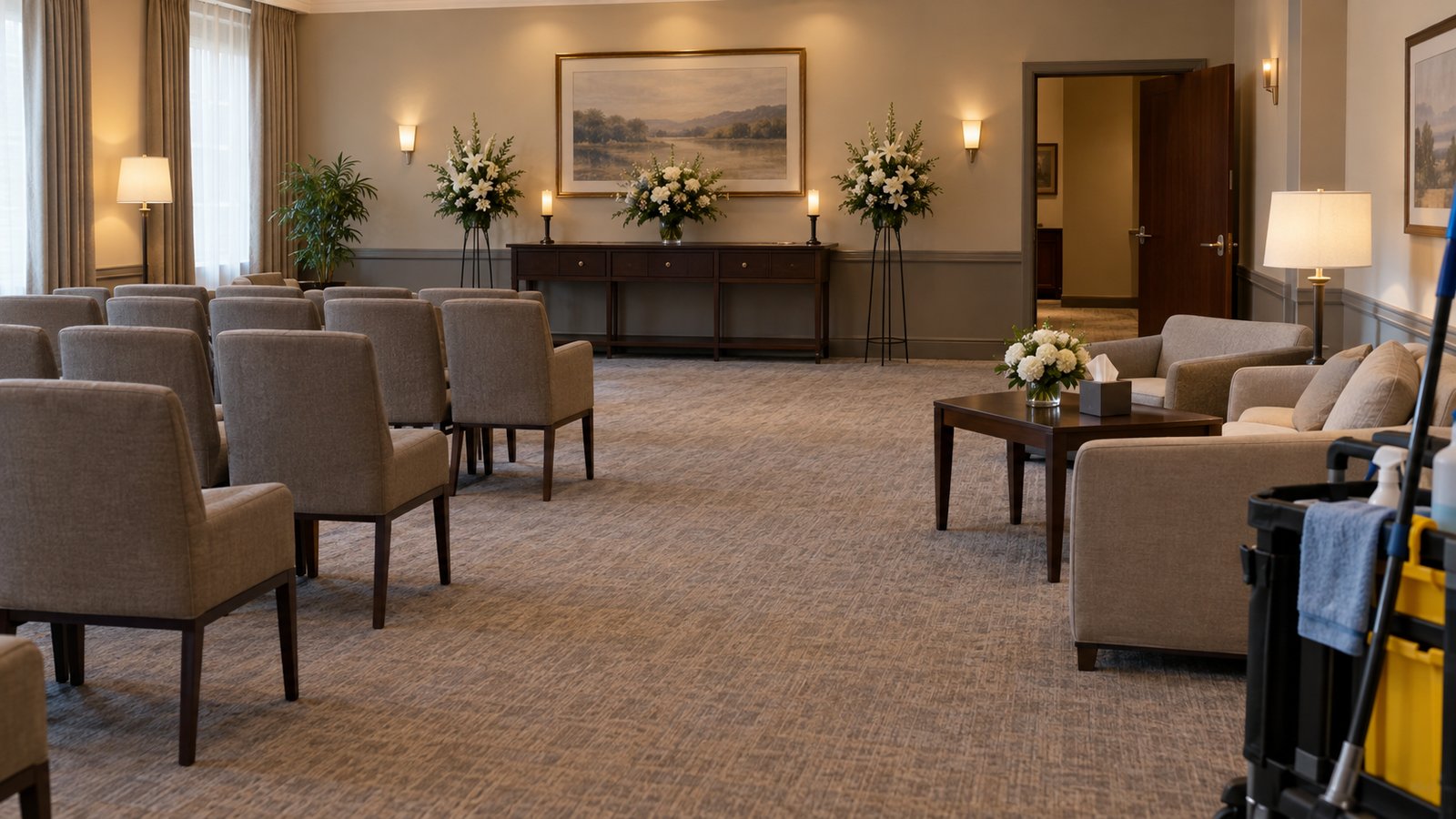
Funeral homes need consistent cleaning delivered with discretion. A family visitation, a private arrangement meeting, a staff workroom, and a restricted preparation area cannot be treated as one generic office route. The provider must understand access, privacy, timing, chemical safety, and the limits of its assigned work. GreenPoint Maintenance Services plans service around the funeral home's calendar, with a written boundary between public rooms and specialized operations. OSHA requirements may apply to specific employee exposures, including formaldehyde in embalming work, but routine janitorial service is not a substitute for the employer's exposure-control program. Call 347-332-9348 to schedule a confidential walkthrough.
Define public, staff, and restricted areas
Start by dividing the facility into reception, visitation rooms, arrangement offices, restrooms, staff areas, preparation rooms, and building support spaces. The funeral director should identify rooms that remain locked, areas that require an escort, surfaces cleaners may touch, and objects that must never be moved. A contractor should not handle records, personal effects, caskets, remains, medical materials, or equipment unless the work is separately authorized, trained, and legally appropriate. GreenPoint Maintenance Services records those exclusions in the scope so that a routine cleaning visit respects the home's professional practices.
A 6,000-square-foot funeral home may have several visitation suites that are used intermittently, while a larger facility in Manhattan, the Bronx, Westchester, Nassau County, Bergen County, or Fairfield County may operate multiple chapels and an event calendar. The number of rooms, not just total square footage, determines how the route should be sequenced. Ask the funeral director or designated manager to provide a room-use schedule, key control method, alarm instructions, and escalation contact. GreenPoint can price a fixed scope after seeing the building and schedule; call 347-332-9348 to request a walkthrough.
Prepare visitation rooms and family-facing spaces quietly
Family-facing rooms should be ready before scheduled arrivals and left undisturbed while services are underway. A pre-event checklist can include visible dust, vacuum or floor condition, table and chair touchpoints, entry glass, restroom supplies, and waste removal. A post-event reset may include high-touch surfaces and floor care after the family has departed and the room has been released by staff. Use soft carts, discreet uniform standards, and agreed routes that do not cross a procession or gathering. Ask before moving flowers, photographs, guest books, or personal belongings; when uncertain, leave the item and report it.
A venue near Fordham Road, Pelham Parkway, the Upper West Side, Park Slope, New Rochelle, Garden City, or Jersey City may have traffic and parking constraints that affect arrival windows. Build buffer time around scheduled services, deliveries, and religious observances rather than sending staff at a fixed hour that could interrupt guests. GreenPoint Maintenance Services can schedule after closing, between services, or in a pre-opening window when the home's calendar allows. A defined point of contact should approve any same-day change. Call GreenPoint at 347-332-9348 to set a service window that protects privacy.
Keep specialized preparation work outside routine janitorial scope
Preparation and embalming rooms require facility-specific procedures and trained personnel. A janitorial company should not enter these rooms or handle materials unless the funeral home has explicitly assessed the task, exposure risks, training, protective equipment, and applicable requirements. OSHA's formaldehyde standard applies to occupational exposure from formaldehyde gas, solutions, and releasing materials. It sets an 8-hour permissible exposure limit of 0.75 parts per million and a 15-minute short-term limit of 2 ppm; the employer is responsible for assessing applicable exposures and required controls. A janitorial vendor should not claim that ordinary cleaning eliminates or measures formaldehyde exposure.
Read the [OSHA formaldehyde standard](https://www.osha.gov/laws-regs/regulations/standardnumber/1910/1910.1048) and consult a qualified safety professional when exposure questions arise. The funeral home's exposure control plan, restricted areas, ventilation, spill response, PPE, and training govern access. GreenPoint's normal scope can focus on public rooms, offices, restrooms, halls, and other approved spaces, with explicit stop-work rules for a spill or exposure concern. This boundary is safer for the funeral home and transparent for procurement. To document restricted-area exclusions in a quote, arrange a GreenPoint walkthrough at 347-332-9348.
Set chemical, bloodborne-pathogen, and incident controls
The home should supply or approve products, labels, safety data sheets, dilution instructions, storage locations, ventilation requirements, and required gloves or eye protection. Cleaners should never mix products or decant them into an unidentified bottle. If a routine task could expose workers to blood or other potentially infectious materials, the employer must evaluate the task under applicable rules and establish the appropriate training and work practices. An unplanned spill, sharp, unknown residue, or exposure event is a stop-work and escalation condition, not an invitation for an untrained cleaner to improvise.
GreenPoint trains staff to follow the approved chemical list and report an exception through the supervisor. Use a written matrix for room, product, cloth or mop, PPE, wet contact time, and storage. Keep supplies in a locked or controlled location so they are not visible in guest areas. Our [OSHA cleaning-chemical safety guide](/blog/osha-cleaning-chemical-safety-ghs-sds/) and [commercial cleaning company insurance requirements](/blog/cleaning-company-insurance-requirements/) can help managers prepare vendor questions. For a confidential review of the approved task list, call GreenPoint Maintenance Services at 347-332-9348.
Protect privacy through access, scheduling, and conduct rules
Discretion is an operating requirement, not a slogan. A written onboarding checklist can cover background-screening expectations, uniform and badge standards, phone and photography restrictions, key custody, alarm codes, guest interaction, lost property, incident reporting, and confidentiality. Limit access credentials to assigned staff and establish a process for temporary substitutes. Do not allow a cleaner to photograph guests or service details; JaniTrack images should be limited to approved work surfaces and kept out of private family or case information. GreenPoint can set photo boundaries with management before a digital verification route goes live.
A supervisor should confirm arrival and departure, contact the funeral director when a room is occupied, and avoid unnecessary conversation with guests. If a private service runs late, the cleaner should pause rather than enter. For multi-location operators across New York, New Jersey, and Connecticut, a shared training standard can be paired with site-specific instructions for entrance routes, parking, and lockup. Fixed pricing should identify the normal schedule, holiday adjustments, emergency requests, and the approval method for additional work. GreenPoint does not charge hidden hourly fees for the agreed scope; call 347-332-9348 for a written quote.
Document readiness and manage quality discreetly
The best audit is useful without drawing attention. Define visible outcomes for each room, such as floor condition, dust on specified ledges, restroom supplies, waste removal, and the status of a reported maintenance issue. A checklist should show whether a room was occupied, inaccessible, or held by the funeral director. An exception log protects the privacy of families by recording only the operational detail needed to fix the issue. Managers can review completion and recurring complaints without collecting unnecessary personal data or revealing service schedules to unauthorized staff.
JaniTrack can provide timestamped, GPS-tagged photos and task status for GreenPoint-assigned work, but management controls the approved image locations and retention expectations. Photos should not capture guests, service materials, documents, or sensitive spaces. GreenPoint Maintenance Services reports 98% client retention and offers fixed pricing with no hidden fees; buyers should verify references and written privacy controls before award. See our [quality assurance program guide](/blog/quality-assurance-commercial-cleaning-program/) and [how to choose a commercial cleaning company](/blog/how-to-choose-commercial-cleaning-company/) for vendor review questions. Call GreenPoint at 347-332-9348 to review a private-room inspection plan.
During onboarding, ask the funeral home's manager to walk the crew through a normal day and a day with overlapping services. Agree on what happens when a room is occupied, a family arrives early, a service runs late, or a public entrance must be kept clear for a procession. Provide an escalation contact who can respond after hours, and make sure the substitute supervisor has the same access limits as the regular lead. The cleaner should be trained to pause, step back, and notify management rather than ask a family member for permission or enter a room to finish a checklist. This small operational rehearsal can prevent an avoidable privacy breach.
A useful quality scorecard is intentionally short. It can track whether scheduled rooms were accessible, whether the entry and public restrooms met the agreed presentation standard, how quickly a reported issue received a response, and whether any access rule was violated. Do not rank employees on the number of rooms they can enter or reward a photo count that encourages unnecessary images. Keep the measure tied to outcomes and privacy. GreenPoint Maintenance Services can review results with the funeral director at a monthly check-in, identify a recurring need for more time or an adjusted visit window, and document agreed changes before they become part of the recurring quote. Keep guest names, service details, and family information out of routine performance reports; use room codes and operational notes instead.
Frequently asked questions
Can a janitorial crew clean a preparation room? Only when the funeral home specifically authorizes the scope, verifies training and exposure controls, and determines that the work is appropriate. Many routine contracts expressly exclude preparation and embalming areas.
How should a funeral home schedule cleaning around services? Tie the schedule to the room calendar and set a release contact. Use pre-opening or post-service windows, with a clear rule that staff pause and notify management if a room is occupied.
Does OSHA's formaldehyde limit apply to every cleaner in a funeral home? The standard applies to occupational exposure to formaldehyde, but whether a particular janitorial task creates exposure must be assessed by the employer. A general cleaning contract does not establish exposure compliance.
What privacy requirements should be in a vendor contract? Address screening, access credentials, phones and photos, guest interaction, key custody, incident reporting, confidentiality, substitute staffing, and limits on data collected by a verification app.
What should a funeral-home cleaning quote include? List rooms and exclusions, approved tasks, visit windows, event changes, supplies, supervision, access procedures, incident contacts, photo boundaries, periodic work, insurance, and the fixed-price change process.
GreenPoint Maintenance Services provides discreet, fixed-price commercial cleaning with JaniTrack verification configured around privacy boundaries and a 98% client retention rate. Call 347-332-9348 to schedule a confidential funeral-home walkthrough and written scope.