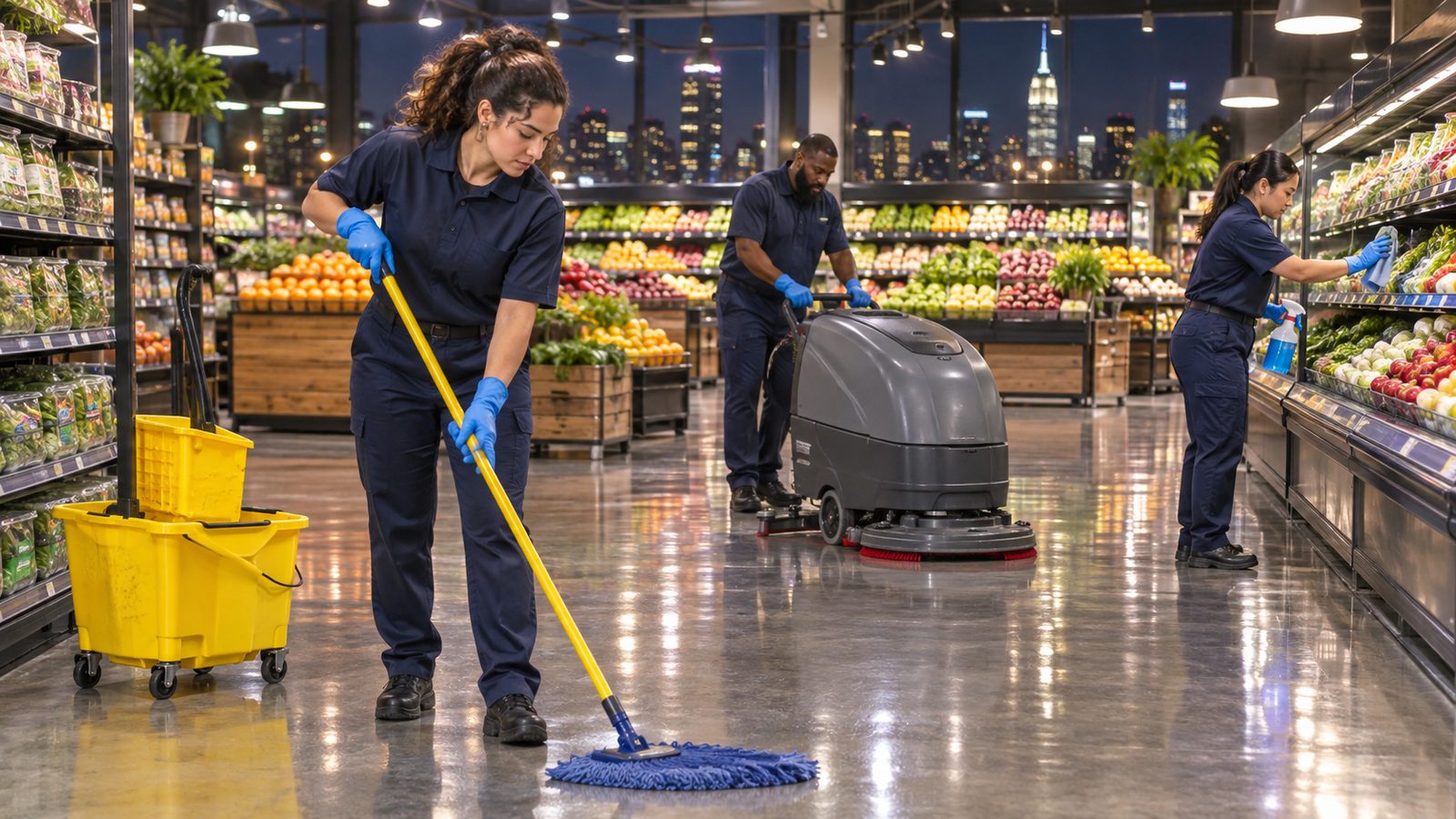
Grocery store cleaning in New York City must support continuous customer traffic, food-protection practices, deliveries, refrigeration, and rapid response to spills. A supermarket's sales floor is only one part of the scope: entrances, produce, checkout lanes, restrooms, receiving areas, staff rooms, and waste zones all need defined owners and schedules. GreenPoint Maintenance Services works with facility teams to map those tasks, agree on proof of service, and set predictable fixed pricing. Call 347-332-9348 to schedule a store walkthrough before requesting a quote or changing vendors.
Divide the store into food, customer, and back-of-house zones
Create a floor plan for entrances and vestibules, produce, bakery, deli, seafood, meat, dry grocery, checkout lanes, customer restrooms, offices, staff rooms, receiving, cold storage, and waste handling. Note which surfaces contact food, which are customer-touchpoint surfaces, and which are floors or building finishes. A 25,000-square-foot neighborhood market with a busy prepared-food counter may have a different risk profile from a 60,000-square-foot supermarket with larger aisles and more receiving activity. Record hours, delivery times, floor materials, drains, and water access.
Local conditions change by borough and neighborhood. A store near Fordham Road in the Bronx, Roosevelt Avenue in Queens, Fulton Street in Brooklyn, or 125th Street in Manhattan may have a different pedestrian rush, delivery access, and sidewalk-soil pattern. A location near Atlantic Terminal or Jackson Heights–Roosevelt Avenue can see clustered transit arrivals, while a neighborhood grocery may draw steady local foot traffic all day. GreenPoint Maintenance Services asks the manager to identify the busiest hour, receiving entrance, and public spill-response route. For related planning, see restroom cleaning best practices for high-traffic locations and commercial cleaning cost per square foot.
Separate routine janitorial work from food-safety duties
The contract should state whether cleaners handle floors, public restrooms, lobby glass, waste, non-food-contact counters, or any back-room tasks. Food-contact equipment and preparation surfaces often belong to trained store employees under the store's food-safety program; do not assume a general janitorial scope includes them. Name who cleans slicers, cutting boards, display cases, drains, refrigeration interiors, and cooking equipment, and confirm any manufacturer or health-department procedures. The buyer should obtain approval from the store's food-protection lead before adding a task that touches food or food-contact surfaces.
The New York City Health Code, including Article 81's food-service rules, and the store's own food-protection plan may be relevant depending on the operation and task. The store's compliance lead should identify which requirements apply to its specific permits, food areas, and staff. A janitorial contractor should not represent that routine floor cleaning alone satisfies food-code requirements. GreenPoint can document scope boundaries and handoffs, including how to isolate a cleaning task from food preparation and how to notify management when a spill, pest sign, damaged tile, or drain concern is observed.
Schedule work around customer flow, deliveries, and store hours
A workable plan typically combines scheduled cleaning with a response process for unscheduled spills. Define who monitors entrance mats, checkout zones, restrooms, and beverage areas during open hours, and who covers more intensive floor work after close. Identify aisle closures, wet-floor signage, drying time, and an alternate accessible customer route. If overnight cleaning is used, state when deliveries, stocking, refrigeration checks, and store opening preparation take priority. A 6 a.m. receiving window should be visible on the schedule, not discovered after a crew blocks a dock.
Build a frequency chart by risk and use. For planning, a high-traffic restroom may need scheduled checks several times per shift, entrance mats may need attention during rain or snow, and lower-traffic offices may be serviced once daily or less. Those are examples to validate against sales volume, staffing, weather, and inspection history. GreenPoint Maintenance Services can propose separate porter and evening tasks so a store does not pay overnight staff to solve every daytime issue. To arrange a quote, call 347-332-9348 and include the store's opening hours and delivery calendar.
Control slip, trip, chemical, and equipment risks
Spills and wet floors are operational safety concerns. Establish who places warning signs, how an area is isolated, how customers are routed around it, and who verifies the floor is dry before reopening. OSHA's Walking-Working Surfaces rules address workplace hazards, and employer responsibilities depend on the circumstances and worksite. The vendor and store should coordinate training, incident reporting, footwear, equipment inspection, and safe use of cords and hoses. Cleaners should know when to stop and report a hazard rather than improvising around electrical equipment or a refrigeration leak.
For chemicals, require product labels, safety data sheets, dilution instructions, approved storage, PPE, and no-mixing rules. OSHA Hazard Communication addresses employee access to chemical hazard information. Keep cleaning chemicals segregated from food and food-contact materials according to store policy and applicable rules, and never store them in unlabeled beverage containers. GreenPoint uses Green Seal certified products where appropriate but verifies food-area restrictions, surface compatibility, and label directions with the client. Identify who authorizes a product change and how staff learn about it.
Document inspections, incidents, and corrective action
Define an inspection routine for floors, restrooms, entries, waste areas, and high-touch public zones. A usable form records time, location, observable condition, action taken, and who closed the issue. Separate a missed task from a maintenance defect, pest observation, stockout, or food-safety concern so the correct manager responds. Set response times by severity; a customer-area spill may need immediate attention, while a scheduled detail task can follow the normal shift. Review trends weekly or monthly rather than relying on a general satisfaction rating.
JaniTrack, GreenPoint's verification system, can connect timestamped, GPS-tagged photos and inspection notes with a live dashboard. Photos should be limited to appropriate areas and avoid people, payment screens, security monitors, and business-sensitive information. ATP testing may be used for selected surface-monitoring programs, but it does not identify a pathogen and cannot stand in for a food-safety inspection or correct disinfectant process. GreenPoint reports a 98% client-retention rate; request examples of inspection records and how a repeated miss leads to coaching, schedule changes, or corrective work.
Compare vendor price and staffing assumptions
Ask bidders to price the same zones, days, shifts, porter coverage, response expectations, equipment, supplies, periodic floor work, and exclusions. Specify whether consumables such as restroom paper and liners are provided by the store or vendor. Identify whether floor stripping, machine scrubbing, drain work, high dusting, post-construction cleanup, and exterior pressure washing are in the base agreement or priced separately. A square-foot estimate should be understood alongside traffic, restroom fixture count, food-area restrictions, and the number of service checks.
GreenPoint Maintenance Services Corp uses fixed pricing with no hourly billing and no hidden fees; the quote should identify assumptions and a written process for changes in store hours, footprint, or task frequency. Verify insurance, workers' compensation, training, references, and supervision for overnight and daytime work. GreenPoint is MBE/MWBE certified with NYS, NYC, and NYC DOE programs and registered in SAM.gov; buyers should confirm current documents and their relevance to the bid. For contract language, see commercial cleaning contract key terms and how to choose a commercial cleaning company.
Ask how the proposed team handles equipment and floor compatibility. A store may have polished concrete, resilient tile, quarry tile, sealed wood, or coated surfaces with different care instructions. Identify manufacturer guidance, finish history, drains, and areas where water must be limited. Request a periodic-maintenance calendar with the method and expected downtime, especially for checkout lanes and food-adjacent routes. Do not accept a promise to 'deep clean everything' without a list of surfaces and tasks. GreenPoint can map routine work separately from scheduled machine scrubbing, carpet extraction, and post-renovation service so store management can approve cost and timing in advance.
Plan onboarding, coverage, and seasonal adjustments
Before launch, coordinate the vendor's first service day with the store manager, night operations lead, and food-protection contact. Confirm badges, alarm codes, approved-product list, storage, receiving access, equipment, and who can authorize a floor closure. Identify a backup supervisor and the process for an unfilled shift. A joint opening inspection can record the initial condition of floors, mats, restrooms, and waste areas, making future service reviews more specific than a general satisfaction score.
Adjust the schedule when the store changes hours, remodels a department, opens a new prepared-food counter, or enters a heavy seasonal period. A small increase in produce or beverage traffic can make a previously adequate spill-response route too slow. Use sales and incident patterns together with inspection data to determine whether to add a porter check, change a task interval, or ask the store to repair a surface. Keep each scope adjustment dated and authorized so the monthly invoice remains understandable.
A site review is the most reliable way to turn those operational details into a quote. GreenPoint Maintenance Services can walk the sales floor, public areas, receiving path, and waste room with store leadership, then identify inclusions and exclusions in writing. Call 347-332-9348 to book the walkthrough and request sample JaniTrack inspection evidence before choosing a contractor.
Frequently asked questions about grocery-store cleaning
Q: How often should grocery-store restrooms be cleaned? A: Set the interval using traffic, fixture count, opening hours, and inspection results. Use a documented check schedule and record service rather than choosing one frequency for every store.
Q: Should a janitorial vendor clean food-contact surfaces? A: Only when the store assigns that task, approves the method and product, and confirms staff training and food-safety procedures. Many stores keep those tasks with trained department employees.
Q: What should a supermarket cleaning quote include? A: List areas, shift coverage, daytime response, task frequencies, supplies, equipment, periodic work, inspection records, safety controls, exclusions, and change-order rules.
Q: Can a grocery store be cleaned while it is open? A: Yes, if the route, barriers, signs, staff training, and customer access plan make the work safe and operationally acceptable. High-impact floor work is often scheduled for lower-traffic periods.
Q: Does ATP testing prove a grocery store is pathogen-free? A: No. ATP can be one indicator of organic residue under a defined protocol, but it does not identify pathogens or replace food-safety controls and inspections.
Schedule a grocery-store walkthrough with GreenPoint Maintenance Services at 347-332-9348 or info@greenpointms.com. GreenPoint can scope daytime response, night service, approved-product controls, and JaniTrack verification under fixed pricing, backed by a reported 98% client-retention rate.