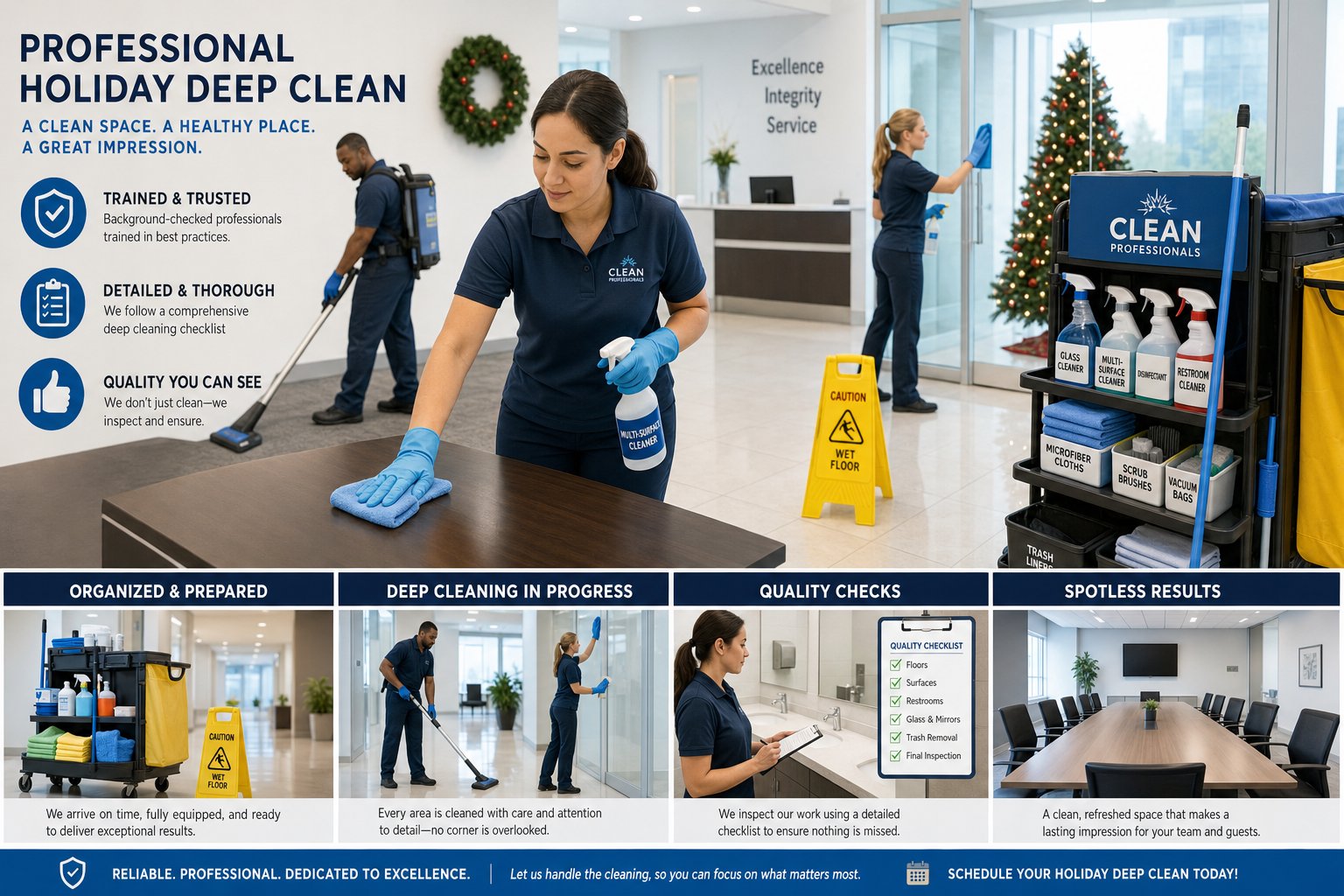
A holiday deep cleaning project is most valuable when it is planned as a controlled facility reset, not a last-minute race to empty trash. Closures create an opportunity to reach carpet edges, high surfaces, kitchens, restrooms, floors, storage, and overlooked transition areas. GreenPoint Maintenance Services coordinates commercial deep cleaning across NY, NJ, CT, PA, and FL so owners can reopen with a documented, safe, and realistic handoff.
Choose the Closure Window and Scope
Start with the actual closure calendar: tenant move-out dates, school recess, production shutdowns, staff holidays, security coverage, and the first day of reopening. A Manhattan office near Rockefeller Center may have a short quiet window even when the tenant calendar says “closed.” A Long Island warehouse may operate around shipping cutoffs, while a Florida facility may remain open through the holidays. Define the accessible hours before selecting tasks.
Divide the project into must-have reset work, periodic maintenance, and optional restoration. Must-have work protects reopening: waste removal, restrooms, kitchens, high-touch points, floors, and safety routes. Periodic work may include carpet extraction, VCT care, high dusting, or interior glass. Restoration is separate and may require specialized equipment. GreenPoint uses a walkthrough to convert that list into a fixed scope rather than an open-ended hourly commitment.
Inspect Before Moving Furniture
A pre-project inspection should record floor finishes, carpet condition, furniture density, wall protection, access restrictions, water sources, electrical points, loading paths, and existing damage. Photograph conditions before work so the owner and cleaning team share the same baseline. Identify sensitive equipment, artwork, tenant property, confidential records, and areas that remain occupied.
GreenPoint Maintenance labels the work zones and assigns a sequence that limits rework. If a floor is scheduled for finish work, complete high dusting and wall-edge cleaning first. If carpet extraction is planned, coordinate furniture moves and drying time. A StockPoint record can capture timestamped GPS-tagged photos and open issues. See [post-construction cleaning phases explained](/blog/post-construction-cleaning-phases-explained/) for a similar phased approach.
Reset Entrances, Lobbies, and Common Areas
Holiday traffic leaves soil at the front door, mat edges, vestibules, elevator tracks, lobby corners, and stair landings. Vacuum or clean mats according to their construction, remove edge buildup, wipe accessible high-touch points, and clean under movable furniture. Check salt, grit, and moisture controls in NY, NJ, CT, and PA; in Florida, check sand, humidity, and storm-related residue.
High-visibility areas deserve a final inspection under the building’s actual lighting. GreenPoint supervisors look for streaks, cloudy glass, missed baseboards, residue, wet-floor risks, and furniture returned out of alignment. A polished lobby is not proof that back-of-house areas were reset, so the route should include loading docks, service corridors, waste rooms, and staff spaces.
Restore Floors and Carpets Safely
Select floor care by material and condition. VCT may need stripping, sealing, and finishing; tile may need scrubbing and grout attention; stone requires compatible products and methods; carpet requires fiber-appropriate extraction or low-moisture care. Do not use a one-size-fits-all chemical. Confirm dwell time, ventilation, slip resistance, drying time, and manufacturer restrictions.
GreenPoint can schedule carpet cleaning and floor work in phases so one route remains passable. Use barriers and signage, control extension cords, and keep occupants away until the surface is safe. Fixed pricing with no hourly billing and no hidden fees makes it easier to compare a holiday project with a recurring janitorial scope. Call 844-814-0810 for a quote that separates restoration from routine service.
Deep-Clean Kitchens, Break Rooms, and Restrooms
Shared kitchens need degreasing and residue removal around counters, appliance exteriors, sinks, cabinet fronts, floors, and waste points. Keep food-contact surfaces on the approved product and rinse plan. Restrooms need fixtures, partitions, dispensers, floors, drains, touch points, and odor-source review. Use dedicated, color-coded microfiber tools to prevent restroom equipment from entering food areas.
If a facility serves children, patients, or the public, coordinate product selection, access, and reopening checks with the responsible manager. GreenPoint follows labels, SDS guidance, and client-approved procedures; it does not improvise around sensitive populations. The supervisor records missed repairs such as leaking faucets, failed dispensers, cracked grout, or damaged caulk for the owner to address.
Use the Shutdown for High-Level and Detail Work
A closure is the right time to consider tops of lockers, partition caps, light coves, accessible vents, door frames, radiator covers, storage tops, and areas behind equipment. Evaluate access and fall protection before adding elevated work. The correct method may require a lift, a specialty crew, or a building engineer. Never turn a cleaning schedule into an unplanned height or electrical hazard.
GreenPoint Maintenance provides a task boundary and escalation path. The crew can document accessible high dusting and report areas that need owner-provided access. In buildings near Penn Station, PATH, SEPTA, or busy retail corridors, the quiet window may be shorter than expected, so a priority map helps the team complete the highest-value work first.
Plan Safety, Security, and Handoff
Holiday work often occurs with fewer building staff available. Confirm keys, badges, alarms, elevator reservations, loading access, emergency contacts, incident reporting, and the person who accepts the completed work. Protect confidential documents and tenant property. Document any pre-existing damage and keep chemical storage secured. OSHA-aligned training should cover slips, trips, PPE, chemicals, lifting, and powered equipment.
At handoff, provide a concise completion summary: zones serviced, periodic tasks completed, open repairs, floor or carpet drying status, photos, inspection results, and recommended follow-up. StockPoint can provide live status during the project and evidence after completion. GreenPoint’s 98% client retention comes from making reopening predictable, not from declaring every project perfect without proof.
Budget and Staff the Project
Estimate labor from square footage, access, soil, floor types, furniture density, project hours, equipment, consumables, supervision, and drying constraints. A 20,000-square-foot office with dense workstations can require more detail time than a 40,000-square-foot open warehouse. Separate recurring service, project cleaning, floor restoration, and specialty access so bids are comparable.
GreenPoint offers fixed pricing with no hourly billing and no hidden fees. A walkthrough can identify where a second shift, porter, or specialty technician is genuinely needed. Call 844-814-0810 or email info@greenpointms.com with the address, square footage, closure dates, floor types, and required handoff date. GreenPoint can build a practical schedule across the tri-state area and Florida.
Adjust for Local Conditions
For New York City, plan around tenant access, building rules, and winter salt entering from sidewalks and transit hubs. In Westchester, Long Island, New Jersey, Connecticut, and Pennsylvania, include parking lots, vestibules, and snow or rain transitions. In Florida, include humidity, sand, storm debris, and faster response after water intrusion. Local building and health requirements remain the owner’s responsibility, while GreenPoint operationalizes the approved cleaning scope.
Schools may need coordination with NYC DOE or district calendars and product rules. Medical offices need patient-safe scheduling and infection-prevention coordination. Retail and hospitality properties need guest-facing routes and after-hours security. GreenPoint Maintenance Services can walk the site, confirm the constraints, and document what will be ready before reopening.
A reopening checklist should be as deliberate as the cleaning itself. Confirm that floors are dry, equipment is returned, wet-floor signs are removed only when safe, emergency exits remain clear, waste is removed, chemical containers are secured, and open repairs are assigned. Walk the most visible routes with the building contact before tenants return, then keep a short list of items that can be completed without delaying occupancy. GreenPoint can pair the project with [commercial cleaning cost per square foot](/blog/commercial-cleaning-cost-per-square-foot/) so the owner sees which tasks are recurring, periodic, or one-time. This transparency helps procurement compare proposals and prevents a “deep clean” label from hiding different assumptions about furniture moves, floor restoration, high-level work, or after-hours security.
Build a contingency into the calendar for delayed deliveries, a wet floor that needs extra drying time, a locked room, or a repair discovered during detail work. A one-day buffer is often less expensive than rushing a floor project or reopening before a safety check is complete. GreenPoint’s supervisor can report the exception immediately, propose a safe sequence, and preserve the highest-priority reopening tasks even when the original plan changes.
Ask for a post-project decision on the recurring schedule. Some work belongs every day, some every week, and some once or twice a year. If the holiday project reveals heavy buildup behind a break-room appliance or repeated salt damage at a vestibule, document the recommended frequency and estimated impact. GreenPoint can update the service plan after the walkthrough so next year’s closure is planned from real evidence rather than memory.
For a portfolio, rank buildings by reopening risk and work backward from the earliest tenant arrival. Keep one shared checklist for documentation, then add site-specific pages for loading access, security, floor materials, and emergency contacts. This makes it easier for an owner to compare a Manhattan tower, a Brooklyn office, a Connecticut school, and a Florida property without forcing every location into the same work sequence. A short manager sign-off confirms that the plan matched the actual handoff.
FAQ: Holiday Commercial Deep Cleaning
Q: How far in advance should a facility book a holiday deep clean? A: Start as soon as closure dates and access rules are known. Earlier planning gives the team time to reserve equipment, coordinate floor drying, and sequence multiple buildings.
Q: What should be included in the final handoff? A: Include completed zones, periodic tasks, inspection results, photos or dashboard evidence, open repairs, drying or access restrictions, and the name of the person accepting the work.
Q: Can GreenPoint clean while some staff remain onsite? A: Often yes, but the scope and sequence should separate occupied areas from closure work. Call 844-814-0810 so the walkthrough can identify safe service windows and access controls.
Q: Is floor stripping always part of a holiday deep clean? A: No. Floor care depends on material, finish, traffic, condition, and owner goals. It should be priced as a defined periodic task, not assumed inside every deep-clean package.
Q: How can I get a fixed quote? A: Email info@greenpointms.com or call 844-814-0810 with location, square footage, closure dates, floor types, and reopening deadline. GreenPoint will schedule a walkthrough and document the assumptions.
Plan a holiday facility reset with GreenPoint Maintenance Services at 844-814-0810. GreenPoint serves NY, NJ, CT, PA, and FL with fixed pricing, StockPoint verification, Green Seal certified products, MBE/MWBE credentials, and 98% client retention.