In NYC hospitality, cleaning is part of the brand experience. Guest reviews mention fingerprints on elevator buttons, odors in corridors, and the shine of the lobby floor as often as the room size. The decision most operators face is not “clean or not,” but who should clean what: in-house housekeeping, a contract cleaning partner, or a hybrid model. This guide breaks down where each approach performs best in Manhattan, Brooklyn, Queens, the Bronx, and Staten Island—and how GreenPoint Maintenance Services can document results with StockPoint verification, ATP testing options, and fixed-price transparency. For a walkthrough and quote, call 844-814-0810 or email info@greenpointms.com.
What counts as hotel cleaning in NYC (and why the split matters)
Hotel cleaning is really two different operations: (1) guest-room turnover (beds, bathrooms, linen, amenities) and (2) public-area and back-of-house hygiene (lobby, elevators, corridors, restrooms, meeting rooms, staff areas, loading docks, and sometimes kitchens). Housekeeping teams are optimized for room turns and guest interaction. Contract cleaning teams are typically optimized for public-area cadence, deep cleaning, floor care, and higher-footfall zones where consistency matters more than speed per room. In NYC, that split affects labor coverage, scheduling, supply control, and accountability—especially when you are managing late checkouts, early arrivals, and unpredictable occupancy swings.
When in-house housekeeping is the right answer
In-house housekeeping usually wins when your primary need is fast, repeatable guest-room turns under tight check-in/check-out windows. Your internal team knows your brand standards, minibar and amenity procedures, and the “micro-expectations” that vary by property (pillow placement, towel folding, room scent, and how to stage work carts in narrow Manhattan corridors). In-house is also a strong fit when you want direct daily management control, cross-training across laundry or runner duties, and immediate staffing decisions based on occupancy. If most cleaning scope is guest rooms, an internal team often delivers better operational flow than rotating third-party room attendants.
When contract cleaners outperform (public areas, audits, and the “always-on” zones)
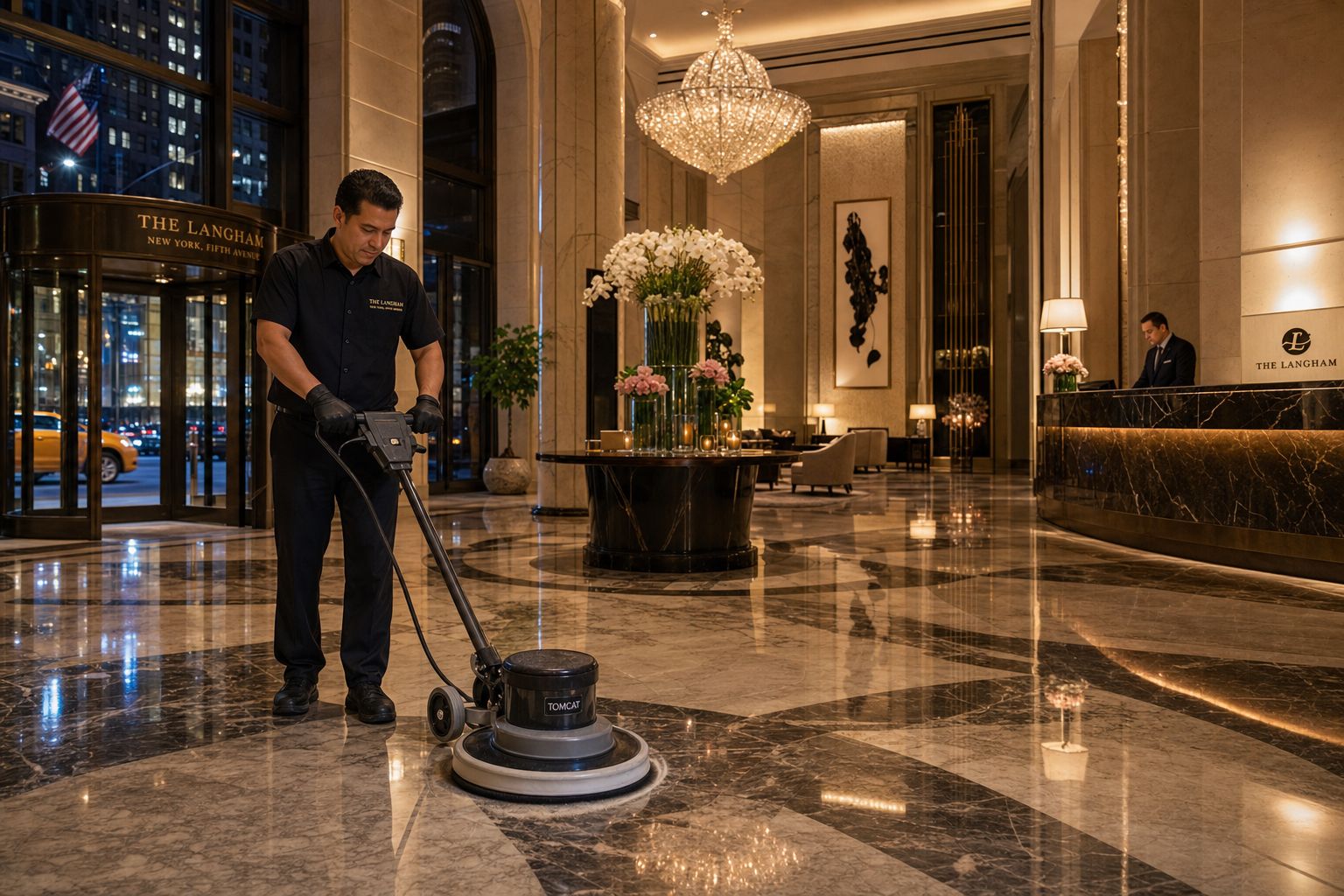
Contract cleaning tends to outperform in areas that must look “show-ready” all day: lobby floors, elevator cabs, glass, high-touch surfaces, public restrooms, and meeting/event spaces. These zones are impacted by foot traffic from transit-heavy hubs like Penn Station, Grand Central, Port Authority, Fulton Center, and major subway transfers, where dirt load and touch frequency are high. A contract team can be scheduled in split shifts (early AM polish, daytime maintain, late-night reset) without pulling room attendants away from turns. GreenPoint Maintenance Services frequently supports hotels with daytime porter service, restroom checks, and continuous lobby/elevator touch-up while your in-house team stays focused on rooms. For a fixed-price proposal, call 844-814-0810.
NYC hotel use-cases where hybrid staffing is the best model
A hybrid model is common in Midtown and Downtown Manhattan: housekeeping owns guest rooms; a contract partner owns public areas, night cleaning, and specialty tasks. Examples: (1) overnight lobby and corridor reset to protect guest experience during daytime check-ins; (2) quarterly carpet extraction in guest-room corridors; (3) floor-care programs (VCT, LVT, stone, polished concrete) that require equipment and process discipline; (4) post-construction cleaning after room refreshes; and (5) seasonal traffic spikes tied to conventions at Javits Center or events near Madison Square Garden and Barclays Center. Hybrid staffing reduces burnout, improves quality consistency, and limits “scope creep” because responsibilities are clearly assigned.
Guest rooms vs public areas: different standards, different risks
Guest-room cleaning is judged by the guest and by brand QA. Public-area cleaning is judged by everyone—guests, visitors, vendors, inspectors, and online reviewers passing through. Public restrooms are especially sensitive: odors, wet floors, empty soap, and smudged mirrors quickly become reputational issues. Safety risk is also different: lobby slip-and-fall exposure increases during rain and snow days, and NYC entrance mat programs matter (think heavy slush at street-level properties near subway entrances). A contract team can run documented mat rotations, salt-neutralizer floor washes, and frequent restroom touchpoints. For broader facility standards, see GreenPoint’s related guidance on [restroom cleaning best practices for high-traffic](/blog/restroom-cleaning-best-practices-high-traffic/) and [commercial cleaning cost per square foot](/blog/commercial-cleaning-cost-per-square-foot/).
Evidence-based cleaning: what property leaders can measure
Hospitality leaders increasingly want proof, not promises. Industry bodies like ISSA emphasize standardized processes and inspection-driven quality control, and many operators use checklists plus periodic audits to keep performance stable across shifts. GreenPoint Maintenance Services adds verification tools through StockPoint: timestamped, GPS-tagged photo evidence, optional ATP testing for targeted areas, and a live dashboard so managers can see that critical tasks happened on schedule. This is especially valuable for public areas that are hard to supervise continuously—like service corridors, stairwells, and staff break rooms. If you want a measurable quality program instead of anecdotal feedback, schedule a walkthrough at 844-814-0810.
Compliance, safety, and chemical handling in busy NYC hotels
Hotels face real safety constraints: chemicals must be labeled and stored correctly, teams must understand Safety Data Sheets (SDS), and staff need consistent PPE habits in high-pace environments. OSHA’s Hazard Communication expectations apply when crews handle disinfectants, degreasers, and specialty floor products—especially when work occurs around guests, banquet staff, and deliveries. If you run kitchens or have food service, you also need strict separation between front-of-house aesthetics and back-of-house sanitation routines. GreenPoint uses Green Seal certified products where appropriate and builds GHS/SDS compliance into onboarding and site training. (Related: [OSHA cleaning chemical safety: GHS and SDS](/blog/osha-cleaning-chemical-safety-ghs-sds/) and [fire code chemical storage](/blog/fire-code-cleaning-chemical-storage/).)
Scheduling realities: late-night resets, early-morning polish, and NYC noise rules
NYC hotels often need cleaning outside normal business hours: overnight floor work, early-morning lobby polish before check-outs, and discreet restroom refreshes during events. Your building may also have rules about freight elevator use, loading dock schedules, and noise (especially in mixed-use properties). Contract cleaners can be staffed specifically for night work and specialty tasks without pulling room attendants from turnover. GreenPoint designs scopes with clear “quiet-hour” methods (microfiber detailing, low-noise equipment selection, staged floor sections) and aligns with building management so crews move efficiently without guest disruption. To plan a schedule that fits your property, call 844-814-0810.
Cost control: why fixed pricing beats hourly for hospitality
Hourly cleaning pricing can look cheaper until reality hits: overtime during sold-out weekends, unplanned events, and the constant need for restroom coverage. Fixed pricing and a defined scope reduce budget volatility and make performance easier to manage. GreenPoint Maintenance Services uses fixed pricing—no hidden fees, no “extra hour” surprises—paired with documented deliverables and a quality assurance plan. For operators comparing models, the key question is: what work is guaranteed daily/weekly/monthly, what is on-demand, and how are results verified. If you want a clean scope you can defend in a budget meeting, request a walkthrough at 844-814-0810.
A quick decision framework for NYC hotel operators
Use in-house housekeeping when the majority of your risk is room-turn speed and brand-standard room presentation. Use contract cleaners when the majority of your risk is public-area appearance, restroom readiness, and documented audits across long operating hours. Use a hybrid model when you need both—and when you want your in-house team focused on rooms while a specialist team protects lobbies, elevators, meeting rooms, corridors, and overnight resets. Regardless of model, demand measurable outcomes: inspection scoring, photo verification, and clear SLAs. GreenPoint can support Manhattan, Brooklyn, Queens, the Bronx, Staten Island, and nearby Westchester/Long Island properties with scalable staffing and proof-driven reporting.
Need hotel cleaning coverage that holds up in guest reviews and brand audits? GreenPoint Maintenance Services (MBE/MWBE certified, 98% client retention) builds fixed-price hotel cleaning scopes with StockPoint verification (timestamped, GPS-tagged photos) and optional ATP testing for high-risk areas. Schedule a walkthrough and quote: call 844-814-0810 or email info@greenpointms.com.