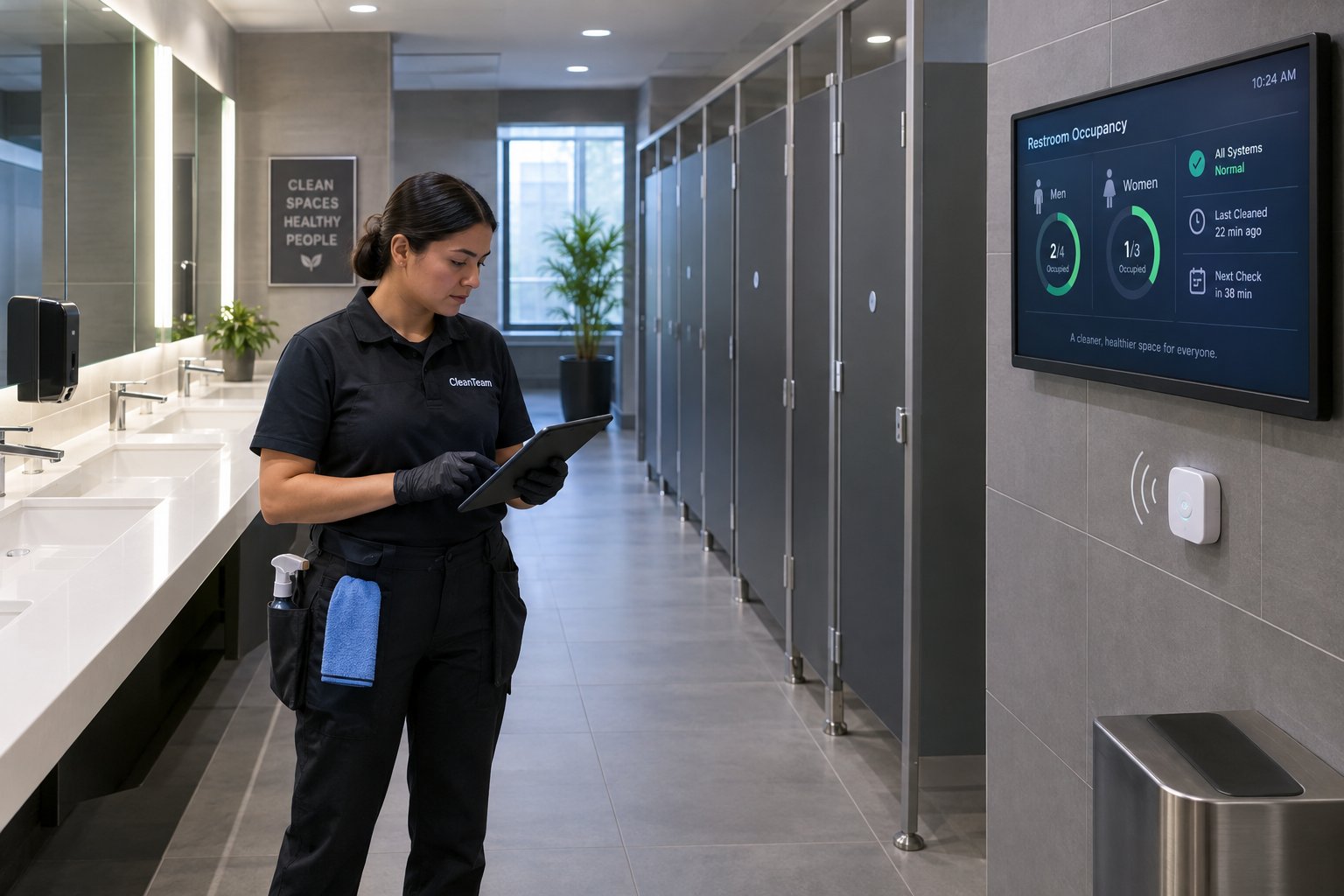
Restroom traffic data can help a facility manager decide when to inspect, restock, or schedule an extra clean, but a sensor count is not the same as a clean restroom. Occupancy, flush, door, dispenser, and odor sensors each measure a narrow event. GreenPoint Maintenance Services combines useful traffic signals with visual inspection, supply checks, touchpoint cleaning, and supervisor review. That distinction matters in a Midtown tower, a Queens school, a Brooklyn retail site, or a Florida office where humidity and peak traffic can change the service need quickly.
What a Restroom Sensor Actually Measures
An occupancy sensor may count entries, dwell time, or an estimated traffic volume; a dispenser sensor may count activations; and a leak or odor sensor may flag a condition. None of these measurements describes every fixture, stall, floor edge, or touchpoint. A facility team should define the decision it wants to make before installing hardware. If the goal is fewer empty soap dispensers, a dispenser-level signal may help; if the goal is overall quality, human inspection remains essential.
Use data to prioritize a route rather than to declare success. The [restroom cleaning best-practices guide](/blog/restroom-cleaning-best-practices-high-traffic/) lays out the physical work that still needs to happen: fixtures, partitions, touchpoints, floors, waste, odor sources, and supplies. GreenPoint's scope can connect a sensor alert to a supervisor check without turning the crew into button-pushers who reset alerts without correcting the condition.
Choose Sensors by Facility and Risk
A 40,000-square-foot office with two restroom banks may benefit from simple occupancy and dispenser data. A stadium, transit-adjacent retail site, hospital clinic, or school may require more frequent checks and stronger privacy controls. Count fixtures, entrances, stalls, sinks, dispensers, and peak windows before buying. GreenPoint recommends a two-week baseline of complaints, supply-outs, inspection results, and labor minutes so the sensor pilot has something to improve.
Privacy and security belong in procurement. Avoid collecting identifiable images or unnecessary device data in sensitive areas; ask where readings are stored, who can access them, how long they are retained, and whether the vendor sells aggregated data. In a NYC DOE or medical setting, coordinate with the privacy and facilities contacts before mounting equipment. Call 347-332-9348 to schedule a walkthrough that maps the service zones without exposing personal information.
Create Traffic-Based Cleaning Triggers
A trigger should lead to a defined action. For example, a restroom may receive an inspection after a traffic threshold, a restock check when a dispenser alert appears, and a full clean at the contracted interval. Do not set one threshold for every building. A 25-person office restroom and a 1,000-person retail restroom have different soil, supply, and response patterns. GreenPoint writes the trigger, expected response time, and escalation owner into the operating plan.
Use a short pilot with normal, peak, and event conditions. Compare sensor-triggered routes with the existing schedule and record whether the extra visit found a real need. If a trigger creates 20 false alarms a day, the program is adding work without improving quality. ISSA appearance-level concepts can help the team describe the desired condition, while the sensor only indicates where a person should look.
Pair Data With Supplies and Touchpoints
The highest-value use of restroom data is often supply continuity. A soap, tissue, towel, or sanitizer shortage is immediately visible to occupants and can undermine confidence even when the fixtures are clean. Sensor alerts should connect to a stocked supply cart, a route checklist, and a closing inspection. GreenPoint can track restock exceptions in JaniTrack and review whether the cause is demand, poor par levels, delayed deliveries, or a dispenser fault.
Touchpoint work still needs a method. Handles, locks, faucet controls, flush buttons, partitions, baby-changing surfaces, and hand-drying controls require an approved product, correct contact time, and clean tools. Color-coded microfiber systems reduce cross-use between restrooms and other zones. A device can suggest timing; it cannot choose the safest product or confirm that the cleaner reached the back of a fixture.
Staffing Around Midtown, Transit, and Campus Peaks
Restroom service must follow people, not just clocks. A tower near Penn Station or Grand Central may peak before work, at lunch, and after events. Downtown Brooklyn and DUMBO properties may see visitor surges, while Astoria, Flushing, or a Bronx campus may have school, retail, or community schedules. A Staten Island or Westchester site may have fewer entries but longer travel between buildings. GreenPoint uses a zone map and traffic pattern to assign day-porter rounds, evening detail, and supervisor checks.
Traffic data can also protect the labor budget. If a low-use restroom receives unnecessary hourly rounds, the manager can shift attention to the high-use bank while preserving a minimum inspection standard. GreenPoint offers fixed pricing with no hourly billing and no hidden fees; the quote can show the base frequency and the optional event or threshold response. Call 347-332-9348 for a site-specific labor review.
Set Alert Ownership and Response Times
Every alert needs an owner, response window, and closure field. A leak alert may go to engineering, a dispenser-out alert to the day porter, and a repeated odor alert to the supervisor and building manager. If an alert cannot be acted on because the room is occupied, the system should record that exception rather than silently reset it. GreenPoint's quality assurance approach keeps the alert, observation, action, and verification together.
The first month should include a daily review of false positives, missed triggers, supply-outs, occupant complaints, and labor impact. Adjust thresholds only after looking at the physical condition. BLS labor data can inform staffing conversations at a high level, but the facility's own route minutes are more useful for its budget. GreenPoint Maintenance Services can report both the data trend and the human decision made from it.
Measure Quality, Not Just Sensor Activity
Useful metrics include inspection completion, supply-out rate, repeat complaints, time to response, verified appearance level, rework, and cost per occupied restroom. Sensor uptime and battery life matter, but they are not service quality. Selected ATP testing may help assess cleaning effectiveness on appropriate surfaces; it should not be treated as a universal hygiene score. JaniTrack can join checklist completion, approved photos, ATP results where relevant, and corrective actions.
A monthly review should ask whether the program changed outcomes. If complaints fell 30% but labor rose 45%, the team needs to redesign the route. If supplies stayed available and response time improved without extra visits, the sensor may be earning its place. GreenPoint's 98% client retention comes from this kind of transparent review rather than from presenting a dashboard as proof by itself.
Write a Practical Sensor Pilot Scope
The pilot scope should cover device types, mounting, network access, data ownership, privacy, battery replacement, calibration, service hours, alert routing, response time, and removal. Include a baseline and a decision date. The [digital cleaning verification systems guide](/blog/digital-cleaning-verification-systems/) explains why data fields and human review should be designed together. GreenPoint can help a client define the cleaning workflow while the sensor supplier owns the hardware commitments.
Start with one restroom bank or one floor, not the whole portfolio. Run the pilot for at least two peak cycles and one quiet period. At the end, document what changed, what did not, and what the sensor could never see. Call 347-332-9348 to schedule a fixed-price walkthrough and build a baseline before purchasing devices.
A useful operating record is concise enough to review and detailed enough to act on. GreenPoint uses a zone map, approved scope, supervisor review, and an exception owner so the client does not have to reconstruct a service event from scattered texts. For a multi-floor Manhattan office, a Bronx campus, or a New Jersey distribution site, the record should identify the exact area, time, task, condition, and next action. GreenPoint Maintenance Services keeps the service conversation tied to evidence instead of vague assurances.
Review the first 30 days as a pilot, even when the contract is intended to run for years. Compare planned labor with actual minutes, look at repeat exceptions, ask occupants which areas fail first, and verify that supplies and access are adequate. If the facility changes its hours, tenant mix, floor finish, or event calendar, schedule a walkthrough rather than asking the crew to absorb new work. Call 347-332-9348 or email info@greenpointms.com when a scope needs to change.
GreenPoint can also separate routine cleaning from periodic work such as carpet extraction, VCT maintenance, high dusting, glass, post-event recovery, and emergency response. That distinction protects the budget and helps a facility manager compare vendors on the same basis. Fixed pricing means the agreed scope is visible, with no hourly billing and no hidden fees. GreenPoint's MBE/MWBE certifications, SAM.gov registration, and Green Seal certified product options can be documented during procurement.
For quality assurance, GreenPoint uses JaniTrack where the site approves it: timestamped GPS-tagged photos, selected ATP testing, checklist completion, supervisor review, and a live dashboard. The system is not a substitute for a trained person or a manufacturer instruction, but it gives a manager a practical way to see exceptions and closure. GreenPoint's 98% client retention is supported by this feedback loop and by correcting recurring conditions instead of merely closing tickets.
Frequently Asked Questions
Do restroom sensors replace cleaners? No. Sensors identify events or conditions; cleaners still inspect fixtures, remove soil, restock supplies, clean touchpoints, and respond to exceptions.
Are restroom traffic sensors a privacy risk? They can be if they collect unnecessary images or identifiable data. Prefer non-imaging counts, limited retention, access controls, and review by the facility's privacy and security contacts.
How often should a high-traffic restroom be checked? Use a baseline schedule plus traffic or event triggers. Transit-adjacent, retail, school, and stadium sites may need checks more often than a low-use office restroom.
Can JaniTrack connect with sensor-based service? GreenPoint can record sensor-triggered tasks, inspection outcomes, approved photos, supply exceptions, and supervisor closure in JaniTrack where the client approves the workflow.
How do I price a smart-restroom pilot? Call 347-332-9348 for a walkthrough. GreenPoint can separate the fixed cleaning scope from device, network, installation, and optional response costs.
Call GreenPoint Maintenance Services at 347-332-9348 or email info@greenpointms.com to schedule a facility walkthrough and fixed-price quote. GreenPoint combines trained local teams, Green Seal certified product options, and JaniTrack verification with a 98% client retention rate.