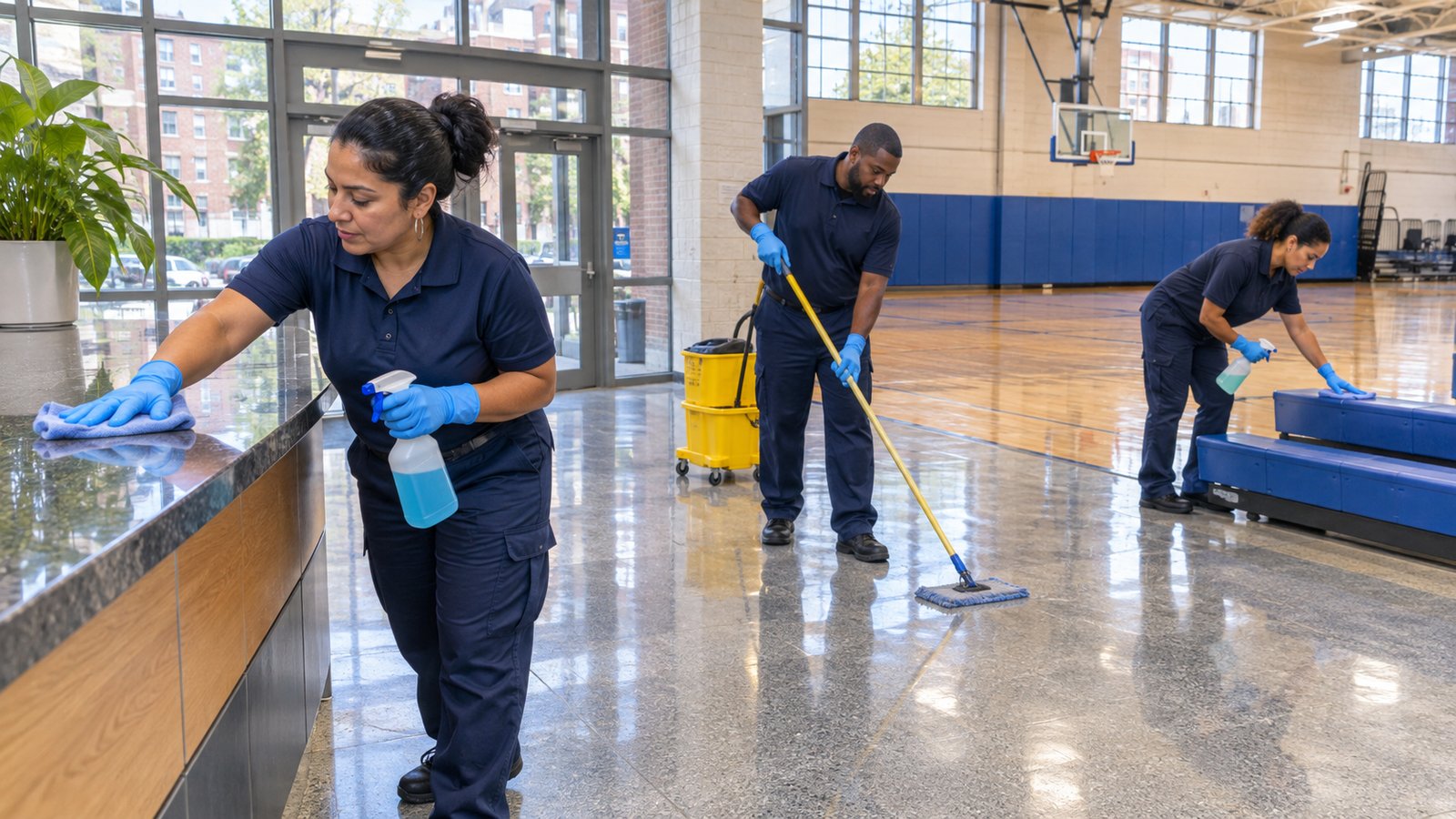
Municipal recreation center cleaning in the Bronx is a public-facing service problem, not simply a nightly floor-care assignment. A well-built scope accounts for gym floors, locker rooms, restrooms, program rooms, entrances, equipment-touching surfaces, and the changing schedule of classes and events. GreenPoint Maintenance Services helps public facility teams convert those demands into a room-by-room task plan, inspection routine, and fixed-price proposal. Call GreenPoint at 347-332-9348 to discuss a walkthrough; an on-site review helps verify actual occupancy and access conditions before a quote is prepared.
Map the center by use, traffic, and opening hours
Start with a floor plan and divide the facility into spaces that behave differently: gymnasium and courts, fitness rooms, locker and shower areas, public restrooms, multipurpose rooms, offices, corridors, entrances, and storage. A 40,000-square-foot center with two gyms and busy locker rooms has a different labor profile from an office building of the same size. Record square footage, flooring, hours, user volume, scheduled programs, and whether a space is open before or after the main doors close. Include special-event days and weekend peaks rather than estimating from a quiet weekday visit.
Bronx centers near Crotona Park, St. Mary's Park, or the 161st Street and Yankee Stadium area may see different arrival waves and event traffic. A center near the 149th Street–Grand Concourse transit connection may experience a concentrated morning or evening rush, while a park facility can have seasonal outdoor activity that brings grit and wet soil indoors. GreenPoint Maintenance Services asks who controls building access, where a cleaning team may stage carts, and which doors remain public. For a broader frequency framework, compare the proposed schedule with cleaning frequency standards by facility type and restroom cleaning best practices for high-traffic buildings.
Set gym, locker-room, and restroom service levels
Write tasks in observable terms. For a gym, that might mean remove loose debris, spot-clean approved floor areas, empty waste, clean accessible glass, and report damage or spills. Court finishes and athletic surfaces often have manufacturer-specific care instructions, so do not assume a general-purpose cleaner or wet-mop routine is appropriate. Locker rooms may require more than one service check during a heavy-use day, with separate tasks for benches, sinks, showers, partitions, drains, and replenishment. Restrooms need a defined frequency, consumable par levels, and a method for recording out-of-stock conditions.
Use observed traffic, complaints, and inspection findings to adjust frequency. A reasonable pilot might inspect high-use locker rooms at opening, mid-shift, and closing, while a low-use administrative suite receives a different cadence. Those are planning examples, not a universal rule; confirm them with the center's program calendar and available staff. GreenPoint can put routine tasks and periodic work such as machine scrubbing, high dusting, or interior glass into separate service lines so staff know what is included. Call 347-332-9348 to arrange a walkthrough and identify surfaces that require manufacturer-approved methods.
Coordinate cleaning around classes, camps, and public events
Municipal recreation schedules can change daily. Ask for recurring class times, youth programs, senior activities, leagues, camps, rentals, and public meetings, then mark setup and turnover windows on the service calendar. A 30-minute room reset between programs needs a named task list and a realistic response window. Define who requests extra work, who can approve it, and how a one-time event charge appears on an invoice. This protects the regular nightly scope from being gradually consumed by unplanned resets and helps the center maintain a dependable public-service standard.
Plan the route from supply closet to each zone so carts do not obstruct accessible paths, exits, or public programming. Confirm elevator and key procedures, alarm responsibilities, sign-in rules, and the process for a late-running event. The center's own building and emergency policies govern access; janitorial staff should know how to report a hazard without attempting work outside their training. GreenPoint Maintenance Services can build a schedule around the actual facility calendar and identify the exact handoff between center employees and the contractor. If the calendar changes seasonally, include a quarterly scope review rather than leaving the original staffing plan untouched.
Specify products, worker safety, and public-building rules
Request a current product list, labels, safety data sheets, dilution instructions, and storage plan. OSHA's Hazard Communication requirements address communicating chemical hazards and making relevant safety information available to employees. A contractor should train staff to follow product labels, use required protective equipment, keep chemicals in labeled containers, and avoid mixing products. For a public recreation center, the buyer should also establish rules for wet-floor signs, barricades, secure storage, incident reporting, and keeping cleaning tools away from children and the public.
GreenPoint uses Green Seal certified products where appropriate, subject to surface compatibility and the facility's approved-product requirements. Green certification does not mean every product is suitable for every material, and a disinfectant's label directions must be followed when disinfection is specified. Confirm how a contractor separates cloths and tools for restrooms, food areas, and general spaces; a documented color-coded microfiber system can reduce task crossover. NYC Parks or the municipality should confirm applicable procurement, site, and building procedures for the individual center. GreenPoint can include those instructions in training records and the service plan rather than relying on verbal handoffs.
Verify completed work with inspections and useful evidence
A quality plan should say which rooms are inspected, how often, what counts as a pass, who receives a deficiency notice, and when correction is due. A simple rotation can sample high-use spaces daily and a broader room set weekly, with a monthly trend review for recurring misses. Separate appearance issues from repair requests, safety incidents, and supply gaps because they have different owners. ISSA's cleaning-industry resources and appearance-level concepts can help buyers describe outcomes, but the center should still define practical, site-specific acceptance criteria.
JaniTrack, GreenPoint's verification system, can associate timestamped, GPS-tagged photos and inspection notes with service activity and show status in a live dashboard. ATP testing can be used as one supplementary measurement on selected surfaces when the client and contractor agree on a protocol; it is not a pathogen test or a guarantee that a room is sterile. GreenPoint reports a 98% client-retention rate, a company-level indicator rather than a promise about any one contract. Ask to see an example of a corrective-action record and how a reported miss is assigned, fixed, and closed.
Compare municipal bids by full scope and fixed cost
Compare proposals using the same room list, frequencies, shift windows, staffing assumptions, periodic tasks, supplies, supervision, and exclusions. Ask whether the quoted price includes consumables, equipment, event resets, floor restoration, high dusting, and emergency response. A fixed monthly price can make budgeting easier when the scope is stable; the contract should explain how authorized additions or material scope changes are approved. GreenPoint Maintenance Services Corp provides fixed pricing with no hourly billing and no hidden fees, with inclusions documented before work begins.
Municipal buyers should also verify insurance, workers' compensation, required registrations, MBE/MWBE documentation, references, and any solicitation-specific credentials. GreenPoint is MBE/MWBE certified with NYS, NYC, and NYC DOE programs and is registered in SAM.gov; the buyer should confirm the current status and solicitation requirements directly during procurement. No certification replaces a competitive evaluation or a complete scope. For contract structure and vendor checks, review how to write an RFP for commercial cleaning and commercial cleaning contract key terms.
Plan a transition, staffing backup, and seasonal review
A service transition should include site orientation, access and alarm testing, equipment delivery, product approval, baseline photographs where permitted, and a joint first inspection. Identify the supervisor who will be on site, the backup contact, the time window for call-outs, and how an absence is covered without leaving a public room unserviced. A 30-day review can compare attendance, completion records, user feedback, and inspection results with the original scope. GreenPoint can include these start-up steps in the written plan so a municipal facility has a record of who approved each operating detail.
Revisit frequencies when the park or program calendar changes. Summer camps, winter leagues, school-break programs, and large community events may shift traffic to different rooms and times. A quarterly check-in can adjust staffing and authorized extra work without rewriting the whole agreement. Keep the baseline fixed and document each approved change, including its effective date and budget impact. This is especially helpful when the center must explain public spending or compare contract performance across seasons.
For a Bronx center, the most useful first step is to walk the service route with the facility manager and note busy periods, secure doors, and high-use restrooms. GreenPoint Maintenance Services can prepare a room-level proposal after that review. Call 347-332-9348 to request a quote or book the walkthrough, and ask for sample inspection and corrective-action records before selecting a vendor.
Frequently asked questions about Bronx recreation-center cleaning
Q: How often should a Bronx recreation center be cleaned? A: Match frequencies to usage. Public restrooms and busy locker rooms may need multiple checks each day, while offices and low-traffic rooms can follow a different schedule. Establish the starting plan from an on-site review and adjust from inspections and user volume.
Q: What should a recreation-center cleaning quote include? A: It should identify each room, routine tasks, frequency, shift, supplies, periodic floor work, supervision, inspection method, exclusions, and the process for event or emergency work. GreenPoint can prepare a fixed-price scope after a walkthrough.
Q: Can janitorial staff clean athletic floors with ordinary products? A: Not automatically. The facility should provide floor-manufacturer requirements, and the vendor should confirm compatible products, dilution, tools, and drying time before work starts.
Q: Does ATP testing prove a gym is disinfected? A: No. ATP measures organic residue through a defined testing method and should be interpreted as one process indicator, not proof that pathogens are absent or that a surface is sterile.
Q: How can a municipal buyer compare contractors fairly? A: Issue the same room inventory and service requirements to each bidder, then compare staffing, inspection evidence, safety documentation, price inclusions, insurance, and qualifications against published evaluation criteria.
Schedule a Bronx recreation-center walkthrough with GreenPoint Maintenance Services at 347-332-9348 or info@greenpointms.com. GreenPoint brings fixed-price scopes, JaniTrack verification with timestamped GPS-tagged evidence, and a reported 98% client-retention rate; confirm the right service level for your center on site.