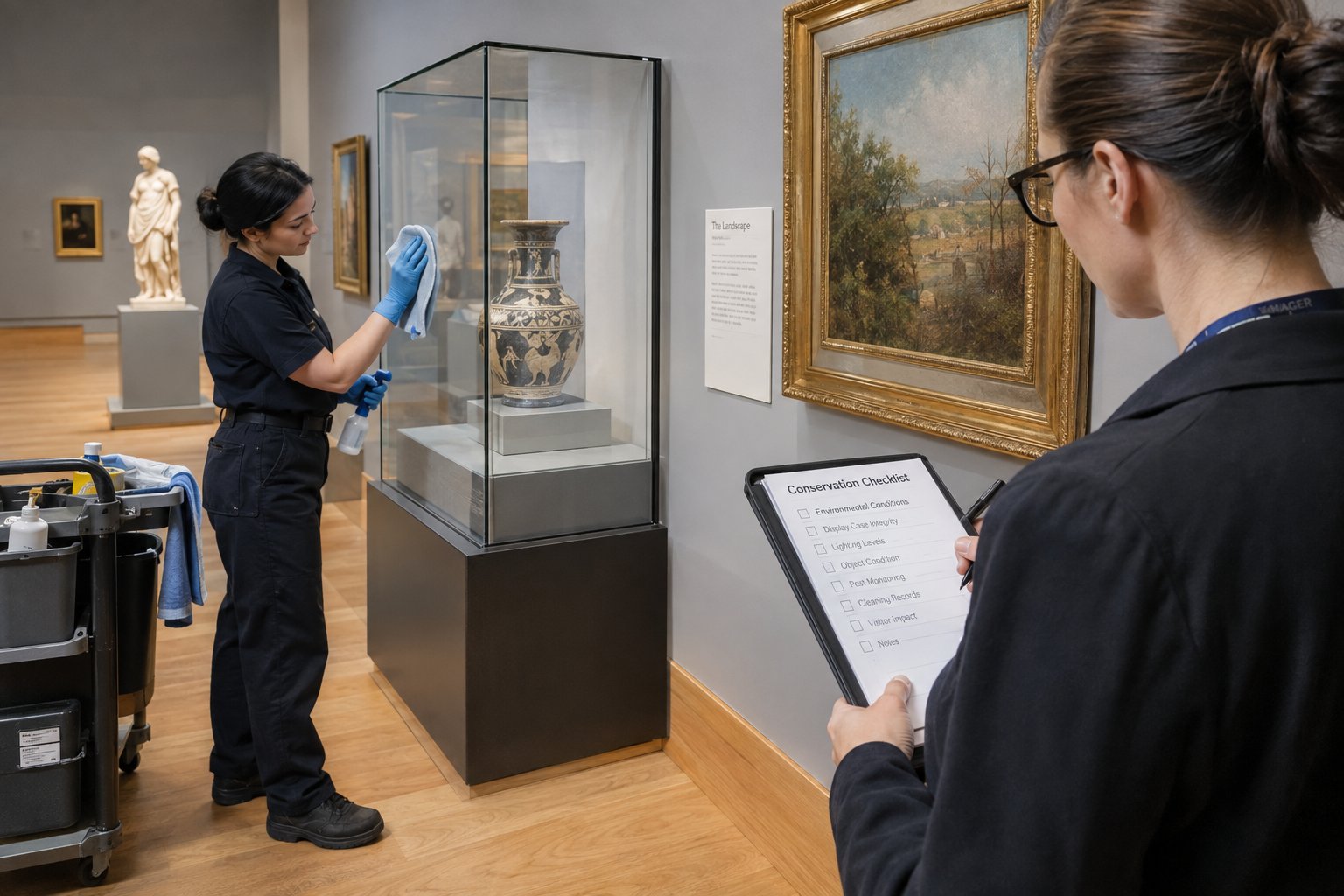
A museum or gallery cleaning RFP must protect the visitor experience without treating a collection like an ordinary office. Dust, humidity, vibration, water, residue, fragrance, ladders, and photography all deserve clear boundaries. GreenPoint Maintenance Services helps cultural organizations in Manhattan, Brooklyn, Queens, the Bronx, Staten Island, Westchester, Long Island, New Jersey, Connecticut, Pennsylvania, and Florida define safe janitorial scopes for galleries, public areas, offices, education rooms, storage support, and events. GreenPoint works from the museum’s conservation direction, uses Green Seal certified products where approved, and provides JaniTrack evidence for completed work.
Define conservation boundaries before requesting bids
The first section of a museum cleaning RFP should distinguish collection care from building cleaning. GreenPoint asks the museum to identify galleries, cases, plinths, frames, storage, conservation labs, loading docks, restrooms, offices, classrooms, cafés, and event spaces. The RFP states what cleaners may touch, what requires a conservator, what must remain dry, and who releases an area. A 15,000-square-foot Chelsea gallery does not carry the same risk or traffic pattern as a 200,000-square-foot museum near Central Park or Philadelphia’s Parkway.
Clear boundaries make bids comparable. GreenPoint can price floor vacuuming, glass cleaning where approved, restroom service, waste removal, entry mats, event resets, and office cleaning separately from collection-sensitive work. Operators can use [questions to ask a commercial cleaning company](/blog/questions-to-ask-commercial-cleaning-company/) and [cleaning audit checklist for facility managers](/blog/cleaning-audit-checklist-facility-managers/) as pre-RFP references. Call 347-332-9348 if a walkthrough is needed before the scope is issued.
Gallery floors, dust, and visitor traffic
Gallery floors collect soil from sidewalks, transit hubs, school groups, and event traffic. GreenPoint uses a method matched to the floor finish and collection environment, with low-moisture work where appropriate and clear protection around plinths, cases, and wall edges. The RFP should state whether vacuuming occurs before opening, after closing, or in sections, and whether the vendor must coordinate with guards or visitor-services staff. A floor that looks clean but leaves grit at a case base can still create a maintenance issue.
The museum should provide floor plans, traffic estimates, access hours, and known restrictions. GreenPoint records completed zones in JaniTrack and can use timestamped GPS-tagged photos of unobstructed floors or service closets where photography is allowed. The dashboard helps distinguish a missed task from a gallery closed for a private event. GreenPoint’s fixed pricing makes it easier to budget recurring work, while restorative care remains a separately approved line.
Cases, glass, frames, and no-touch zones
Display cases and artworks need a no-assumption rule. GreenPoint’s janitorial team does not dust an object, open a case, move a plinth, or apply product to a frame unless the museum’s written scope and conservator authorize it. Exterior glass, ledges, and surrounding floors may be included with a defined tool and method. The RFP should specify lint-free materials, ladder or lift rules, water limits, and the person who signs off on a sensitive area.
A gallery manager can ask for a sample method statement rather than a vague promise to be careful. GreenPoint trains staff to stop when a surface, artifact, label, or cable is uncertain and escalate to the supervisor. GreenPoint also avoids photographing artwork or visitor information in JaniTrack unless the client approves. A call to 347-332-9348 can start a walkthrough focused on collections, security, event calendars, and cleaning boundaries.
Humidity, air quality, and product selection
Cleaning choices can affect air quality and the perception of a gallery. GreenPoint uses Green Seal certified products where they satisfy the museum’s approved performance and conservation requirements, but certification does not replace ventilation, dilution, dwell time, or a material-compatibility review. The RFP should identify fragrance restrictions, low-moisture expectations, HVAC coordination, and rules for aerosol or spray use. HEPA vacuuming may be appropriate for some dust-control tasks when the facility’s conservation team approves the equipment.
Managers can review [HEPA filtration in commercial cleaning](/blog/hepa-filtration-commercial-cleaning/) and [green cleaning for commercial buildings](/blog/green-cleaning-commercial-buildings-guide/) as procurement context. GreenPoint documents the method used and reports leaks, condensation, visible mold concerns, or a ventilation problem rather than masking it. For galleries in coastal New York, New Jersey, or Florida, seasonal humidity and storm preparation should be included in the operating assumptions.
Public programs, schools, and event resets
Museums host school groups, openings, lectures, weddings, and donor events that change cleaning needs quickly. GreenPoint can schedule pre-event readiness, restroom checks, waste and spill response during an event, and post-event reset without changing the base collection boundary. The RFP should state who may authorize an extra service, how quickly the vendor must respond, and whether catering areas are included. At a site near the Museum Mile, DUMBO, Newark, Stamford, or Philadelphia’s cultural district, transit and visitor peaks influence timing.
Education rooms and art-making spaces require their own surface and supply list. GreenPoint removes approved waste, cleans tables and sinks, checks floors for paint or adhesive residue, and reports materials that require conservation or facilities direction. A manager can call 347-332-9348 for a fixed event-service quote. The schedule should avoid implying that a standard office wipe-down is sufficient for paint, clay, food, or large visitor groups.
RFP service levels, exclusions, and staffing
A strong RFP describes frequency by room type, not only a monthly total. GreenPoint recommends listing daily gallery floors, restroom checks, office service, weekly detail tasks, monthly high dusting where approved, seasonal mat or floor care, and event response. Exclusions should cover artwork, case interiors, hazardous materials, pest treatment, construction dust, and conservation tasks unless separately qualified. Staffing assumptions should state shift length, supervisor coverage, backup plan, and whether the vendor supplies consumables.
The bid form can ask vendors to price a base year, renewal option, emergency response, and periodic work. GreenPoint offers fixed pricing, no hourly billing, and no hidden fees so the museum can compare a real scope rather than a teaser rate. Its MBE/MWBE certification through NYS, NYC, and NYC DOE and SAM.gov registration can support public or nonprofit procurement files. Call 347-332-9348 before issuing an RFP if the floor plans or collection boundaries are unclear.
Verification, incident reporting, and collection safety
Verification should demonstrate that the museum’s agreed spaces were serviced while preserving collection security. GreenPoint uses JaniTrack timestamps, checklist completion, exception status, and suitable GPS-tagged photos of service evidence. The museum controls which areas permit photography and how records are retained. A supervisor reports a broken display component, water leak, damaged finish, or suspicious residue immediately; the objective is fast escalation, not a quiet re-clean that erases evidence.
Monthly reviews can examine missed areas, re-clean requests, visitor complaints, supply use, response times, and near misses. GreenPoint’s 98% client retention is a useful indicator of sustained client communication, but the RFP should still define measurable service levels. If a gallery expands, a new exhibition opens, or an event calendar changes, call 347-332-9348 to revise staffing before a coverage gap appears.
Local museum service logistics
Cultural facilities have distinctive access conditions. GreenPoint accounts for loading docks near Manhattan landmarks, security screening around museums on Fifth Avenue, street closures in Brooklyn, school-group arrivals in Queens, and freight or weekend rules in New Jersey, Connecticut, Pennsylvania, and Florida. A site survey records elevators, stairs, storage closets, water access, alarm procedures, and the route from service entrance to galleries. The final RFP can then specify realistic start times and response windows.
GreenPoint Maintenance Services supports single institutions and multi-site organizations with consistent reporting and local supervision. The team serves NY, NJ, CT, PA, and FL and can separate recurring janitorial work from floor, carpet, pressure-washing, and post-event services. Call 347-332-9348 to schedule a walkthrough and receive a fixed quote that protects the collection boundary while making ordinary facility work accountable.
A practical scoring matrix for cultural institutions
A museum RFP scoring matrix can assign points for conservation-boundary training, supervisor coverage, room-by-room frequencies, emergency response, product transparency, documentation, staffing continuity, and price. GreenPoint encourages institutions to ask finalists to explain one realistic scenario, such as a spill near a plinth before opening or a gallery closed for a private event. The answer reveals more than a generic promise to deliver high-quality service.
The institution should also request references for comparable public-facing facilities and ask how the vendor handles a near miss. GreenPoint’s process emphasizes reporting and correction rather than hiding an exception. JaniTrack can show when a service was scheduled, completed, or held for authorized access, while the museum retains control of security and collection information. Call 347-332-9348 if the procurement team wants help translating a floor plan into measurable frequencies.
After award, a 30-day transition period protects the museum from a sudden change in routine. GreenPoint inventories mats, vacuums, approved chemicals, waste points, keys, badges, and conservation restrictions, then trains the assigned team in the building’s actual routes. The supervisor reviews the first week with visitor services and facilities. That implementation work is part of a reliable cleaning program even when the public never sees it.
Frequently Asked Questions
Can a commercial cleaner work around museum collections?
Yes, when the museum defines no-touch areas, approved methods, access rules, and conservator release conditions. GreenPoint cleans the authorized building surfaces and escalates anything uncertain instead of moving or treating an object without written direction.
Should artwork be included in a janitorial RFP?
Normally, collection and conservation tasks should be separated from ordinary janitorial work unless a qualified specialist is expressly contracted. GreenPoint can include gallery floors, exterior surfaces, restrooms, offices, and event areas with clear boundaries and exclusions.
How can a museum verify cleaning without showing artwork?
JaniTrack can record timestamps, checklist completion, exceptions, and suitable photos of floors or service areas. GreenPoint follows the museum’s photography and security rules and does not need to photograph artwork, visitors, labels, or confidential records.
What products should a museum cleaning vendor use?
The museum should approve products based on surface compatibility, fragrance, ventilation, and conservation direction. GreenPoint can offer Green Seal certified products where appropriate, while still following label directions, dilution, dwell time, and the museum’s method statement.
How do we price an RFP fairly?
List rooms, frequencies, access windows, staffing, consumables, event response, exclusions, and periodic work. Call 347-332-9348 for a walkthrough; GreenPoint will provide fixed pricing with assumptions instead of an undefined hourly figure.
Protect the collection and clarify every cleaning boundary with GreenPoint Maintenance Services. Call 347-332-9348 to schedule a museum or gallery walkthrough and fixed quote, backed by JaniTrack verification, GreenPoint’s 98% client retention, MBE/MWBE credentials, and approved Green Seal options.