If you manage a public, charter, or private school in New Jersey, “clean enough” is not a feeling — it is a documented program. NJ Department of Education expectations touch daily custodial routines, health and safety practices, chemical controls, and clear records you can show during audits, parent inquiries, or incident reviews. GreenPoint Maintenance Services helps tri-state facilities build proof-driven cleaning programs that reduce risk and protect attendance, while keeping budgets predictable with fixed pricing (no hourly surprises). Call 347-332-9348 to schedule a walkthrough and get a school-specific scope and quote.
In this guide, we translate NJ DOE-aligned expectations into a practical playbook: what to clean, how often, how to use disinfectants safely, what to document, and how to verify performance with tools like ATP testing and GPS-tagged photos through JaniTrack. If you also manage NYC campuses, compare your program to our NYC-focused resources like [school cleaning checklist for custodial staff](/blog/school-cleaning-checklist-custodial-staff/) and [NYC DOE-approved vendor considerations](/blog/school-cleaning-nyc-doe-approved-vendor/).
What “NJ DOE school cleaning requirements” means in practice
School cleaning expectations in New Jersey typically align with three realities: (1) infection prevention in high-contact environments, (2) safe chemical handling for staff and students, and (3) documented procedures that can be repeated every day regardless of who is on shift. GreenPoint’s approach is evidence-based: we treat cleaning as a controllable process, not an “effort.” That means written scopes, training, inspection routines, and measurable verification — the type of operational discipline that supports a 98% client retention rate.
You will see different terminology across districts and guidance documents, but your compliance foundation is consistent: a frequency plan by space type, a disinfection protocol for touchpoints, a safety plan for chemicals and equipment, and a record system. If you want a quick benchmark on frequency by space, use [cleaning frequency standards by facility type](/blog/cleaning-frequency-standards-by-facility-type/) as a starting point and then tailor it to your building use and student age groups.
Facility zones NJ schools must prioritize (and why auditors ask about them)
New Jersey schools are built around repeated, dense circulation: students move bell-to-bell through corridors, stairwells, cafeterias, gyms, and shared restrooms. That makes specific zones higher risk for both germs and visible cleanliness issues. GreenPoint typically organizes scopes into zones so supervisors can inspect consistently and districts can understand what they’re paying for.
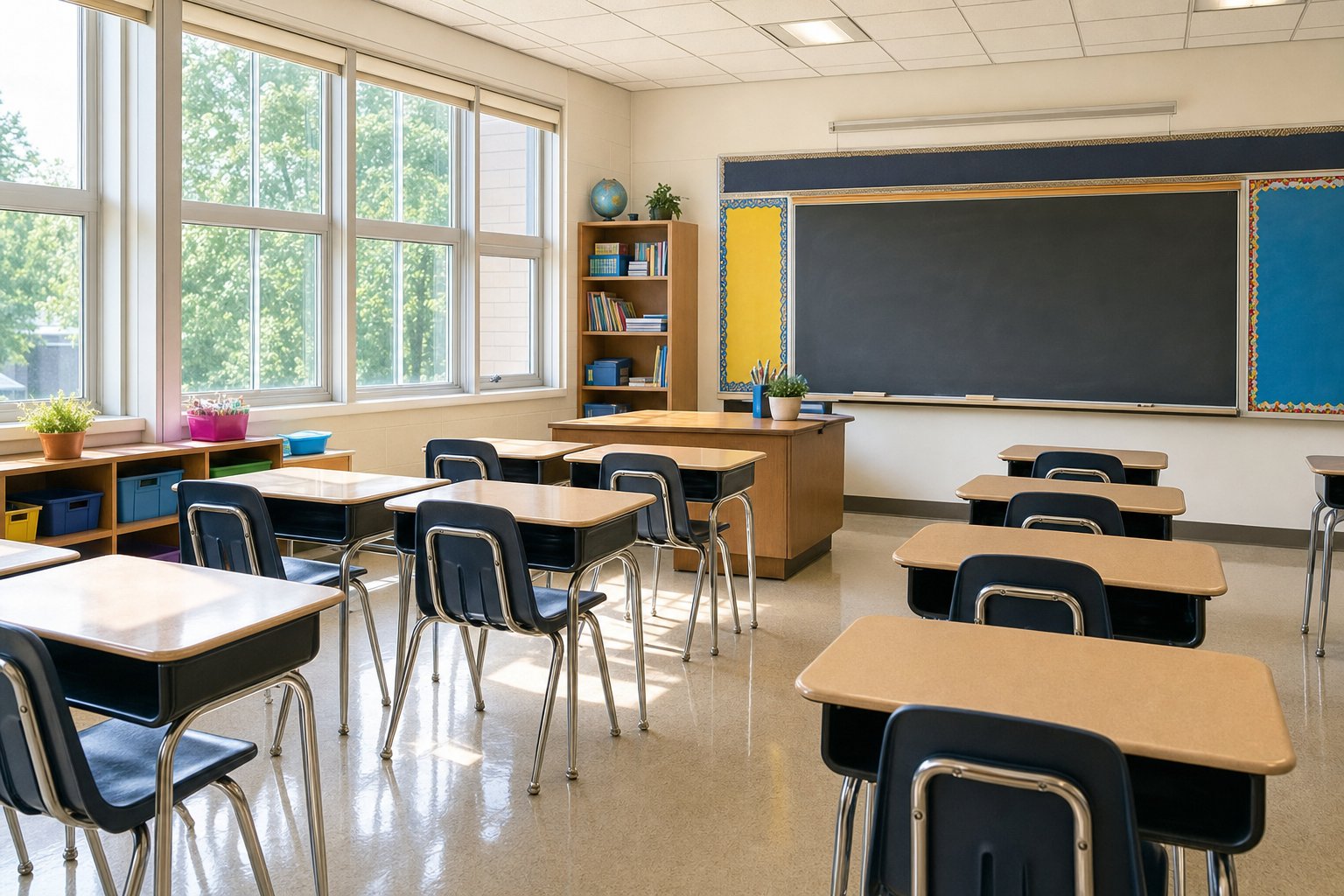
Core zones to prioritize: main entrances and vestibules, hallways and stair rails, classroom touchpoints (desks, door handles, shared supplies areas), nurse’s office, restrooms, cafeterias and serving lines, gyms/locker rooms, media centers, and staff break rooms. Also include bus loading areas and security desks because those touchpoints are used continuously during arrival and dismissal near transit corridors like NJ Transit stations or major arterials such as Route 1, Route 9, and the Garden State Parkway.
Recommended school cleaning frequencies: daily, weekly, monthly
A defensible frequency plan is one of the easiest ways to show you have control. At minimum, most schools use a layered schedule: daily “touchpoint + trash + restroom” coverage, weekly detail work, and periodic deep cleaning aligned to breaks. The exact schedule should reflect student density, after-school activities, and community health conditions.
Daily: restrooms (multiple checks), high-touch points, cafeteria tables and floors, trash removal, spot mopping, and entry glass/handles. Weekly: detailed floor edging, classroom sink fixtures, disinfecting shared equipment, and deeper restroom detailing. Monthly/quarterly: VCT scrub-and-recoat planning, carpet extraction, high dusting, vent cover wipe-downs, and storage room organization. For floor care planning, see [VCT floor care strip, seal, and wax](/blog/vct-floor-care-strip-seal-wax-guide/) and for carpet strategy review [carpet cleaning methods compared](/blog/carpet-cleaning-methods-compared/).
Disinfecting vs cleaning in schools: what to document
Cleaning removes soils; disinfecting uses an EPA-registered product to reduce pathogens on surfaces. In schools, you need both — and you need your documentation to show the difference. A common compliance gap is “we wiped everything down” without listing the product, dwell time, and targeted surfaces.
GreenPoint Maintenance Services standardizes disinfection documentation with (1) a defined touchpoint list, (2) product name and EPA registration confirmation, (3) dwell time used, and (4) shift sign-off. For an accessible overview of product registration expectations, reference [EPA disinfectant registration basics](/blog/epa-disinfectant-registration-guide/). This protects your district during stakeholder questions and aligns with the safety discipline expected in regulated environments.
OSHA chemical safety: SDS access, labeling, and training
Regardless of what a district calls its “requirements,” chemical safety is non-negotiable. OSHA’s Hazard Communication principles matter in custodial closets, loading docks, and any area where concentrates or aerosols are stored. Schools should maintain accessible Safety Data Sheets (SDS), ensure secondary containers are labeled, and train staff on correct dilution, PPE, and what to do during spills.
GreenPoint builds chemical controls into the program: we align products to Green Seal-oriented options where feasible, reduce unnecessary chemical variety, and require consistent labeling and SDS availability. If your team needs a refresher, use [OSHA cleaning chemical safety (GHS/SDS)](/blog/osha-cleaning-chemical-safety-ghs-sds/) and pair it with controlled storage practices like those outlined in [fire code chemical storage basics](/blog/fire-code-cleaning-chemical-storage/).
NJ school documentation checklist: what you should be able to show in 5 minutes
A practical test: if a superintendent, principal, or parent asks how you maintain sanitation, can you show a complete picture quickly? A five-minute documentation packet reduces stress and prevents “policy drift” where expectations change by building or shift.
At minimum, GreenPoint recommends: an area-by-area scope of work, cleaning frequency matrix, disinfecting touchpoint list, product list with EPA registration confirmation and SDS links/locations, staff training logs, inspection forms, and an issue escalation process. If you use an RFP, incorporate documentation requirements early (see [how to write an RFP for commercial cleaning](/blog/how-to-write-rfp-commercial-cleaning/)) so bidders price the real standard, not an assumed one.
How to verify cleaning in schools (JaniTrack + ATP testing)
Verification is how you move from “we think it’s clean” to “we can prove it.” GreenPoint uses JaniTrack, a digital verification system that captures timestamped, GPS-tagged photos and supervisor checklists in a live dashboard. This is especially useful across multi-school portfolios in Bergen, Essex, Hudson, Union, Middlesex, and Monmouth counties where consistency is the biggest challenge.
For higher-risk areas like nurse offices, special education rooms, and cafeterias, we can add ATP bioluminescence testing as a spot-audit tool to measure residual organic material on surfaces. If you want the science in plain terms, review [what ATP testing means for cleaning verification](/blog/what-is-atp-bioluminescence-testing-cleaning/) and consider pairing it with [digital cleaning verification systems](/blog/digital-cleaning-verification-systems/).
Staffing, turnover, and consistency: the hidden compliance risk
Many school cleaning problems are not caused by “bad workers,” but by inconsistent staffing and unclear expectations. When turnover rises, training quality drops and the program becomes person-dependent. That is when touchpoints get missed, restrooms degrade, and documentation becomes a last-minute scramble.
GreenPoint builds resilience into the process: standardized checklists, role-based training, and supervisor verification. If your district is evaluating in-house versus contracted labor, use [commercial cleaning vs in-house custodial](/blog/commercial-cleaning-vs-in-house-custodial/) and consider the operational impact discussed in [janitorial employee turnover impact](/blog/janitorial-employee-turnover-impact/).
How to scope and price NJ school cleaning without hourly surprises
School administrators often get trapped by hourly billing: the invoice changes with staffing gaps, weather, events, or “extra attention” requests. GreenPoint Maintenance Services uses fixed pricing built around an explicit scope and verification plan, so you know what you’re buying and what “complete” means each day.
To estimate budget drivers, review [commercial cleaning cost per square foot](/blog/commercial-cleaning-cost-per-square-foot/) and then validate your “true cost” including supervision, supplies, and quality failures with [calculating total cost of ownership](/blog/calculating-true-cleaning-cost-tco/). For a tailored NJ school plan, call 347-332-9348 to schedule an on-site walkthrough.
Need a documented, audit-ready NJ school cleaning program? GreenPoint Maintenance Services can build a zone-based scope, frequency schedule, OSHA-safe chemical plan, and verification routine using JaniTrack (timestamped GPS-tagged photos) with optional ATP spot testing. Schedule a walkthrough and quote at 347-332-9348 or email info@greenpointms.com — most districts choose us for proof-driven quality and predictable fixed pricing.