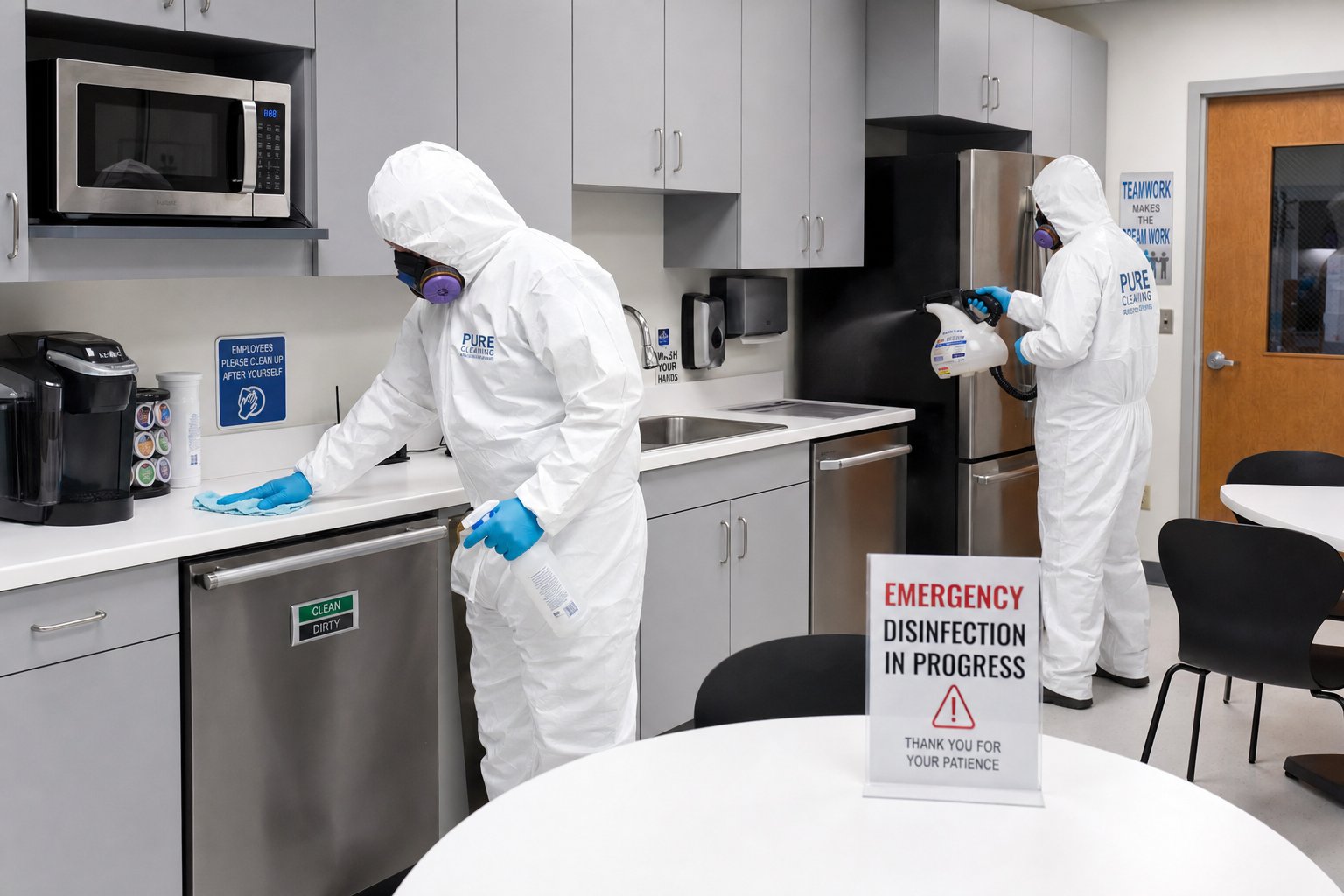
Norovirus is one of the fastest-spreading causes of gastrointestinal illness, and office outbreaks can go from one sick employee to a full-floor disruption in days—especially in shared restrooms and pantry areas. If you’re searching for "norovirus office cleaning" in NYC, North Jersey, or Connecticut, you need a response plan that is specific: correct disinfectant selection, proper contact time, PPE, waste handling, and documentation that your stakeholders can trust. GreenPoint Maintenance Services provides emergency cleaning and targeted disinfection programs supported by JaniTrack verification. For urgent response scheduling, call 347-332-9348.
Why norovirus is different from ‘regular’ seasonal illness in offices
Norovirus spreads efficiently through contact with contaminated surfaces, shared touchpoints, and poor hand hygiene—making commercial buildings with shared kitchens, conference rooms, and multi-stall restrooms especially vulnerable. In dense NYC corridors (Midtown, FiDi, Downtown Brooklyn, Long Island City) and transit-adjacent buildings (near major subway hubs, PATH, commuter rail), occupant turnover and shared touchpoints increase risk. The operational takeaway is simple: your outbreak plan must prioritize restrooms, pantries, elevator hardware, and any area where someone may have vomited or had an accident. GreenPoint’s protocols focus on fast containment with proof of completion so you can communicate confidently to tenants and HR.
Immediate containment checklist (first 2 hours)
Treat the first two hours as containment, not "deep cleaning." Step 1: isolate the impacted area (conference room, restroom stall bank, pantry) and restrict access using signage and physical barriers. Step 2: identify the likely contamination pathway—restroom touchpoints, shared pantry handles, breakroom tables, and any soft seating nearby. Step 3: stop routine cleaning tasks that could spread contamination (e.g., dry dusting, vacuuming without HEPA filtration). Step 4: notify building management/security so elevator bank usage and restroom access can be managed temporarily. If you need a vendor who can mobilize quickly with the right PPE and process, call GreenPoint Maintenance Services at 347-332-9348.
PPE and worker safety: what your vendor should require
Outbreak response cleaning exposes workers to bodily fluids and chemical disinfectants. Your vendor should use appropriate gloves, eye protection, and masks/respiratory protection where aerosol risk exists, and should train staff in doffing procedures to prevent self-contamination. Chemical handling should follow OSHA-aligned safety practices (labeling, SDS access, and dilution control), as described in [OSHA cleaning chemical safety: GHS and SDS](/blog/osha-cleaning-chemical-safety-ghs-sds/). GreenPoint standardizes PPE and chemical handling so the response protects both occupants and the cleaning team.
Product selection: ‘bleach vs. everything else’ and why it matters
Many facility teams default to "just use bleach," but the right answer is: use a disinfectant that is labeled for norovirus (or an appropriate surrogate) and apply it exactly to label instructions, including contact time. Bleach can be effective, but it can also damage finishes and some metals if used incorrectly, and it requires careful dilution and ventilation. For busy offices with sensitive finishes, your vendor should evaluate surface compatibility, select the correct chemistry, and ensure dwell time is met—this is the same "clean first, disinfect second" principle explained in [EPA disinfectant registration guide](/blog/epa-disinfectant-registration-guide/). GreenPoint’s proposals specify products and procedures so you’re not relying on improvisation during an outbreak.
Step-by-step emergency cleaning protocol (what ‘good’ looks like)
A defensible norovirus response typically follows this sequence: (1) remove visible soil and bodily fluid contamination using disposable absorbent materials; (2) bag and seal waste immediately to avoid cross-contamination; (3) clean the surfaces with a detergent step to remove residue; (4) apply disinfectant to high-touch and impacted surfaces and maintain wet contact time; (5) use dedicated tools and color-coded microfiber for impacted zones to prevent tool transfer to "clean" areas; and (6) perform a final high-touch wipe-down of adjacent touchpoints such as door hardware and elevator call buttons. GreenPoint also documents the response via JaniTrack so building management can confirm completion.
The 72-hour high-touch strategy after an incident
Outbreak response isn’t only the night of the incident. For the next 72 hours, many offices benefit from increased high-touch disinfection frequency—especially in restrooms, pantries, and shared conference rooms. That does not mean disinfecting every square foot; it means tightening cadence on the surfaces people touch most. Facilities can use verification strategies from [digital cleaning verification systems](/blog/digital-cleaning-verification-systems/) and measurement guidance from [what is ATP bioluminescence testing](/blog/what-is-atp-bioluminescence-testing-cleaning/) to confirm your program is hitting the right touchpoints. GreenPoint designs the 72-hour plan as an add-on scope with clear tasks and fixed pricing. Call 347-332-9348 to schedule.
NYC tri-state operational realities: elevators, shared lobbies, and multi-tenant restrooms
In NYC and the tri-state region, outbreaks are operationally complicated by shared building infrastructure: elevator banks serving multiple tenants, lobby touchpoints, and shared restroom cores. A good vendor coordinates with property management so the response covers common areas without disrupting unrelated tenants. In buildings near major foot traffic corridors (Times Square, Grand Central, Fulton Center, Jersey City PATH stations), elevator button disinfection is especially important because occupants from multiple companies share the same touchpoints. GreenPoint’s building-wide programs can cover both tenant suites and shared areas, with a single dashboard for accountability.
Why norovirus is uniquely hard to control with standard office cleaning
Norovirus is the leading cause of acute gastroenteritis outbreaks in the United States, and offices are not spared. Three properties make it especially difficult for general office cleaning programs: it has an extremely low infectious dose (as few as 18 viral particles per CDC), it survives on hard surfaces for up to two weeks, and most quaternary ammonium ('quat') disinfectants—the workhorse of routine office cleaning—are not effective against it. Only EPA List G products with specific norovirus claims (typically hypochlorite/bleach-based or accelerated hydrogen peroxide formulations) reliably inactivate the virus. A facility relying on routine quat-based cleaning will not control a norovirus outbreak, no matter how often crews clean. GreenPoint Maintenance Services stocks EPA List G disinfectants on every emergency response truck and can mobilize within hours of an outbreak call across the tri-state area. Call 347-332-9348 for outbreak response 24/7.
First 24 hours: the playbook GreenPoint runs on an outbreak call
Hour 0-2: Phone intake and risk triage—identify affected zones, last-known clean time, occupancy plan, and any vomit/diarrhea events that need biohazard handling. Hour 2-6: PPE-equipped crew mobilizes with List G product, single-use cleaning materials, and biohazard waste handling kits. Hour 6-24: Phased terminal disinfection of all affected zones plus shared paths (restrooms, kitchens, elevators, door hardware), with bagged disposal of contaminated cleaning materials. Hour 24-72: Follow-up disinfection of high-touch zones, ATP verification of sentinel surfaces, written report to facility manager. The single biggest mistake we see when called after another vendor’s response is missing the secondary surfaces—the elevator buttons, the printer keypad, the breakroom microwave handle—where the virus persists and re-seeds new cases. For ATP verification background, see [what is ATP bioluminescence testing in cleaning](/blog/what-is-atp-bioluminescence-testing-cleaning/).
Communication: what to tell employees during and after the response
Facility managers often underestimate the communication side of an outbreak. Effective messaging includes: (1) acknowledgment that an outbreak occurred and what’s being done, without naming affected individuals; (2) which areas are closed, when they will reopen, and the standard being applied; (3) clear sick-leave guidance—anyone with symptoms should stay home for 48-72 hours after symptoms resolve, per CDC; (4) practical hygiene reminders (handwashing with soap is more effective than alcohol sanitizer against norovirus). GreenPoint Maintenance Services provides facility managers with template employee communication after every outbreak response. Transparent communication reduces rumor cycles and helps prevent additional cases by encouraging symptomatic employees to stay home.
Cost of an outbreak response in the tri-state market
Emergency norovirus disinfection in NY, NJ, and CT typically runs $0.20-$0.45 per square foot for a single terminal disinfection plus 48 hours of enhanced follow-up cleaning. A 30,000 sq ft office floor experiencing a confined outbreak might see a total response cost of $7,000-$13,500 including labor, biohazard disposal, and verification. That is a fraction of the cost of an extended outbreak: even five additional cases at an average of 2.5 lost workdays per case represents $5,000-$15,000 in lost productivity at typical knowledge-worker wages, before counting reputational and morale costs. GreenPoint Maintenance Services offers fixed-price outbreak response packages so finance teams can authorize on a phone call rather than scrambling for purchase orders. Call 347-332-9348 24/7.
Preventing the next outbreak: what should change after the response
Most outbreaks are not random. After response, GreenPoint Maintenance Services walks the facility with the operations team and identifies three to five preventable contributors: insufficient handwashing supplies at sinks, missed elevator-button frequency, vending and snack stations without sanitizer, no sick-leave policy enforcement, or shared kitchenware without dishwasher cycles. Adjusting the recurring scope to address these is usually cheap—often within the existing contract budget—and dramatically reduces repeat outbreak risk. For broader environmental cleaning standards, see [healthcare-associated infections: environmental cleaning](/blog/healthcare-associated-infections-environmental-cleaning/) and [COVID cleaning standards: permanent changes](/blog/covid-cleaning-standards-permanent-changes/).
Tri-state response coverage: NY, NJ, CT 24/7
GreenPoint Maintenance Services maintains outbreak-response staging across the five boroughs, Westchester, Long Island, northern New Jersey, and southwestern Connecticut. Standard mobilization windows from the time we accept the job: Manhattan and Brooklyn—2-4 hours; Queens, Bronx, Staten Island, southern Westchester—3-5 hours; Long Island, northern Westchester, northern NJ, southwestern CT—4-6 hours. We hold MBE/MWBE certifications (NYS, NYC, NYC DOE), are SAM.gov registered for government work, and carry the insurance limits typical for outbreak response. Schedule a walkthrough or set up a standing emergency response contract by calling 347-332-9348.
FAQ: norovirus office cleaning and disinfection
Q: How quickly should we respond after someone vomits at work? A: Immediately. Isolate the area and begin containment; delays increase the risk of spread to touchpoints and footwear traffic. Q: Can our nightly janitorial team handle this? A: Only if they have outbreak training, PPE, correct disinfectants, and a documented process; many routine programs aren’t set up for bodily-fluid incidents. Q: Do we need to close the office? A: Not always, but you may need to close the impacted area temporarily and increase high-touch disinfection frequency for 48–72 hours. Q: What areas should be disinfected first? A: Restrooms (faucets, stall latches, dispensers), pantry handles, door hardware, elevator buttons/rails, shared conference room touchpoints. Q: How do we prove to employees that the space is safe? A: Provide a clear summary of what was cleaned and disinfected and when; GreenPoint’s JaniTrack verification helps you communicate with evidence. Q: What should we do to prevent the next outbreak? A: Combine hygiene messaging, restocking (soap/paper), and a targeted scheduled disinfection program rather than relying on ad-hoc reactions; see [scheduled disinfection vs routine cleaning](/blog/scheduled-disinfection-vs-cleaning-difference/) for a framework.
Need emergency norovirus response cleaning in NY, NJ, or CT? GreenPoint Maintenance Services can mobilize with outbreak-ready PPE, labeled disinfectants, and JaniTrack verification so your stakeholders have proof—not guesses. Call 347-332-9348 or email info@greenpointms.com for urgent scheduling and a fixed-price scope.