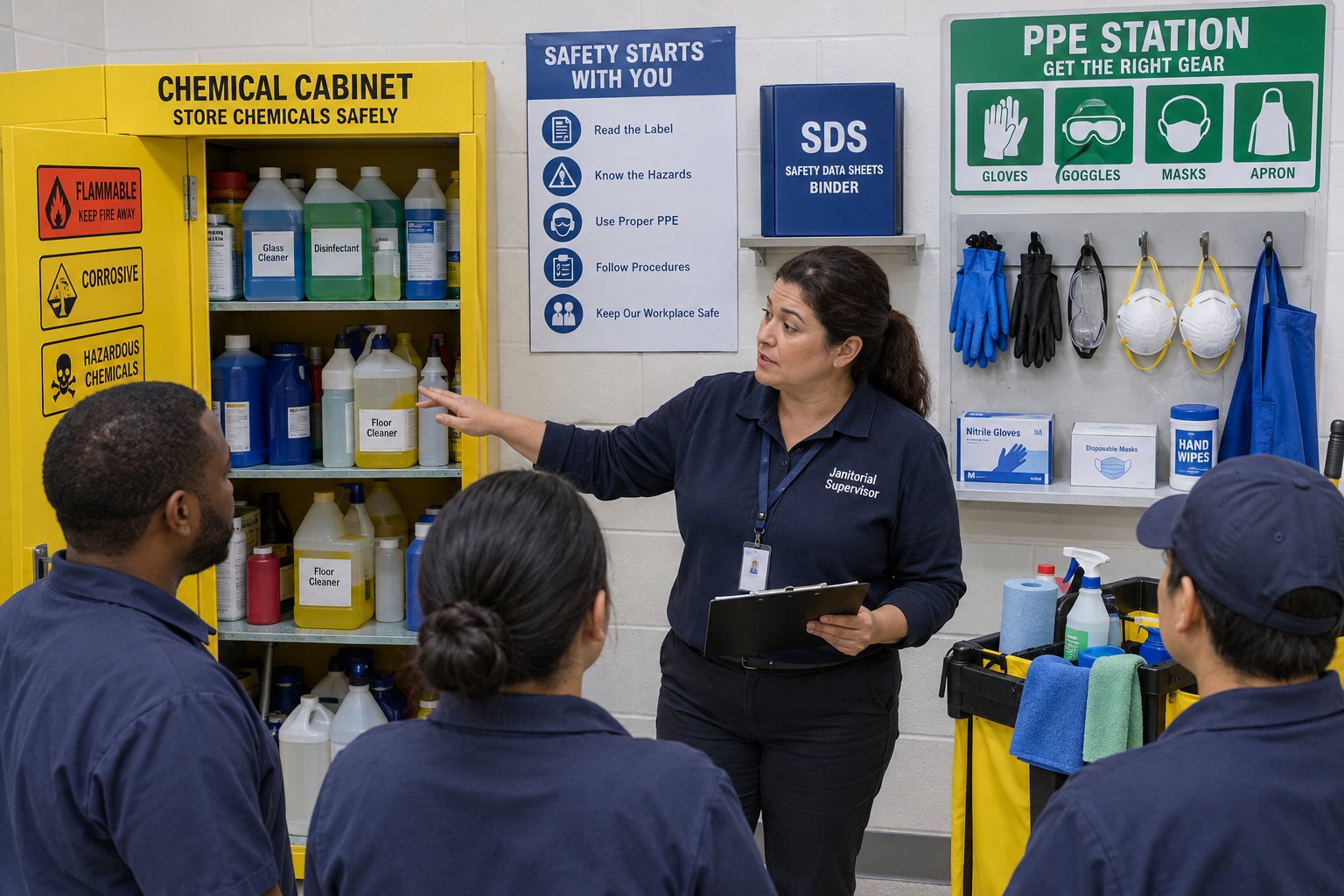
Cleaning chemicals can remove grease and pathogens, but an unmanaged chemical cabinet can expose workers to burns, respiratory irritation, incompatible reactions, and avoidable citations. OSHA's Hazard Communication Standard requires employers to inform workers about chemical hazards through labels, Safety Data Sheets, and training. GreenPoint Maintenance Services turns those requirements into a field program for offices, schools, medical practices, warehouses, restaurants, and public buildings in New York, New Jersey, Connecticut, Pennsylvania, and Florida. GreenPoint Maintenance Services uses a site-specific product register, supervisor checks, and JaniTrack evidence so managers can verify that a safe procedure exists beyond the first day of orientation.
The core parts of an OSHA chemical communication program
A defensible program names the responsible person, lists hazardous chemicals, explains labels and pictograms, identifies where SDS files are available, describes non-routine tasks, and records employee training. The list should cover concentrates, ready-to-use disinfectants, degreasers, floor finishes, restroom chemicals, aerosols, hand soaps, and maintenance products. It should also identify products supplied by the building or stored in a shared closet. GreenPoint inventories each location and removes obsolete or unknown containers from active use.
OSHA does not require a fancy binder; it requires accessible information and effective training. A digital SDS library can work if every shift can access it and the system remains available during an incident. GreenPoint keeps a site copy or approved digital access path, posts emergency contacts, and tests the process with a crew member. A manager can request a training and walkthrough review at 347-332-9348.
Labels, pictograms, and secondary containers
Every shipped container should retain the manufacturer label unless it is immediately used by the employee who transferred it. A secondary spray bottle needs the product identity and hazard information required by the employer's system; an unlabeled bottle is not acceptable simply because everyone knows it is glass cleaner. GreenPoint uses pre-printed labels, verifies dilution instructions, and prohibits handwritten mystery bottles. Color-coded microfiber helps keep a bathroom tool out of a food-service zone, but color alone is not a chemical label.
Supervisors should inspect cabinet shelves and carts for faded labels, leaking caps, incompatible storage, and expired products. They should ask a cleaner to identify the product and locate its SDS, not merely ask whether a label is present. GreenPoint documents the result in JaniTrack and assigns a corrective action. The [fire-code guide to cleaning chemical storage](/blog/fire-code-cleaning-chemical-storage/) is useful when a facility needs to review flammability and storage quantities with its fire-safety professional.
SDS access and the sixteen-section format
Safety Data Sheets generally follow a sixteen-section format covering identification, hazards, composition, first aid, firefighting, accidental release, handling and storage, exposure controls, physical and chemical properties, stability, toxicology, ecological information, disposal, transport, regulatory information, and other details. Workers do not need to memorize every section, but they need to know where to find first aid, PPE, spill response, and storage information quickly.
A strong site test takes less than five minutes: choose a product from the cart, find its current SDS, identify the required gloves and eye protection, and explain what to do after a splash. GreenPoint conducts that practical check during onboarding and refreshers, then records attendance and gaps. Call 347-332-9348 to schedule a walkthrough for a Manhattan office near Penn Station, a school in the Bronx, or a warehouse near Newark Airport.
Training for real janitorial tasks
Training should match the work. A restroom specialist needs dilution, ventilation, splash response, and incompatible-chemical examples. A floor-care technician needs finish-removal hazards, slip controls, machine safety, and eye protection. A school cleaner needs child-access prevention and storage discipline. A medical office crew needs bloodborne-pathogen boundaries in addition to chemical information. GreenPoint uses demonstrations, plain-language instructions, multilingual support where needed, and a knowledge check rather than handing over a binder.
Refresher training is appropriate when a new product arrives, a label changes, a process changes, an incident occurs, or a worker shows a gap. OSHA also expects information about non-routine tasks and workplace hazards. GreenPoint supervisors review the route and the product register, then use JaniTrack records to show which team members completed the module. This operational approach supports the same proof-driven culture behind GreenPoint's 98% client retention.
PPE, ventilation, and spill response
PPE is the last line of defense, not permission to ignore a safer product or a better method. The SDS and task assessment should guide glove material, eye protection, apron or footwear, and respiratory protection decisions. Workers need clean PPE, a place to store it, and a rule against taking contaminated gloves into a break room. GreenPoint checks that eyewash access, ventilation, and spill materials are available before a high-risk task begins.
A spill plan should identify who isolates the area, who calls the manager, what information responders need, and how contaminated materials are disposed of. Workers should not mix chemicals to improve performance or neutralize a spill unless the written procedure directs it. GreenPoint reports incidents and near misses, pauses unsafe work, and coordinates with the facility's emergency plan. Managers can call 347-332-9348 for a site-specific quote and training review.
What supervisors should audit each week
A short weekly audit can check labels, SDS access, cabinet condition, carts, dilution equipment, PPE, ventilation, spill kits, training gaps, and incompatible storage. The auditor should sample actual work areas rather than only inspect the supply closet. GreenPoint's JaniTrack dashboard can attach a photo and corrective-action due date to each finding, giving the account manager a searchable record.
Audit trends matter more than a perfect one-time score. Repeated unlabeled bottles may indicate a bad transfer process; empty gloves may indicate supply failure; a missing SDS may indicate a purchasing handoff problem. GreenPoint shares patterns with the property manager and adjusts the scope instead of blaming an individual cleaner. Fixed pricing and no hidden fees make the safety-support work easier to budget.
Applying the program across New York and neighboring states
A portfolio that includes a Midtown law office, a school near Flushing, a medical suite in Westchester, a warehouse in New Jersey, and a campus in Connecticut should use one core program with site-specific addenda. Local fire codes, building rules, product restrictions, language needs, and emergency contacts can vary. GreenPoint maintains a central product register while mapping each cabinet and shift, so a manager can see which information belongs to which location.
For broader procurement, compare training and verification alongside price. [Questions to ask a commercial cleaning company](/blog/questions-to-ask-commercial-cleaning-company/) includes insurance, supervision, and quality checks that complement chemical-safety questions. GreenPoint is MBE/MWBE certified in New York and SAM.gov registered, serves NY, NJ, CT, PA, and FL, and starts every new program with a walkthrough at 347-332-9348.
Frequently Asked Questions
What does OSHA Hazard Communication require from a janitorial employer?
The program generally needs a written plan, chemical inventory, compliant labels, accessible SDSs, and employee information and training. The exact implementation depends on the workplace and products. GreenPoint reviews those elements during a site walkthrough and documents training without treating a checklist as a substitute for employer responsibility.
Can janitorial workers use chemicals transferred into spray bottles?
They can when the transfer, label, dilution, storage, and use process complies with the product instructions and Hazard Communication requirements. An unlabeled or mystery bottle should be removed from service. GreenPoint uses labeled containers and supervisor checks, and can be reached at 347-332-9348 for a program review.
How often should chemical-safety training be repeated?
Repeat training when products, labels, tasks, or hazards change, after an incident or near miss, and whenever observation shows a knowledge gap. Many facilities also schedule an annual refresher. GreenPoint uses onboarding, task demonstrations, and documented refreshers tied to the actual route.
Does GreenPoint provide SDS documents?
GreenPoint maintains product information for the chemicals it supplies or uses and coordinates access with the facility's own inventory. The property should retain its required records and ensure every shift can access them. A walkthrough at 347-332-9348 identifies the cleanest handoff.
For an OSHA-aligned janitorial chemical program with labeled products, SDS access, practical training, and JaniTrack audit proof, call GreenPoint Maintenance Services at 347-332-9348. GreenPoint's MBE/MWBE credentials, fixed pricing, Green Seal product options, and 98% client retention support accountable facility operations.