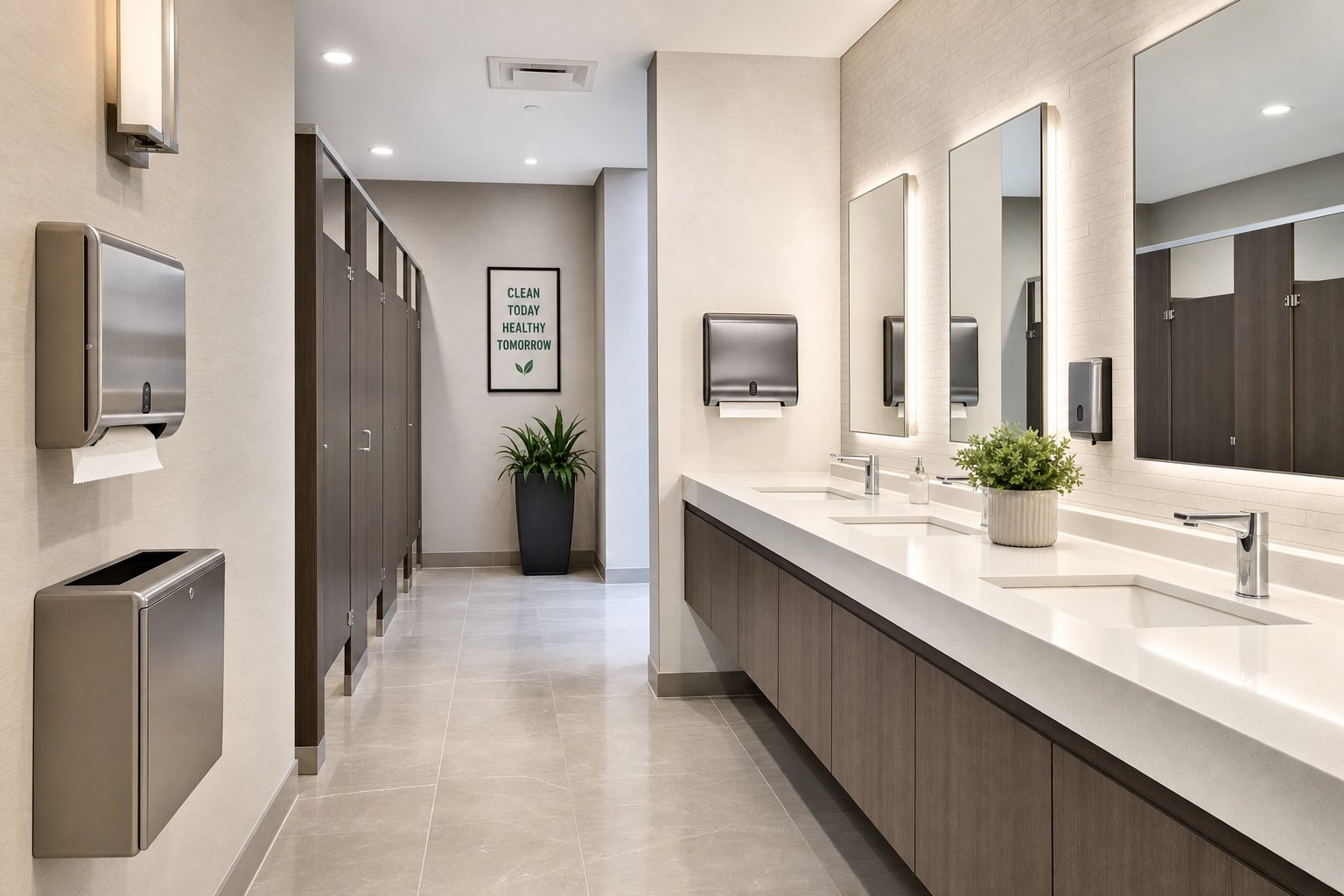
If your facility runs out of paper towels or tissue even once a month, you are paying twice: first in emergency purchasing and second in complaints, downtime, and reputational damage. GreenPoint Maintenance Services sees this pattern in offices, retail, and medical buildings across Manhattan, Brooklyn, Queens, the Bronx, Staten Island, Westchester, Long Island, and New Jersey—especially in restrooms near lobby turnstiles, food courts, and tenant amenity floors. The fix is not ordering more; it is measuring use, setting a par level, standardizing dispensers, and verifying service in a way you can audit. If you want us to review your current supply program and create a no-surprises plan, call 844-814-0810 for a walkthrough and quote.
Why restroom supply outages happen (and why they repeat)
Stockouts repeat because most buildings manage consumables as a reaction, not a system. The most common root causes we see at GreenPoint: no consistent par levels by restroom, too many dispenser types (each requiring different refills), unclear responsibility between tenants and building staff, and service that is not verified with time-stamped evidence. A single missed refill on a high-volume floor can trigger a chain of complaints, extra labor, and emergency runs to local suppliers—often at retail pricing.
In the tri-state, restrooms near transit access points (Penn Station area, Grand Central vicinity, Fulton Center-adjacent buildings, PATH-connected lobbies in Jersey City) often see peaks tied to commuter waves and visitor traffic. If your program does not account for those peaks, the same stalls and dispensers will run empty at the same times every week. GreenPoint Maintenance Services designs supply control around predictable demand patterns rather than averages.
Build a par-level system that matches traffic, not guesswork
A par level is your minimum on-hand inventory that prevents outages between delivery cycles. For most commercial properties, we set par levels using three numbers: average daily consumption, peak-day multiplier, and replenishment lead time. Example: if a restroom uses 2.5 cases of hand towels per week, you do not keep 3 cases total—you keep enough for peak weeks plus delivery buffer. In practice, many facilities target 2 to 3 weeks of coverage for core items to avoid emergency purchasing and to lock in pricing.
We also recommend assigning par by restroom zone instead of by building total. A ground-floor public restroom may use 3x the volume of a tenant-only restroom on an upper floor. GreenPoint documents each zone, labels storage locations, and sets reorder points that your team can audit. If you want a fast assessment, call 844-814-0810 and we will walk the restrooms, storage rooms, and loading dock workflow.
Standardize dispensers to cut SKUs, waste, and refill errors
Too many dispenser models is a silent budget killer. Each variation means a different refill, different key, and different training requirement—leading to partial refills, wrong refills, or teams bypassing the dispenser and leaving rolls on counters. Standardizing to one or two dispenser families for towel, tissue, and soap typically reduces SKU count by 30–60% and sharply reduces service errors. It also supports bulk purchasing and consistent user experience.
When we evaluate dispenser changes, we look at: capacity (how long it lasts at peak traffic), controlled dispensing (to reduce over-pulling), and maintenance (jam rates, battery life for touchless units). A good standardization project often pays back in months through reduced consumption and fewer emergency runs. GreenPoint can coordinate with property management and vendors so upgrades do not disrupt tenants.
Use consumption benchmarks to catch overuse, theft, and hidden demand
Facilities should track consumables per occupant or per visitor, not just per month. While every site is different, a simple starting point is measuring weekly cases used per floor and comparing it to badge counts, visitor logs, or footfall estimates. If one restroom consumes 2–3x similar restrooms, you may have a dispenser issue, a leaking soap system, a paper towel jam that forces waste, or unaccounted public access.
GreenPoint’s approach is to create a baseline in the first 30 days and then flag variance beyond a set threshold (for example, 15–20% over baseline). This mirrors the way facility teams manage utilities: you do not need perfection; you need signals that tell you where to investigate. Tracking also strengthens budget forecasting and supports fixed-price cleaning agreements with no hidden supply markups.
Set a restroom servicing cadence that matches peak windows
Most stockouts happen during predictable high-traffic windows: morning arrivals, lunch, and late afternoon departures. If your team services restrooms only at the start or end of shift, you will miss the peak. GreenPoint often recommends a mid-day touchpoint for lobbies and amenity floors, even if it is a quick 5–7 minute restock and wipe-down. In medical offices and urgent care settings, we add checks aligned to patient surges.
For multi-tenant buildings, we also clarify responsibilities: what the janitorial team restocks versus what tenants provide. Ambiguity leads to finger-pointing and last-minute orders. GreenPoint Maintenance Services documents these responsibilities in a simple scope that property managers can share with tenants and vendors.
Prevent ‘phantom inventory’ with organized storage and two-bin systems
A common tri-state problem is storage spread across multiple closets, mechanical rooms, or unsecured areas near loading docks. People think supplies exist, but they are in the wrong place—or partially used cases get opened and forgotten. A two-bin system fixes this: you use from Bin A, and when it empties you switch to Bin B and trigger reorder. This works especially well for tissue, towels, liners, and soap refills.
GreenPoint labels bins by item, restroom zone, and reorder point. For buildings with multiple service entrances or shared loading docks, we also plan where deliveries land and how supplies flow to each floor. That reduces labor hours wasted searching for product and reduces the risk of expired or damaged stock.
Verify restroom servicing with evidence: StockPoint and audit trails
Supply programs fail when there is no verification. GreenPoint uses StockPoint to capture time-stamped, GPS-tagged photos and task completion logs so you can confirm that restocking and checks actually happened. In higher-sensitivity environments, we pair verification with ATP testing to validate cleaning outcomes on high-touch points like dispenser levers, faucet handles, and door pulls. That proof-driven approach is a major reason GreenPoint maintains 98% client retention.
If you already track quality, connect your supply metrics to your cleaning metrics. A spike in restroom complaints often correlates with refill misses, staffing gaps, or dispenser maintenance issues. For deeper verification strategy, see our guide on digital verification systems: [Digital Cleaning Verification Systems](/blog/digital-cleaning-verification-systems/).
Pricing and contract structure: avoid hidden supply markups
Some vendors keep cleaning labor cheap and recover margin by marking up paper products and liners. Facility managers should ask: Are consumables billed at cost-plus? Are substitutions allowed? Is there a dispenser standard? What is the reorder cadence? GreenPoint’s fixed pricing model is designed to remove surprises—no hourly billing, no hidden fees—and to make supply costs predictable with clear documentation. For cost context, compare against typical cleaning cost structures in [Commercial Cleaning Cost Per Square Foot](/blog/commercial-cleaning-cost-per-square-foot/).
In New York City, supply delivery also has operational costs: freight elevator scheduling, loading dock rules, and union or building requirements for after-hours moves. A strong program plans deliveries so your team is not paying premium labor to move cases at the wrong time.
FAQ: restroom consumables management
Q: How do I calculate a par level for paper towels? A: Start with weekly cases used, convert to daily average, multiply by a peak factor (often 1.2–1.5 for commuter-heavy buildings), then add lead time. GreenPoint can do this in a walkthrough and set reorder points by restroom zone—call 844-814-0810.
Q: Should we standardize to hard-roll or multifold towels? A: It depends on traffic and dispenser control. Hard-roll with controlled dispensing often reduces over-pulling in high-volume restrooms; multifold can work well in smaller tenant-only restrooms. Standardization matters more than the exact format.
Q: Why do we overspend even when we buy in bulk? A: Overspend usually comes from waste (over-dispensing), wrong-product purchases due to too many dispenser types, and emergency orders at higher prices. Tracking usage per floor and reducing SKU complexity are the fastest fixes.
Q: How often should restrooms be checked? A: At minimum, align checks to peak windows (morning, lunch, late afternoon). In many NYC office towers, a mid-day restock prevents most complaints. Public-facing restrooms may need multiple touchpoints per shift.
Q: Can you prove that restocking happened? A: Yes. GreenPoint uses StockPoint for time-stamped verification, and we can add ATP testing for objective hygiene validation on high-touch surfaces.
Want a zero-stockout restroom program with predictable costs? GreenPoint Maintenance Services will audit dispensers, set par levels, and implement verified servicing with StockPoint documentation. Call 844-814-0810 or email info@greenpointms.com to schedule a walkthrough and fixed-price quote.