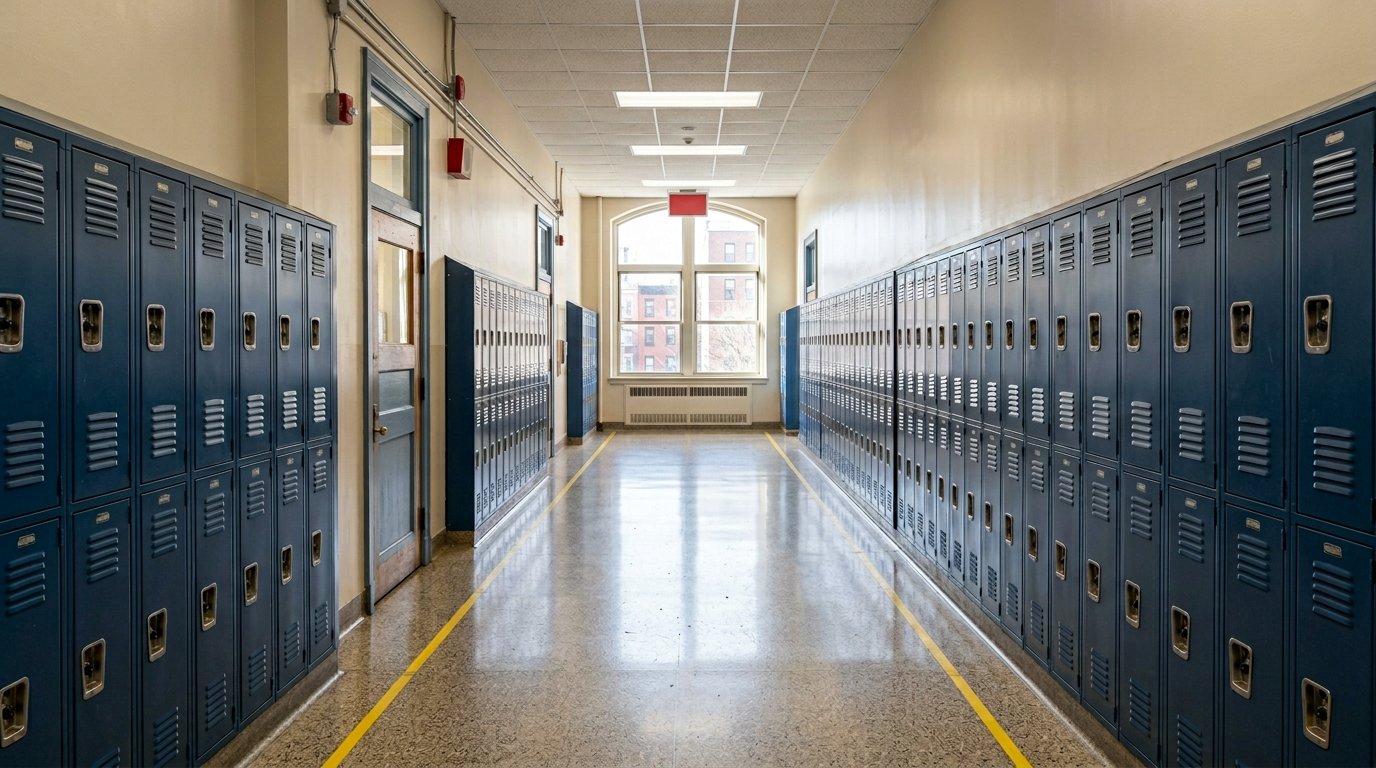
NYC schools operate at a scale that leaves little room for guesswork: high student density, shared touchpoints, strict visitor and background rules, and constant schedule changes for events, testing, and after-school programs. Facility managers and administrators typically need a school cleaning vendor that can document performance, respond quickly, and communicate clearly across principals, custodial teams, and central office stakeholders. GreenPoint Maintenance Services provides MBE-certified commercial cleaning across New York City and the tri-state area, with a proof-driven quality system designed for public-sector expectations. If you are evaluating vendors for an NYC campus or multi-site network, call 347-332-9348 to schedule a walkthrough and receive a fixed-price proposal with transparent scope.
Why NYC school cleaning is different from standard commercial janitorial
School facilities combine the traffic of a transit hub with the hygiene expectations of a healthcare-adjacent environment. Thousands of students and staff move through entrances, cafeterias, gyms, auditoriums, and restrooms on tight bell schedules, meaning soils accumulate faster and cleaning windows are shorter. NYC adds additional complexity: older building stock, mixed ventilation conditions, and frequent community use after hours (PTA meetings, sports leagues, adult education). GreenPoint approaches NYC school cleaning with a risk-based plan that prioritizes high-touch surfaces, restroom sanitation, cafeteria support areas, and indoor air quality practices rather than relying on generic “office” routines.
A practical benchmark many facility teams use is the “clean for health” idea promoted by industry groups like ISSA: appearance matters, but the goal is reducing contamination on the surfaces people actually touch. For a deeper baseline on what “clean” means in a measurable way, see GreenPoint’s breakdown of industry definitions and inspection targets in [ISSA Clean Standards appearance levels](/blog/issa-clean-standards-appearance-levels/) and how verification tools support consistency in [digital cleaning verification systems](/blog/digital-cleaning-verification-systems/).
DOE vendor expectations: documentation, backgrounding, and site coordination
When a school district or DOE-aligned procurement team evaluates cleaning vendors, they typically look beyond price and ask for evidence of reliability: insurance certificates, training records, staffing plans, and clear escalation processes. NYC school environments also require coordination with safety protocols, visitor management, and the building’s leadership team. GreenPoint Maintenance Services is SAM.gov registered and supports documentation-heavy environments where compliance and audit readiness are part of the day-to-day.
The practical takeaway for NYC decision-makers is to request a walkthrough-based scope that accounts for: building entry and security procedures, areas closed to outside staff during school hours, seasonal deep cleans, and the difference between classroom resets and true disinfection work. If your team wants a straightforward assessment, call 347-332-9348 to schedule a walkthrough; GreenPoint will map the building, confirm constraints, and propose a fixed-price scope with no hidden fees.
Neighborhood realities: transit hubs, older buildings, and after-hours community use
Local conditions shape school cleaning plans. A campus near major transit (e.g., 125th Street in Harlem, Atlantic Terminal in Downtown Brooklyn, or Jackson Heights–Roosevelt Avenue in Queens) can see higher tracked-in soils and more frequent entryway cleaning needs. Schools adjacent to parks and waterfront areas (Prospect Park, Flushing Meadows, or along the East River) may deal with seasonal pollen and moisture that affect floors and HVAC filters. GreenPoint builds NYC school scopes around these realities, including more frequent mat service coordination, targeted floor care, and seasonal adjustment windows.
Older NYC school buildings also have unique challenges: porous flooring, worn VCT, aging grout lines, and limited storage. If a vendor cannot safely store and label products, or does not train staff on chemical handling, the risk of incidents increases. For facility teams that want a compliance-oriented view of product labeling, SDS access, and training practices, GreenPoint also covers OSHA-aligned fundamentals in [OSHA cleaning chemical safety (GHS/SDS)](/blog/osha-cleaning-chemical-safety-ghs-sds/).
Proof you can show: JaniTrack verification and measurable cleanliness
In schools, “we cleaned it” is rarely enough—leaders want to see proof, especially after illness spikes or parent concerns. GreenPoint uses JaniTrack verification to provide timestamped, GPS-tagged photos and service records tied to specific areas. For higher-risk spaces (nurse rooms, restrooms, cafeterias), GreenPoint can also incorporate ATP testing as a rapid indicator of organic residue after cleaning. This turns conversations from opinions into data: what was cleaned, when, by whom, and how it performed against a target.
Verification also improves accountability across shifts and substitute staff, which is especially useful for campuses with evening programs or weekend events. If you want to understand how ATP fits into a practical QA program, see [what is ATP bioluminescence testing](/blog/what-is-atp-bioluminescence-testing-cleaning/) and how GreenPoint structures quality checks in [quality assurance commercial cleaning program](/blog/quality-assurance-commercial-cleaning-program/).
Staffing, retention, and the real cost of “low bid” janitorial
School environments expose weak staffing models quickly. High turnover leads to inconsistent routines, missed areas, and repeated retraining, which shows up as more complaints and more time spent managing the vendor. GreenPoint’s 98% client retention is not a slogan; it reflects the operational discipline of stable staffing, documented procedures, and verification that reduces “mystery work.” If you are comparing bids, it helps to consider total cost of ownership: management time, rework, complaints, and disruptions to school operations.
For procurement teams and facility directors, ask vendors how they handle coverage when an employee calls out, how they train new staff, and what QA system they use beyond a supervisor walk-through. GreenPoint provides fixed pricing—no hourly billing—so the incentive stays aligned with outcomes rather than time on site. To see how hidden costs add up, review [calculating true cleaning cost (TCO)](/blog/calculating-true-cleaning-cost-tco/) and the operational impact of churn in [janitorial employee turnover impact](/blog/janitorial-employee-turnover-impact/).
Green cleaning for schools: safer products without sacrificing performance
Parents, staff, and unions increasingly ask what products are used around children, especially in classrooms and early education wings. GreenPoint uses Green Seal certified products where appropriate and builds product plans around safe handling, dilution control, and clear labeling. This supports indoor air quality goals and reduces irritant exposure while still meeting the practical need for disinfection in restrooms and food-adjacent spaces.
A strong green program is not only about the product label; it’s about process: microfiber systems, color-coding to prevent cross-contamination, and HEPA filtration where needed. For facility teams standardizing their approach, GreenPoint’s guidance in [green cleaning for commercial buildings](/blog/green-cleaning-commercial-buildings-guide/) and [HEPA filtration commercial cleaning](/blog/hepa-filtration-commercial-cleaning/) can help frame the discussion in practical terms.
What to ask in an RFP or walkthrough for NYC school cleaning
A walkthrough is the fastest way to surface scope gaps that lead to disputes later. In NYC schools, the details matter: entrances and stairwells, gym bleachers, auditorium seating, cafeteria grease points, restroom partitions, nurse rooms, staff lounges, and storage constraints. Ask for a room-by-room scope, a clear frequency matrix, and a definition of what “deep clean” includes (and what it does not).
GreenPoint recommends adding proof requirements to the process: periodic JaniTrack photo verification, supervisor inspections, and ATP sampling in selected high-risk areas during the first 30–60 days. If your team needs help structuring an RFP that vendors cannot “interpret away,” start with [how to write RFP commercial cleaning](/blog/how-to-write-rfp-commercial-cleaning/) and the practical guardrails in [commercial cleaning contract key terms](/blog/commercial-cleaning-contract-key-terms/). Then call 347-332-9348 to schedule a walkthrough with GreenPoint and receive a fixed-price bid.
Need an NYC school cleaning partner that can prove performance? GreenPoint Maintenance Services delivers DOE-ready documentation, JaniTrack verification (timestamped GPS-tagged photos), and stable service backed by 98% client retention. Call 347-332-9348 or email info@greenpointms.com to schedule a walkthrough and get a fixed-price proposal with no hidden fees.