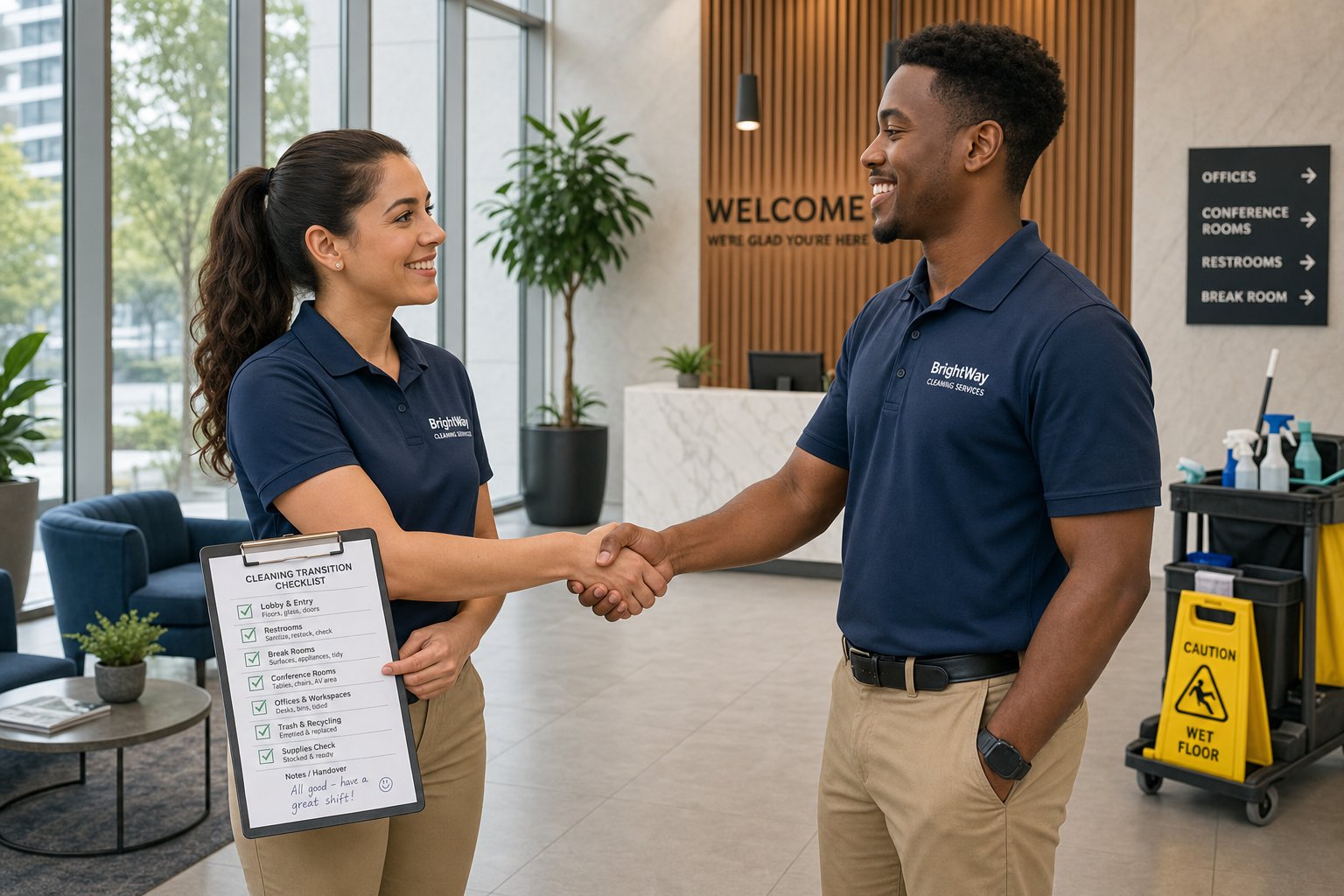
Switching janitorial vendors is one of the highest-risk moments in facility operations—because you are changing processes, people, and routines while the building still has to look perfect every day. The good news: a disciplined 30-day transition can eliminate service gaps, reset standards, and build a measurable QA baseline that prevents backsliding. This playbook is built for tri-state buildings (NY, NJ, CT) where access rules, freight elevator schedules, and tenant expectations can be intense. If you want GreenPoint Maintenance Services to run your transition with a fixed-price plan and documented proof of clean, call 844-814-0810 to schedule a walkthrough.
Before Day 1: lock the scope, access, and responsibilities (so nothing falls between teams)
Most transition problems are not "cleaning" problems—they are scope and access problems. Before the first shift, confirm who owns keys, badge access, alarms, loading dock rules, freight elevator times, trash staging locations, and who supplies consumables. In NYC, simple constraints—like a Midtown building restricting freight use during peak hours or a Downtown Brooklyn site coordinating with MTA-adjacent foot traffic—can break a schedule if not planned. GreenPoint starts every transition with a walkthrough and a written scope-by-area so both sides agree on what "done" means.
Days 1–3: baseline audit and a "stop the bleeding" stabilization checklist
Your first objective is stabilization: remove visible issues that generate tenant complaints (restrooms, lobby glass, elevator cabs, trash overflow, break rooms). GreenPoint performs a baseline audit on day one, documenting current conditions with photos and notes so you can measure improvement. We also identify high-risk areas for pathogens and cross-contamination and align cleaning frequency to the facility type; a helpful reference is [ISSA clean standards appearance levels](/blog/issa-clean-standards-appearance-levels/). If you want this audit packaged into a transition plan, call 844-814-0810.
Days 4–7: staffing alignment, zone maps, and the first supervisor cadence
Transitions fail when the staffing plan on paper does not match the building reality. During week one, finalize zone maps (who owns which floors/areas), shift start times, and coverage for call-outs. GreenPoint assigns an accountable supervisor and sets a routine for end-of-shift checks. This is also the week to confirm training requirements and safety expectations, including OSHA-aligned chemical handling and SDS access for the products used onsite.
Days 8–14: kickoff deep clean to reset the building (the "new vendor" moment)
A deep clean in the first two weeks creates a visible step-change and removes legacy buildup that makes daily cleaning look ineffective. Typical priorities include: restroom detail (grout lines, fixtures, drains), glass and stainless steel polishing in lobbies, break-room appliance exteriors, conference room touchpoints, and entry-mat programs. In winter months, salt and slush residue can require more aggressive floor care near entrances and vestibules. GreenPoint plans the deep clean around tenant schedules and can execute after-hours to avoid disruption—ask for a walkthrough at 844-814-0810.
Days 8–14: establish a measurable QA baseline with StockPoint + ATP (where it matters)
The fastest way to prevent "it was cleaned" arguments is to create a baseline of proof. GreenPoint uses StockPoint verification—timestamped, GPS-tagged photos tied to tasks—so facility managers can verify completion without walking every floor. For higher-risk environments or high-touch areas, ATP testing adds an objective cleanliness metric. If you want the method explained, see [digital cleaning verification systems](/blog/digital-cleaning-verification-systems/) and [what is ATP testing](/blog/what-is-atp-bioluminescence-testing-cleaning/). A baseline in week two becomes your yardstick for every monthly review.
Days 15–21: tenant communication plan (reduce noise while you improve outcomes)
In occupied buildings, perception drives complaint volume. Tell tenants what is changing, what to expect, and how to report issues. For example: signage in restrooms during detail cleaning, a short email to office managers about new nightly routines, and a single channel for requests. GreenPoint supports a clear escalation path so small issues do not become multi-day problems. If your property has multiple entrances near transit hubs (Penn Station, Grand Central, Atlantic Terminal, or major bus corridors), call out which entry points get extra attention during peak traffic hours.
Days 22–30: tighten the cadence—inspections, metrics, and a monthly operating rhythm
By week four, the work should be predictable and auditable. Lock a recurring inspection schedule, define audit checklists by area, and set a monthly review meeting with metrics. GreenPoint recommends tracking: audit score, complaint count, response time, attendance, photo-proof completion rate, and ATP results where used. This aligns with the philosophy that what gets measured gets managed—especially in multi-tenant buildings where expectations vary by floor. If you want help building this into your contract language, see [quality assurance commercial cleaning program](/blog/quality-assurance-commercial-cleaning-program/) (and if that link ever shows an underscore, it will still be readable, but we recommend using hyphens).
Common transition pitfalls (and how to prevent them)
The most common pitfalls are: unclear supplies responsibility, missing access to closets or mechanical rooms, underestimating restroom traffic, and failing to plan floor care. Another hidden issue is chemical compatibility—using the wrong product on stone, VCT, or LVT can cause damage. GreenPoint avoids this by documenting surfaces and using Green Seal certified products where possible. For facilities with sensitive IAQ needs, integrate HEPA filtration practices and review [indoor air quality commercial cleaning](/blog/indoor-air-quality-commercial-cleaning/) for best practices.
Why fixed pricing helps transitions: fewer disputes, faster stabilization
Hourly billing during a transition often creates conflict—because the building needs extra attention early, yet every additional hour becomes a negotiation. GreenPoint Maintenance Services uses fixed pricing and a defined onboarding plan so the first month focuses on outcomes, not timecards. The result is a cleaner building faster, with fewer surprises for property management. If you are comparing contract models, read [commercial cleaning contract key terms](/blog/commercial-cleaning-contract-key-terms/) and then schedule a walkthrough at 844-814-0810.
Planning a vendor changeover in NYC or the tri-state? GreenPoint Maintenance Services can execute a 30-day transition with a kickoff deep clean, StockPoint photo verification, and optional ATP testing—backed by a fixed-price proposal and a 98% client-retention track record. Call 844-814-0810 or email info@greenpointms.com to schedule a walkthrough and get a quote.