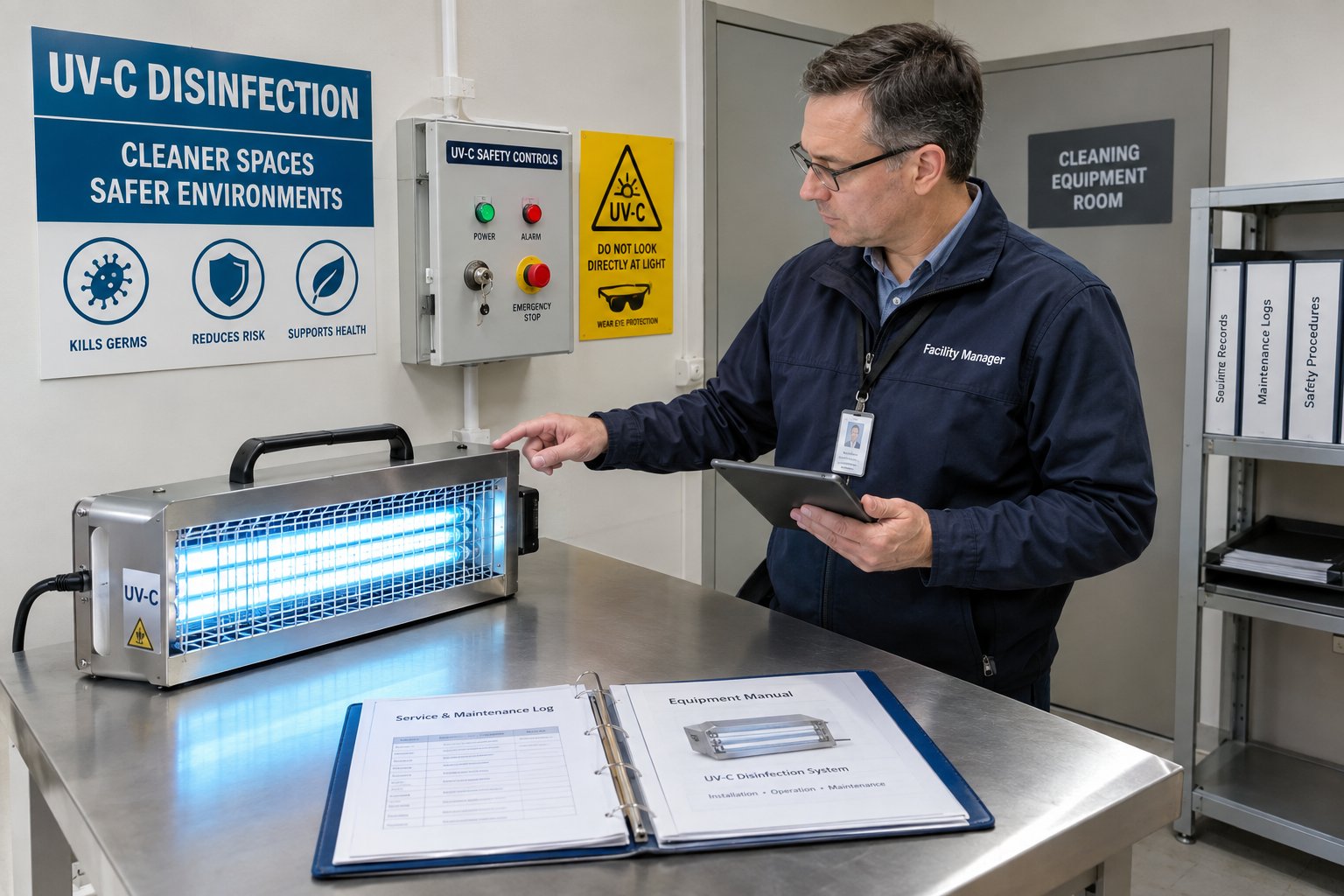
UV-C can be a useful layer in a commercial cleaning program, but a lamp, robot, or cabinet is not a complete sanitation plan. Facility managers in Manhattan, the Bronx, Brooklyn, Queens, Staten Island, Westchester, Long Island, New Jersey, Connecticut, Pennsylvania, and Florida need to ask how a vendor controls exposure, proves room coverage, and connects treatment to ordinary cleaning. This guide turns a promising technology into a measurable purchasing decision. GreenPoint Maintenance Services evaluates UV-C as one tool inside a documented program that starts with soil removal, uses registered products when appropriate, and produces evidence a property team can review.
Start With the Contamination-Control Objective
A buyer should define the problem before discussing wattage. Is the objective a lower microbial burden in an unoccupied exam room, a supplemental treatment for a school bus garage, odor control in a restroom, or a repeatable terminal-cleaning step? UV-C works best when the room is empty, surfaces are reasonably clean, line-of-sight limitations are understood, and the device has a validated dose at the target distance. It does not replace wiping, laundering, hand hygiene, or removal of organic soil. GreenPoint writes the objective into the scope so the proposal says what success means rather than promising that a machine makes every surface safe.
For a 10,000-square-foot Midtown office, the plan may call for closed-room treatment of conference suites after a respiratory illness report, while an urgent-care clinic near Jamaica requires a stricter terminal-cleaning sequence. In Newark, Stamford, Philadelphia, or a Florida coastal property, HVAC schedules, humidity, room geometry, and local building access can change the deployment. Ask the vendor to list room dimensions, furniture assumptions, reflective surfaces, treatment time, exclusion zones, and the action taken when a room fails inspection. A clear room list is more valuable than a dramatic equipment brochure.
Ask for Dose, Coverage, and Validation Data
The key technical question is not whether a lamp emits UV-C; it is whether the intended surface receives a validated dose for the stated organism and device configuration. Request irradiance or dose data, calibration intervals, sensor method, distance assumptions, shadowing limitations, and the test standard used by the manufacturer. Ask whether the data applies to the exact model and lamp age being proposed. GreenPoint also asks for a room-by-room treatment map and a repeatable acceptance record. A claim such as 99.9% reduction is incomplete unless the buyer knows the organism, surface, exposure time, and test conditions.
A practical specification can require an equipment check before every shift, a documented start and stop time, a signed room release, and an exception note for beds, cabinets, partitions, or equipment that blocks line of sight. If the vendor cannot explain how a 2,500-square-foot Brooklyn classroom differs from a 400-square-foot Staten Island restroom, the proposal is not ready. JaniTrack can hold timestamped GPS-tagged photos, room status, supervisor notes, and ATP readings when the sampling plan calls for them. That combination makes a technology claim auditable without pretending ATP is a direct UV-C dose meter.
Make Safety Controls Non-Negotiable
Direct exposure to germicidal UV-C can injure eyes and skin, so safety controls belong in the contract, not in a verbal orientation. Ask for motion sensors, door interlocks, emergency-stop operation, warning signs, key or badge control, audible and visual countdowns, and a written room-release procedure. OSHA expectations for hazard communication and training still apply, as do building security rules and the client's emergency procedures. A responsible UV-C cleaning vendor names a qualified operator, records training, and explains what happens if a sensor, interlock, or lamp fails. GreenPoint will not release a room until the approved control sequence is complete.
In a Bronx school, the plan should coordinate with NYC DOE access rules, custodial leadership, and child-protection procedures; in a Manhattan medical suite, it should coordinate with patients, clinical staff, and infection-prevention leadership. At a Long Island distribution center, the route must protect forklift traffic and night-shift employees. Ask who checks adjacent rooms, who holds the key, how contractors are notified, and how a near miss is reported. The lowest price is not a bargain if a property manager must explain an uncontrolled exposure or an undocumented room entry.
Confirm How UV-C Fits With Routine Cleaning
UV-C has no cleaning power against dust, grease, fingerprints, and residue. The service sequence should therefore identify soil removal, detergent cleaning, approved disinfection, drying or dwell time, UV-C treatment, and final release. CDC guidance on environmental cleaning supports a risk-based approach: high-touch surfaces and visibly soiled areas still need physical cleaning. GreenPoint uses color-coded microfiber systems, Green Seal certified product options, and area-specific checklists before considering an optional UV-C pass. The sequence is especially important in healthcare, childcare, and food-adjacent spaces where residue and contact patterns vary.
A useful contract distinguishes daily work from periodic technology work. A Queens dental office might need every-visit surface cleaning, nightly restroom service, and an unoccupied UV-C treatment after a deep clean; a Westchester office may need UV-C only for an incident response. The proposal should identify who moves furniture, who protects electronics, what stays outside the treatment area, and how the client is notified when a room is unavailable. For background on selecting a complete provider, compare [how to choose a commercial cleaning company](/blog/how-to-choose-commercial-cleaning-company/) and [electrostatic disinfection explained](/blog/electrostatic-disinfection-explained/).
Compare Vendor Credentials and Equipment Ownership
A serious evaluation includes the operator's training, insurance, equipment model, maintenance history, replacement-lamp policy, and manufacturer support. Ask whether the vendor owns the equipment or is reselling a pilot, and whether the quoted price includes calibration, batteries, filters, repairs, travel, and reporting. GreenPoint Maintenance Services is MBE/MWBE certified in New York programs, registered in SAM.gov, and able to document a broader cleaning operation rather than a single-device service. Those credentials do not prove UV-C performance by themselves; they show that procurement, risk, and continuity questions can be answered by an accountable provider.
The buyer should request two references with similar room geometry and operating constraints, plus a sample report with identifying information removed. Check whether the reference received room-level evidence or merely a completion invoice. A vendor that serves the Port Authority area, Grand Central offices, downtown Brooklyn, Jersey City, Stamford, or Philadelphia should explain travel windows and contingency coverage. GreenPoint assigns an operations contact, sets a response rule, and uses fixed pricing with no hourly billing or hidden fees after the walkthrough. Call 347-332-9348 if procurement needs a scope that can be compared line by line.
Set an Acceptance Test Before the Pilot
A pilot should have a baseline, a defined treatment area, a control method, and a decision rule. Record room dimensions, occupancy, surface types, existing cleaning frequency, and any relevant ATP readings before the pilot. After treatment, verify equipment logs, room-release records, visual condition, and the agreed sample results. Do not make a broad health claim from one swab or one photo. GreenPoint presents the findings as operational evidence: what was treated, what was inaccessible, which exceptions were corrected, and whether the program is ready for a larger route.
For a 20-room medical practice, the pilot might cover four representative rooms over two service nights and compare the documentation workload with the clinical schedule. For a 50,000-square-foot school, it might cover a gym, nurse's office, two classrooms, and a restroom after deep cleaning. Include staff feedback, door-control observations, treatment time, and the cost per room. JaniTrack can show the time line and corrective actions to an authorized client dashboard. Schedule a walkthrough at 347-332-9348 before buying equipment; GreenPoint can quote a controlled pilot rather than an open-ended experiment.
Price the Program, Not Just the Machine
UV-C proposals can hide labor and access costs behind a device price. Ask for the number of rooms, visits per week, treatment minutes, setup and breakdown time, travel, supervisor review, consumables, calibration, emergency response, and reporting. A 30-minute treatment can require an additional 20 minutes for isolation, signage, inspection, and release. A fixed price should explain what happens when rooms are occupied, furniture blocks coverage, a security delay changes the route, or the client adds a floor. GreenPoint separates recurring cleaning, periodic treatment, and optional incident response so a facility manager can compare total cost of ownership.
Use square-footage and room-count benchmarks only as planning tools. A 100,000-square-foot office with open seating may have fewer treatment zones than a 20,000-square-foot clinic with many small rooms and turnover between patients. A hotel near Times Square, a school in Newark, and a warehouse in Allentown each have different access windows. GreenPoint does not bill hourly and does not add hidden fees; the walkthrough confirms scope, frequency, and exclusions before pricing. Call 347-332-9348 or email info@greenpointms.com for a documented quote tied to your floor plan.
Build Reporting That Facility Teams Will Use
A technology program earns trust when the report is concise enough to read and detailed enough to investigate. Require a daily or per-visit record showing site, operator, room, equipment ID, start and stop time, safety check, exceptions, release, and corrective action. Add weekly trend data for missed rooms, access delays, repeat findings, and service response. GreenPoint's JaniTrack workflow can combine timestamped GPS-tagged photos, supervisor inspections, and ATP testing where appropriate. The record supports a facilities meeting without implying that a dashboard replaces professional judgment or an infection-prevention program.
Local managers also need a practical escalation path. A property in Long Island City may need a same-night response when a tenant reports a concern; a Westchester campus may need next-day coordination with security; a Florida facility may need storm-related access changes. Put the phone tree in the scope and identify who approves a room release. GreenPoint provides a named contact and can schedule a walkthrough at 347-332-9348. With 98% client retention, GreenPoint has a strong reason to correct exceptions quickly and make the evidence understandable to the people paying for the service.
Frequently Asked Questions
Is UV-C a replacement for commercial cleaning?
No. UV-C is a supplemental treatment that depends on an empty room, validated dose, line of sight, and safety controls. Soil removal, detergent cleaning, registered disinfection products, ventilation, and hand hygiene remain essential. GreenPoint defines the role of UV-C in the scope before quoting.
What should a UV-C vendor document?
Request equipment ID, operator, room, dimensions, treatment time, dose or irradiance method, safety checks, exceptions, room release, and corrective action. GreenPoint can organize timestamped GPS-tagged photos and inspection records in JaniTrack, with ATP sampling when it is part of the approved plan.
Can UV-C be used in an occupied office or school?
Only when the exact equipment and operating procedure are designed for that use and exposure controls are demonstrated. Many germicidal UV-C room treatments require the space to be empty. GreenPoint coordinates access with building staff and does not release a room until the approved safety sequence is complete.
How much does UV-C cleaning cost?
Cost depends on rooms, square footage, access windows, treatment frequency, setup time, equipment, reporting, and travel. A walkthrough produces a fixed quote rather than an hourly guess. Call 347-332-9348 or email info@greenpointms.com with a floor plan and desired schedule.
Does GreenPoint serve New Jersey, Connecticut, Pennsylvania, and Florida?
Yes. GreenPoint serves the New York City boroughs, Westchester, Long Island, New Jersey, Connecticut, Pennsylvania, and Florida. A site review confirms staffing, access, local requirements, and the evidence package before service begins.
Schedule a UV-C program walkthrough with GreenPoint Maintenance Services at 347-332-9348 or info@greenpointms.com. Receive fixed pricing, written safety controls, JaniTrack verification, and a room-level acceptance plan backed by GreenPoint's 98% client retention record.