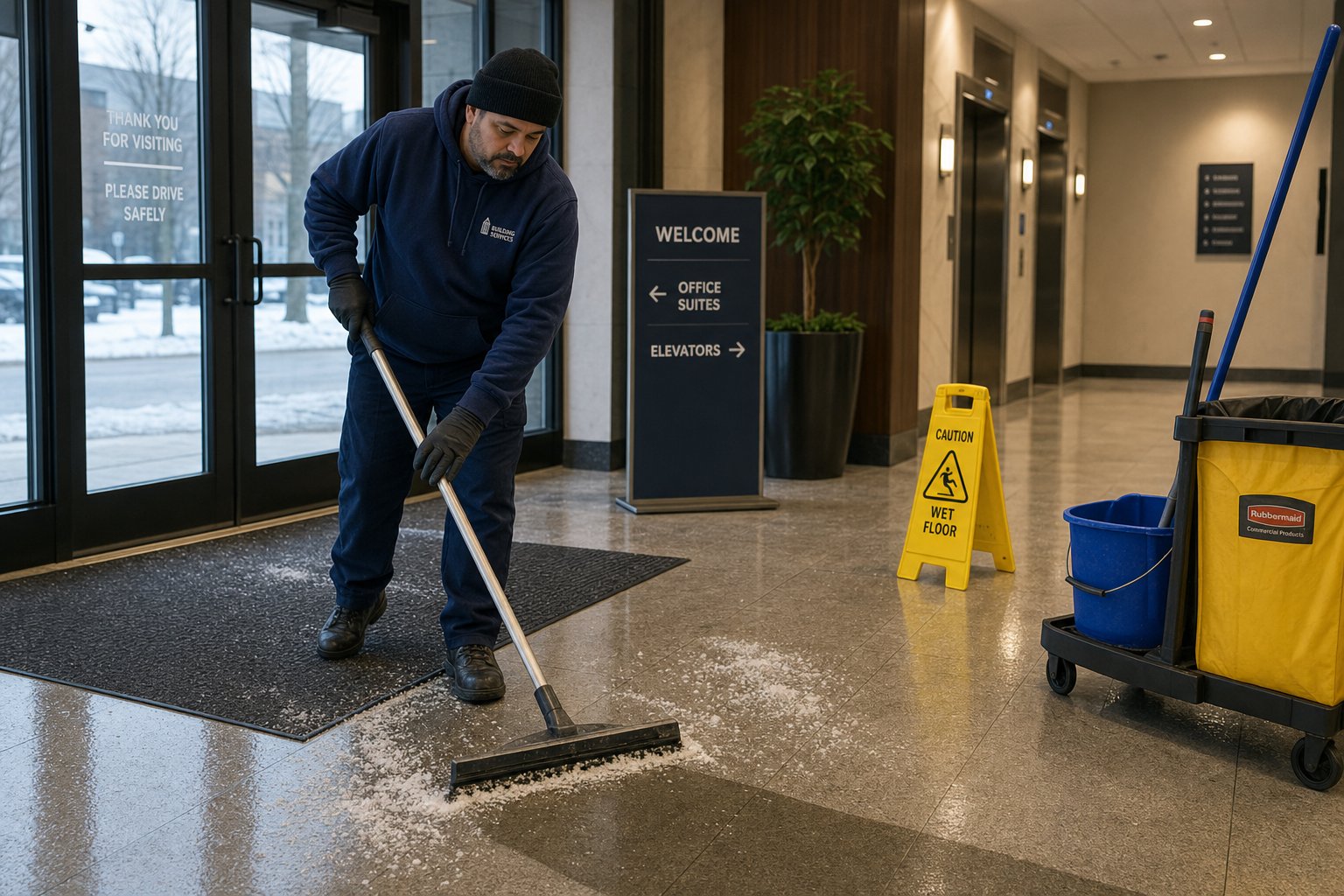
Winter in the Tri-State area turns every entrance into a floor-care test. Rock salt, de-icing brine, slush, and grit arrive on shoes at Penn Station, Grand Central Terminal, PATH stations, Metro-North platforms, and neighborhood sidewalks from Midtown Manhattan to White Plains and Long Island. For a commercial property, the right response is not a single extra mopping shift; it is a documented winter program that protects finishes, reduces slip exposure, and keeps tenants moving. This guide explains a practical plan for offices, schools, healthcare sites, retail, warehouses, and multi-tenant buildings across New York, New Jersey, Connecticut, and Pennsylvania. GreenPoint Maintenance Services builds that plan around entryway controls, measured inspections, fixed pricing, and JaniTrack evidence. If a facility manager wants a winter walkthrough or a written quote, call GreenPoint at 347-332-9348.
Why winter salt damages commercial floors
Sodium chloride crystals are abrasive. When salt dries on resilient flooring, stone, terrazzo, concrete, or finished wood, foot traffic grinds the crystals into the surface. Brine also leaves a hygroscopic residue that attracts moisture, so a lobby can look dull or feel tacky long after a storm. On polished stone, acidic or overly aggressive cleaners can compound the problem by etching the finish. The cost is cumulative: a 20,000-square-foot office with three busy entrances may need repeated spot work every day, while a warehouse dock can spread grit hundreds of feet into aisles.
The winter risk is operational as well as cosmetic. The [ISSA clean standards and appearance levels](/blog/issa-clean-standards-appearance-levels/) framework helps teams define what acceptable appearance looks like, but managers still need a response trigger: visible crystals, a tracked-in wet zone, a full mat, or a slip complaint. GreenPoint Maintenance Services trains crews to treat those triggers as work orders, not subjective impressions. GreenPoint can document the condition with timestamped, GPS-tagged JaniTrack photos so a building owner can see whether an entrance was checked before the morning rush and after the evening commute.
Build a three-zone entrance defense
A winter entrance should have an exterior scraper mat, an absorbent walk-off mat, and a clean transition zone inside the security line. In Manhattan towers near Times Square, Herald Square, or the World Trade Center, the exterior mat may need frequent emptying because pedestrian volume overwhelms its capacity. In Brooklyn and Queens facilities near Atlantic Terminal, Court Square, Astoria Boulevard, or Jamaica Center, the same principle applies even when the doorway is smaller. A useful benchmark is to place enough matting for approximately 10 to 15 shoe steps before a person reaches the main floor; the exact layout depends on fire exits, ADA clearances, and the landlord’s plan.
Mats are controls, not storage bins. GreenPoint checks whether edges curl, backing slides, water pools beneath the mat, or the mat has reached saturation. Crews vacuum loose grit before damp mopping so they do not turn salt into paste. At schools, clinics, and senior communities, preserve clear routes for wheelchairs and walkers and use wet-floor signs where they are visible from the approach. GreenPoint Maintenance Services can schedule an entrance check around opening time, lunch, and the afternoon commute, with service intervals adjusted after the first storm rather than guessed in a spreadsheet.
Choose the right chemistry for salt residue
Routine residue removal starts with the least aggressive method that works: dry soil removal, cool or lukewarm water, and a neutral cleaner approved for the flooring manufacturer. A dedicated neutralizing cleaner may be appropriate for heavy mineral residue, but dilution and dwell time matter. Never mix products. OSHA’s Hazard Communication Standard requires accessible labels and Safety Data Sheets, and the [GHS and SDS guide for cleaning chemicals](/blog/osha-cleaning-chemical-safety-ghs-sds/) is a useful reference for facility managers reviewing winter supplies. GreenPoint uses Green Seal certified products where the surface and performance requirements allow, while keeping product selection tied to the finish rather than a generic green claim.
Stone, VCT, ceramic tile, carpet, and sealed concrete each need a different approach. On VCT, repeated overwetting can push moisture into seams; on carpet, salt wicking can create a white ring after the surface appears dry. On unfinished concrete, a low-moisture scrub may be safer than flooding the slab. GreenPoint records the surface type, product, dilution, and observed result in the site plan. That record reduces the chance that a relief worker uses an acid cleaner on marble or a high-alkaline degreaser on a sensitive finish.
Set measurable inspection and response standards
A winter scope should name inspection locations and response times. For example, a building may require entrance checks every 60 minutes during active snowfall, a five-minute response to visible pooling, and a documented deep clean within 24 hours after a storm. Those numbers are starting points, not universal law; a 50,000-square-foot corporate lobby, a Bronx community clinic, and a Westchester warehouse will generate different traffic patterns. The key is to define the condition, owner, and deadline. The [cleaning audit checklist for facility managers](/blog/cleaning-audit-checklist-facility-managers/) can help convert observations into a repeatable scorecard.
GreenPoint uses JaniTrack to pair visual checks with timestamps, GPS-tagged photos, and supervisor review. When ATP testing is part of a high-touch or healthcare scope, an ATP reading can establish a baseline and help verify that a cleaning method changed the measured condition; it is not a substitute for visual inspection or pathogen testing. GreenPoint can share dashboard evidence with an operations contact, and the manager can use the history to identify whether the same lobby needs more matting, more labor, or a different schedule.
Protect floors after the storm, not only during it
The first clear day is the right time to remove the residue that daily spot cleaning cannot reach. A post-storm service can include edge vacuuming, low-moisture scrubbing, grout-line attention, carpet extraction in designated zones, and finish inspection. VCT or resilient floors may need interim spray buffing only when the existing finish and manufacturer instructions support it. Stone may require a pH-appropriate clean and a separate maintenance plan. The [VCT floor-care strip, seal, and wax guide](/blog/vct-floor-care-strip-seal-wax-guide/) explains why stripping too frequently can be as damaging as neglecting the floor.
For facilities in Staten Island, Newark, Jersey City, Stamford, or New Haven, snow response may be complicated by longer travel times and multiple entrances. Put the post-storm scope in the contract before weather arrives. GreenPoint Maintenance Services offers fixed pricing instead of hourly billing, so the owner can define included square footage, mat handling, and approved add-ons. GreenPoint’s supervisors can also photograph high-risk areas such as elevator thresholds, loading-dock corridors, and the base of revolving doors where moisture often hides.
Coordinate cleaning with safety and local access rules
A cleaning plan cannot block an accessible route, fire exit, elevator landing, or transit-facing sidewalk. New York City buildings should coordinate with their building management and local maintenance requirements, while properties in New Jersey, Connecticut, and Pennsylvania should follow their own municipal snow-removal and sidewalk rules. OSHA does not prescribe a single salt-removal schedule, but employers still have a responsibility to control recognized slip hazards. The [NYC building maintenance and Local Law guide](/blog/nyc-local-law-building-maintenance/) gives managers a starting point for connecting cleaning records with building obligations.
At a busy office near Grand Central, a crew may need to stage signs and equipment so commuters can pass safely. At a school near Flushing or a medical office near Jamaica, the route must remain understandable to children, patients, and visitors. GreenPoint communicates the work window, protects pedestrian flow, and removes signs as soon as the surface is safe. A short pre-storm walkthrough with the property manager can identify hose bibs, drain locations, mat storage, elevators, and restricted areas before the first shift begins.
Estimate labor and materials without hidden winter charges
Winter budgets improve when the scope uses measurable units. Track entrance count, mat dimensions, expected storm days, square footage, floor types, cleaning frequency, and the number of after-hours callouts. A 10,000-square-foot professional office with two entrances may need different labor than a 10,000-square-foot retail store with four doors and 2,000 daily visitors. The [commercial cleaning cost per square foot guide](/blog/commercial-cleaning-cost-per-square-foot/) explains why a square-foot rate alone never describes the full total cost of cleaning.
GreenPoint Maintenance Services presents a fixed proposal that spells out routine service, storm-response conditions, consumables, equipment, and exclusions. There is no hourly billing and no hidden fee for a manager who needs to understand what is included. GreenPoint can schedule a walkthrough, revise the frequency after the first weather event, and provide a quote by calling 347-332-9348 or emailing info@greenpointms.com. That clarity is especially useful for government, school, and multi-tenant procurement teams that need a defensible service record.
FAQ: Tri-State winter salt and snow floor care
Q: How often should a commercial lobby be checked during snowfall? A: Start with every 60 minutes during active snowfall and shorten the interval when the entrance has heavy pedestrian traffic, visible pooling, or a full mat. GreenPoint documents the actual condition so the property can tune the schedule instead of paying for a blind fixed interval.
Q: Can salt damage be removed with vinegar or household products? A: Do not improvise. Flooring manufacturers, OSHA chemical-safety rules, and the site SDS determine the safe product. GreenPoint identifies the floor type first, uses approved dilution, and records the method; a walkthrough can be scheduled at 347-332-9348.
Q: Are winter mats enough to prevent slips? A: Mats reduce tracked-in water and grit when they are correctly sized, positioned, maintained, and replaced before saturation. They do not eliminate hazards. GreenPoint combines mat inspections, prompt removal, signage, and JaniTrack verification for a complete control plan.
Q: Does GreenPoint serve buildings outside Manhattan? A: Yes. GreenPoint Maintenance Services serves Manhattan, the Bronx, Brooklyn, Queens, Staten Island, Westchester, Long Island, New Jersey, Connecticut, Pennsylvania, and Florida, with the schedule set around the site’s access and storm conditions.
Q: How can an owner request a winter floor-care quote? A: Call GreenPoint at 347-332-9348 or email info@greenpointms.com to schedule a walkthrough. The proposal can identify entrances, square footage, floor types, response triggers, and fixed pricing before the next storm.
Prepare before the forecast changes: call GreenPoint Maintenance Services at 347-332-9348 to schedule a Tri-State winter walkthrough and fixed-price quote. GreenPoint backs its program with JaniTrack timestamps, GPS-tagged photos, and a 98% client-retention record.