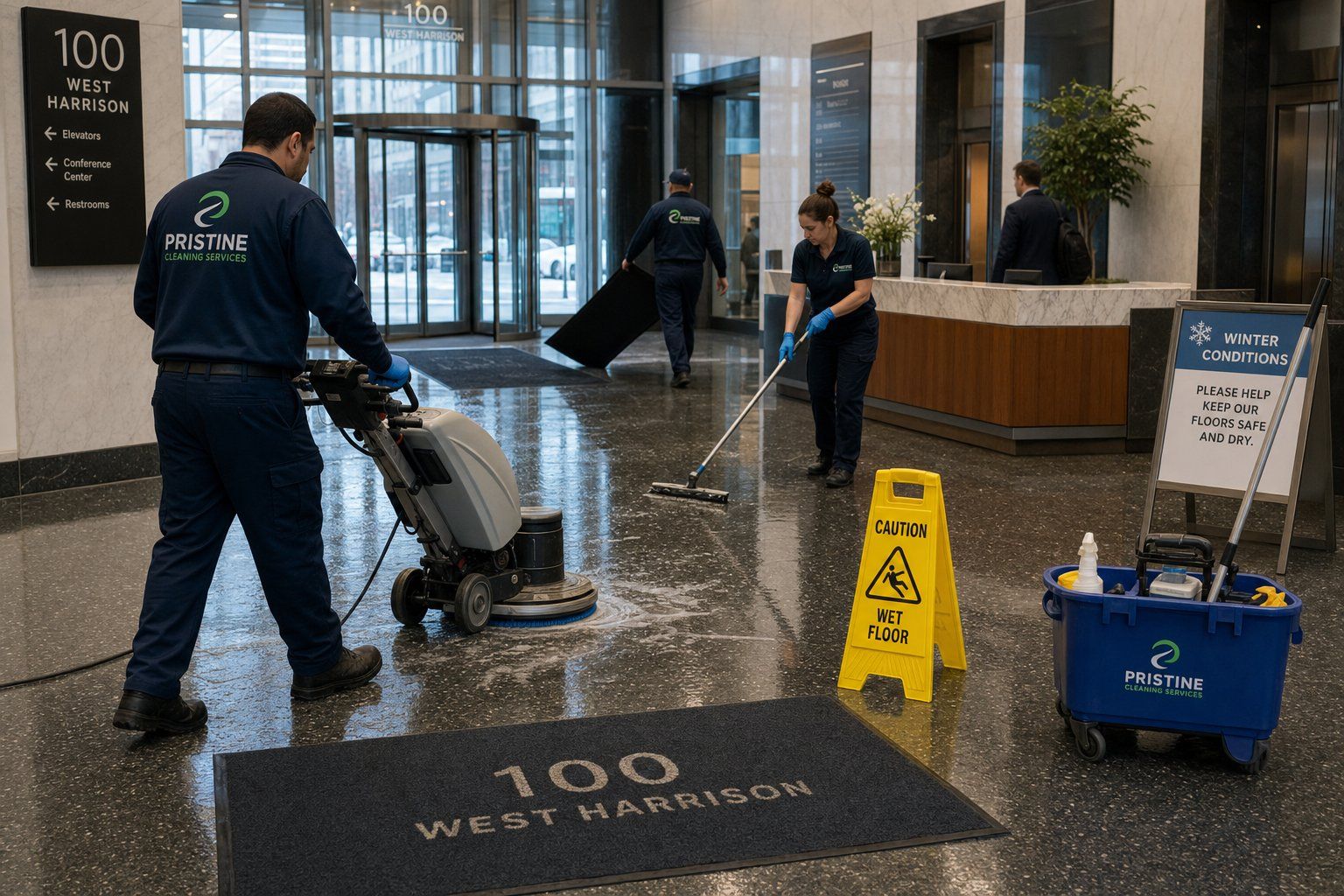
Winter salt and snow turn a clean commercial lobby into a safety and appearance problem within minutes. Offices near Penn Station, Grand Central, PATH stations, Metro-North, Long Island Rail Road, Newark Penn, Stamford, and Philadelphia transit corridors receive tracked-in water, calcium chloride, grit, and slush from employees and visitors. A winter program needs entry mats, patrols, floor-safe chemistry, drying, signage, and documented response—not a single nightly mop. GreenPoint Maintenance Services Corp builds fixed-price seasonal programs across Manhattan, the Bronx, Brooklyn, Queens, Staten Island, Westchester, Long Island, New Jersey, Connecticut, Pennsylvania, and Florida. Call 844-814-0810 to schedule a snow-season walkthrough.
Why winter soil behaves differently in a lobby
Snowmelt carries dissolved de-icing salts and abrasive grit into the first 20 to 30 feet of a lobby, then wheels and shoes spread it toward elevators, security desks, turnstiles, and corridor thresholds. As water evaporates, salt can leave a white haze, attack some finishes, and create a slip risk when the film stays wet. A 15,000-square-foot Midtown lobby with 500 daily entries needs a different patrol rhythm from a 5,000-square-foot suburban office with 80 entries. GreenPoint Maintenance Services starts with traffic, entrances, floor type, drains, mat capacity, and building hours.
The goal is controlled soil removal and quick drying. Stronger chemical is not automatically better; the cleaner must follow product labels and floor-manufacturer guidance. GreenPoint uses Green Seal certified product options where compatible, color-coded microfiber, wet-floor signs, and StockPoint records so the property manager sees when a wet zone was addressed.
Design the entrance mat system
Use a three-zone approach where space allows: exterior scraper mat, absorbent transition mat, and interior walk-off mat. The exact length depends on the entrance, but a practical starting point is 10 to 15 feet of combined matting before a visitor reaches the main floor. Mats should lie flat, have intact edges, and be vacuumed or exchanged before they become saturated. GreenPoint can map mat locations and set an exchange trigger based on weather and traffic rather than waiting for a visible puddle.
Ask who owns mat rental, shaking, laundering, replacement, and storage. A mat that is full of salt cannot absorb the next wave of snow. GreenPoint’s proposal separates recurring lobby cleaning from mat service and documents exceptions when a landlord or building engineer controls the entrance. Email info@greenpointms.com or call 844-814-0810 for a site review.
Set patrol frequencies around storms and transit peaks
A winter schedule should have storm mode, ordinary cold-weather mode, and recovery mode. During an active storm, a porter may inspect entrances every 15 to 30 minutes, replenish mats, remove slush, and place signs; after closing, the crew performs detailed salt removal and floor care. The correct interval depends on precipitation, foot traffic, entrance count, and building policy. GreenPoint documents the agreed response window so security and facilities know when to call for an urgent spill.
Locations near the 34th Street, Fulton Street, Atlantic Avenue, Journal Square, Newark Penn, Stamford, or Center City transit networks may see surges when trains are delayed or events end. Manhattan properties should coordinate with building security and sidewalk conditions; New Jersey, Connecticut, and Pennsylvania sites should include parking-lot and loading-door transitions. Call 844-814-0810 to build a route that matches actual arrivals.
Match salt removal to the floor finish
Salt haze behaves differently on polished concrete, terrazzo, VCT, ceramic tile, natural stone, rubber, and carpet. The scope should name the finish, approved cleaner, dilution, dwell time, extraction or rinse method, drying plan, and who approves periodic restoration. GreenPoint does not use an unapproved acidic or abrasive treatment because it is faster; the team follows manufacturer and product-label directions and escalates a damaged finish to facilities.
For VCT, frequent neutral cleaning and periodic finish maintenance may protect appearance; for stone, residue and water control are critical; for carpet, extraction and spot treatment should be coordinated with drying and occupancy. The [VCT floor care strip, seal, and wax guide](/blog/vct-floor-care-strip-seal-wax-guide/) explains why winter response and periodic floor restoration should be priced as different tasks.
Control water, signage, and slip hazards
A wet-floor sign is part of a process, not a storage solution. GreenPoint places signs before wet work, blocks a small area when needed, keeps cords and carts out of travel paths, and removes signs only after the surface is safe. Supervisors inspect thresholds, elevator entrances, mat edges, ramps, stair landings, and accessible routes. OSHA walking-working-surface principles and the building’s safety plan should inform training and incident reporting.
The property should define who responds to a visitor fall, where incident forms live, and how a damaged mat or leaking door is escalated. StockPoint can record the time, location, response, inspection, and corrective action without substituting for the building’s formal incident process. GreenPoint reports a failed drain, door sweep, or roof leak as a facilities issue rather than asking cleaning staff to compensate forever.
Keep elevators, turnstiles, and public touchpoints ready
Winter soil travels beyond the lobby. Elevator thresholds, button panels, handrails, security desks, turnstiles, restroom entries, and shared umbrellas may need daytime checks. GreenPoint can add a porter route for touchpoints and restocking while an evening crew handles detailed floors, waste, and corners. Do not spray directly on elevator controls, access readers, or electronics; use the approved cloth-and-product method.
Track supply-outs, response time, visible residue, mat saturation, complaints, and repeat wet zones. The [restroom cleaning best practices for high-traffic buildings](/blog/restroom-cleaning-best-practices-high-traffic/) offers a useful model for inspection cadence in public areas. GreenPoint’s StockPoint dashboard can show authorized managers which zones were checked and which exceptions remain open.
Plan snow, salt, and access logistics locally
Snow operations affect more than the cleaning closet. Put sidewalk clearing, parking, loading, elevator reservations, freight access, building closures, and emergency contacts into the seasonal plan. NYC buildings may coordinate with property management and DSNY sidewalk responsibilities; New Jersey, Connecticut, and Pennsylvania properties should confirm their municipality and landlord arrangements. GreenPoint does not assume that a janitorial contract includes snow removal or exterior plowing; the proposal names the boundary.
For a campus in Westchester or Long Island, the route may depend on a cleared parking lot; for a Brooklyn or Queens property, subway and street conditions can affect arrival; for a Newark or Stamford office, the building may switch to a weather schedule. GreenPoint uses a contact tree and backup staffing plan. Email info@greenpointms.com or call 844-814-0810 before the first major storm.
Budget winter service with fixed assumptions
A seasonal quote should show routine visits, storm-mode patrols, mat service, salt removal, consumables, porter coverage, periodic floor work, emergency response, and exclusions. GreenPoint Maintenance Services provides fixed pricing with no hourly billing and no hidden fees, while stating the number of entrances, square footage, floor finishes, and response assumptions. The [commercial cleaning cost per square foot](/blog/commercial-cleaning-cost-per-square-foot/) explains why the same square footage can require very different labor when traffic and weather are different.
Ask for a written change trigger for an extraordinary storm, closure, construction, or tenant event. GreenPoint’s MBE/MWBE certifications, SAM.gov registration, Green Seal options, and 98% client retention support procurement, but the property’s actual mat capacity and response window determine the plan. Call 844-814-0810 for a no-obligation walkthrough.
Review each storm and the end-of-season condition
After a major event, GreenPoint reviews response time, mat saturation, salt findings, complaints, slips or near misses, staffing, and equipment. StockPoint can connect a patrol to the zone, timestamp, inspection, and corrective action. At season end, inspect baseboards, thresholds, carpets, floor finish, mat wear, and storage before the next winter. Record what should change while the details are fresh.
For a multi-property portfolio across NY, NJ, CT, PA, and Florida, use a common winter scorecard but retain local weather and access notes. GreenPoint Maintenance Services can train a common team on wet-floor and chemical controls while each building sets its own storm trigger. A clear review turns one winter’s experience into next year’s fixed proposal.
Winter lobby cleaning is a response system: keep soil outside, remove it quickly when it arrives, dry the floor, protect the finish, and document the exception. GreenPoint’s 98% client retention comes from repeatable service, but each property still needs a walkthrough because mats, entrances, transit peaks, and floor types differ. Call 844-814-0810 or email info@greenpointms.com to set the storm-mode trigger and escalation tree.
GreenPoint Maintenance Services can coordinate porter checks, evening floor work, and local building contacts across Manhattan, the Bronx, Brooklyn, Queens, Staten Island, Westchester, Long Island, NJ, CT, and PA. StockPoint provides timestamped GPS-tagged records, approved photos where permitted, and corrective-action status. Fixed pricing with no hourly billing and no hidden fees makes the winter assumptions visible to procurement and property operations.
A written winter plan also gives security and reception a shared answer when a visitor reports a puddle, a damaged mat, or a slippery threshold. GreenPoint names the first responder, the escalation contact, and the inspection record so the issue is closed rather than passed between departments.
FAQ: practical answers for facility and procurement leaders
How often should a commercial lobby be checked during snow? During active snow, many high-traffic entrances need checks every 15 to 30 minutes, but the right interval depends on precipitation, traffic, mat capacity, and building policy. GreenPoint sets the patrol frequency during the walkthrough and can switch to a storm-mode route.
How do you remove salt from commercial floors? Use a method matched to the floor finish, approved product, label directions, dwell time, water control, and drying plan. GreenPoint avoids unapproved acids or abrasives and separates recurring cleaning from periodic floor restoration.
How much entry matting does a lobby need? A practical starting point is 10 to 15 feet of combined scraper and absorbent matting where the entrance allows, with maintenance before mats become saturated. GreenPoint maps mat capacity, ownership, exchange triggers, and storage in the proposal.
Does winter cleaning include snow removal outside? Not automatically. The contract should state whether sidewalks, parking lots, loading areas, mats, and interior floors are included or assigned to a landlord or specialty contractor. GreenPoint names the boundary and reports unsafe exterior conditions.
How do I get a winter lobby cleaning quote? Call GreenPoint Maintenance Services at 844-814-0810 or email info@greenpointms.com. We will review entrances, traffic, transit peaks, mats, floor finishes, storm response, and local access before providing fixed pricing.
GreenPoint Maintenance Services Corp can prepare a winter salt and snow lobby program with a no-obligation walkthrough. Call GreenPoint at 844-814-0810 or email info@greenpointms.com for fixed pricing, storm-mode patrols, StockPoint verification, and floor-safe salt removal across the tri-state area.