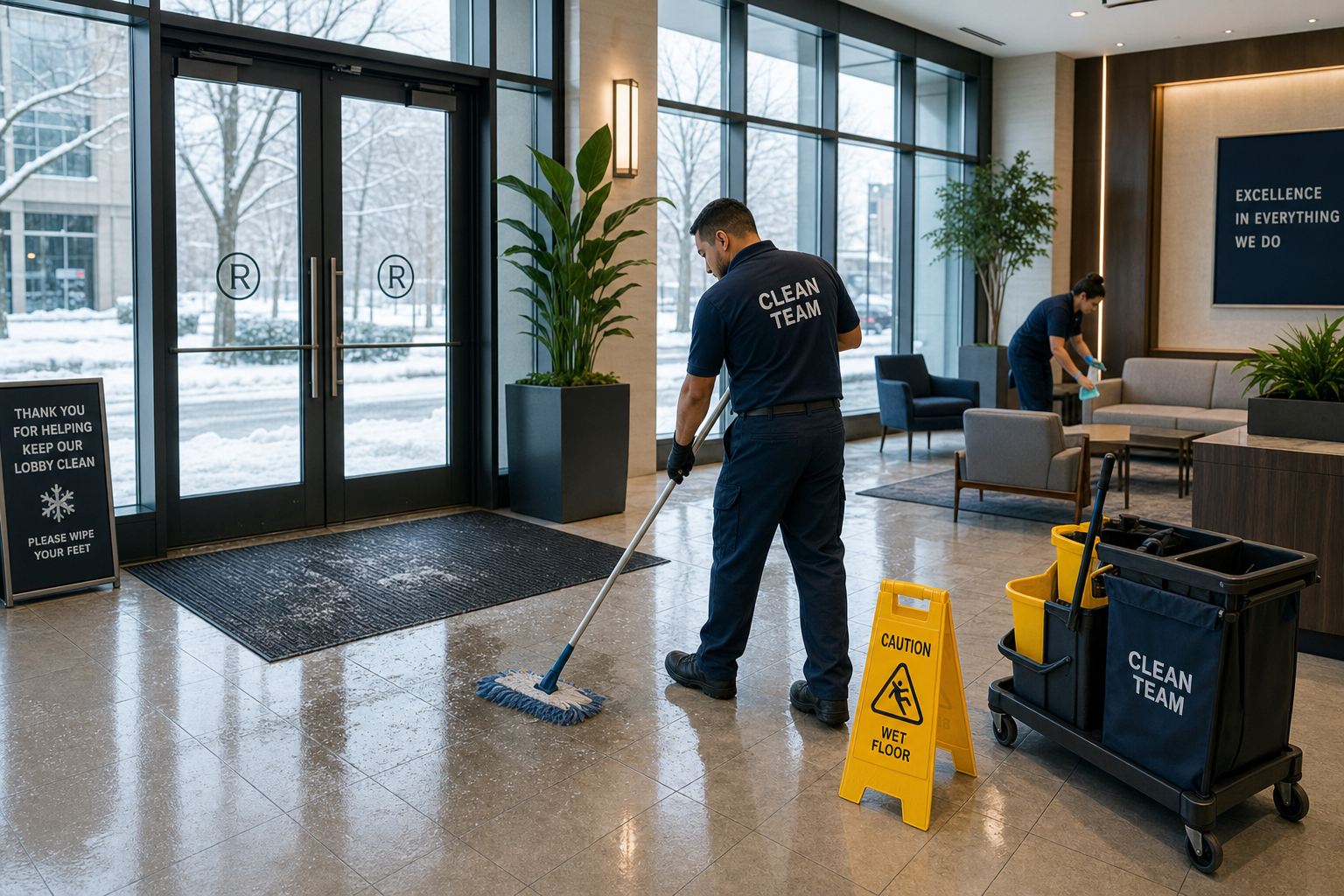
In NYC and the tri-state, winter maintenance is a floor-protection game. Snow melt and de-icing salts get tracked into lobbies, elevators, and corridors, where they can etch stone, haze finishes, and create slip risk. GreenPoint Maintenance Services builds winter salt-mitigation programs that combine entry matting strategy, neutralizing floor chemistry, and measurable daily routines verified with StockPoint. For a walkthrough and fixed-price winter plan, call 844-814-0810.
Why snow and salt destroy floors (and why “mopping more” often makes it worse)
Rock salt (sodium chloride) and common ice melt blends bring two problems: abrasive grit that scratches surfaces and dissolved salts that leave residue as water evaporates. If teams use the wrong cleaner or skip neutralization, residue can build up and attract more soil, creating a gray “winter film” that looks like poor cleaning even when staff is working hard. Over-wetting can also push salty water into grout lines and floor edges.
GreenPoint starts by identifying your floor types—stone, VCT, LVT, ceramic, polished concrete—and sets the correct winter chemistry and equipment for each. If you are planning winter programs, review [winter facility maintenance checklist northeast](/blog/winter-facility-maintenance-checklist-northeast/) and call 844-814-0810 for a building-specific plan.
Entry matting design: the cheapest way to reduce winter damage
The best winter cleaning strategy begins outside the door. A practical standard is a minimum 12–15 feet of matting coverage from entrance to interior transition so shoes can shed moisture and salt. For large lobbies in Midtown, Downtown Brooklyn, Jersey City, and Stamford, that often means combining scraper mats at the vestibule with absorbent walk-off mats inside. Mat placement should also cover side doors and loading dock entries, not only the main lobby.
GreenPoint can coordinate mat rotation and laundering schedules as part of a fixed-price program. The goal is to prevent saturated mats from becoming “dirty sponges.” We also document mat condition and placement with StockPoint photos during storms so building teams can see that controls were deployed.
Daily winter cadence: portering during storms + nightly neutralizing cleaning
A winter cadence typically includes: daytime portering passes during active precipitation, quick removal of slush at entrances, frequent wet-floor signage, and targeted damp mopping with a neutralizing solution. Nightly work should include auto-scrubbing or machine cleaning for larger lobbies and corridors to remove dissolved salts before they dry into residue. The frequency should scale with storm intensity—light snow is different than heavy wet slush.
For staffing math, a 20,000–40,000 sq ft lobby/corridor footprint may need a dedicated porter during peak storm hours plus a properly equipped night crew. GreenPoint prices these programs in fixed, predictable packages rather than billing by the hour. Call 844-814-0810 to map a winter coverage plan to your property’s traffic and access rules.
Chemistry: neutralizers, rinse cycles, and what not to use on stone
Winter residue control depends on using the right pH. Many stone floors and certain finishes can be damaged by harsh alkaline cleaners, while acidic products can etch calcium-based stone. GreenPoint uses neutralizing cleaners for salt removal and sets rinse cycles for auto-scrubbers to prevent sticky residue. We also train staff to avoid mixing chemicals and to follow SDS/GHS safety protocols—see [OSHA cleaning chemical safety](/blog/osha-cleaning-chemical-safety-ghs-sds/).
If your facility uses “green cleaning” requirements, we can align neutralizing chemistry with your compliance goals while still focusing on winter salt removal. For a written winter chemical program and training approach, schedule a walkthrough at 844-814-0810.
Slip-and-fall risk: signage, drying strategy, and documented controls
Winter maintenance is also risk management. Slush and wet saltwater increase slip potential at vestibules, elevator banks, and restroom approaches. A strong program includes: rapid moisture capture (matting), wet-floor signage protocols, fast response to pooling water, and a drying strategy that avoids leaving films. GreenPoint documents storm response actions—mat deployment, signage placement, and cleanup passes—so property managers have defensible records.
Many buildings rely on informal routines that are hard to prove after an incident. GreenPoint’s proof-driven approach uses StockPoint timestamped photos and route verification, which supports consistent execution across shifts.
Floor finish preservation: when to burnish, when to scrub/recoat, when to strip
Winter is hard on floor finish. The best strategy is to preserve finish before it fails: maintain with neutral cleaning and burnishing where appropriate, then plan a scrub/recoat when wear lines appear. Strip and refinish should be a last resort because it is labor-intensive and can disrupt building operations. For resilient surfaces, reference [VCT floor care strip seal wax guide](/blog/vct-floor-care-strip-seal-wax-guide/) and align your plan with traffic patterns.
GreenPoint estimates floor-care work using realistic square-foot productivity and provides transparent, fixed pricing. If you are comparing vendors, use total-cost thinking—see [calculating true cleaning cost TCO](/blog/calculating-true-cleaning-cost-tco/).
Multi-site winter standardization across NY/NJ/CT (reporting that actually helps)
If you manage multiple locations—NYC plus Jersey City, Hoboken, White Plains, or Stamford—winter inconsistency becomes a brand issue. GreenPoint standardizes winter scope language, response triggers, and reporting so each site follows the same playbook while adapting to local layouts. Our StockPoint dashboard makes it easy to see storm responses across sites and identify which locations need added matting or staffing.
GreenPoint Maintenance Services is MBE/MWBE certified and SAM.gov registered, which supports compliance-driven procurement for portfolios. To review your winter program across the tri-state, call 844-814-0810 for a walkthrough and scope proposal.
FAQ: Winter snow and salt mitigation cleaning
Q: How much matting do we really need? A: A practical target is 12–15 feet of continuous walk-off coverage from entry to interior transition, plus coverage for side doors and loading areas.
Q: Why does the lobby look gray even after mopping? A: Dissolved salts can dry into residue that attracts soil; neutralizing chemistry and rinse cycles are needed, not only more water.
Q: Do we need daytime porters during storms? A: For busy properties, yes—daytime passes prevent buildup, reduce slip risk, and protect finishes before nightly crews arrive.
Q: Should we strip and refinish every winter? A: Not usually; preserving and recoating finish is often cheaper and less disruptive than full stripping if winter controls are implemented.
Q: How can we document storm response for risk management? A: Use timestamped photo verification, route tracking, and written checklists; GreenPoint provides this through StockPoint reporting.
Stop winter salt from destroying your floors. GreenPoint Maintenance Services builds a winter matting + neutralizing cleaning program and verifies storm response with StockPoint. Call 844-814-0810 for a walkthrough and fixed-price winter coverage plan for NYC and the tri-state.