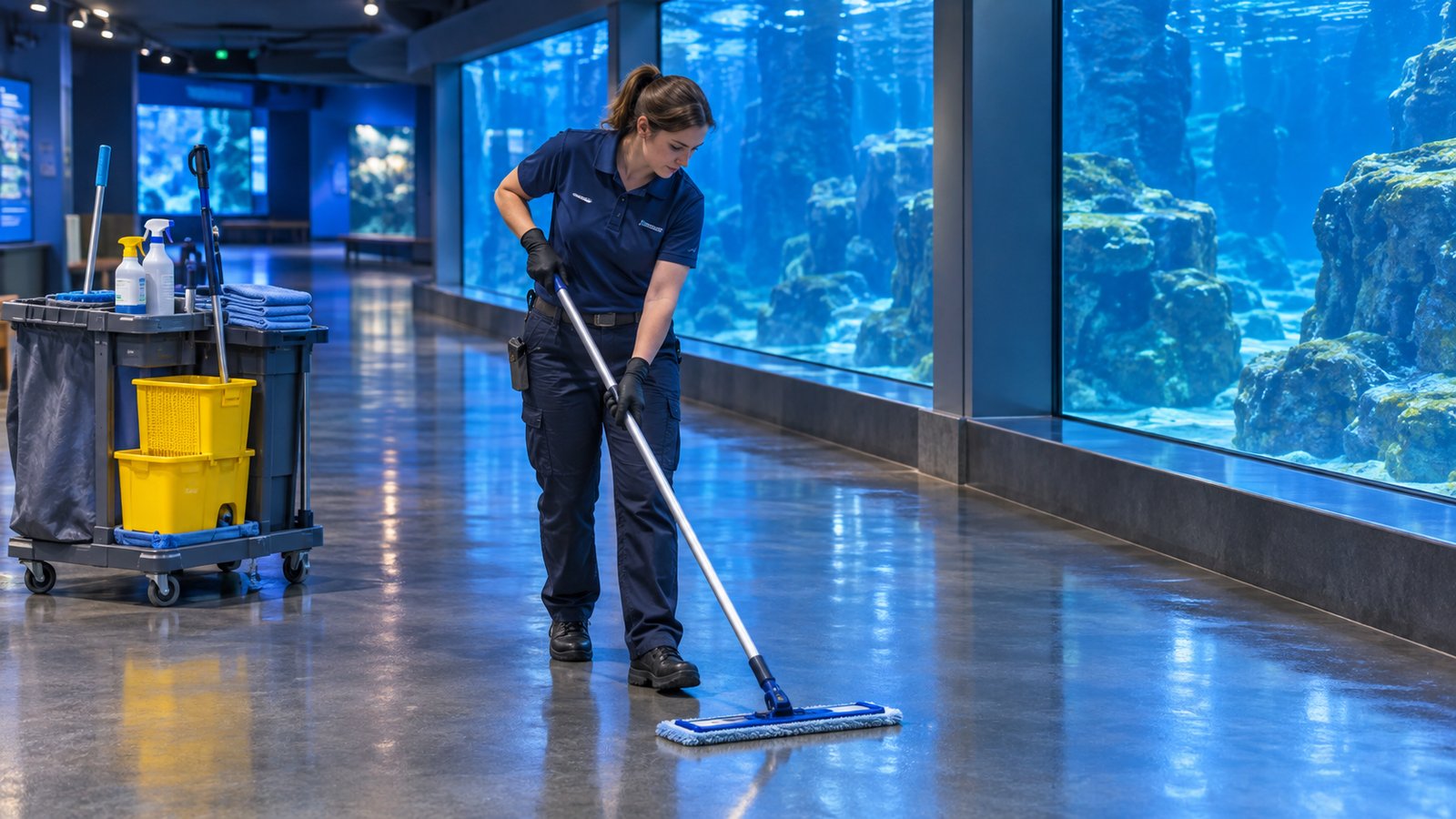
A zoo or aquarium brings together public spaces, food service, animal habitats, wet environments, educational programs, and highly controlled back-of-house operations. A commercial cleaning contractor should understand where its work begins and ends, how visitor traffic changes by season, and which tasks must remain under animal-care, veterinary, or facility staff control. This guide focuses on public areas and clearly assigned vendor work for institutions in New York, New Jersey, and Connecticut. GreenPoint Maintenance Services can help buyers create a scope that supports guest experience without crossing into animal-care responsibilities.
Draw a clear boundary between public and animal-care work
Start with a facility map that separates entrances, ticketing, galleries, visitor restrooms, dining areas, classrooms, theaters, gift shops, staff areas, exhibit barriers, animal contact zones, and restricted service corridors. Mark which areas are within the janitorial contract and which belong to animal-care, veterinary, or specialized exhibit teams. A vendor should not enter an enclosure, handle feed or bedding, clean animal-care tools, or move signage unless the institution has expressly assigned the task, trained the workers, and approved the procedure.
Define transition zones where people move between animal-contact and general visitor areas. CDC guidance for animal exhibits emphasizes handwashing after touching animals or areas where they live, roam, or eat, including when visitors did not directly touch an animal. It also recommends handwashing stations and signs at exits and other transition points. See the CDC visitor guidance for animal exhibits and CDC resources for animal exhibitors. Cleaning contractors can keep public sinks, counters, floors, and dispensers serviceable, but should not independently set the institution’s public-health policy.
Build frequencies around visitor flow and exhibits
A busy Saturday, school holiday, or special event can create a different service load from a weekday morning. Schedule restroom checks, dining-area resets, entry mat care, trash removal, and spill response around expected attendance and program times. High-touch public surfaces such as railings, door hardware, elevator buttons, and seating should be addressed under the facility’s written routine, with additional attention during high attendance or an illness event as directed by facility leadership. Set a baseline frequency and a defined surge process rather than relying on an unlimited promise to clean “as needed.”
For an aquarium, wet-floor conditions near galleries, touch pools, food service, and entry vestibules require rapid communication and careful barriers. In a zoo, outdoor paths may carry soil, leaves, and water into indoor exhibits and visitor buildings. GreenPoint Maintenance can plan rounds using facility maps and time windows, then record completed checks in JaniTrack. A per-room schedule should identify the person responsible, approved tools, target appearance, and the procedure for a spill, a blocked route, or an area closed by animal staff.
Keep chemicals and cleaning tools controlled
The institution should approve products and methods for each surface, particularly near animals, food, water features, interpretive materials, and sensitive exhibit components. Follow the product label, dilution, dwell time, PPE, ventilation, and rinsing instructions. Never mix products. Store chemicals in locked, labeled areas away from public access and animal feed or supplies. Use separate, color-coded tools for restrooms, dining spaces, and any institution-approved exhibit-adjacent task; do not carry a contaminated mop or cloth from a restroom into a gallery.
CDC’s public-animal-setting recommendations emphasize removing organic material before disinfection and tailoring the method to the situation. The institution should determine which surfaces are appropriate for cleaning or disinfection, and the contractor should follow that written direction. Aquarium water, exhibit surfaces, pumps, life-support components, and animal-care equipment need specialized staff oversight; an ordinary janitorial scope should not imply technical aquarium maintenance. GreenPoint uses Green Seal certified products where suitable and approved, but certification alone does not establish compatibility with a particular exhibit or species.
Plan wet floors, weather, and accessibility
Aquariums often have humid or splash-prone areas, while zoos contend with rain, snow, tracked soil, and seasonal debris. Use entry matting, frequent visual checks, prompt spill response, and a plan for safe drying. Place barriers so visitors have a clear alternate route, including accessible paths for wheelchairs, strollers, and mobility devices. Do not block emergency exits, tactile or interpretive signage, or the line of sight required by exhibit staff. If a floor is being scrubbed, schedule the work when the gallery can be routed safely or closed.
Document who receives a call for a leak, animal-related incident, broken glass, bodily-fluid spill, or water intrusion. These are not interchangeable cleaning tickets: some require an immediate safety response, veterinary direction, facilities repair, or specialized remediation. GreenPoint’s staff should report and isolate only within training and site policy, then escalate to the designated institution contact. For general cleaning-plan design, see quality assurance for commercial cleaning programs and high-traffic restroom cleaning best practices.
Write vendor requirements that can be verified
A procurement package should include a facility map, cleaning boundaries, public hours, attendance patterns, event calendar, access and screening rules, approved-product list, waste routes, key control, emergency contacts, and required training. Describe deliverables in observable terms: restrooms checked at defined intervals, dispensers stocked, floors free of loose debris, litter removed from assigned routes, and exceptions reported before a shift ends. Require a startup plan, named supervisor, backup coverage, inspection method, and corrective-action timeline. Price routine service and event surge coverage separately so each can be evaluated.
Ask vendors how they train staff not to enter animal-care zones, photograph visitors, or share sensitive facility information. Require confidentiality and credential rules, incident escalation, and proof of insurance. GreenPoint Maintenance is MBE/MWBE certified in New York State, New York City, and NYC DOE systems, and is SAM.gov registered; a buyer should verify the certification relevant to its procurement and evaluate the full operational proposal. GreenPoint can provide a fixed-price scope with no hourly billing or hidden fees for the defined work.
Use documentation without confusing it for animal-health testing
For public areas, useful documentation can include timestamped task completion, supply checks, inspection scores, incident tickets, corrective actions, and service photos that avoid guests and restricted areas. JaniTrack gives GreenPoint a way to record timestamped, GPS-tagged photos and task activity in a live dashboard. The facility should decide whether photos are permitted and define privacy rules, retention, and access. Operational evidence supports accountability, but it is not a substitute for veterinary inspection, water-quality monitoring, exhibit maintenance, or pathogen testing.
Set monthly reviews around repeated problems: a restroom that empties before the next check, a wet threshold that needs more matting, or an event route that overwhelms the normal staffing plan. GreenPoint Maintenance reports 98% client retention, but zoo and aquarium buyers should request references and a report sample for comparable public environments. The right partner should be able to show how it closes a missed task, how it respects an animal-area boundary, and how it communicates a hazard in real time.
Prepare teams for opening, closing, and privacy
Orientation should happen before staff enter the facility, not during the first public shift. Cover visitor-service expectations, radio etiquette, restricted doors, animal-care boundaries, emergency assembly points, lost-child procedures, photography rules, incident reporting, and what to do if a guest asks a worker for animal or veterinary advice. The contractor’s supervisor should receive the current site map and the names of authorized contacts, while the customer should explain which directions may only come from animal-care or security staff. GreenPoint Maintenance Services should document that assigned workers understand the limits of the public-area scope.
Plan coverage for opening and closing transitions. Before gates open, the team may need to clear litter, verify that assigned restrooms are stocked, and report any unsafe floor condition. At closing, the crew may reset dining spaces and public restrooms without entering galleries that are occupied by animal staff. Event nights, school-group arrivals, and seasonal attendance peaks should be on the calendar early enough to arrange additional coverage. The site should decide whether surge work is included in the monthly fee, billed at a pre-agreed event rate, or requested through a written change order. To schedule a vendor walkthrough for a Tri-State institution, call 347-332-9348.
Protect visitor privacy and incident reporting
Guest privacy also deserves explicit handling. Photos should focus on a cleaned surface or completed task and should avoid identifiable visitors, children, ticket details, back-office screens, and restricted animal areas. If a photo is unnecessary to verify a task, use a timestamped checklist or supervisor review instead. Define who can access records, how long they are retained, and how an incident image is shared with the institution. JaniTrack can support GreenPoint’s timestamped, GPS-tagged task documentation, but the institution should approve the photo policy before deployment. This attention to boundaries builds accountability without compromising visitor trust.
The same privacy discipline should apply to radios, public-facing conversations, and incident notes. Cleaning staff may notice a spill, damaged barrier, or guest concern, but they should report only what is necessary to the authorized supervisor and avoid discussing animal health or visitor incidents with other guests. The institution can provide a short incident form with time, location, immediate action, person notified, and follow-up owner. GreenPoint Maintenance can align its reporting steps with the institution’s communications plan so observations reach the right department quickly and remain available for a documented review.
Zoo and aquarium cleaning questions
Q: Should a janitorial contractor clean animal habitats? A: Only when the institution expressly assigns the task, provides appropriate training, approves methods, and coordinates with animal-care staff. Most routine commercial cleaning scopes should clearly exclude enclosure and animal-care work.
Q: How often should public restrooms be checked? A: Base the interval on attendance, opening hours, restroom count, events, and observed demand. Specify checks in the scope and adjust after reviewing actual service logs.
Q: Can the contractor choose disinfectants independently? A: No. The facility should approve products and methods for the surfaces and nearby animals, food, and water. Staff must follow labels and site procedures.
Q: How can a Tri-State zoo or aquarium request a proposal? A: Provide public hours, maps, attendance patterns, event dates, access rules, and cleaning boundaries. GreenPoint Maintenance Services can schedule a walkthrough at 347-332-9348 or through info@greenpointms.com. Call 347-332-9348 to arrange a vendor-scope review.
Schedule a public-area cleaning walkthrough with GreenPoint Maintenance at 347-332-9348. GreenPoint will define animal-care boundaries, visitor-area frequencies, and approved verification; its JaniTrack records support documented tasks, with a reported 98% client retention rate.