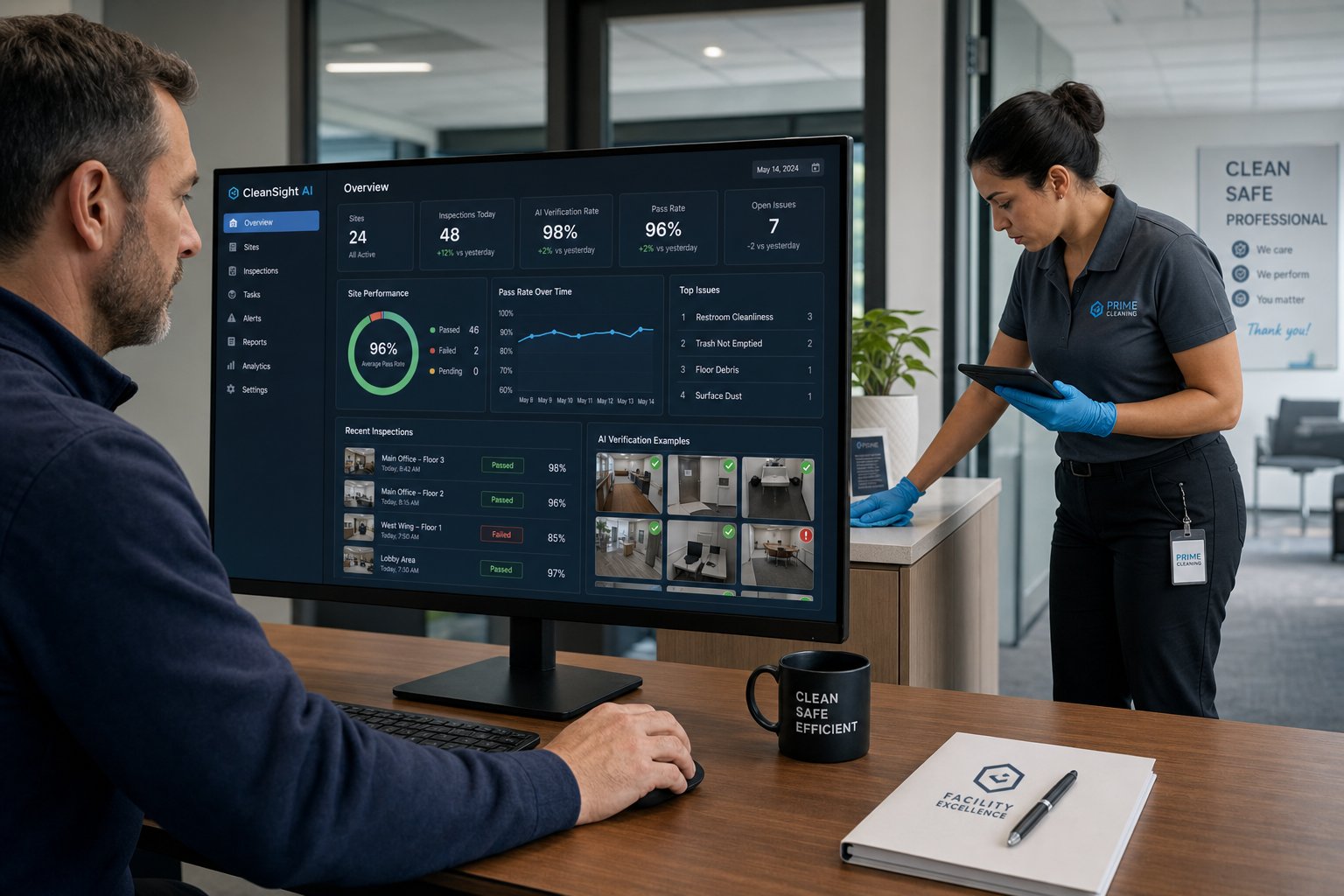
AI cleaning verification can help a facility find missed tasks faster, but it cannot replace a trained supervisor who understands surfaces, safety, access, and the client’s risk profile. GreenPoint Maintenance Services Corp combines StockPoint timestamped GPS-tagged records, ATP testing where appropriate, human inspections, and transparent fixed pricing for commercial buildings in New York, New Jersey, Connecticut, Pennsylvania, and Florida. This guide explains practical use cases for offices, schools, healthcare-adjacent sites, warehouses, and retail. Call 844-814-0810 to schedule a technology-aware walkthrough.
Define the quality question before buying software
AI is most useful when a facility can state the decision it must improve: Was the restroom checked before the morning rush? Which zones have repeat misses? Did a cleaner reach a restricted floor? How quickly were supply-outs closed? GreenPoint Maintenance Services starts with the service standard, not the dashboard. A 50,000-square-foot Midtown office and a 50,000-square-foot Bronx school may have the same area but different traffic, privacy, access, and inspection rules.
Write the baseline in plain language: cleanable surfaces, frequency, outcome, evidence, exception, and owner. The [digital cleaning verification systems](/blog/digital-cleaning-verification-systems/) guide explains why digital records are strongest when tied to a human-approved checklist. GreenPoint can map that checklist during a no-obligation walkthrough.
Use AI to prioritize patterns, not to invent standards
Computer vision or machine-learning tools may flag a full bin, visible floor debris, an empty dispenser, or a long gap between inspections. Those alerts are prompts for review, not an automatic verdict. Lighting, camera angle, seasonal coats, construction dust, and furniture moves can create false positives. GreenPoint supervisors verify the condition, record the reason, and decide whether to coach, re-clean, or escalate a facilities repair.
AI also should not silently create a new privacy risk. A camera in a restroom, medical area, school corridor, or employee workspace needs a client-approved purpose, placement, retention period, access list, and notice process. GreenPoint prefers privacy-safe StockPoint task evidence and client-approved photos rather than collecting images that are unnecessary for the cleaning decision.
Connect sensors, checklists, and StockPoint records
A useful verification stack may combine QR or NFC check-ins, time and location data, inspection forms, dispenser alerts, occupancy signals, and selected ATP readings. GreenPoint uses StockPoint to connect the route, timestamp, GPS-tagged location, checklist completion, issue note, and corrective action. The point is a traceable chain: what was expected, what happened, who reviewed it, and when it was closed.
No single signal proves cleanliness. A GPS record shows presence, not every surface; a photo shows one angle; ATP indicates organic residue on a tested area, not sterility; an AI model may miss clear residue. GreenPoint’s quality program uses multiple signals and states their limits. The [what is ATP bioluminescence testing](/blog/what-is-atp-bioluminescence-testing-cleaning/) article gives managers the right way to interpret a reading.
Protect privacy and data ownership
Before enabling AI, ask where data is stored, who can access it, how long it is retained, whether a vendor trains a model on it, and how deletion works. Healthcare offices near NYU Langone or Montefiore, schools in Brooklyn or Queens, and government buildings near City Hall may have stricter privacy and security expectations than a private warehouse. GreenPoint keeps cleaning records focused on rooms and tasks and excludes patient, student, employee, and visitor identifiers.
Contracts should address cameras, subcontractors, breach notice, exports, audit rights, uptime, support, and end-of-term deletion. GreenPoint does not promise that a dashboard alone meets HIPAA, FERPA, or public-sector security requirements. We coordinate with the client’s privacy and IT owner before a device is installed, then document the approved boundaries in the scope.
Use human audits for context and safety
A trained supervisor can distinguish soil from surface damage, a missed visit from an inaccessible room, and an empty soap dispenser from a broken plumbing fixture. Human audits also catch chemical labels, wet-floor hazards, blocked exits, damaged mats, and unsafe carts that an image model may not understand. GreenPoint supervisors review routes, inspect high-risk areas, coach cleaners, and assign corrective actions instead of simply accepting a score.
For an office tower near Grand Central, a school near Fordham Road, or a warehouse by Newark Airport, access and operating windows shape what “complete” means. GreenPoint records a legitimate exception when a room is occupied, locked, under repair, or unsafe. Call 844-814-0810 to design an audit cadence that respects the building’s real operations.
Build an evidence-based scorecard
Useful measures include inspection pass rate, repeat findings, time to correction, missed check-ins, supply-outs, zone coverage, complaint response, and exception reasons. GreenPoint can review a 30-day baseline, set thresholds by facility type, and show a manager which action is open. A 95% check-in rate may sound strong until a building discovers that the remaining 5% are all high-traffic restrooms; quality metrics need risk weighting.
ISSA appearance levels can help define the visible outcome, while BLS labor data reminds buyers that cleaners perform a skilled, labor-intensive job. GreenPoint uses a scorecard to improve routes and training, not to push an unrealistic speed target. The [ISSA clean standards appearance levels](/blog/issa-clean-standards-appearance-levels/) guide helps translate “looks clean” into an agreed standard.
Make alerts actionable for the operating team
An alert should name the location, condition, severity, owner, response window, and closure evidence. “Restroom issue” is weak; “third-floor restroom, two empty towel dispensers, daytime check due by 10:00, facilities owner notified” is actionable. GreenPoint configures StockPoint notes and escalation paths around the client’s security desk, facilities lead, and account supervisor.
Avoid alert fatigue by setting thresholds and quiet periods. A warehouse during a shift change may need a different trigger from a quiet executive suite. GreenPoint reviews false alerts weekly during launch, removes low-value notifications, and keeps emergency events separate from routine appearance findings. Email info@greenpointms.com if the current dashboard produces numbers without decisions.
Specify AI requirements in a cleaning RFP
Procurement should request the supported devices, offline behavior, data fields, privacy controls, integrations, audit logs, retention, export format, training, uptime, support response, and pricing. Also ask for a human-review process and a sample report with false-positive handling. GreenPoint Maintenance Services offers fixed pricing with no hourly billing and no hidden fees, and our MBE/MWBE, SAM.gov, Green Seal, and 98% retention credentials support qualification without replacing a site-specific scope.
Keep the service contract accountable for outcomes, not a technology brand. The proposal should identify square footage, rooms, service windows, staffing, consumables, periodic work, corrective-action timing, and what happens when the platform is offline. GreenPoint can provide a technology-neutral quote after a walkthrough at 844-814-0810.
Pilot, validate, and improve over 30 days
Choose one representative zone such as a lobby, restroom bank, classroom wing, or warehouse breakroom. GreenPoint records the baseline, trains cleaners and supervisors, runs the tool for 7 to 14 days, and compares alerts with human findings. At day 30, review whether the technology found meaningful misses, reduced response time, or simply added administration. Keep only signals that change an operating decision.
For multi-site portfolios across Manhattan, the Bronx, Brooklyn, Queens, Staten Island, Westchester, Long Island, NJ, CT, PA, and FL, use a common core scorecard with local annexes. GreenPoint can standardize StockPoint categories while each property controls privacy, access, and emergency rules. Call 844-814-0810 to schedule a pilot discussion.
Price verification as part of the service outcome
AI verification should be priced alongside supervision, training, inspections, device maintenance, data support, and corrective labor. A cheap app cannot compensate for an undersized crew or unclear scope. GreenPoint’s fixed-price proposals separate recurring cleaning, periodic projects, technology assumptions, consumables, and exclusions so finance can compare total cost per cleanable square foot. The [commercial cleaning cost per square foot](/blog/commercial-cleaning-cost-per-square-foot/) guide covers that broader comparison.
GreenPoint Maintenance Services Corp is MBE/MWBE certified, SAM.gov registered, and offers Green Seal certified product options. Those qualifications support institutional procurement, but the strongest proof remains a readable record of task, inspection, exception, and correction. Call 844-814-0810 or email info@greenpointms.com for a quote with no hidden fees.
GreenPoint’s position is practical: use AI to find patterns and prioritize attention, then let trained people decide what the condition means and how to correct it. StockPoint gives managers a transparent record without requiring unnecessary images of people or private spaces. GreenPoint’s 98% client retention comes from dependable operations, not a technology slogan. Request a sample report and a walkthrough at 844-814-0810.
GreenPoint can support an office, school, warehouse, medical practice, or multi-site portfolio with human supervision, fixed pricing, and no hourly billing. Email info@greenpointms.com to review the data boundary, inspection standard, and 30-day pilot plan.
Technology adoption should end with a decision rule that a manager can explain to a cleaner. GreenPoint documents which signal starts a review, who validates it, what correction is expected, and when the issue is closed. If a platform cannot work offline, export its data, or explain an alert, the service plan needs a manual fallback. That operational humility protects the client from buying a dashboard that nobody trusts. GreenPoint Maintenance Services keeps the client’s approved appearance and safety standard in charge while technology reduces blind spots.
FAQ: practical answers for facility managers
Can AI verify that a facility is clean? It can flag selected visible or sensor-based conditions, but it cannot prove every surface is clean or replace a trained inspection. GreenPoint combines AI signals with StockPoint records, human audits, and client-approved standards.
Does AI cleaning verification require cameras? No. Check-ins, digital checklists, dispenser sensors, occupancy signals, and selected ATP readings may provide useful evidence. GreenPoint favors the least intrusive data that answers the facility’s quality question.
How should a facility handle false AI alerts? Require human review, record the reason, tune thresholds, and measure repeat false positives during a pilot. GreenPoint treats an alert as a prompt for a supervisor, not an automatic performance penalty.
What should be in an AI cleaning technology contract? Include data ownership, retention, privacy, security, uptime, offline operation, exports, support, training, audit logs, device costs, and the human-review process. GreenPoint also names the cleaning scope and corrective-action response.
How do I request an AI-aware cleaning quote? Call GreenPoint Maintenance Services at 844-814-0810 or email info@greenpointms.com. We will review zones, risk, privacy, devices, staffing, reporting, and fixed-price assumptions before recommending a pilot.
GreenPoint Maintenance Services Corp can design a human-led, AI-aware cleaning verification program after a no-obligation walkthrough. Call 844-814-0810 or email info@greenpointms.com for fixed pricing, StockPoint evidence, privacy-safe implementation, and a quality plan supported by 98% client retention.