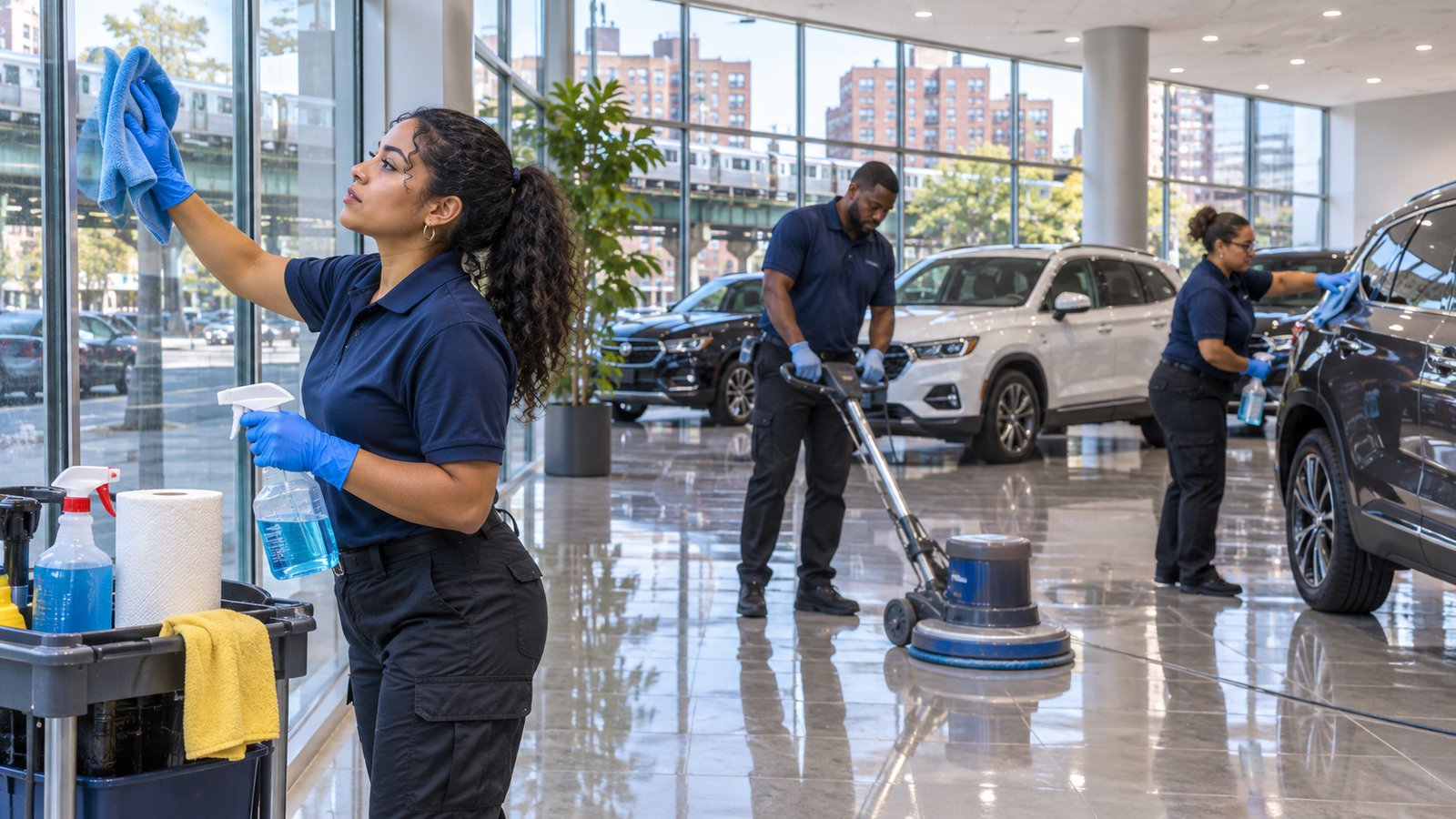
An auto dealership is both a retail showroom and an active work site. Customers notice fingerprints on glass, tracked-in grit, restrooms, and waiting areas, while service departments create different soil and safety conditions from the sales floor. A qualified cleaning vendor should separate these zones, respect vehicle and key controls, and define exactly what its staff may handle. GreenPoint Maintenance Services Corp provides MBE-certified commercial cleaning with fixed-price scopes and documented service. GreenPoint Maintenance Services can walk a Bronx or Queens dealership before quoting; call 347-332-9348 to schedule a walkthrough and review the service calendar.
Divide the Dealership Into Cleaning Zones
Start the scope with a site map that separates the showroom, reception, sales offices, finance offices, customer lounge, restrooms, parts counter, staff areas, delivery bay, and service department. These spaces have different occupants, surfaces, access rules, and soil loads. A showroom may prioritize polished floors and glass before opening, while a service lane may require barriers and authorization before any cleaner enters. For a 25,000-square-foot dealership with a showroom, service counter, and several offices, define each area and task separately instead of assuming one square-foot rate captures all work. GreenPoint reviews the layout and proposes an area-by-area service route.
Identify what is excluded. Cleaning staff should not move vehicles, touch customer property, handle keys, wipe vehicle paint, enter locked parts rooms, or clean machinery unless the dealership has specifically authorized and trained for that task. The contract can include showroom floor care, accessible glass, waste, restrooms, and agreed common surfaces while leaving automotive detailing and shop maintenance to the dealership’s trained teams. GreenPoint Maintenance Services documents access boundaries and site contacts before service starts. That written division helps prevent a routine janitorial worker from being asked to perform a task that creates risk or conflicts with dealership procedures.
Protect the Showroom Appearance
Showroom floors are a constant brand signal. Dust, tire marks, footprints, and outdoor grit show quickly under bright ceiling lights and reflective glass. The cleaning plan should identify flooring type, approved equipment, the expected finish, and any time that vehicles must be moved or covered. A pre-opening route might include dry soil removal, a compatible damp-cleaning method, spot attention at customer paths, and a final visual check from the entrance. GreenPoint can specify when machine work occurs and how access is restricted until the floor is dry, which helps avoid both poor presentation and slip hazards.
Glass requires a separate schedule. Exterior-facing windows, entrance doors, interior partitions, and customer counters do not soil at the same rate. Define which panels are included, whether the vendor cleans reachable glass only, and when specialized high-reach work is quoted separately. In the Bronx, dealerships near the Major Deegan Expressway, Fordham Road, or the Grand Concourse may contend with different dust and traffic patterns than a Queens location near Northern Boulevard, Queens Boulevard, or the Long Island Expressway. These are service-planning examples, not a claim that every storefront soils identically. GreenPoint adjusts the frequency after a walkthrough and inspection.
Keep Customer Areas Ready Through the Day
The lounge and reception zone may need more than one daily check when customers are waiting for service or meeting with sales staff. Set a schedule for accessible tables, counters, door pulls, trash, floors, and restrooms, and clarify whether daytime coverage is included in the base program. Restrooms should have a defined replenishment responsibility and a process for reporting plumbing or dispenser problems. GreenPoint Maintenance Services can price a daytime porter separately from evening cleaning when the dealership needs continuous public-facing attention. A clear distinction helps the manager see whether the monthly price includes a person on site or only scheduled visits.
Customer-facing cleaning should be discreet without making service invisible. Ask staff to use clean equipment, avoid blocking accessible routes, and coordinate vacuuming or floor work around sales conversations and vehicle deliveries. The contract should state the allowed service windows, approved storage location, and how an urgent spill is handled. GreenPoint uses a walkthrough to understand opening hours, test-drive traffic, service intake peaks, and after-hours entry rules. Call 347-332-9348 to request a Bronx or Queens quote. Bring the current schedule and note any areas where customers have complained about presentation, so the proposed route can target the real operational pressure points.
Separate Service Bays and Shop-Support Areas
Service bays can contain automotive fluids, sharp scrap, tools, vehicle lifts, hot components, and other hazards that are not part of ordinary office janitorial work. Dealership management should identify whether the cleaning contractor is limited to public counters and adjacent corridors or is expected to clean inside any shop zone. If a bay task is considered, define hazard assessment, training, PPE, equipment, spill response, and who has authority to release the area. GreenPoint does not treat every shop surface as a standard floor-cleaning assignment; the scope must match the dealership’s safety program and the worker’s demonstrated qualifications.
OSHA’s Hazard Communication Standard covers workplace chemical hazard communication, while OSHA’s walking-working surfaces standard addresses housekeeping and safe walking surfaces. The dealership should coordinate contractor access with its own safety lead and make sure employees know how to report an unknown spill or blocked exit. Cleaning staff should never mix products or use a product on automotive finishes without written approval. GreenPoint can keep approved products and areas in the site plan and use Green Seal-certified options where compatible with the task.
Schedule Around Bronx and Queens Traffic
Local access affects whether a contractor can consistently meet a service window. A Bronx dealership may have limited curb space near Fordham Road, East 149th Street, or the Major Deegan, while a Queens location near Jamaica Avenue, the Van Wyck Expressway, or LaGuardia-area corridors may contend with different delivery and commuter peaks. Ask the vendor to document the entrance, loading point, employee parking rules, badge procedure, alarm codes, and approved equipment storage. GreenPoint reviews the site route so crews are not expected to move through vehicle display or delivery areas without permission.
Plan service around opening, closing, service write-up, and vehicle delivery times. A 6:00 a.m. clean may be useful for a showroom that opens early, while a post-close shift can reduce interference with customers but requires secure access. If there are multiple buildings, set the sequence and how a delayed shift is reported. GreenPoint Maintenance Services can include weekend or seasonal tasks when requested and separate them from the recurring schedule. For the quote, call 347-332-9348 and provide each site address, approximate square footage, restroom count, hours, and any special rules for keys, alarms, vehicles, or after-hours access.
Use Digital Checks to Catch Repeat Problems
A dealership manager needs evidence at the level of the showroom, lounge, restrooms, and service entrance, not a single statement that the building was cleaned. Define observable standards such as clear glass at agreed panels, no visible grit in primary customer paths, stocked restroom dispensers, and waste removed from assigned areas. GreenPoint uses JaniTrack to record timestamps, GPS-tagged photos where suitable, quality checks, and a live dashboard. A photo should respect customer privacy and avoid capturing screens, documents, license plates, or people unless the dealership has approved the method.
Review trends by area and time. If tire marks repeatedly appear before the showroom opens, the floor route may need to start later or include an entrance mat check. If the restroom is consistently depleted by mid-afternoon, the schedule may need daytime service. GreenPoint states a 98% client retention rate; ask what period and denominator the company uses and request references from a comparable retail or automotive site. For consistent inspection language, review ISSA Clean Standards appearance levels and digital cleaning verification systems. GreenPoint’s reporting can show task completion and corrective action, while the dealership retains responsibility for final operational acceptance.
Compare Proposals for Total Cost and Accountability
Ask bidders to price the same rooms, schedule, equipment, supplies, consumables, daytime coverage, periodic floor care, and exclusions. Request a labor and supervision plan, backup coverage, insurance evidence, staff training approach, and complaint response process. A quote that excludes high-visibility glass, restrooms, or weekend service may look lower while failing the dealership’s actual need. GreenPoint Maintenance Services uses fixed pricing for an agreed scope, with additional work listed separately for approval rather than hidden in hourly assumptions. Compare each bid on completed work and verification as well as monthly price.
Ask how the company protects keys, alarm details, customer information, and vehicle access. Verify certifications and registrations against the dealership’s procurement requirements; GreenPoint is MBE/MWBE certified with New York State, NYC, and NYC DOE and registered in SAM.gov. Those credentials may support supplier diversity goals but do not guarantee fit, so request a site-specific plan and references. A complete vendor decision should confirm the named account lead, startup schedule, first inspection date, and scope-change approval process. GreenPoint Maintenance Services can prepare a written Bronx or Queens proposal after the walkthrough; call 347-332-9348 to arrange one.
Frequently Asked Questions
Question: What does dealership janitorial service usually cover? Answer: A defined scope may include showroom floors, accessible glass, customer offices, lounge, restrooms, waste, and common corridors. Vehicle detailing, shop spills, and equipment cleaning should be excluded unless specifically assessed and authorized.
Question: How often should an auto showroom be cleaned? Answer: Set frequency around opening hours, foot traffic, floor type, glass exposure, and customer expectations. High-visibility entrances may need daily attention, while periodic floor restoration can be scheduled separately.
Question: Can a cleaning company work in an active service department? Answer: Only under a clearly assessed scope with site safety approval, training, PPE, access controls, and defined spill procedures. Routine janitorial staff should not handle automotive fluids, tools, or unknown hazards by assumption.
Question: What should a Bronx or Queens dealership provide for a quote? Answer: Share floor plans, service hours, vehicle-area boundaries, restroom counts, floor types, access rules, and current complaints. GreenPoint can schedule a walkthrough at 347-332-9348.
Question: How can a dealer verify after-hours cleaning? Answer: Use written acceptance standards, supervisor inspections, a complaint log, and time-stamped service reporting. GreenPoint’s JaniTrack dashboard can document authorized service without requiring staff to access customer records or vehicles.
Schedule a Bronx or Queens dealership walkthrough with GreenPoint Maintenance Services at 347-332-9348 or info@greenpointms.com. GreenPoint offers fixed-price scopes with JaniTrack verification and a company-reported 98% client retention rate; request a zone-by-zone plan for showroom, customer areas, and approved shop boundaries.