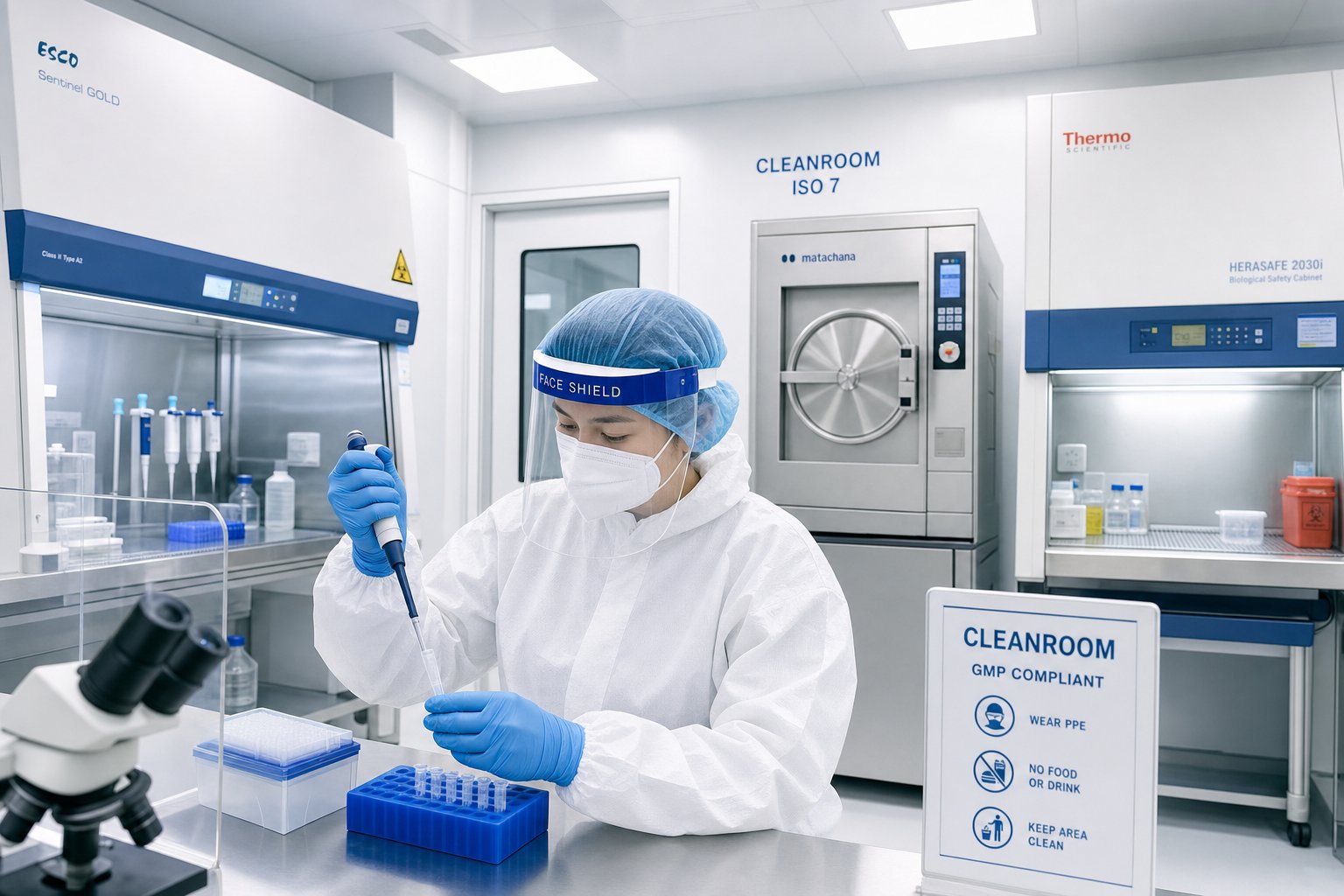
Biotech and life-science facilities are unforgiving: contamination risk, regulated workflows, and equipment that cannot be “wiped down” casually. If you are searching for “biotech lab cleaning” in the tri-state area, the vendor you hire must be able to follow documented SOPs, control chemicals, and prove performance without interfering with operations. GreenPoint Maintenance Services Corp supports commercial facilities across NY, NJ, and CT with a proof-driven quality program, fixed pricing, and StockPoint verification (timestamped, GPS-tagged photos, ATP testing, and a live dashboard). For a walkthrough and proposal, call 844-814-0810.
Biotech lab vs. standard office: why the cleaning program must be engineered
Standard office cleaning focuses on appearance and basic hygiene. Biotech lab cleaning must support process integrity. Even if your site is not a full cleanroom, labs often have controlled areas, material flow rules, and equipment surfaces that are sensitive to residues. The cleaning plan should start with a zoning map (public areas, office, lab support, controlled lab, storage) and a list of surfaces that are in-scope vs. out-of-scope.
GreenPoint’s onboarding begins with a walkthrough and a documented scope that is reviewed with stakeholders. The goal is repeatable execution, not improvisation.
cGMP and documentation: what facility managers should expect from a cleaning vendor
Current Good Manufacturing Practice (cGMP) environments emphasize documentation, change control, and traceability. Even when cleaning is performed by a contracted janitorial team, the expectation is that tasks are executed consistently and can be audited. That means: written task lists, training records, chemical lists with SDS, and a defined verification method.
GreenPoint uses StockPoint to document completion with timestamped, GPS-tagged photos for appropriate areas, and supervisor audits. For critical touchpoints, ATP testing can provide numeric verification that cleaning removed organic residue. Learn more about verification approaches: [Digital cleaning verification systems](/blog/digital-cleaning-verification-systems/) and [What is ATP bioluminescence testing?](/blog/what-is-atp-bioluminescence-testing-cleaning/).
ISO cleanroom classes: how to talk about “clean” without overpromising
Facility teams sometimes ask for “ISO Class X cleaning” when they mean “controlled cleaning with particle awareness.” ISO cleanroom classifications relate to airborne particle counts and operational controls. Unless your facility is designed and monitored as a cleanroom, the cleaning vendor should not promise an ISO class outcome. Instead, the scope should describe the actual controls: HEPA filtration procedures, lint-free materials, restricted entry, gowning, and approved chemicals.
If indoor air quality and dust control are priorities in adjacent office and support areas, HEPA filtration and microfiber systems reduce particulate spread: [HEPA filtration commercial cleaning](/blog/hepa-filtration-commercial-cleaning/) and [Color-coded microfiber systems guide](/blog/color-coded-microfiber-systems-guide/).
Chemical control and OSHA compliance: SDS, labeling, and storage
Lab-adjacent spaces raise chemical sensitivity questions: residues, odors, and compatibility with surfaces. Vendors must manage chemicals under OSHA Hazard Communication (GHS/SDS), label secondary containers, and store products safely. A biotech site should require a chemical list and SDS binder access. Reference: [OSHA cleaning chemical safety (GHS/SDS)](/blog/osha-cleaning-chemical-safety-ghs-sds/) and [Fire code cleaning chemical storage](/blog/fire-code-cleaning-chemical-storage/).
GreenPoint can align product selection to your facility’s requirements and document the products used. When green product requirements apply in office portions of a life-science campus, we can specify Green Seal-aligned options where appropriate.
Traffic flow, gowning, and cross-contamination prevention
Cross-contamination control is often more about process than products. Effective programs define: entry/exit paths, dedicated tools by zone, and color-coded microfiber to prevent restroom tools from ever entering lab support areas. Cleaning carts should not “roam” across zones without controls. GreenPoint’s site-specific plan uses zone separation and documented changeover rules so the cleaning process supports your contamination control strategy.
For multi-tenant lab buildings, elevators, loading docks, and shared corridors become critical. High-touch points in shared areas should be serviced at frequencies aligned to occupancy and risk profile: [Cleaning frequency standards by facility type](/blog/cleaning-frequency-standards-by-facility-type/).
Shift timing: coordinating with scientists, facilities, and security
Many labs operate long hours. A workable solution is to separate “quiet cleaning” in offices and corridors during early evening from controlled area support cleaning later when experiments are stable. The scope should define what happens if a lab is active: do cleaners skip, reschedule, or require a point-of-contact sign-off? Ambiguity causes failure.
GreenPoint assigns a supervisor who coordinates scheduling changes and documents exceptions. To map a plan to your operational schedule, call 844-814-0810 to schedule a walkthrough.
Budgeting biotech lab cleaning: staffing ratios and square-foot drivers
Costs depend on complexity, not just square footage. A 20,000 sq ft life-science suite with controlled zones can cost more than a 40,000 sq ft standard office because of zoning, tool separation, training, and verification. The best practice is to price per defined scope, then normalize by area for comparison. Use these resources for baseline economics: [Commercial cleaning cost per square foot](/blog/commercial-cleaning-cost-per-square-foot/) and [Cleaning staffing ratios square footage](/blog/cleaning-staffing-ratios-square-footage/).
GreenPoint offers fixed pricing to reduce budget volatility and a defined menu for event work (moves, spill response, post-construction) so invoices are predictable.
FAQ: biotech lab cleaning, cGMP, and ISO concepts
Q: Can a janitorial vendor support cGMP expectations? A: Yes—through documented scopes, training, chemical control, and verifiable completion. Your internal QA team may still require oversight, but the cleaning program can be designed to support audits.
Q: Do you clean ISO-classified cleanrooms? A: The correct answer depends on the facility design and controls. We can support controlled cleaning procedures and align to your SOPs, but ISO classification outcomes require environmental monitoring and facility controls beyond janitorial work.
Q: How do you verify cleaning without disrupting lab work? A: We verify completion using zone-based checklists, supervisor audits, and StockPoint photo documentation in appropriate areas. ATP testing can be used on agreed high-touch surfaces when it fits the site’s protocol.
Q: How do you prevent cross-contamination between restrooms and lab support areas? A: We use zone separation, dedicated tools, and color-coded microfiber systems, with documented cart management and training.
Q: How do we start? A: Schedule a walkthrough so we can map zones, traffic flow, and SOP constraints. Call 844-814-0810 or email info@greenpointms.com.
Need biotech lab cleaning that is documentation-ready and verification-driven? GreenPoint Maintenance Services Corp provides fixed pricing, trained teams, and StockPoint verification with timestamped photos plus optional ATP testing. Schedule a walkthrough: 844-814-0810 | info@greenpointms.com.