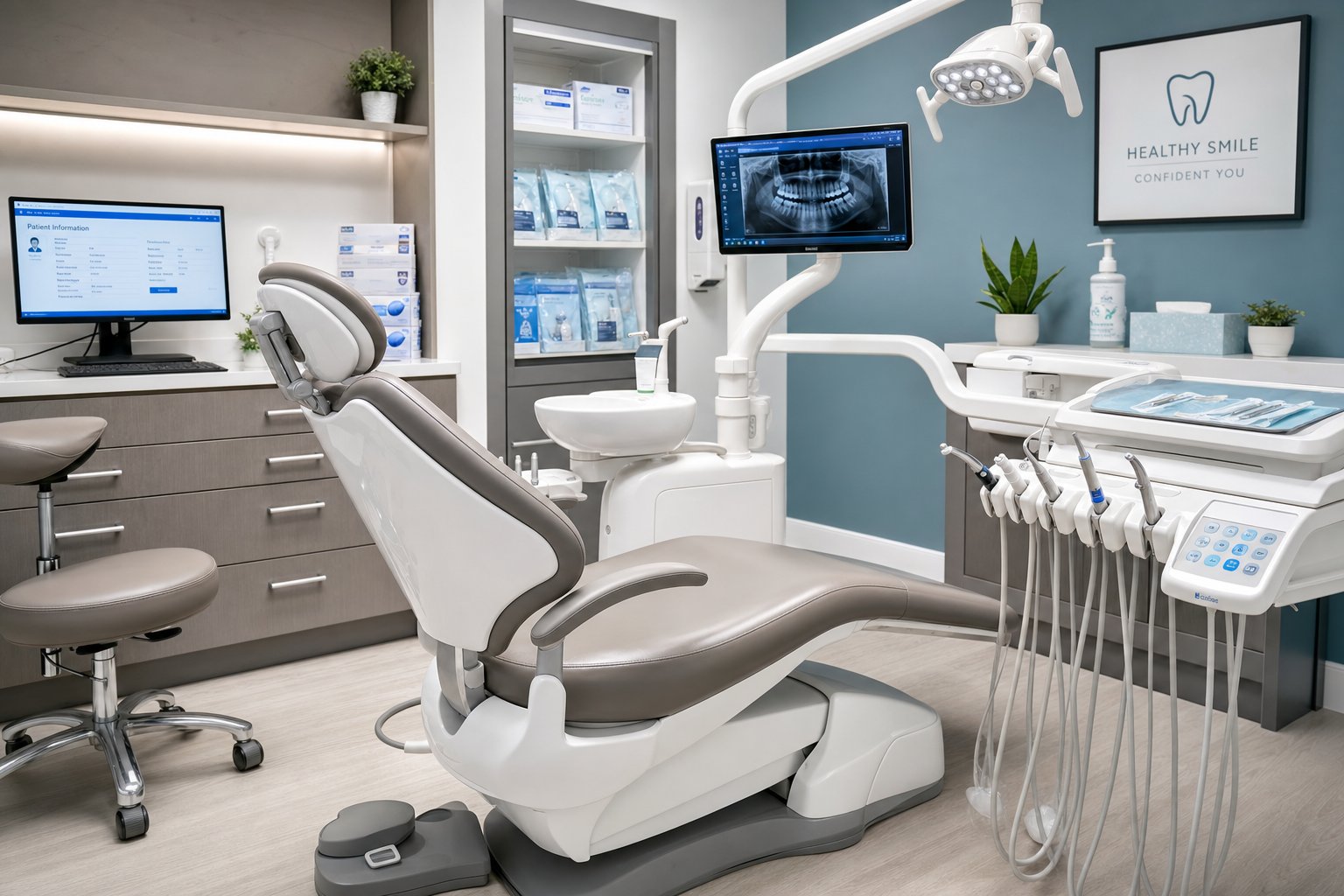
Dental practices have one of the highest “surface turnover” rates in outpatient healthcare: operatories flip quickly, aerosols settle on nearby surfaces, and patient confidence depends on visible cleanliness. If you are comparing “dental office cleaning” vendors in NYC or the tri-state area, you need an infection-control aligned plan that respects OSHA safety rules, uses appropriate EPA-registered disinfectants, and documents results. GreenPoint Maintenance Services Corp is an MBE-certified commercial cleaning provider with a 98% client retention rate and StockPoint verification (timestamped, GPS-tagged photos, ATP testing, live dashboard). To schedule a walkthrough and quote, call 844-814-0810.
Why dental practice cleaning is not the same as standard medical office cleaning
Dental operatories generate aerosols and splatter that increase contamination risk on light handles, chair controls, countertops, and nearby floors. While clinical staff handle instrument sterilization and chairside barriers, the facility cleaning program must support the environment: frequent high-touch disinfection, restroom hygiene, and careful floor care to reduce slip hazards from wet areas.
GreenPoint scopes dental practices with special attention to operatory adjacency areas (hallways, waiting rooms, restrooms) so the environment reinforces patient trust and reduces complaint risk.
OSHA basics: bloodborne pathogens, sharps awareness, and chemical safety
Dental facilities are governed by OSHA rules related to bloodborne pathogens and hazard communication. Cleaning teams must understand sharps awareness (never compress trash, never reach into liners) and must follow SDS/labeling requirements for chemicals. Vendors should show training practices and their chemical safety program. Reference: [OSHA cleaning chemical safety (GHS/SDS)](/blog/osha-cleaning-chemical-safety-ghs-sds/) and dental clients often benefit from a broader OSHA-aligned medical cleaning overview: [Medical office cleaning requirements OSHA](/blog/medical-office-cleaning-requirements-osha/).
A practical procurement step is to require written procedures for trash handling, PPE, and incident escalation. If a vendor cannot describe how they protect staff, they will not protect your patients either.
EPA disinfectants and contact times: avoiding the most common compliance miss
The most common failure we see is “spray and wipe immediately.” Many disinfectants require a wet contact time (often several minutes) to achieve their label claims. Your cleaning scope should specify which products are used where and how contact time is achieved without disrupting the practice. A helpful reference for compliance language is our guide: [EPA disinfectant registration guide](/blog/epa-disinfectant-registration-guide/).
GreenPoint can align disinfectant selection to your practice needs and document procedures so expectations are consistent across staff changes.
Operatory turnover support: what can be in-scope vs. out-of-scope
Clinical turnover tasks (barrier changes, instrument reprocessing) remain clinical responsibilities. Facility cleaning can support turnover by maintaining floors, removing visible soils in corridors, sanitizing waiting room touchpoints, and ensuring restrooms and pantry areas are consistently serviced. During onboarding, GreenPoint defines clear boundaries to prevent confusion and protect compliance.
If your practice wants a structured cleaning frequency plan, start here: [Cleaning frequency standards by facility type](/blog/cleaning-frequency-standards-by-facility-type/) and use appearance-level language for expectations: [ISSA clean standards appearance levels](/blog/issa-clean-standards-appearance-levels/).
High-traffic zones that drive reviews: waiting rooms, restrooms, and entrances
Patients judge a practice quickly. Waiting rooms should have visibly clean glass, dust-free surfaces, and disinfected touchpoints (check-in counter, chair arms, door pulls). Restrooms must be serviced for odor control and replenishment; in many practices, restrooms require at least one mid-day touch-up even if full cleaning happens at night.
Indoor air quality also affects comfort. Dust control and HEPA filtration can reduce particulate load in common areas: [Indoor air quality commercial cleaning](/blog/indoor-air-quality-commercial-cleaning/) and [HEPA filtration commercial cleaning](/blog/hepa-filtration-commercial-cleaning/).
Verification and QA: StockPoint photos plus optional ATP testing
Healthcare-adjacent facilities benefit from proof. GreenPoint uses StockPoint verification with timestamped, GPS-tagged photos and a live dashboard to confirm completion by zone (restrooms, waiting area, corridor). Where appropriate, ATP testing can quantify residual organic matter on agreed surfaces—useful for continuous improvement without disrupting clinical protocols. Learn more: [Digital cleaning verification systems](/blog/digital-cleaning-verification-systems/) and [What is ATP testing?](/blog/what-is-atp-bioluminescence-testing-cleaning/).
This evidence-based QA approach helps stabilize quality and supports long-term retention—one reason GreenPoint maintains a 98% client retention rate.
Costs and budgeting: what affects dental practice cleaning pricing
Pricing is driven by restroom count, operatory count, traffic level, floor type mix, and service window. Many practices find that a fixed-price scope reduces surprises, especially when patient volume fluctuates seasonally. For baseline economics, reference: [Commercial cleaning cost per square foot](/blog/commercial-cleaning-cost-per-square-foot/) and [Calculating true cleaning cost (TCO)](/blog/calculating-true-cleaning-cost-tco/).
To get an accurate quote, schedule a walkthrough so the scope can be built around your actual flow and constraints. Call 844-814-0810 or email info@greenpointms.com.
FAQ: dental practice cleaning and infection control
Q: Do you clean operatories during the day? A: We can support daytime touch-up of floors and common areas, but clinical turnover tasks are typically handled by clinical staff. We define boundaries in the scope to protect compliance.
Q: How do you handle sharps risk? A: Cleaning staff are trained not to compress waste and not to reach into trash. Any suspected sharps issues are escalated per the site’s protocol.
Q: Can you use EPA-registered disinfectants and follow contact times? A: Yes. We document products and procedures and ensure staff understand wet contact times where the label requires it.
Q: How do you prove cleaning was completed? A: GreenPoint uses StockPoint photo verification by zone plus supervisor audits. ATP testing is available for agreed surfaces when appropriate.
Q: How do I get a quote? A: Schedule a walkthrough so we can confirm square footage, restroom counts, and service windows. Call 844-814-0810.
For dental practice cleaning with OSHA-aligned safety, documented procedures, and verifiable quality, choose GreenPoint Maintenance Services Corp. Fixed pricing plus StockPoint verification (timestamped photos + optional ATP testing). Schedule a walkthrough: 844-814-0810.