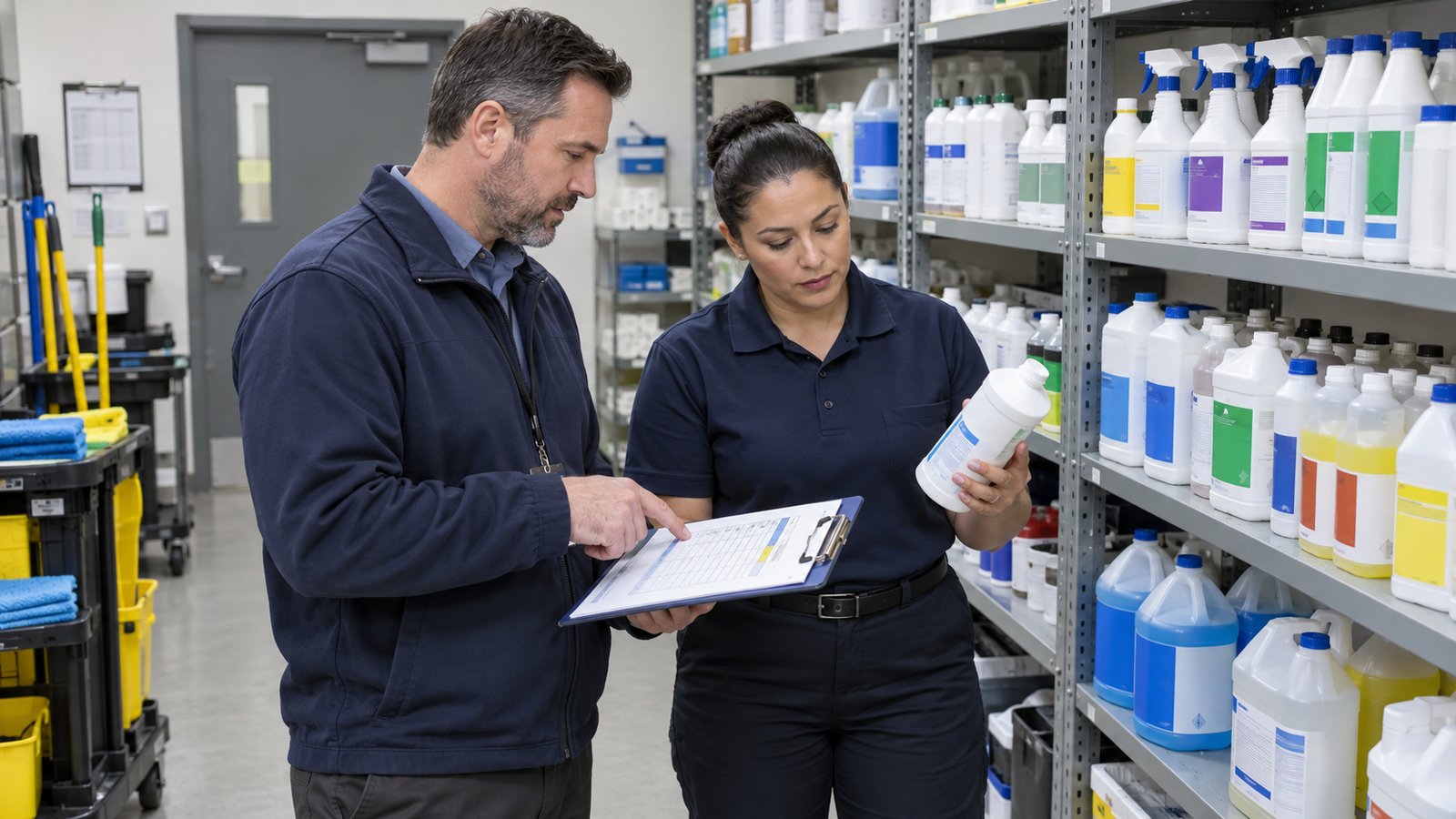
A cleaning contractor may need to replace a product because of a manufacturer change, a supply interruption, a surface issue, a safety concern, or a client sustainability goal. The risk is not substitution itself; it is making a change without the buyer knowing what will be used, whether it performs, or how workers will be trained. A strong contract gives both parties a practical approval route before a new chemical arrives on site. GreenPoint Maintenance Services uses site-specific product controls that connect the task, label, Safety Data Sheet, surface, dilution, and user training. This guide explains what a facility manager should require, how to review alternatives, and how to keep records useful without turning product approval into an administrative bottleneck.
Separate routine consumable replenishment from product substitution
A vendor should be able to replenish the approved product listed in the scope without seeking new approval for every delivery. A substitution occurs when the manufacturer, product identity, formula, intended use, hazard classification, dilution, or application method changes in a material way. The contract should define what counts as a change and require advance written notice before the replacement is used. If the approved product is unavailable, the vendor can request temporary approval with an end date and a plan to return to the standard product. Emergency exceptions should be narrow, documented, and reviewed after the immediate need has passed.
Create an approved-product register with product name, manufacturer, intended task, surfaces, dilution, application method, required PPE, label date or revision, SDS location, and approving person. Add a field for client restrictions such as fragrance, food-contact use, stone, resilient flooring, or occupied spaces. The register should be accessible to supervisors and workers who need it, while sensitive purchasing details can remain with procurement. A clear register helps prevent a relief cleaner from bringing an unreviewed product onto the site and gives the client a baseline for future audits.
Use a hazard and performance assessment before approval
Review the proposed alternative for health and physical hazards, label directions, exposure controls, required PPE, storage incompatibilities, disposal instructions, and intended-use restrictions. OSHA’s Hazard Communication Standard requires employers to maintain a written program, communicate hazards through labels and Safety Data Sheets, and train employees on hazardous chemicals in their work area. See the current [OSHA Hazard Communication requirements](https://www.osha.gov/laws-regs/regulations/standardnumber/1910/1910.1200). An SDS is not a complete substitute for product training, and the contractor remains responsible for its workers’ applicable training and protective measures.
Compare the product’s performance for the real soil and surface, not just a generic claim. A proposed floor cleaner should be tested on the floor finish; a restroom product should be evaluated against the specified soil and fixture material; a disinfectant must be used only for label-supported claims and surfaces. EPA’s safer-chemical guidance describes informed substitution as evaluating alternatives for hazards, performance, and economic feasibility. A structured review can compare hazard profile, surface compatibility, odor, dilution, use cost, packaging, training burden, waste, and supply reliability. A lower-cost concentrate may not save money if it requires higher dilution, more labor, or repeat cleaning.
Check the label, SDS, certification, and regulatory status
Review the product label and current SDS together. Confirm the exact product identifier, intended application, dilution, contact time if applicable, surface restrictions, ventilation, storage, PPE, first aid, and emergency information. OSHA’s [SDS overview](https://www.osha.gov/hazcom/appendix-d) explains the standardized information in the 16-section document. A green or low-odor label is not proof that the product is harmless or appropriate for every worker and surface. If the proposed product carries an EPA Safer Choice label, verify it in the program’s [product search](https://www.epa.gov/saferchoice/products) and check the category and use instructions.
Do not treat cleaning certifications as interchangeable. Green Seal’s GS-37 standard covers specified industrial and institutional cleaners such as general-purpose, restroom, glass, and carpet cleaners, while products making disinfectant or sanitizer claims are subject to different requirements. See [Green Seal GS-37 scope](https://greenseal.org/standards/gs-37-cleaning-products-for-industrial-and-institutional-use/). If a product claims to disinfect, verify the EPA registration and label directions for the intended organism, surface, and use. Refer to the [EPA disinfectant registration guide](/blog/epa-disinfectant-registration-guide/) rather than relying on the phrase “hospital grade” as a substitute for label review.
Write a practical approval workflow into the contract
A complete workflow identifies who can request a substitution, what documentation must accompany the request, who reviews it, how long review should take, and whether the product can be used before approval. A standard request packet can include the reason for change, current and proposed labels, SDS, use dilution, affected surfaces and tasks, certification or registration information, a short risk/performance comparison, and a sample or test plan. The client should name a primary approver and backup so a routine change does not wait indefinitely. A good process distinguishes a minor supply change from a change that affects hazards, disinfection claims, performance, or contract cost.
Specify that the contractor will not introduce an unapproved product into the facility except under a defined emergency process. Require notice before use, limited application, worker instruction, and a post-event review. If the substitution increases cost, changes dilution, or requires additional equipment, require a written price impact and client acceptance before the scope changes. Include rights to reject a product that is incompatible with the facility, and define how the vendor will return to the previous product or propose another alternative. [Commercial cleaning contract key terms](/blog/commercial-cleaning-contract-key-terms/) offers related clauses for approvals, scope changes, and documentation.
Test the alternative on a controlled, representative area
When a change is approved for evaluation, choose a small test area that represents the actual surface and soil, and get written permission from the facility contact. Record the surface material and finish, product and dilution, tool, dwell time, temperature or ventilation conditions if relevant, appearance before and after, residue, odor, worker feedback, and any damage. Use the manufacturer’s directions and do not mix the proposed product with existing chemicals. A test is not a license to use the product everywhere; the reviewer should confirm the result and expand use only after acceptance.
For repeated-use changes, assess performance over several services rather than on one demonstration. A floor may look good when wet but leave a film after drying; a restroom cleaner may remove light soil but fail under weekend traffic. Track product consumption per usable gallon or per service zone, rework, complaints, inspection results, and supply availability. If the product is a disinfectant, the label’s contact time and pre-cleaning instructions matter; a rushed trial that ignores them is not a valid comparison. Use a simple sign-off with approver, date, test result, allowed locations, and review date.
A substitution record should answer a future auditor’s basic questions without requiring staff to reconstruct the decision from memory: what changed, why it changed, who approved it, what evidence was reviewed, where it may be used, and when the decision will be revisited. Store the approved version with the site’s chemical register and make obsolete copies easy to identify. GreenPoint Maintenance Services can review the facility’s current approval path during a walkthrough and provide a fixed-price quote for cleaning under the agreed product list; call 347-332-9348 to schedule a review.
Train employees and manage inventory after the decision
After approval, update the product register, work instructions, dilution equipment, labels on secondary containers where required, and SDS access. Train affected workers before the product is used, including shift substitutes. Cover the task, hazards, protective measures, spill response, incompatibilities, storage, first aid, and any change to the routine. Keep obsolete products out of service and dispose of them according to label and applicable local requirements; do not pour concentrated material into a drain unless the label and facility procedure allow it. Supervisors should verify that the correct product and dilution appear at the work area.
Inventory control should record the product, lot or delivery date where practical, location, quantity, and reorder point. A facility with multiple buildings may designate one secured chemical room per building and limit quantities at satellite closets. Store products in their original labeled containers when possible, segregate incompatible materials, and keep emergency information available. OSHA’s [safer-chemicals substitution framework](https://www.osha.gov/safer-chemicals/basics) encourages systematic review of hazards, alternatives, feasibility, and implementation rather than an unexamined one-for-one swap. GreenPoint Maintenance Services can document approved products and site procedures for the client’s review.
Document exceptions and verify compliance on site
The audit trail need not be complicated. Keep the request, supporting label and SDS, approval, test result, training record, date the product entered the site, and any later change. During inspections, compare the product in the janitor closet with the approved register, check that secondary containers are labeled, and confirm that staff can find the applicable SDS. Record a mismatch as a corrective action with an owner and due date. Do not photograph private personnel or safety incidents broadly; capture only the information needed to resolve the product-control issue.
JaniTrack gives GreenPoint clients a live dashboard for service records, approved task evidence, timestamped GPS-tagged photos, and selected ATP results where relevant. Those tools can verify that a service occurred, but they do not replace chemical inventory, label review, or hazard training. GreenPoint Maintenance Services reports 98% client retention and offers fixed pricing with no hourly billing or hidden fees; product substitutions that change cost or scope are still reviewed with the client rather than silently embedded in an invoice. For a broader product policy, see [green cleaning for commercial buildings](/blog/green-cleaning-commercial-buildings-guide/) and [OSHA chemical safety and GHS/SDS](/blog/osha-cleaning-chemical-safety-ghs-sds/).
Frequently asked questions about cleaning-product substitutions
Q: Can a cleaning contractor substitute a product without telling the client? A: The contract should require advance written approval for material changes to product identity, hazards, intended use, dilution, application, performance, or price. Routine replenishment of the same approved product is different from a substitution. Q: Does an SDS prove that a cleaning product is safe? A: No. An SDS communicates hazards and protective measures; it does not certify a product as harmless or confirm that it performs on a particular surface. Review the label, training, surface compatibility, and task requirements together.
Q: Does a green certification mean a disinfectant is approved for every pathogen? A: No. Product certifications cover defined criteria and categories. For disinfectant claims, verify the EPA registration and follow the product label for organisms, surfaces, dilution, and contact time. Q: What documents should a vendor submit for approval? A: Request the label, current SDS, reason for change, intended tasks and surfaces, dilution, hazard/performance comparison, test plan, training changes, and any price impact. Call GreenPoint Maintenance Services at 347-332-9348 to review a site-specific chemical approval process.
Make product changes deliberate, documented, and safe for the facility and the people who work in it. Call GreenPoint Maintenance Services at 347-332-9348 to schedule a walkthrough and review your chemical-approval workflow. GreenPoint provides fixed-price scopes, Green Seal-certified products where appropriate, and JaniTrack service documentation.