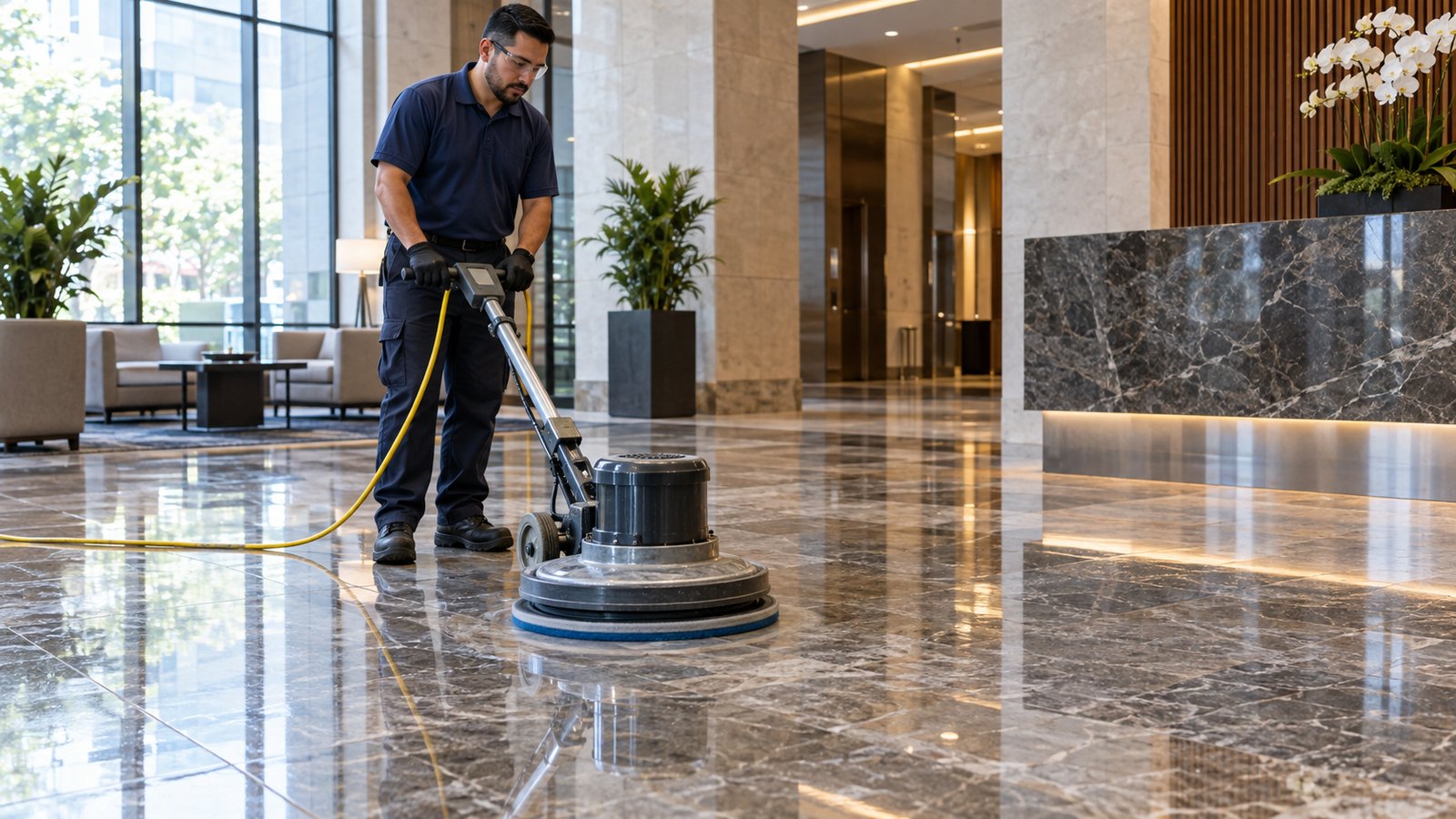
A natural-stone lobby can be one of a commercial building’s most visible assets, but stone is not a single, interchangeable flooring material. Marble, limestone, travertine, granite, slate, and terrazzo differ in mineral composition, porosity, finish, grout, and tolerance for acids and abrasives. A cleaner that is safe for one surface can etch another, and an aggressive pad can turn a small maintenance problem into a costly restoration project. GreenPoint Maintenance Services builds stone programs around identification, soil removal, compatible chemistry, and measured results rather than a generic mop-and-buff routine. This buyer’s guide explains what facility managers should specify, how to evaluate a contractor, and how to protect floors in offices, residential lobbies, healthcare waiting rooms, and public buildings.
Identify the stone and finish before choosing a method
Start with the building’s finish schedule, renovation records, or stone supplier. If records are missing, a qualified stone-care professional should document the material, finish, grout, existing sealer, and any repairs before recommending chemicals or machines. Marble and limestone are calcium-carbonate stones and are vulnerable to acidic products; granite is generally more acid-resistant but can still be scratched or damaged by unsuitable chemicals. Terrazzo may combine marble chips with cementitious or resin binders, so the binder and finish matter as much as the aggregate. Do not identify a floor by color alone, and do not use a test chemical on an occupied floor without approval and a discreet test area.
The Natural Stone Institute recommends neutral cleaners or stone-specific products for routine care and warns that acids such as vinegar or lemon can dull or etch calcareous stone. Its [natural-stone care guidance](https://www.naturalstoneinstitute.org/consumers/care/) also emphasizes frequent dust mopping because grit acts as an abrasive. Keep a record of the stone name if known, finish, installation date, sealer history, manufacturer recommendations, and approved products. This record prevents a new vendor or relief worker from treating a honed limestone corridor as if it were resilient vinyl. GreenPoint Maintenance Services can incorporate an owner-approved floor map and product list into the site-specific scope.
Control grit at the door before it reaches the lobby
Most preventable wear begins at entrances. Sand, road dust, salt, and fine construction debris are carried onto the floor by shoes, carts, and deliveries; repeated foot traffic grinds those particles against the finish. A practical soil-control plan uses exterior scraping where site conditions permit, a well-sized entry mat, and an interior absorbent mat that is long enough to capture soil from multiple steps. Inspect mats daily, vacuum or clean them on a defined schedule, and replace saturated or curled mats promptly. A mat that is too short, dirty, or unsecured can become both ineffective and a trip hazard.
During a walkthrough, map the actual routes from sidewalk, parking, loading dock, and elevator to the reception desk. A 20,000-square-foot office with one public entrance may need a different mat and dust-mopping frequency than a 20,000-square-foot clinic with two street entrances and constant patient traffic. Use traffic observations rather than square footage alone to set the schedule. GreenPoint’s JaniTrack verification can record assigned work, timestamped GPS-tagged photos, and recurring floor observations so the manager can see whether entrance controls are being maintained. For general frequency planning, compare the floor zones with the framework in [cleaning frequency standards by facility type](/blog/cleaning-frequency-standards-by-facility-type/).
Use a short entrance log to note rain, wind, grit, salt, mat loading, and the time a lobby needs an extra pass. After two or three weeks, compare those observations with inspection findings rather than assuming every day needs the same labor. GreenPoint Maintenance Services can review those traffic patterns on a walkthrough and prepare a fixed-price seasonal adjustment; call 347-332-9348 to schedule the review.
Build a daily routine around dry soil removal
For most occupied stone floors, begin each service with dry dust removal using a clean, non-treated microfiber or dust mop. Work systematically from the farthest area toward the exit, collect rather than push grit into corners, and change or clean the mop when it is visibly soiled. Vacuum attachments and wheels should be in good condition and free of embedded debris that could scratch the finish. Spot-clean spills promptly, blotting rather than spreading the liquid. Then damp mop only as needed with a compatible, properly diluted neutral cleaner, using clean solution and a clean rinse process where the manufacturer requires it.
More detergent is not a shortcut to better cleaning. Overconcentration can leave a film that attracts soil, creates streaks, and makes a polished floor appear dull. Train staff to use the dilution system exactly as labeled, use separate clean and recovery solution where the equipment allows, and avoid leaving standing water on stone or in grout joints. Place wet-floor signs before work begins and remove them only when the area is dry and safe. A useful routine checklist captures entrance mat condition, dust-mop coverage, spill response, restroom or lobby splash zones, and exceptions such as a damaged tile or recurring black heel marks.
Choose periodic care by soil load and finish condition
Daily cleaning removes loose soil; it does not correct etching, deep scratches, worn traffic lanes, or failed grout. Set periodic work from observed conditions and the stone manufacturer’s recommendations. A low-traffic executive suite might need a monthly detailed edge clean, while a transit-adjacent lobby may require weekly machine-assisted maintenance and more frequent mat service. These are planning examples, not universal ISSA-prescribed intervals. A floor inspection should record visible soil, gloss consistency, scratches, etch marks, grout condition, slip concerns, and whether the surface is becoming harder to maintain.
Restoration may involve honing, polishing, crystallization, or resealing, but these are not interchangeable tasks and should not be included as vague language in a nightly janitorial price. Ask the contractor to distinguish routine cleaning from restorative floor work, identify the proposed process and test area, list equipment and pads, describe dust and access controls, and state who accepts the final finish. For a terrazzo or marble floor, obtain written approval from the owner or stone specialist before abrasive or chemical restoration. See [VCT floor-care methods](/blog/vct-floor-care-strip-seal-wax-guide/) for why a resilient-floor finish system should not be casually applied to stone.
Before the first service, ask the provider to walk the floor with the building contact and note the starting condition. Document existing chips, dull bands, repaired grout, worn finish, and any areas that need a specialist rather than routine cleaning. This baseline protects both the owner and the cleaning team from confusing old damage with a new service issue. GreenPoint Maintenance Services can use the walkthrough to set a zone-by-zone frequency and submit a written fixed-price quote; call 347-332-9348 to arrange the visit. The proposal should list the approved product, routine tasks, periodic work, exclusions, and the person authorized to approve restoration.
Use compatible products and make the floor specification explicit
Write the approved product name, dilution, application method, dwell time if relevant, rinse requirement, and prohibited products into the site plan. Exclude acidic descalers, vinegar, lemon-based cleaners, abrasive powders, and unapproved rust removers from calcareous stone zones. Do not assume that a product labeled green, natural, or multipurpose is automatically suitable for every surface. A product can be safer from one perspective and still be incompatible with a finish. Check product documentation and manufacturer instructions, and test an approved product on an inconspicuous area before deploying it across a large lobby.
GreenPoint Maintenance Services uses Green Seal-certified products where they are appropriate to the task, while treating surface compatibility and the label’s intended use as separate checks. The [commercial green-cleaning guide](/blog/green-cleaning-commercial-buildings-guide/) explains how buyers can evaluate environmental claims without substituting a label for a performance specification. A contract should also say who may approve a product change, how a change is tested, and what happens if the product affects stone appearance. Fixed pricing should identify included routine tasks and separately price restoration, stain treatment, emergency response, and after-hours access so the owner can compare bids fairly.
Measure service quality with repeatable inspections
A floor-care program is easier to manage when inspection points are visible and repeatable. Define representative zones such as the first 20 feet inside each entrance, elevator thresholds, reception, corridor turns, and restroom approaches. Use a simple rating scale for visible grit, streaking, standing water, missed edges, mat condition, and damage reporting. Photograph defects from consistent angles and compare them over time; a photo is evidence of a condition, not proof that a floor is sterile or free from all contamination. If the building uses ATP testing for selected hygiene checks, interpret results according to the instrument, surface, sampling protocol, and baseline rather than treating one number as a universal clean/dirty threshold.
JaniTrack gives GreenPoint clients a live dashboard for service verification, timestamped GPS-tagged photos, and selected ATP results. The practical value is faster exception handling: a property manager can identify a missed entrance zone, ask for a correction, and track closure rather than waiting for a monthly complaint summary. GreenPoint’s stated 98% client-retention rate is a company performance claim, not a guarantee for an individual floor or building; buyers should still confirm scope, references, staffing coverage, insurance, and escalation contacts. A monthly review can compare complaint trends, inspection findings, corrective-action closure, and any floor-care work completed against the approved plan.
Frequently asked questions about commercial stone floors
Q: Can a janitorial team use vinegar on a marble lobby? A: No. Marble and limestone are calcium-carbonate stones that can etch when exposed to acids. Use only an owner-approved, stone-compatible cleaner and follow the stone supplier’s instructions. Q: How often should a commercial stone floor be cleaned? A: Remove grit and inspect spills every service day, then set damp-mopping and machine-maintenance intervals from traffic, soil, finish, and manufacturer guidance. A busy entrance may need daily attention; a quiet office zone may need less frequent wet cleaning.
Q: Does sealing prevent every stain? A: No. A sealer can reduce absorption for some stones and products, but it does not make a floor stain-proof, etch-proof, or maintenance-free. Confirm whether the stone should be sealed and which sealer is compatible before application. Q: What should a stone-floor cleaning quote include? A: Request a mapped scope, product and dilution list, daily and periodic frequencies, access plan, floor-restoration exclusions, inspection method, correction response, and fixed price. Call GreenPoint Maintenance Services at 347-332-9348 to arrange a walkthrough and quote.
Protect a high-visibility stone floor with a surface-specific plan, not guesswork. Call GreenPoint Maintenance Services at 347-332-9348 to schedule a facility walkthrough and fixed-price quote. GreenPoint verifies recurring work through JaniTrack, including timestamped GPS-tagged photos and selected ATP testing, and reports a 98% client-retention rate.