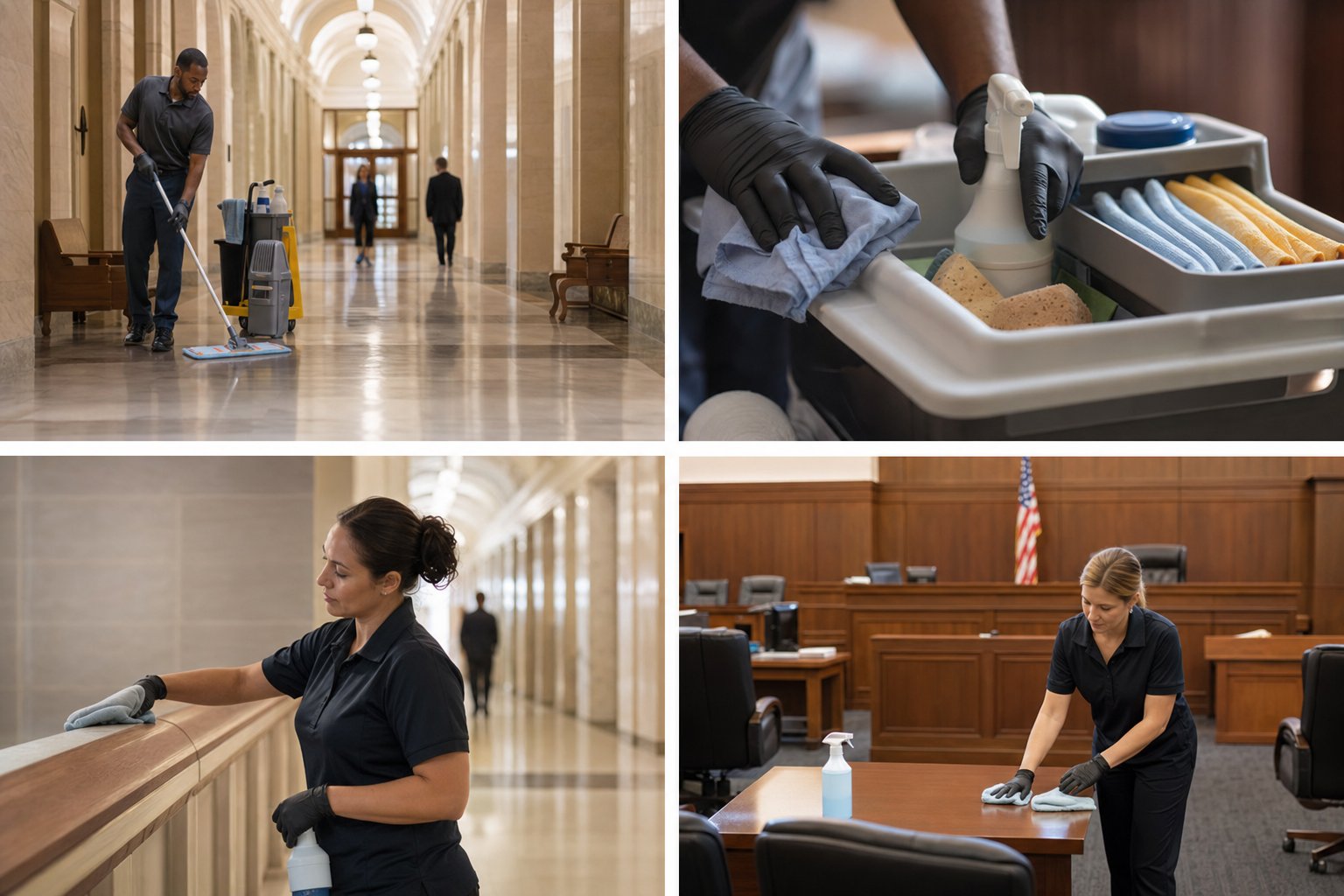
A courthouse is both a public building and a security-sensitive workplace. Jurors, attorneys, judges, defendants, clerks, law enforcement, visitors, and facilities staff move through distinct routes, often on a fixed calendar. Cleaning must keep public corridors, courtrooms, elevators, restrooms, holding areas, and administrative zones ready without disrupting proceedings or compromising access controls. GreenPoint Maintenance Services builds courthouse cleaning programs around court schedules, restricted zones, OSHA-safe chemical handling, and reviewable documentation for government and quasi-government facilities across NY, NJ, CT, PA, and FL.
Map public, controlled, and restricted zones
The first deliverable should be a security-aware floor map. Separate public entrances, screening queues, jury assembly, courtrooms, attorney conference rooms, clerk counters, chambers, holding areas, sally ports, evidence storage, secure elevators, mechanical spaces, and staff offices. Each zone needs an owner, service window, approved route, and rule for what the cleaner may touch. GreenPoint records those boundaries in the site plan so a new team member does not improvise near a restricted door.
A downtown courthouse near Foley Square, Newark Penn Station, Philadelphia City Hall, Stamford Government Center, or a county complex may have different screening and loading rules. Record badge requirements, escort procedures, key control, freight-elevator reservations, camera restrictions, and emergency contacts. The [government building cleaning GSA standards](/blog/government-building-cleaning-gsa-standards/) article provides a broader procurement lens, while the courthouse scope must follow the court’s own security authority.
Schedule around hearings, juror movement, and public hours
Court calendars create hard deadlines. A courtroom may need a quiet pre-opening reset, touchpoint service between sessions, and a post-adjournment clean without moving files, exhibits, or personal property. Public restrooms and screening areas often need checks during the day, while chambers and administrative offices may be serviced after close. GreenPoint can create a day-part schedule that names the court contact who releases each zone.
Do not promise the same frequency for every floor. A 100,000-square-foot courthouse with 12 courtrooms, 20 restrooms, and continuous public traffic may need multiple daytime rounds; a small municipal court may need a smaller evening scope plus event-driven service. Call 844-814-0810 for a walkthrough that accounts for docket timing, holidays, jury selection, and security screening.
Clean high-touch public paths with controlled methods
The public path includes entrance handles, security trays where permitted, turnstiles, elevator buttons, seating, counters, courtroom doors, restroom fixtures, and queue barriers. Soil removal comes first; disinfection, where required, must use an EPA-registered product, correct concentration, full coverage, and the label’s contact time. GreenPoint trains teams to follow the approved product list and keeps SDS information available under OSHA Hazard Communication requirements.
Courthouse floors face wet weather, grit, and concentrated traffic at opening and lunch periods. Use walk-off mats, dry soil removal before damp work, compatible cleaners, and visible wet-floor controls. High dusting and glass work should be scheduled away from court activity. GreenPoint’s quality checks focus on the public route because one missed threshold or restroom can undermine a large building’s overall appearance.
Handle holding, medical, and bodily-fluid response carefully
Holding areas and law-enforcement routes may require dedicated tools, escorted access, and special waste procedures. A bodily-fluid incident, needle, vomit, or unknown spill should trigger the court’s exposure-control process rather than an improvised wipe-down. Staff need appropriate PPE, sharps awareness, hand hygiene, and a clear escalation contact. GreenPoint separates routine cleaning from incident response and documents who authorized entry and closeout.
Never photograph people, evidence, documents, or security equipment without written authorization. StockPoint can record task completion, timestamps, inspection notes, and corrective actions while omitting restricted images. If the court permits photographs in public areas, use a defined evidence policy. ATP testing may support selected surface trend monitoring, but it is not a pathogen test and does not replace visual inspection or validated response procedures.
Protect records, evidence, and confidential areas
Cleaners should not move files, exhibits, juror materials, devices, or personal property. The scope should identify desks and counters that remain untouched, rules for found items, and the exact escalation path. In clerk offices, records rooms, and chambers, service may require a court employee’s presence or a restricted checklist. Background screening, named staff, badge return, and supervisor oversight should be part of the vendor evaluation.
GreenPoint uses access matrices and handoff logs to support continuity when a regular cleaner is absent. A substitute should receive the current zone rules before entering, not after an incident. GreenPoint’s 98% client retention reflects attention to reliable service relationships, while security procedures remain controlled by the court and its authorized officials.
Use StockPoint for accountable government service
A courthouse facilities manager often has to document work to a chief administrator, procurement team, inspector, or contract manager. StockPoint can provide timestamped GPS-tagged photos where allowed, task checklists, supervisor inspections, dashboard visibility, and corrective-action status. Configure user access around public records, security, and privacy requirements; a record is useful only when it does not expose protected information.
GreenPoint combines digital evidence with visual inspection and client review. A photo cannot prove that a restroom was cleaned correctly if the wrong product or dwell time was used. A short report should show completed areas, missed access, exceptions, response time, and the owner of the corrective action. GreenPoint can help a courthouse move from “the crew says it was done” to a reviewable operational record.
Regional courthouse logistics matter
New York City courts near Foley Square, Brooklyn Borough Hall, Queens Civic Center, and Staten Island require coordination with dense transit and security operations. Westchester and Long Island courthouses may have parking, campus, and multiple-building routing. New Jersey facilities in Newark, Jersey City, Trenton, and Hackensack have local screening and loading procedures. Connecticut, Pennsylvania, and Florida courthouses add their own county, state, storm, and public-access requirements.
Build service windows around the actual facility, not a generic regional promise. Record snow, rain, hurricane, or heat response plans where relevant; an entry mat and vestibule can become the highest-risk area during a weather event. GreenPoint can coordinate a regional account while keeping each court’s authorized contacts and access rules separate. Fixed pricing states the agreed scope without hourly billing or hidden fees.
Write a defensible courthouse cleaning specification
A procurement-ready specification states facility areas, frequencies, staffing, consumables, floor-care cycles, waste streams, security requirements, training, inspection, response times, insurance, and exclusions. Include court closures, special proceedings, weekend events, and emergency callout rules. Ask vendors to price recurring work separately from post-construction, high dusting, window, carpet, or biohazard response.
GreenPoint Maintenance Services is MBE/MWBE certified through NYS, NYC, and NYC DOE programs and registered in SAM.gov. GreenPoint Maintenance Services can use Green Seal certified products where appropriate, follow an approved chemical list, and provide StockPoint-ready documentation. Call 844-814-0810 or email info@greenpointms.com for a courthouse walkthrough and a fixed-price proposal.
Audit performance without disrupting proceedings
The best audit is brief, repeatable, and timed to the building’s rhythm. Inspect representative courtrooms, public corridors, restrooms, elevators, staff areas, and entry zones; record appearance, supply levels, safety conditions, access issues, and corrective actions. Trend failures by location and task. A recurring restroom miss may require a different frequency; a recurring courtroom issue may indicate a schedule conflict rather than poor effort.
GreenPoint’s supervisor can review the checklist with the facilities contact and close exceptions through StockPoint. The company’s 98% client retention is a useful proof point, but the court should judge the program by documented response, reliable access control, and clean public routes. Call 844-814-0810 when the courthouse needs a new scope or a service recovery plan.
Frequently Asked Questions
Question: How is courthouse cleaning different from office cleaning? Answer: Courthouse service adds public screening routes, court calendars, controlled access, holding areas, records and evidence restrictions, and a need to avoid disrupting proceedings. GreenPoint builds a zone and access matrix before staffing.
Question: Can cleaners enter courtrooms during proceedings? Answer: Only according to the court’s approved schedule and access authority. Routine service may occur before opening, between sessions, or after adjournment; daytime staff can coordinate through the designated court contact.
Question: How should a courthouse handle a bodily-fluid incident? Answer: Use the facility’s exposure-control and incident-response procedure, appropriate PPE, trained staff, proper waste handling, and documented closeout. Routine janitorial staff should not improvise with unknown spills or sharps.
Question: Can StockPoint be used in a secure court building? Answer: It can support task records, inspections, corrective actions, and approved timestamped photos. The court should configure evidence rules to prohibit restricted photography and protect documents, people, and security information.
Question: How do I request secure government janitorial pricing? Answer: Call GreenPoint at 844-814-0810 or email info@greenpointms.com. The walkthrough will map zones, security procedures, court hours, frequencies, and fixed-price inclusions.
For proposal structure, see [how to choose a commercial cleaning company](/blog/how-to-choose-commercial-cleaning-company/) when evaluating secure-site vendors.
Protect the public path and the court’s security rules with GreenPoint Maintenance Services. Call 844-814-0810 for a courthouse walkthrough, a documented scope, fixed pricing with no hourly billing or hidden fees, and StockPoint-ready proof backed by GreenPoint’s 98% client retention.