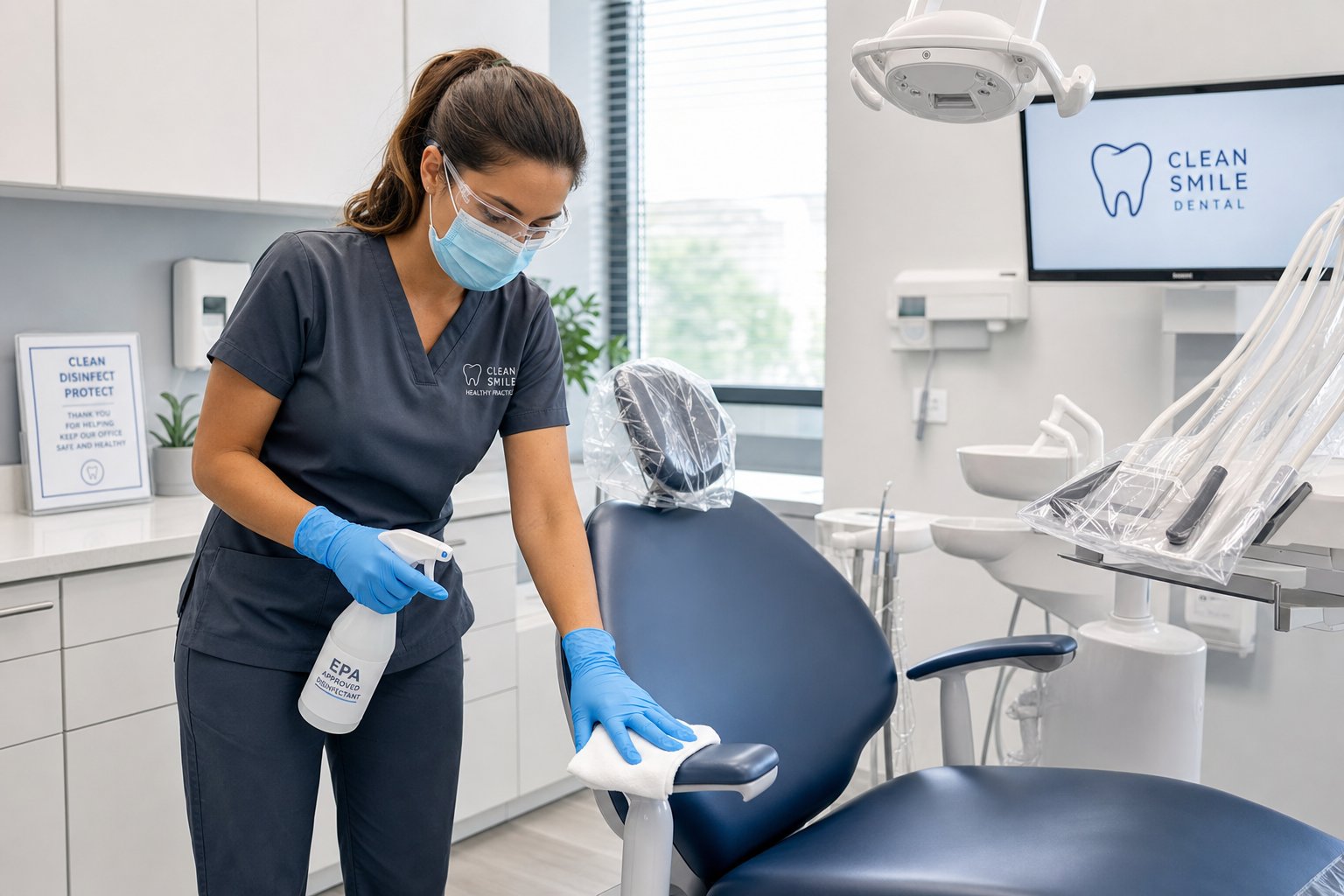
Dental office cleaning must separate clinical treatment rooms, public reception, staff areas, and instrument-processing zones. A practice near Manhattan’s medical corridors, the Bronx, Queens, Stamford, or Philadelphia can lose patient confidence when fingerprints, dust, odors, or missed touchpoints are visible. This guide sets a practical janitorial scope without confusing environmental cleaning with sterilization. GreenPoint Maintenance Services Corp trains teams for healthcare-adjacent environments, follows product labels and OSHA requirements, and uses StockPoint documentation so practice managers can see what was completed.
Divide the practice into risk-based zones
A dental office should have at least four cleaning maps: reception and waiting, treatment and operatory rooms, staff/support areas, and instrument-processing or utility spaces. Each map needs its own tools, sequence, and access rules. Reception focuses on chairs, door pulls, check-in counters, toys where present, floors, and visible dust. Operatories require careful cleaning of environmental surfaces around the chair, light handles only when approved, counters, sinks, and floors. Instrument reprocessing follows the practice’s clinical protocol and should not be treated as routine janitorial work. GreenPoint builds the zone map with the office manager and clearly marks what the cleaning crew may and may not touch.
Define what the janitorial team owns—and what it does not
Cleaning removes soil; disinfection uses an EPA-registered product according to its label; sterilization is a validated clinical process. The contract should state that janitorial staff do not process instruments, open sterile packs, handle sharps, or enter restricted areas without authorization. GreenPoint Maintenance coordinates with the dental practice’s infection-prevention lead, documents product dwell times, and escalates spills or sharps immediately. The [medical office cleaning requirements and OSHA guide](/blog/medical-office-cleaning-requirements-osha/) is a helpful companion for PPE, exposure response, and training questions. Clear boundaries protect patients, clinicians, cleaners, and the practice’s compliance record.
Use a room-by-room treatment-room sequence
After the clinical team removes waste and secures instruments, cleaners can follow a high-to-low and clean-to-dirty sequence: remove routine waste, dust or wipe approved upper surfaces, clean environmental touchpoints, detail the sink and splash zone, spot-clean walls and glass, then finish the floor. Use fresh microfiber for each operatory or defined group and never reuse a restroom cloth. GreenPoint’s supervisor audits the sequence and can use StockPoint timestamped GPS-tagged photos in approved, non-confidential views. Avoid photographing patient information, clinical screens, or identifiable records. A documented sequence makes a new cleaner easier to train and makes a complaint easier to investigate.
Manage reception, waiting, and children’s areas
Patient-facing spaces need a calm appearance and a low-odor experience. Schedule visible cleaning outside peak arrivals where possible, but keep a rapid response for spills. High-touch points include entrance handles, armrests, check-in counters, pens, tablet stands, and restroom fixtures. GreenPoint uses Green Seal certified products when compatible with the manufacturer’s surface guidance and the practice’s infection-control plan. A nightly detail should include corners, baseboards, chair legs, and floors; daytime checks should address visible debris and touchpoints. ATP testing can be used selectively as a trend tool, not as a claim of sterilization; the [ATP bioluminescence testing guide](/blog/what-is-atp-bioluminescence-testing-cleaning/) explains how to interpret it responsibly.
Handle instrument and utility areas with special controls
Instrument-processing spaces may contain sinks, splash, packaging materials, chemical containers, and regulated waste. The practice should identify which surfaces are in the janitorial scope and which belong to trained clinical staff. Keep chemical storage labeled and segregated, maintain SDS access, and avoid mixing products. OSHA’s Hazard Communication Standard and Bloodborne Pathogens Standard inform training, PPE, exposure response, and reporting. GreenPoint documents approved products, carries color-coded tools, and escalates any blood or body-fluid incident under the practice’s written procedure rather than improvising. A manager walkthrough should review eyewash access, sharps containers, restricted cabinets, and the path from operatories to waste holding.
Build a reliable schedule around patient hours
A two-operatory practice may need nightly service, while a multi-chair clinic with extended hours benefits from a daytime check plus a detailed close. Frequency should reflect patient volume, restroom use, floor type, and procedure mix. GreenPoint can plan daily, weekly, and monthly tasks without taking clinical rooms out of service during appointments. The schedule should include periodic carpet extraction, hard-floor machine work, high dusting, and HVAC grille dusting where appropriate. For offices near Penn Station, Grand Central, Fordham Road, Flushing, or Center City Philadelphia, transit and parking constraints make arrival communication important. Call 844-814-0810 for a walkthrough that maps the actual operating day.
Verify performance without compromising privacy
A dental practice needs evidence, but evidence must respect confidentiality. StockPoint can document time, location, checklist completion, inspection outcomes, and corrective actions; photos should exclude patient records and clinical identifiers. GreenPoint’s supervisor checks restrooms, reception, operatories, and staff areas against a baseline. Monthly reporting can show inspection pass rate, open issues, response time, supply incidents, and recurring trouble zones. The [quality assurance commercial cleaning program](/blog/quality-assurance-commercial-cleaning-program/) gives a structure for review meetings. If a manager sees residue on a counter or misses a restroom refill, the issue should have an owner and due time—not just a promise to “be more careful.”
Price a dental cleaning scope transparently
A fixed quote should identify frequency, room count, consumables, waste exclusions, periodic floor work, emergency response, and any clinical-area restrictions. GreenPoint Maintenance Services does not use hourly billing or hidden fees; our proposal explains assumptions and change-order triggers. Ask vendors about worker screening, insurance, training, replacement coverage, and their approach to chemicals around patients and equipment. A low price that excludes restocking or quarterly detail can create operational costs later. GreenPoint’s 98% client retention and MBE/MWBE certifications support procurement documentation, while the site assessment determines the actual service price. Email info@greenpointms.com or call 844-814-0810 to request a no-obligation quote.
Coordinate the team on opening and closing procedures
The final step is a written handoff: alarm and access rules, clinical exclusions, waste path, approved products, emergency contacts, opening condition, and closing checklist. GreenPoint trains the assigned team, supervisor, and relief staff against that document, then schedules a 14-day review. Managers should tell the crew about construction, new equipment, changed patient hours, or a new sterilization workflow before the change begins. GreenPoint Maintenance Services Corp can support one dental office or a regional group across NY, NJ, CT, PA, and FL. A consistent standard, documented in StockPoint and reviewed with the office manager, keeps patient-facing quality stable as the practice grows.
Practice leaders should include clinicians in the kickoff without turning them into janitorial supervisors. Their role is to identify clinical boundaries, approved products, patient-flow constraints, and incident procedures; GreenPoint’s role is to train the cleaning team, supervise delivery, and report exceptions. Put the final room map near the service closet and in the digital plan, then revisit it when a chair, sink, flooring material, or operating hour changes. A manager can call 844-814-0810 for a walkthrough that includes the office administrator and infection-prevention contact. This shared ownership makes a fixed quote more useful because everyone can see what is included, excluded, and measured. This documented approach gives owners a repeatable standard for onboarding, inspections, budgeting, and renewal decisions across changing occupancy and facility conditions.
A strong kickoff packet should include the room map, approved product list, exposure contacts, access schedule, waste path, and a short “do not touch” list for every operatory. Keep the packet current when the office adds a chair, changes a disinfectant, remodels reception, or extends evening appointments. GreenPoint can give the office manager a supervisor contact and a relief-worker briefing so the standard survives vacation and sick coverage. During a monthly review, compare inspection results with patient-flow changes and clinician observations; a repeated miss near one chair may indicate an equipment or workflow issue, not only a cleaning issue. Document the corrective action and close it with a date. For practices serving Midtown, Fordham, Flushing, Staten Island, Stamford, or nearby Pennsylvania communities, reliable arrival procedures matter as much as the room checklist. Call 844-814-0810 to book a walkthrough and receive a fixed proposal that protects clinical boundaries and patient trust.
A professional cleaning program is strongest when the operating record is easy to read six months later. Keep the approved scope, room inventory, frequency chart, product list, access rules, and escalation contacts together. At launch, GreenPoint reviews the first inspection with the client and records any baseline exceptions instead of allowing them to become an argument about performance. At renewal, compare the original assumptions with actual occupancy, traffic, events, tenant changes, and project work. That comparison helps an owner decide whether to change a route, add a periodic service, repair a facility condition, or keep the plan unchanged. GreenPoint’s supervisors can explain why a task is daily, weekly, monthly, or triggered by an event, and StockPoint gives the account team a factual record for that conversation. Managers should also name one person authorized to approve a scope change and one person who receives urgent notifications. This prevents duplicate instructions and protects the cleaning crew from conflicting requests. For a walkthrough, call 844-814-0810 or email info@greenpointms.com; GreenPoint will listen to the operational goals, confirm the boundaries, and provide a fixed-price quote that procurement and facilities can both understand.
FAQ: practical answers for facility decision-makers
Does dental office cleaning include instrument sterilization? No. Janitorial cleaning and disinfection of approved environmental surfaces are different from clinical instrument processing and sterilization. The dental practice must define restricted areas and clinical ownership. GreenPoint follows the approved scope, does not handle sharps or instruments, and escalates exposure incidents under the practice procedure.
What areas should be separated in a dental cleaning plan? At minimum, separate reception/waiting, treatment rooms, staff/support spaces, and instrument-processing or utility areas. Each zone should have its own tools, sequence, PPE, and access rules. GreenPoint creates a room-by-room map during the walkthrough.
How often should a dental office be cleaned? Most practices need a detailed service at least daily, with daytime checks based on patient volume and restroom or waiting-room turnover. Weekly and monthly tasks cover edges, glass, floors, and high dusting. GreenPoint sets frequency from chairs, hours, surfaces, and traffic rather than a generic square-foot promise.
Can cleaning work be documented without exposing patient information? Yes. StockPoint can record time, location, checklist completion, inspections, and corrective actions. Photos are limited to approved views and must exclude records, screens, and identifying patient information. GreenPoint reviews privacy boundaries during onboarding.
How can a dental practice get a cleaning quote? Call GreenPoint Maintenance Services at 844-814-0810 or email info@greenpointms.com for a no-obligation walkthrough. We provide fixed pricing with no hourly billing and no hidden fees after reviewing the rooms and clinical boundaries.
GreenPoint Maintenance Services Corp is ready to map the scope at a no-obligation walkthrough. Call GreenPoint at 844-814-0810 or email info@greenpointms.com to schedule a site review; we return a fixed-price proposal with no hourly billing and no hidden fees. [what is ATP bioluminescence testing](/blog/what-is-atp-bioluminescence-testing-cleaning/)