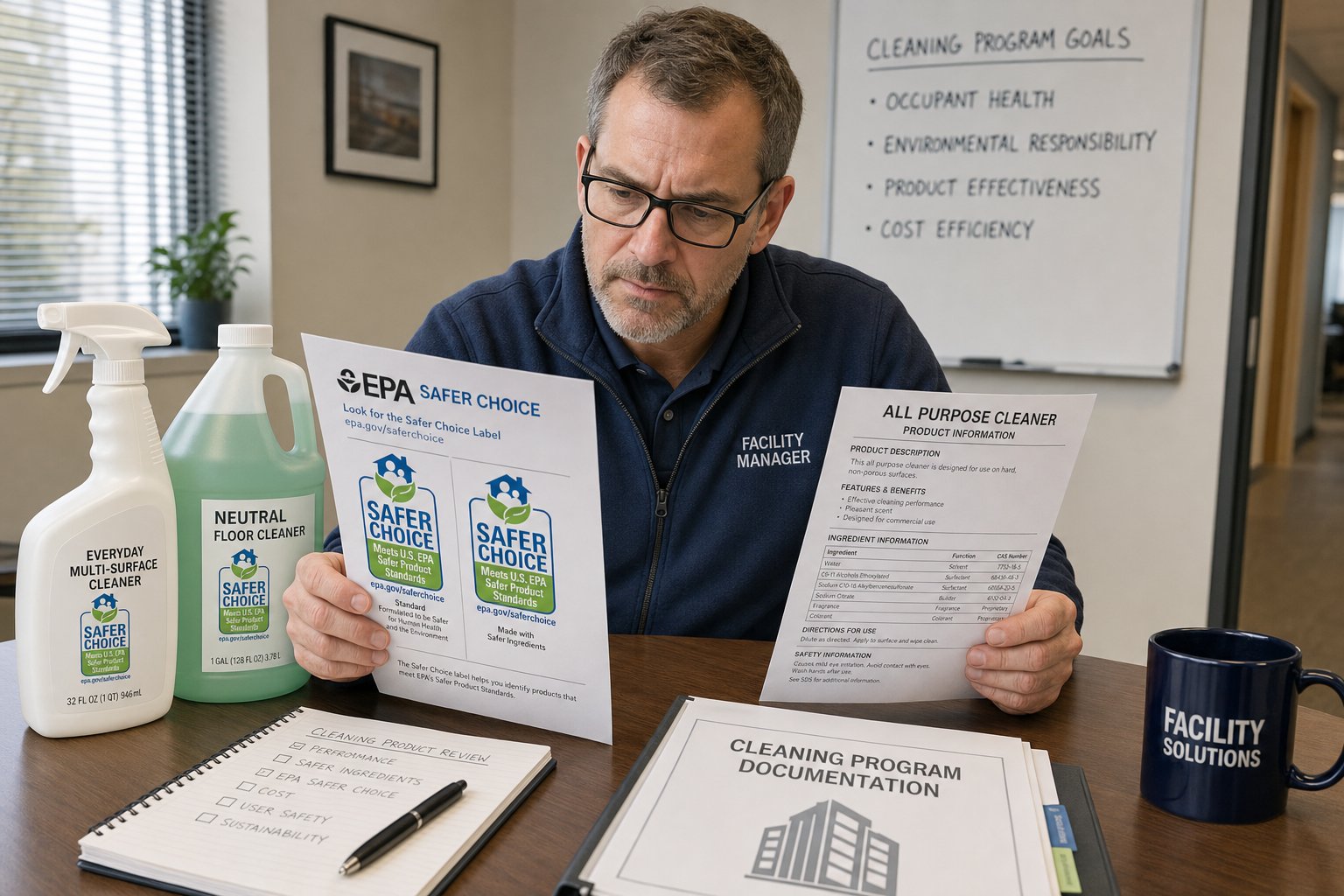
“Green cleaning” is not a complete specification. A facility buyer needs to know which product is approved, what claim is being made, whether the label can be verified, how the product is diluted, and whether the cleaning result still meets the required standard. EPA Safer Choice gives purchasers a recognizable framework for evaluating safer chemical ingredients, but it does not eliminate the need for training, documentation, or performance checks. This guide helps commercial property teams in New York, New Jersey, Connecticut, Pennsylvania, and Florida write a green cleaning program that can withstand questions from tenants, auditors, and procurement teams.
What EPA Safer Choice actually signals
The EPA Safer Choice label indicates that a product has gone through the program’s review of ingredients and product performance criteria. Buyers should confirm the exact product name and manufacturer in the current EPA Safer Choice product directory rather than relying on a vendor’s verbal description. A similar-sounding “eco” product is not automatically certified. GreenPoint Maintenance Services treats certification as a documentable product attribute and keeps the selected product list aligned with the client’s scope, building requirements, and available supply chain.
Safer Choice is different from Green Seal, LEED, and a general “green” marketing statement. Green Seal certifications address defined product or service standards, LEED is a building rating system with purchasing and operations credits, and a marketing claim may have no independent certification behind it. A credible RFP states which certification is required for which task, what substitutions are allowed, and what evidence the contractor must provide. GreenPoint can map products to the facility’s procurement policy instead of putting one label on every bottle.
Build a product verification file
For each chemical, keep the exact product name, manufacturer, certification or listing URL, label, SDS, intended use, dilution, contact time, PPE, storage location, and approved surface list. Include the date reviewed and the person responsible for updates. This file should be available to the facility manager and cleaning supervisor. GreenPoint uses documented product lists so a substitute purchased during a supply shortage is reviewed before it enters the program. A product that is safer by claim but wrong for a surface or soil condition can still create operational risk.
Read the label and SDS together. The label tells the user how to apply the product, required contact time, dilution, and restrictions; the SDS explains hazards, first aid, handling, storage, and spill response. Do not use a product outside its label or pour concentrate into an unmarked bottle. The [OSHA cleaning chemical safety and GHS/SDS guide](/blog/osha-cleaning-chemical-safety-ghs-sds/) provides a practical companion checklist. GreenPoint trains crews on both documents and keeps chemical questions on the escalation path instead of asking an employee to guess.
A buyer should also ask how the vendor will prove that the selected product is used at the site. Useful evidence includes inventory checks, dispenser or dilution-control logs, supervisor inspections, purchase records, and replacement approval. JaniTrack can connect a route or task record with an approved product checklist and timestamped GPS-tagged photos where the client permits them. GreenPoint’s objective is a traceable process: the right product, at the right concentration, on the right surface, with a visible correction when something goes wrong.
Evaluate performance and exposure together
Safer ingredients do not mean a product can be sprayed everywhere or used without ventilation. Review fragrance, VOC content, aerosols, skin and eye hazards, respiratory sensitivity, and slip risk. Use pump sprays or dampened microfiber where feasible, avoid unnecessary fragrance, and schedule stronger products during unoccupied periods. The [indoor air quality commercial cleaning guide](/blog/indoor-air-quality-commercial-cleaning/) explains why product choice, HEPA filtration, microfiber, and timing affect what occupants breathe. GreenPoint uses Green Seal certified products where appropriate and adjusts methods to the building’s IAQ goals.
The product must still perform against the soil and risk. A neutral cleaner may suit daily floors, while a degreaser is needed in a restaurant, an EPA-registered disinfectant may be required for a defined pathogen claim, and a specialty finish may be needed for resilient flooring. “Safer” is not a license to under-clean. GreenPoint Maintenance Services starts with the required appearance and hygiene outcome, then selects a compliant product and process that achieves it without unnecessary chemical load.
Measure the cleaning program with a mix of visual and objective checks. Use appearance inspections for dust, residue, streaks, and waste; ATP testing for selected surfaces when trending residual organic soil is useful; and incident logs for odors, skin reactions, damage, or slips. No single measure proves every claim. GreenPoint reviews inspection trends through JaniTrack and uses corrective action when a product, dilution, tool, or frequency is not producing the intended result.
Write a green cleaning scope for local facilities
A New York City office near the World Trade Center, a school near Flushing, a medical suite in Westchester, and a warehouse in Elizabeth do not have identical needs. Identify occupancy, ventilation, floor types, patient or student sensitivity, LEED or WELL goals, waste rules, storage space, and delivery constraints. Buildings near subway entrances may track in more soil, while coastal Florida sites may need extra attention to moisture and mold risk. GreenPoint provides a walkthrough at 347-332-9348 to connect product selection to the actual facility.
Include a substitution protocol. The contractor should notify the buyer before replacing a listed product, provide the label and SDS, confirm certification status, explain the reason, and receive written approval for permanent changes. For urgent substitutions, define who can authorize them and how the product file will be updated. GreenPoint’s fixed-pricing scope can state which product families are included and which specialty treatments require a separate written quote, with no hidden fees or hourly billing.
For government, education, and corporate procurement, define reporting cadence and audit rights. A monthly report might list active products, certification status, substitutions, training completions, incidents, inspections, and open actions. New York City and New York State buyers may also need MBE/MWBE documentation, while federal work may require SAM.gov registration. GreenPoint is MBE/MWBE certified in New York, SAM.gov registered, and can provide procurement documentation alongside operational reporting.
Train people, not just paperwork
Every cleaner needs task-level instruction: identify the bottle, read the label, measure dilution, wear the listed PPE, observe contact time, protect adjacent materials, and report an exposure or spill. Demonstrate the method at the sink, restroom, floor, or patient area where it will be used. GreenPoint supervisors coach in the work zone and record training, including refresher dates. A binder on a shelf is not a training program if the person using the chemical cannot explain the basic controls.
Color-coded microfiber, closed dilution systems, and clearly labeled secondary containers reduce preventable mistakes. Store concentrates in a locked or controlled area away from food, linens, and incompatible chemicals. Keep eyewash access and emergency contacts visible where the risk assessment requires them. GreenPoint can review storage closets in Manhattan, Queens, Newark, Stamford, Philadelphia, Tampa, or Orlando during a walkthrough and recommend a layout that supports safe work rather than slowing it down.
Ask the vendor how supervisors verify technique after onboarding. GreenPoint uses inspection observations, JaniTrack task completion, product inventory checks, and client feedback. The company’s 98% client retention is supported by making the program explainable: managers can see what was done, employees know why a method matters, and corrective work is assigned instead of buried in a general quality score. Call 347-332-9348 when your existing green program has labels but no operating evidence.
Avoid common green-claim mistakes
The most common mistake is treating “natural,” “non-toxic,” “eco-friendly,” or “biodegradable” as a complete safety or certification claim. Those words may not describe the full hazard profile, concentration, or intended use. Another mistake is assuming a certified product works for every surface. A third is counting recycled packaging while ignoring over-dilution, aerosol use, disposable microfiber, or uncontrolled waste. GreenPoint helps buyers separate claim verification from process performance so the program is credible to occupants and procurement reviewers.
Do not remove disinfectants or specialty products solely to improve a sustainability score. Use an EPA-registered disinfectant when the task requires a pathogen claim, follow the label contact time, and control exposure through method and timing. Sustainability can come from targeted application, microfiber, dilution control, training, and fewer unnecessary fragrances. GreenPoint’s team can explain the difference between cleaning, sanitizing, and disinfecting during a facility walkthrough and document the reason for each product category.
Budget for the whole program, not just the bottle price. Labor, dispensers, training, storage, floor finish compatibility, equipment, verification, and disposal often matter more than a few cents of chemical cost. GreenPoint Maintenance Services offers fixed pricing after scope review and can price specialty work separately. Call 347-332-9348 for a written quote that states products, frequencies, assumptions, verification, and approved substitutions.
Frequently Asked Questions
Q: Is EPA Safer Choice the same as Green Seal? A: No. They are different programs with different criteria and listings. Confirm the exact product or service certification required by your procurement policy; GreenPoint can maintain both the product file and the operational scope.
Q: Does a Safer Choice label mean a product is harmless? A: No. It indicates review under the program’s criteria, but users must still follow the label, SDS, dilution, PPE, storage, and ventilation requirements. GreenPoint trains cleaners on those controls.
Q: Can green cleaning work in healthcare or food service? A: Yes, when products and methods match the required disinfecting, sanitizing, food-contact, and regulatory needs. GreenPoint separates routine cleaning from specialized claims and documents the approved use.
Q: How often should a commercial product list be reviewed? A: Review when a product changes, a supplier substitutes an item, a label or SDS updates, an incident occurs, or the client’s standard changes; a scheduled quarterly check is a practical baseline. JaniTrack can support site-level verification.
Q: How do I request an EPA Safer Choice cleaning proposal? A: Call GreenPoint Maintenance Services at 347-332-9348. GreenPoint will review the facility, product requirements, IAQ goals, storage, training, and reporting before offering fixed pricing.
A procurement review is strongest when it asks for evidence in the same format from every bidder. Request the current listing or certification record, label, SDS, dilution instructions, surface limitations, fragrance information, substitution process, and a sample training record. GreenPoint can organize that material into a product matrix that a facilities director can review in minutes. If a product is unavailable, the team documents the replacement and its operational impact instead of quietly changing the bottle. That discipline protects the buyer’s sustainability claim, the cleaner’s safety, and the building’s surfaces at the same time.
Ask GreenPoint Maintenance Services to verify your commercial cleaning products and process. Call 347-332-9348 for a walkthrough, a documented product file, JaniTrack visibility, Green Seal options, and fixed pricing with no hidden fees.