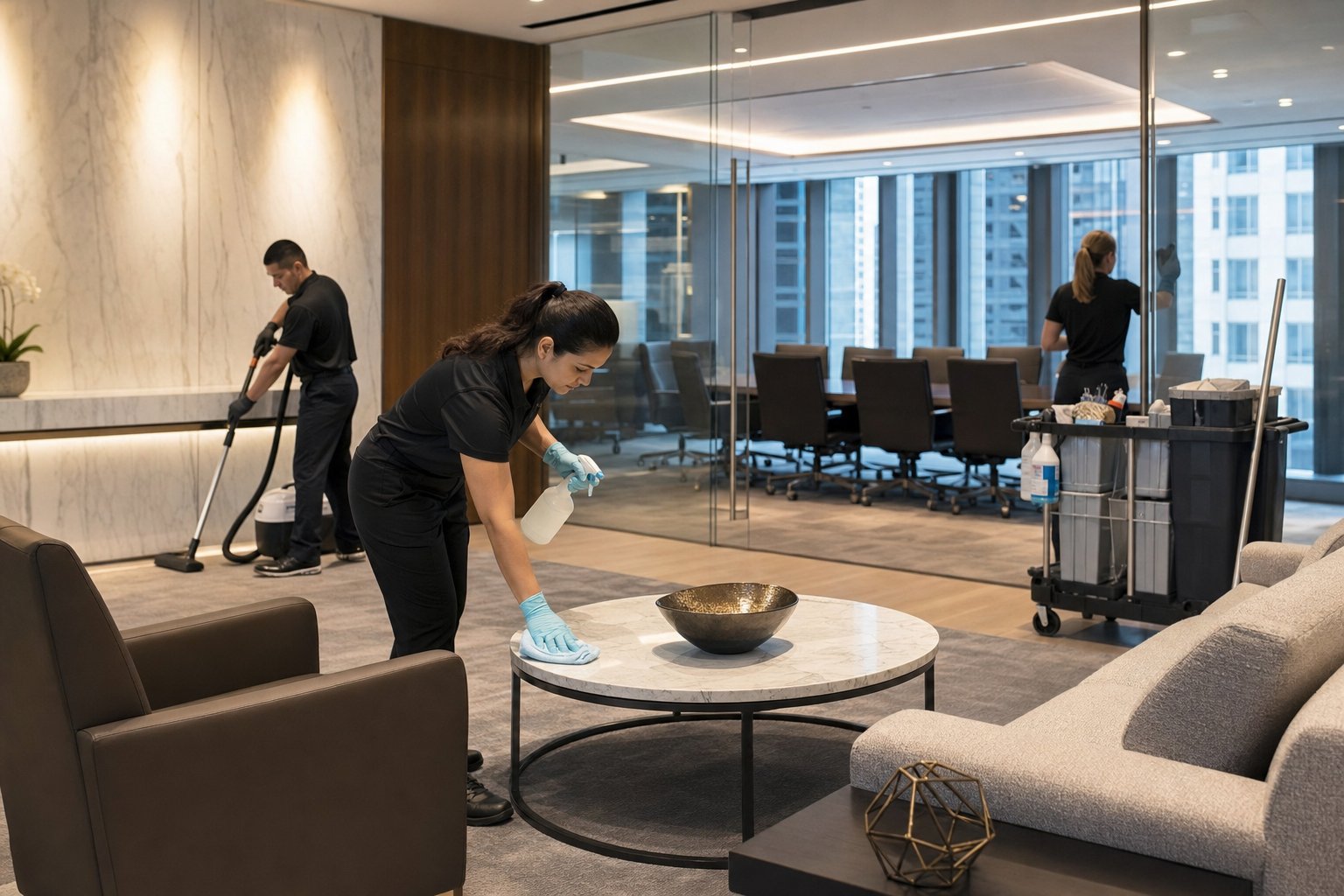
Financial services offices communicate trust through every visible detail: a streak-free reception desk, clean conference room, orderly restroom, and quiet service handoff. They also contain sensitive documents, controlled floors, trading technology, and client information that make access and data handling as important as appearance. GreenPoint Maintenance Services designs secure office cleaning programs for banks, wealth managers, insurers, fintech teams, and professional-services firms across Manhattan, Brooklyn, Queens, Jersey City, Stamford, Philadelphia, and South Florida.
Define security boundaries before the first shift
Map public, employee, restricted, and highly restricted areas. Reception, visitor lounges, conference centers, kitchens, restrooms, and corridors can have a routine scope; records rooms, trading floors, server rooms, cash-handling areas, and executive suites may require escorts, separate schedules, or client-performed cleaning. GreenPoint records doors, alarm procedures, badge rules, elevator access, and prohibited items in the site plan.
The work order should state what remains on desks, what must be left untouched, and how found documents or devices are escalated. Cleaners should not photograph screens, files, badges, or personal information. StockPoint documentation can use task completion and exception notes without exposing sensitive content. A walkthrough is the moment to decide whether GPS-tagged photos are allowed in specific zones.
Build a polished client-facing cleaning scope
Client areas need a consistent visual standard: clear glass, dust-free reception surfaces, aligned furniture, clean door hardware, spotless elevator thresholds, and replenished restrooms. Define appearance expectations by room and traffic. A 30,000-square-foot Midtown office with a large conference center may require pre-meeting checks and daytime touchpoint rounds, while a low-occupancy advisory suite may need a smaller evening scope.
Use a room inventory instead of a vague phrase such as “general office cleaning.” Count restrooms, kitchens, conference rooms, elevators, entrances, and floors; identify carpet, VCT, stone, wood, and glass. The [ISSA clean standards and appearance levels](/blog/issa-clean-standards-appearance-levels/) guide can help stakeholders agree on what clean looks like. GreenPoint prices the agreed scope on fixed terms, not hidden labor assumptions.
Dust and particulate control around technology
Dust can affect a polished environment and accumulate around vents, cable paths, monitors, and equipment enclosures. Clean from high to low, use suitable microfiber, avoid uncontrolled sprays near electronics, and coordinate with IT before touching workstations or server-adjacent areas. HEPA-capable equipment may be appropriate for specific tasks, but the facility’s engineering and manufacturer requirements come first.
A financial office often has raised floors, dense workstation layouts, and 24-hour operations. Schedule detail work in controlled windows and use signs or barriers when floors are wet. GreenPoint supervisors check corners, baseboards, conference credenzas, and elevator landings because visible misses in those areas can undermine the entire client experience. Call 844-814-0810 to map a dust-control plan.
Restrooms, kitchens, and high-touch points
High-touch service should follow traffic and occupancy: entry handles, turnstiles, elevator buttons, conference-room controls, pantry handles, water dispensers, and restroom fixtures. The goal is not indiscriminate spraying; it is thorough soil removal followed by an appropriate disinfectant when required, with correct coverage and contact time. GreenPoint uses task-specific tools and product instructions, with SDS information available under OSHA Hazard Communication requirements.
Kitchen and pantry cleaning should clarify whether food-contact surfaces are the vendor’s responsibility and which products are approved. In restrooms, document fixture count, replenishment, odor response, and inspection times. For busy floors in FiDi or Hudson Yards, daytime checks may protect service quality more efficiently than adding a larger overnight crew. See [restroom cleaning best practices](/blog/restroom-cleaning-best-practices-high-traffic/) for a fixture-focused checklist.
Access, confidentiality, and incident response
Reliable access controls include named personnel, badge return, key logs, visitor rules, and a clear escalation chain. Train staff to stop work and notify the account lead if they find a document, device, suspicious package, spill near equipment, or door that should be secured. Do not move or dispose of sensitive material. The client defines incident reporting and retention rules; GreenPoint follows them and records only the information needed to close the issue.
Background screening, supervision, and backup coverage should be discussed in the proposal. If the primary cleaner is absent, the replacement must know the access limitations before entering. GreenPoint’s management approach is designed to support continuity, and its 98% client retention is a practical proof point for long-term service relationships.
Regional service considerations
A Manhattan financial office near Wall Street, Grand Central, or Penn Station may have freight-elevator reservations, security screening, and narrow service windows. Jersey City’s Exchange Place and Newport towers have their own loading rules; Stamford offices may coordinate across a campus; Philadelphia sites need parking and access planning. South Florida branches in Brickell, Coral Gables, and Fort Lauderdale add humidity, storm readiness, and high-traffic entry concerns.
For every location, document the local building contact, service window, transit or loading constraints, and emergency response expectations. GreenPoint can coordinate a regional account while keeping each site’s access rules distinct. No hourly billing and no hidden fees means the proposal should plainly state what is included, the frequency, and the response options. Call 844-814-0810 for a walkthrough.
Verification and quality assurance
Quality assurance should combine visual inspection, task completion, client feedback, and trend review. A supervisor can audit a sample of rooms each visit, while the account lead reviews recurring complaints, supply misses, and late access. If ATP testing is approved, use it on selected touchpoints to compare trends; it is a residue indicator, not a pathogen test or a replacement for cleaning standards.
StockPoint can connect timestamped GPS-tagged photos, checklists, inspection results, and corrective actions in a live dashboard. In a confidential office, configure the evidence rules to avoid sensitive screens and papers. GreenPoint gives the facility manager a reviewable record without turning the cleaning team into a security risk. The [digital cleaning verification systems](/blog/digital-cleaning-verification-systems/) guide provides additional program design context.
How to evaluate a secure office cleaning vendor
Request the vendor’s access process, training and supervision model, insurance, background-screening approach, chemical controls, emergency response, and sample quality report. Ask who can enter executive and technology zones, how a lost badge is handled, and how work is verified when photography is prohibited. Require a room-by-room scope and a list of exclusions for IT, records, cash, and personal property.
GreenPoint Maintenance Services is MBE/MWBE certified through NYS, NYC, and NYC DOE programs and registered in SAM.gov. GreenPoint Maintenance Services uses Green Seal certified products where appropriate, offers fixed pricing without hourly billing or hidden fees, and can support StockPoint verification. Call 844-814-0810 or email info@greenpointms.com to request a secure-site walkthrough and quote.
Measure readiness and improve the program
Service-level targets help a financial office protect both appearance and security. Track room completion, restroom inspection rate, supply stockouts, access incidents, corrective-action time, and recurring client complaints. Review the measures with the facilities contact monthly and exclude sensitive content from the report. GreenPoint can align the dashboard to the client’s security policy instead of treating every office as an open-access site.
Plan for confidential events such as board meetings, investor visits, audits, and client receptions. The pre-event scope may include a conference-center reset, glass and restroom inspection, touchpoint service, and a post-event recovery. Identify who authorizes entry and what evidence is permitted. A named GreenPoint supervisor can coordinate the window while the client maintains control of confidential rooms.
Technology and sustainability goals should be balanced with safe, compatible methods. Green Seal certified products may be appropriate for some applications, but product selection still follows surface, equipment, occupant, and label requirements. Use measured dilution, maintain SDS access, and keep liquids away from power and data paths. GreenPoint explains the product and process rather than relying on a green claim alone.
Quarterly reviews should examine whether the service frequency still matches the office. A hybrid workforce can reduce desk traffic but increase meeting-room concentration; a branch opening may create more entry and restroom demand. Adjust the zone plan based on inspections, occupancy, and complaints. GreenPoint documents a change so the client knows what changed and why.
If the facility needs a partner that can discuss security and cleaning in the same meeting, start with a walkthrough. GreenPoint will review access, prohibited areas, service windows, and proof requirements before quoting. Call 844-814-0810 or email info@greenpointms.com to schedule.
Do not overlook the first and last mile of the service route. A secure office may require a service entrance, freight elevator, badge reader, and alarm disarm procedure that changes by building. Midtown, FiDi, Exchange Place, Stamford, and Philadelphia properties should each have a local access note. GreenPoint keeps those instructions with the site scope so a trained replacement does not guess.
Finally, include a service-recovery rule in the agreement. If a room is inaccessible, a supply is missing, or an inspection finds a miss, the supervisor records the reason, assigns a correction, and confirms closure with the facilities contact. This keeps the client conversation factual and protects the account from repeated ambiguity. GreenPoint can review the pattern during a monthly meeting and recommend a scope change only when the evidence supports it. Call 844-814-0810 for a written plan.
Frequently Asked Questions
Question: How do you clean a financial office without exposing confidential information? Answer: Define restricted zones, prohibit photography where required, train staff on found documents and devices, use named access, and escalate incidents instead of moving sensitive material. StockPoint settings can be tailored to the client’s evidence rules.
Question: How often should a bank or wealth-management office be cleaned? Answer: Daily routine cleaning is common, with daytime checks for high-traffic public areas and restrooms. Frequency should follow occupancy, client events, floor size, and complaint or inspection trends.
Question: Does GreenPoint clean offices near Wall Street and Jersey City? Answer: GreenPoint plans service across Manhattan, Brooklyn, Queens, New Jersey, Connecticut, Pennsylvania, and Florida, subject to a walkthrough, building access rules, and a written scope.
Question: What does secure office cleaning cost? Answer: The price depends on square footage, room count, access windows, floor care, security requirements, and frequency. GreenPoint provides fixed pricing for a defined scope rather than an unclear hourly estimate.
Question: How can I schedule a quote? Answer: Call 844-814-0810 or email info@greenpointms.com. GreenPoint will map the facility, access boundaries, client areas, and verification requirements before quoting.
Present a consistently secure, polished workplace: schedule a walkthrough with GreenPoint Maintenance Services at 844-814-0810. Benefit from documented quality, StockPoint-ready verification, MBE/MWBE credentials, and fixed pricing with no hidden fees.