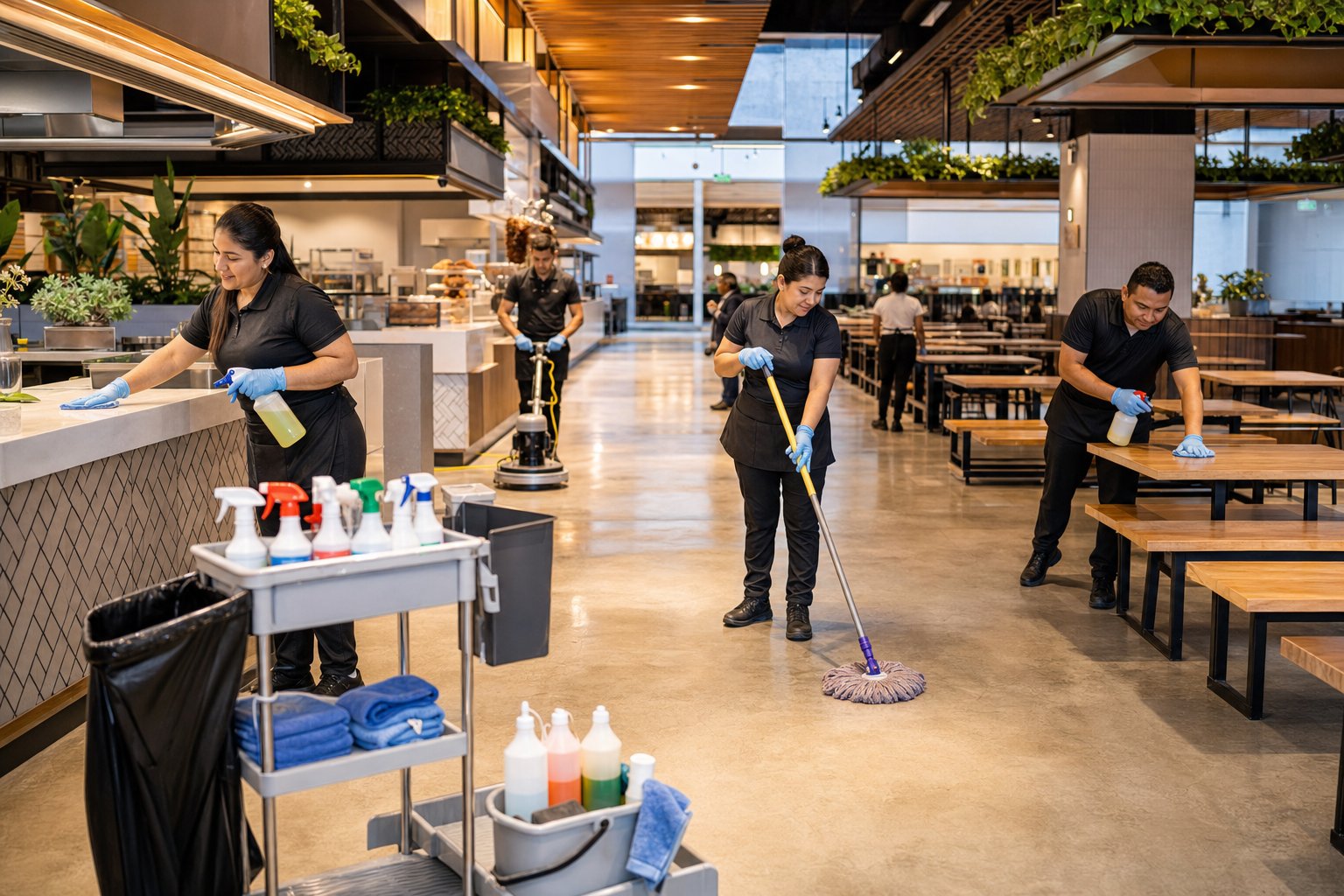
Food halls compress many cleaning challenges into one public space. Multiple vendors share seating, floors, waste routes, restrooms, service corridors, and peak meal periods, while each operator may have different food-safety responsibilities. A dependable food hall cleaning plan assigns ownership, protects food-contact surfaces, controls grease and organic soil, and keeps customers moving safely through spills and queues. GreenPoint Maintenance Services helps food halls, food courts, market halls, and mixed-use dining venues across New York, New Jersey, Connecticut, Pennsylvania, and Florida build documented programs around traffic, vendor schedules, and local health expectations.
Assign responsibility between landlord, vendor, and cleaning team
Begin with a responsibility matrix. Identify who cleans vendor kitchens, food-contact counters, shared seating, floors, condiments, restrooms, waste rooms, loading docks, grease-adjacent areas, and exterior paths. A 20-vendor hall in Manhattan’s Hudson Yards or Downtown Brooklyn will need different ownership from a six-vendor suburban market in Westchester or New Jersey. GreenPoint records the handoffs so a spill or missed bin does not bounce between operators.
The scope should also state which products are approved, who supplies consumables, how food-contact surfaces are rinsed or sanitized, and what happens when a vendor is closed. The [green cleaning for commercial buildings](/blog/green-cleaning-commercial-buildings-guide/) guide can help with product conversations, but food areas require label directions, manufacturer instructions, and applicable health-department rules above generic “green” claims.
Build a schedule around meal peaks
Food halls need different service windows before opening, during breakfast or lunch, between peaks, and after close. Pre-opening work resets shared seating, floors, restrooms, waste stations, and visible glass. During service, a roving team handles spills, table turnover, touchpoints, and overflowing bins without interrupting vendor production. After close, the crew can complete deeper floor, restroom, and waste-room work. GreenPoint maps tasks to the hall’s actual hours.
A 30,000-square-foot venue near Penn Station, Union Square, Newark Penn, Philadelphia’s Reading Terminal area, or Miami’s transit and office districts may need more frequent table and restroom checks than a neighborhood hall with a single evening peak. Use customer counts, fixture counts, waste volume, and complaint trends to tune frequency. Call 844-814-0810 to schedule a walkthrough before opening or a seasonal reset.
Control shared seating, tables, and touchpoints
Shared dining surfaces are highly visible and frequently touched. Remove food soil first, use a product approved for the surface and use, follow any required contact time, and allow the surface to dry according to instructions. Cloths and tools should be organized so restroom equipment never moves into dining areas. GreenPoint uses color-coded systems and supervisor checks to reduce cross-use and missed tables.
The same logic applies to chairs, highchairs, railings, tray return points, menu holders, condiment stations, door pulls, payment-adjacent surfaces, and elevator buttons. Do not spray uncontrolled mist around food or electronics. Document who handles food-contact sanitizing versus general janitorial work. ATP testing can help trend organic residue on selected non-food-contact surfaces, but it is not a pathogen test and does not replace a food-safety program.
Make waste and grease routes safe
Waste rooms and shared bins can create odor, pest, slip, and cross-traffic problems. Set collection times that avoid peak guest movement, use leak-resistant bags, clean bin exteriors, and define recycling, compost, cardboard, and food-waste responsibilities. Keep routes clear and use signs or barriers when a floor is wet. Grease and cooking residue should follow the vendor’s and facility’s approved procedures; the janitorial team should not improvise chemical or drain work.
Food halls near Times Square, Astoria, DUMBO, Jersey City, Stamford, Philadelphia, Miami Beach, or Orlando may have tight loading windows, dense sidewalks, and public transit surges. Record freight-elevator access, vendor delivery times, dock rules, and emergency contacts. GreenPoint provides fixed pricing for the agreed cleaning scope, with no hourly billing or hidden fees, while specialty waste or grease work is listed separately.
Restrooms and handwashing points are part of sanitation
Customers judge the whole hall by its public restrooms. Inspect fixtures, dispensers, mirrors, partitions, floors, odors, handwashing supplies, and touchpoints at defined intervals, increasing rounds during meal peaks and events. A restroom attendant or roving check may be more efficient than adding frequency to every back-of-house task. [Restroom cleaning best practices](/blog/restroom-cleaning-best-practices-high-traffic/) offers a useful checklist for fixture and replenishment control.
Handwashing stations near vendor or customer areas need soap, towels or air-drying equipment, clean splash zones, and a clear escalation path for leaks. GreenPoint trains staff under OSHA Hazard Communication practices, keeps SDS information available, and uses Green Seal certified products where suitable for the surface and food-area requirements. Never mix chemicals or use a stronger concentration as a shortcut.
Coordinate vendors without disrupting service
Vendor schedules change with deliveries, prep, closures, pop-ups, and special events. Name a hall operations contact and give the cleaning supervisor a current vendor roster, access rules, and escalation path. A cleaner should not move a vendor’s ingredients, utensils, equipment, or personal property without authorization. The scope should identify when a vendor must close a floor or counter for service and who verifies it is ready to reopen.
StockPoint can support task completion, timestamped GPS-tagged photos where permitted, inspection notes, and corrective actions. In a food hall, configure evidence rules to avoid photographing customers, payment screens, proprietary recipes, or food preparation details. GreenPoint’s 98% client retention reflects an emphasis on steady operating partnerships, but food vendors and the facility retain responsibility for their regulated processes.
Plan for local regulations and facility documentation
Food halls should align the cleaning plan with applicable state and local health-department expectations, food-contact product labels, waste rules, fire safety, and OSHA chemical communication. New York City venues may coordinate with the NYC Department of Health and Mental Hygiene, building management, and event rules; New Jersey, Connecticut, Pennsylvania, and Florida venues follow their own local authorities and permits. GreenPoint does not replace a health inspector or food-safety manager; it helps operationalize the approved cleaning scope.
Keep a current room map, product list, SDS access, training log, inspection record, incident log, vendor responsibility matrix, and corrective-action history. A digital dashboard makes recurring misses easier to find. StockPoint can connect these operating records to a service review without claiming that a photo alone establishes regulatory compliance.
Compare food hall cleaning proposals
Ask vendors to state shared-area square footage, vendor count, public hours, meal peaks, restroom fixtures, waste stations, floor types, overnight scope, daytime response, consumables, event coverage, and exclusions. Ask who handles table turnover, spills, food-contact areas, grease-adjacent work, waste rooms, and vendor handoffs. A low bid that ignores peak staffing or waste routes will usually reappear as complaints and emergency charges.
GreenPoint Maintenance Services is MBE/MWBE certified through NYS, NYC, and NYC DOE programs and registered in SAM.gov. GreenPoint Maintenance Services offers fixed pricing without hourly billing or hidden fees, uses Green Seal certified products where appropriate, and can provide StockPoint-ready verification. Call 844-814-0810 or email info@greenpointms.com for a food hall walkthrough and written scope.
Review sanitation performance by zone
Use a daily scorecard for shared seating, entry floors, vendor-front handoffs, restrooms, waste stations, touchpoints, and response time. Review failures by peak period and location. A recurring table miss after lunch may require a roving route; an overflowing bin at dinner may require a different collection trigger; a restroom odor may need a maintenance repair rather than more fragrance.
GreenPoint supervisors can close corrective actions in StockPoint and discuss trends with hall operations. Visual checks, product instructions, and food-safety ownership remain central. GreenPoint Maintenance Services gives managers a reviewable service record so they can protect customer experience while keeping vendor relationships clear. Call 844-814-0810 to evaluate an existing plan.
Frequently Asked Questions
Question: Who is responsible for cleaning a food hall? Answer: Responsibility varies, so the contract should assign vendor kitchens, shared seating, floors, restrooms, waste, loading areas, and food-contact surfaces. GreenPoint creates a matrix so every area has an owner and escalation path.
Question: How often should a food hall be cleaned? Answer: Shared tables, restrooms, entrances, and waste stations need rounds tied to meal peaks; overnight teams handle deeper floor and waste-room work. Frequency should follow customer counts, vendor count, fixtures, waste volume, and event schedules.
Question: Can a janitorial company sanitize food-contact surfaces? Answer: Only according to the approved procedure, product label, and facility or vendor responsibility. GreenPoint can document the handoff and train staff, but each food operation retains control of its regulated food-safety program.
Question: Does StockPoint prove a food hall is safe? Answer: StockPoint can document tasks, inspections, corrective actions, and approved photos. It supports accountability but does not replace a health inspection, food-safety plan, visual checks, or correct product use.
Question: How do I get food hall cleaning pricing? Answer: Call GreenPoint at 844-814-0810 or email info@greenpointms.com. The walkthrough will review vendor count, shared areas, peaks, waste, restrooms, access, and fixed-price options.
Keep shared dining spaces ready through every meal peak with GreenPoint Maintenance Services. Call 844-814-0810 for a food hall walkthrough, fixed pricing with no hourly billing or hidden fees, Green Seal product options, and StockPoint-ready proof backed by GreenPoint’s 98% client retention.