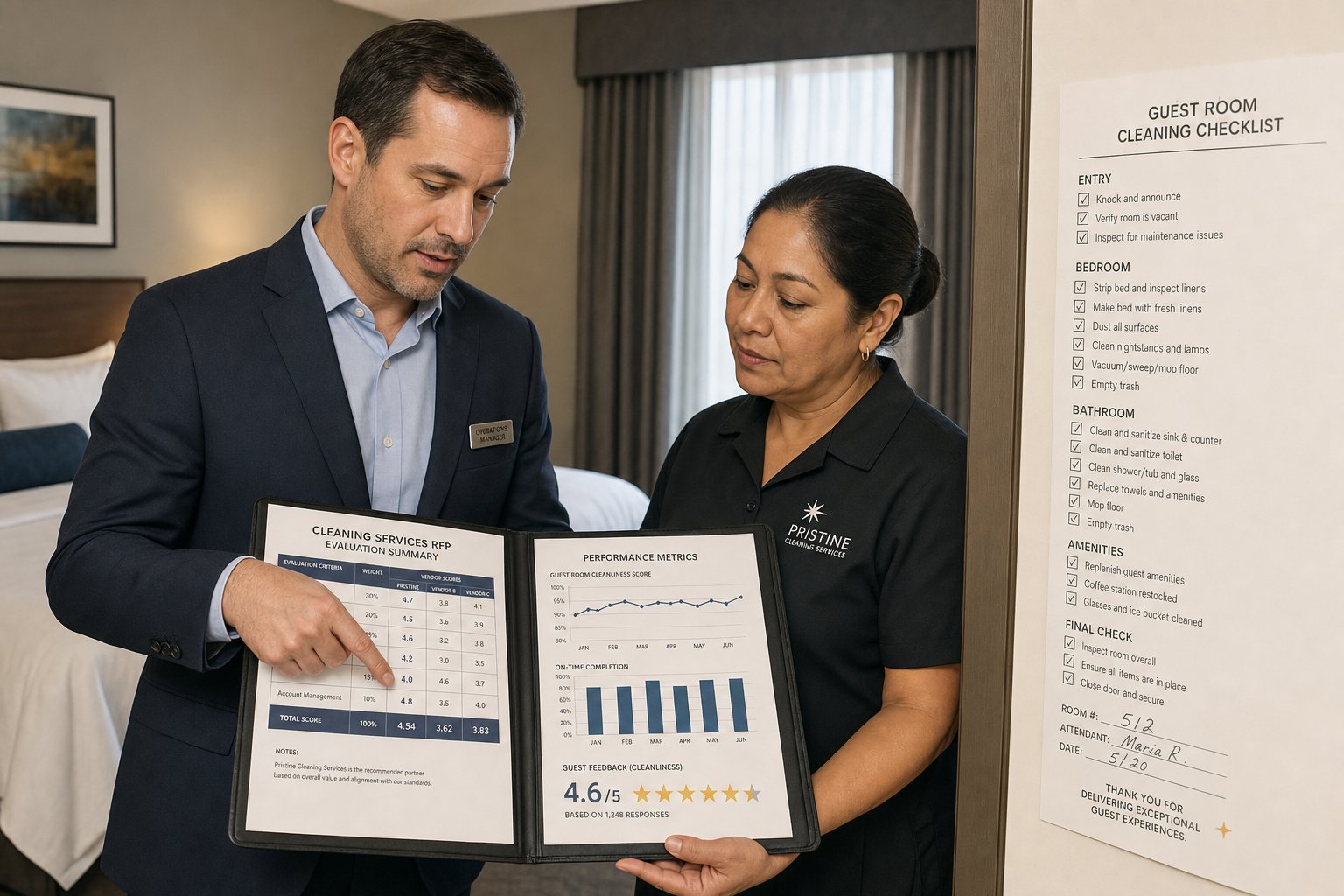
A hotel cleaning RFP has to do more than ask for the lowest nightly rate. It must translate occupancy, check-in promises, room types, public spaces, and safety requirements into a scope that vendors can price and operations teams can measure. A vague request produces uneven bids, while a detailed request reveals whether a contractor can protect guest experience during a 3 p.m. rush. This guide gives hotel owners and general managers a practical, evidence-based framework for writing the RFP, comparing proposals, and validating performance across New York, New Jersey, Connecticut, Pennsylvania, and Florida.
Start with a property fact sheet
Give every bidder the same operating baseline. List keys or rooms, average daily occupancy, peak check-in and check-out windows, room mix, linen flow, number of elevators, public restrooms, meeting rooms, breakfast or restaurant areas, fitness rooms, entrances, loading access, and occupied-hours constraints. A 180-room hotel near Times Square has a different labor curve from a 70-room boutique property in Brooklyn Heights or an airport hotel near JFK, LaGuardia, Newark, or Fort Lauderdale. Include square footage for public areas and the average number of departures per day; room count alone is not enough to calculate labor.
Add a 12-month calendar showing conventions, holidays, weddings, sports weekends, school breaks, and planned renovations. Manhattan properties around Penn Station, Grand Central Terminal, and Javits Center may see sharp turnover spikes, while hotels near Newark Liberty, Westchester County Airport, or Philadelphia International Airport often experience early departures and irregular arrival waves. GreenPoint Maintenance Services uses this information to separate baseline housekeeping from surge coverage rather than hiding peak labor in an inflated flat estimate.
Define room-cleaning scope by room status
A defensible RFP distinguishes stayover service, checkout or departure service, vacant-clean service, deep-clean rotation, out-of-order recovery, and post-maintenance reset. For each status, specify bed making, linen replacement, bathroom fixtures, tub or shower, mirrors, floors, dusting, touchpoints, amenities, waste, windows, odors, and visual inspection. Say whether the vendor supplies chemicals, carts, vacuums, PPE, microfiber, liners, and guest amenities. GreenPoint recommends a room matrix with columns for task, frequency, responsible role, acceptance standard, and evidence required.
Turnover metrics should be measurable without encouraging unsafe rushing. Track minutes from room release to inspection request, inspection request to ready status, re-clean rate, room-attendant productivity by room type, and rooms released by the promised check-in deadline. A practical pilot might target 28 to 35 minutes for a standard checkout room, with suites and accessible rooms receiving separate assumptions. GreenPoint will not treat a room as complete merely because a timer stopped; a supervisor inspection and documented exception are part of the handoff.
Build a lost-and-found, damage, and escalation procedure into the scope. Housekeepers should not improvise around broken glass, needles, bodily fluids, pests, water intrusion, suspected bedbugs, or unsafe electrical equipment. The RFP should name the hotel decision-maker, the vendor supervisor, the engineering contact, and the emergency route. In a high-rise in Long Island City or Downtown Brooklyn, also define freight-elevator windows, corridor noise limits, and cart staging so the cleaning plan respects building operations.
Write guest-ready standards for public spaces
Guest perception is shaped by the lobby, not only by the room. Specify inspection intervals for lobby floors, front-desk surfaces, elevator interiors, bell carts, public restrooms, corridor corners, handrails, door glass, meeting rooms, fitness equipment, and breakfast seating. A useful standard describes what a guest can see at arm’s length: no visible litter, no residue on touchpoints, no overflowing receptacles, dry restroom floors, stocked dispensers, and streak-free high-visibility glass. GreenPoint can pair these checks with timestamped GPS-tagged photos through JaniTrack when the property approves photography protocols.
Public-area coverage needs a day plan and an overnight plan. A daytime attendant can respond to spills and restroom traffic, while an after-hours crew completes vacuuming, mopping, waste removal, high dusting, and detail work. A 24-hour hotel should specify handoff times, response expectations, and who owns a task that starts before midnight and ends after shift change. The [restroom cleaning best practices guide](/blog/restroom-cleaning-best-practices-high-traffic/) offers a useful checklist for guest-facing fixtures, dispensers, floors, and inspection records.
Meeting and banquet spaces need their own addendum. State whether the vendor resets chairs, removes food waste, spot-cleans carpet, polishes floors, wipes staging, and clears loading-area debris. Price event turns by room, guest count, waste volume, and access window instead of an ambiguous “as needed” line. GreenPoint can schedule a walkthrough at 347-332-9348 to map ballrooms, conference rooms, service elevators, kitchen-adjacent routes, and the difference between a normal reset and a same-night conversion.
Make staffing assumptions transparent
Ask bidders to show their staffing model by shift, role, and occupied-room forecast. A proposal should identify room attendants, public-area attendants, supervisors, runners, overnight specialists, and reserve coverage. Require a plan for call-outs, training, uniforms, access badges, language support, and paid relief. GreenPoint Maintenance Services builds coverage around the property’s demand curve and documents who is accountable for each zone; a low bid that assumes every room is identical is not a reliable operating plan.
Use square-footage and task benchmarks as checks, not as automatic promises. Public-area productivity depends on floor type, furniture density, elevators, restroom count, event turnover, and the distance to a janitor closet. A vendor might reasonably plan 2,000 to 3,500 square feet per labor hour for open lobby maintenance but far less for detailed banquet reset or stone floor care. Ask each bidder to explain the assumptions behind its labor hours, then run the math against departures and check-in deadlines.
The [questions to ask a commercial cleaning company](/blog/questions-to-ask-commercial-cleaning-company/) can become the RFP interview scorecard. Add questions about references at comparable room counts, supervisor span of control, supply substitutions, emergency response, insurance, workers’ compensation, background checks, and reporting. GreenPoint is MBE/MWBE certified in New York, SAM.gov registered, and provides fixed pricing with no hourly billing or hidden fees so a hotel can compare proposals on scope rather than surprises.
Require verification and corrective action
A strong RFP defines how quality is sampled. Inspect a percentage of checkout rooms each shift, record defects by category, and trend re-cleans instead of relying on a single monthly walkthrough. Useful fields include room number, status, inspection time, defect type, correction time, supervisor, and guest-impact severity. GreenPoint uses JaniTrack for live dashboard visibility, timestamped GPS-tagged photos where permitted, and exception tracking; the purpose is not surveillance for its own sake but a shared record of what was checked and when.
Set service-level thresholds and a cure process. For example, the hotel might require 95% of sampled rooms to pass on first inspection, 100% of guest-impacting defects to be corrected before release, and a supervisor response within 10 minutes for a public-area spill. Do not invent a penalty without a recovery path: define retraining, staffing adjustment, root-cause review, and the meeting cadence for recurring defects. GreenPoint reports both successful completion and exceptions so management can distinguish an isolated missed amenity from a systemic staffing problem.
Ask for a 30-day mobilization plan and a 90-day stabilization review. The first month should cover keys, closets, chemicals, room nomenclature, access, floor plans, emergency procedures, and inspection calibration. By day 90, the vendor should present trends for productivity, re-cleans, supply usage, guest complaints, and open corrective actions. GreenPoint’s 98% client retention reflects this type of ongoing review: the program is adjusted before small misses become a reason to switch providers.
Compare total value, not just price
Normalize every bid into comparable units: price per occupied room, price per departure room, price per public-area square foot, event reset fee, supply allowance, and emergency rate. Confirm whether taxes, equipment, consumables, uniforms, training, holiday coverage, and management visits are included. Fixed pricing is useful only when the scope is clear. GreenPoint Maintenance Services provides written assumptions, fixed pricing, no hourly billing, and no hidden fees after a facility walkthrough, giving the hotel a stable budget and an auditable change process.
A buyer should also evaluate operational risk. Consider turnover exposure, insurance limits, chemical documentation, OSHA training, sustainability requirements, data handling, key control, and the vendor’s ability to serve multiple properties. Hotels in Manhattan, Queens, the Bronx, Staten Island, Westchester, Long Island, New Jersey, Connecticut, and Florida may need a regional partner that can maintain one standard while adapting to local building rules. Call GreenPoint at 347-332-9348 to discuss a single property or portfolio RFP.
Frequently Asked Questions
Q: What should a hotel cleaning vendor RFP include? A: Include property facts, room-status definitions, public-area scope, staffing assumptions, turnover metrics, inspection standards, supplies, safety procedures, reporting, pricing format, references, insurance, and a mobilization plan. GreenPoint can help turn a walkthrough into a measurable scope.
Q: How many rooms should a housekeeper clean per shift? A: The answer depends on room type, stayover versus departure mix, linen policy, layout, and deadline. Many properties use a point system rather than a flat room count. GreenPoint models the actual task minutes and validates them during a pilot instead of promising an unsafe universal quota.
Q: Can a hotel use JaniTrack for housekeeping verification? A: Yes, GreenPoint can use JaniTrack for route status, timestamped GPS-tagged photos where approved, exceptions, and a live dashboard. Hotel leadership still sets privacy rules and the final guest-ready acceptance decision.
Q: How should a hotel price event and banquet cleaning? A: Separate routine service from event turnover and state rooms, guest count, waste, furniture reset, floors, supplies, access window, and exclusions. GreenPoint provides a fixed quote after mapping the venue and schedule.
Q: How do we start a hotel cleaning walkthrough? A: Call GreenPoint Maintenance Services at 347-332-9348. GreenPoint will review room flow, public spaces, loading, peak dates, safety controls, and verification needs before issuing a written quote.
For the final vendor presentation, ask the bidder to walk through a real arrival day using the property floor plan. Have the team identify when the room list is released, where carts wait, how a supervisor samples rooms, and what happens when engineering or a guest request interrupts the sequence. GreenPoint separates the promised service from the contingency plan and writes both into the operating brief. That approach gives ownership a fair comparison: one proposal may have more supervisors, another more reserve labor, and a third better reporting. The right selection is the one that can explain its assumptions, protect staff from unsafe speed, and produce a guest-ready handoff under the property’s actual constraints.
Build a guest-ready housekeeping RFP with GreenPoint Maintenance Services at 347-332-9348. Get a property-specific scope, JaniTrack verification, fixed pricing, and a partner with 98% client retention across the region.