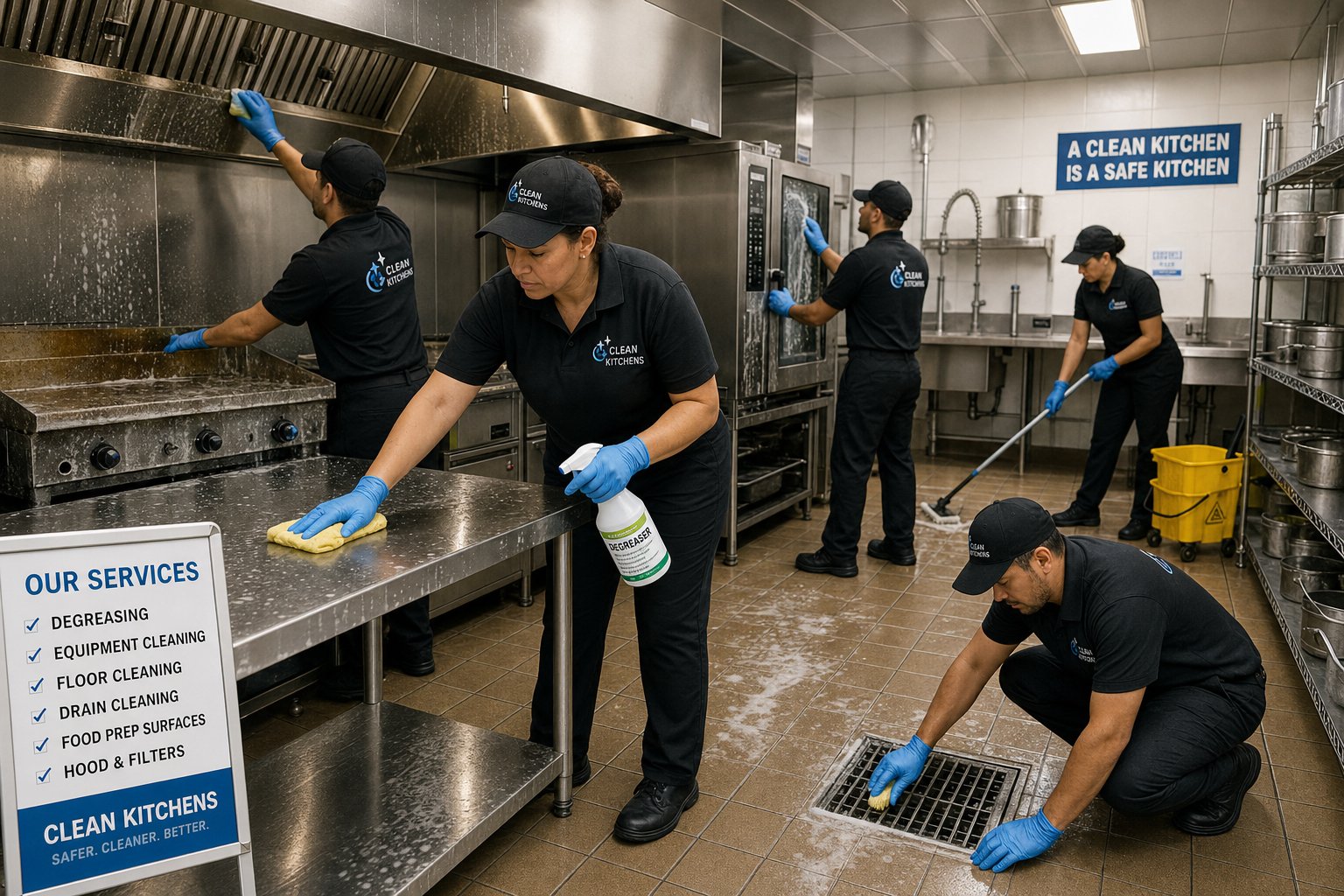
A restaurant cleaning schedule must follow the production line: receiving, storage, preparation, cooking, service, warewashing, waste, and close. “Clean the kitchen nightly” is not a schedule because it does not identify food-contact surfaces, grease accumulation, drains, floors, equipment, or who verifies completion. This guide gives operators a practical daily, weekly, and monthly framework for restaurants, commissaries, caterers, cafés, and hospitality kitchens in Manhattan, Brooklyn, Queens, the Bronx, Staten Island, Westchester, Long Island, New Jersey, Connecticut, Pennsylvania, and Florida.
Separate food safety from appearance
The first scheduling decision is to distinguish food-contact sanitation from general janitorial work. Employees who handle food follow the establishment’s food code procedures for cleaning and sanitizing prep tables, cutting boards, slicers, utensils, and service counters. A janitorial team may handle floors, walls, high dusting, trash, restrooms, and exterior loading areas, but the scope must define handoffs. GreenPoint Maintenance Services asks who owns each surface, which product is approved, what contact time applies, and how completion is recorded so an attractive floor never substitutes for a safe prep line.
Use a zone map for hot line, cold prep, bakery or pastry, dish pit, dry storage, walk-ins, beverage station, dining room, restrooms, offices, and receiving. A 4,000-square-foot neighborhood restaurant in Astoria has different grease and traffic patterns from a 20,000-square-foot commissary near Hunts Point or a catering kitchen in Long Island City. Mark drains, hood access, floor transitions, pest-sensitive gaps, and chemical storage. GreenPoint can schedule a walkthrough at 347-332-9348 to convert that map into a task list and staffing estimate.
Tasks to complete during every operating day
After each production period, clean and sanitize food-contact surfaces according to the kitchen’s approved chemical label and food safety plan. Remove food debris from prep tables, handles, refrigerator pulls, scale buttons, and touchscreens. Sweep loose soil before wet cleaning floors, and keep cleaning tools out of food and clean-equipment zones. A closing checklist should record the person completing each task, time finished, chemical used where required, and the manager’s verification. GreenPoint recommends a visible exception line for equipment that cannot be moved or safely opened.
At close, clean cooking-line exteriors, backsplash, splash zones, under-counter edges, sinks, faucets, and the dish area. Degrease floors with a product compatible with the surface, then rinse or recover residue so the floor is not left slippery. Empty and wipe waste containers, tie liners, clean the waste route, and inspect the loading area for leakage. In New York City, restaurants near Broadway, Flatiron, Downtown Brooklyn, or Roosevelt Avenue may have tight waste windows and shared alleys; the schedule should account for access rather than leaving bags beside a door.
Restrooms, dining rooms, and front-of-house touchpoints need service between the final table and the building lockup. Wipe menus or menu stands, chairs, door pulls, host stands, payment terminals, handrails, and high-touch restroom fixtures. Refill soap, paper, and sanitizer, then check that floors are dry. The [restroom cleaning best practices guide](/blog/restroom-cleaning-best-practices-high-traffic/) provides a useful inspection sequence. GreenPoint can provide a day porter or scheduled touchpoint checks when guest traffic continues for late service.
Weekly deep-clean tasks
Weekly work should reach the places a nightly close cannot. Pull movable equipment where safe, clean casters and legs, detail under shelving, wash walls behind the line, scrub grout and floor edges, clean door gaskets, and remove buildup from drain covers. Schedule hood and exhaust work according to the kitchen’s fire-safety and hood-service requirements; janitorial cleaning does not replace a qualified hood inspection or maintenance contractor. GreenPoint documents the boundary between routine cleaning and specialized service so the manager knows which vendor owns the next action.
Detail cold storage and dry storage on a rotation. Remove expired or leaking items through the kitchen’s inventory process, wipe shelves, clean door seals, sweep corners, and inspect for condensation or pest evidence. Never spray chemicals around exposed food. Use color-coded microfiber and dedicated tools for restrooms, kitchen floors, and food-contact support areas. GreenPoint trains crews on color separation, dilution, PPE, and escalation; the goal is to prevent cross-contamination while keeping a practical labor plan.
Catering operations need a weekly check of transport equipment. Clean and inspect hot boxes, cambros, carts, insulated carriers, loading mats, and vehicle touchpoints according to manufacturer instructions. A catering kitchen near Newark, Jersey City, Stamford, Philadelphia, or Fort Lauderdale may have multiple dispatch waves, so include a pre-load readiness check and post-return reset. Call GreenPoint at 347-332-9348 when the cleaning schedule must cover both a fixed kitchen and a mobile event operation.
Monthly and quarterly maintenance
Monthly tasks should include high dusting, ceiling vents, light fixtures, wall protection, baseboards, door tops, shelving tops, and hard-to-reach ledges. Inspect floor finish, grout, coving, wall coatings, and sealants for degradation. Clean behind reach-in refrigerators and ovens when engineering approves movement. Track recurring grease or moisture sources instead of repeatedly treating symptoms. GreenPoint uses a written zone rotation so monthly detail work does not disappear during busy seasons.
Quarterly, review the schedule against incidents, health department observations, pest activity, customer complaints, drain backups, slip reports, and equipment downtime. Consider floor restoration, carpet extraction in dining areas, pressure washing at loading zones, and a full waste-room reset. Costs vary by soil and access, but a restaurant may budget roughly $0.12 to $0.30 per square foot for recurring janitorial service and more for grease-heavy detail work. GreenPoint uses fixed pricing after a walkthrough rather than charging an open-ended hourly amount.
Seasonality changes the risk profile. Summer heat accelerates odor and waste issues in Queens, Brooklyn, New Jersey shore markets, and South Florida. Winter salt and slush increase floor maintenance near Metro-North, PATH, SEPTA, and subway entrances. Holiday catering increases dispatch volume, while hurricane preparation may change waste routes and water intrusion controls in Florida. GreenPoint can update the schedule by season and record the reason for each change so the operation remains defensible.
Build verification into the close
A checklist is useful only if a manager can tell what was actually completed. Use task IDs, zone, frequency, person, timestamp, exception, corrective action, and verifier. For high-risk tasks, add a visual check or approved test. ATP testing can help a facility trend residual organic soil on selected high-touch or food-support surfaces, but it is a verification tool, not a substitute for the kitchen’s food-safety plan. GreenPoint can pair documented inspections with JaniTrack dashboard updates and timestamped GPS-tagged photos where the client permits them.
Set a short correction window for issues that affect the next shift: wet floors, full waste, blocked drains, missing soap, exposed chemicals, or residue on prep-adjacent surfaces. The supervisor should notify the manager, isolate the area when needed, correct the task, and record the outcome. GreenPoint’s service model emphasizes visible exceptions instead of claiming 100% completion when a door was locked or equipment could not be moved. That transparency helps operators act before a guest or inspector discovers the problem.
Use [color-coded microfiber systems](/blog/color-coded-microfiber-systems-guide/) to make the process understandable for new staff. Label kitchen-floor tools separately from restroom tools, provide a clean-to-dirty sequence, and define laundering or disposal. GreenPoint Maintenance Services trains teams on chemical labels, dilution, contact time, slip prevention, and safe cart placement. A site supervisor can review the checklist at 347-332-9348 and adjust frequency when menu mix or production volume changes.
Coordinate with the kitchen and building
Cleaning windows should respect production, deliveries, pest control, fire protection, and building access. Write down the latest safe start time, expected finish, refrigeration restrictions, alarm procedure, elevator route, and where wet equipment can dry. A restaurant in a mixed-use building must also control noise and odor during overnight work. GreenPoint will coordinate with building management and the kitchen lead so a clean floor is not followed by a blocked egress path or an unplanned chemical odor during breakfast prep.
Chemical storage deserves its own inspection. Keep products labeled, closed, and separated from food, packaging, and linens. Maintain safety data sheets and train employees before they use a product. Do not decant into an unlabeled bottle or mix chemicals. GreenPoint can review the [OSHA cleaning chemical safety and GHS/SDS guide](/blog/osha-cleaning-chemical-safety-ghs-sds/) with the manager and include approved products, PPE, and spill escalation in the site plan.
Ask for a quote that states the production assumptions. GreenPoint Maintenance Services offers fixed pricing, no hourly billing, and no hidden fees after the scope is confirmed. Call 347-332-9348 for a walkthrough covering kitchen zones, square footage, service windows, equipment restrictions, waste, restrooms, and event volume. A written plan is easier to train, audit, and revise than a generic “nightly kitchen cleaning” promise.
Frequently Asked Questions
Q: How often should a commercial kitchen floor be cleaned? A: Sweep and remove spills during service, clean and degrease at close, and schedule edge, grout, drain, and under-equipment detail weekly or based on soil. GreenPoint sets frequency by traffic, menu, floor type, and slip risk.
Q: Does a janitorial company replace a hood-cleaning contractor? A: No. Routine exterior and surrounding-area cleaning is distinct from qualified hood, duct, fire-suppression, and inspection work. GreenPoint documents the boundary and coordinates with the specialized provider.
Q: Can GreenPoint clean while the restaurant is open? A: Yes, with a zone-based plan. GreenPoint can schedule touchpoint, restroom, dining-room, and spill-response work while protecting food and guest areas; call 347-332-9348 to discuss staffing.
Q: What should a kitchen cleaning checklist record? A: Record zone, task, frequency, cleaner, timestamp, product or method where relevant, exception, correction, and manager verification. JaniTrack can add route status and approved photo evidence.
Q: How do I schedule a restaurant cleaning walkthrough? A: Call GreenPoint Maintenance Services at 347-332-9348. GreenPoint will map production, access, waste, storage, floor care, and verification needs before providing a fixed quote.
Before publishing the schedule, test it during the busiest realistic service. Time the close from the last plate through waste removal, floor recovery, equipment detail, and manager sign-off. Note which tasks compete for the same sink, drain, corridor, or power outlet. GreenPoint uses this rehearsal to separate tasks that can happen in parallel from those that must wait for cooling or lockout. The result is a sequence employees can finish without stepping over wet floors or rushing a chemical contact time. Review the trial with the chef and manager, then revise the checklist before the next large booking or seasonal menu change.
Put a practical restaurant and catering kitchen schedule in place with GreenPoint Maintenance Services at 347-332-9348. Get zone-based staffing, JaniTrack proof, Green Seal products where appropriate, and fixed pricing with no hidden fees.