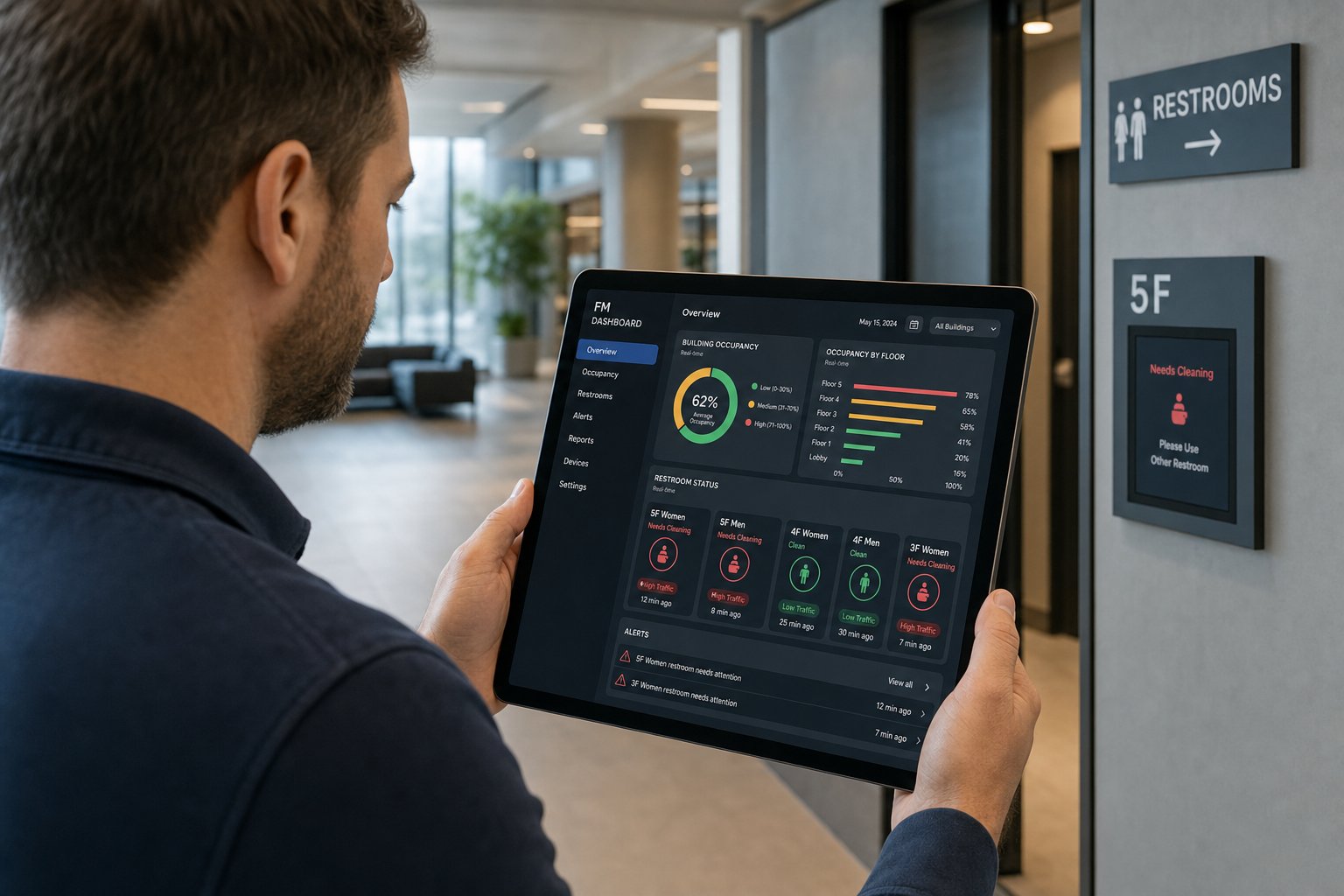
IoT sensors can help a janitorial program answer a question that room checklists cannot: where did demand change, and how quickly did the team respond? Occupancy counters, restroom dispensers, flush counts, leak sensors, and connected service buttons can reveal patterns in a Midtown office, a Bronx school, a Brooklyn coworking floor, or a Westchester medical facility. Sensors do not replace trained cleaners. They make the work more targeted when the data is interpreted with building context, privacy controls, and a verification process. GreenPoint Maintenance Services combines technology with JaniTrack timestamped GPS-tagged photos, supervisor review, and fixed pricing. To discuss a sensor-ready cleaning plan or schedule a walkthrough, call GreenPoint at 347-332-9348.
What IoT means in a commercial cleaning program
In facilities, Internet of Things equipment is a network of small devices that measures a condition and transmits an event. An occupancy sensor might count entries, a restroom sensor might report traffic or a consumable level, and a leak sensor might flag moisture under a sink. A service button can create a request without a phone call. The output is operational data, not a cleaning decision. A facility manager still defines what clean, stocked, safe, and ready mean for each space.
GreenPoint starts with the use case rather than selling hardware. If a restroom beside a busy transit hub sees 800 visits each weekday, a traffic trigger may justify a midday touchpoint. If a low-occupancy executive suite receives one weekly service, the same sensor may only confirm that the fixed schedule is adequate. The [digital cleaning verification systems guide](/blog/digital-cleaning-verification-systems/) explains how digital evidence can connect a work order to a completed task without turning technology into a substitute for supervision.
Which sensors matter most for restrooms
Restroom programs usually benefit from three signals: occupancy or visit count, consumable level, and a user or staff service request. Visit count helps estimate demand; a paper or soap level sensor helps prevent an empty dispenser; and a service request gives a person a direct way to flag a problem. Together, these signals can help distinguish a restroom that needs a quick restock from one that needs a full clean. A useful planning benchmark is to review events by 30-minute or hourly windows, then compare them with actual labor and complaints rather than reacting to every alert.
Technology must respect privacy. Use aggregate counts, not cameras or personally identifiable information, and confirm placement with building ownership, tenants, unions, and counsel where applicable. GreenPoint Maintenance Services trains cleaners to act on room condition and service tickets, never on an individual’s identity. In a Queens facility near Court Square or a Manhattan tower near Bryant Park, the best sensor is the one that improves response without creating a new privacy concern.
Turn occupancy data into a service-frequency model
Occupancy is not the same as soil load. A quiet conference room may be heavily used for one event, while a lobby sees constant movement but little touch contamination. GreenPoint maps traffic data to zones: entrances, elevators, restrooms, break rooms, shared desks, and high-touch points. The [cleaning frequency standards by facility type](/blog/cleaning-frequency-standards-by-facility-type/) guide can provide a baseline, while local observations determine whether daily, twice-daily, or event-triggered service is appropriate.
A pilot should last long enough to capture a normal week and an unusual day. Compare sensor events with JaniTrack task completion, supervisor observations, ATP results where specified, and tenant feedback. For example, if 1,200 restroom visits produce 14 alerts but only two verified supply shortages, the threshold may be too sensitive. If complaints arrive before the alert, the data may be too slow or the sensor may be installed in the wrong location. GreenPoint uses the pilot to adjust staffing and routing, not to promise that an algorithm can predict every mess.
Integrate sensors with verification and accountability
An alert says something happened; verification says what the cleaner did about it. GreenPoint can pair a service ticket with a JaniTrack timestamp, GPS-tagged photo, checklist, and supervisor sign-off. That evidence creates an audit trail for the property manager. It also gives the team a way to investigate recurring issues: a dispenser that needs repair, a door that fails to close, a plumbing leak, or a cleaning frequency that no longer matches occupancy.
For high-touch environments, ATP luminometer testing can add a quantitative hygiene indicator, but the measurement must use a defined sampling plan and consistent thresholds. It does not identify a pathogen and cannot prove a surface is sterile. The [ATP bioluminescence testing guide](/blog/what-is-atp-bioluminescence-testing-cleaning/) explains that distinction. GreenPoint documents which areas were tested, when they were tested, and what corrective action followed so a manager can interpret trends responsibly.
Design the dashboard around decisions
A dashboard should make the next action obvious. Useful views include alerts by location, response time, open versus closed tickets, supply exceptions, repeat complaints, and service completion by shift. Avoid a wall of red indicators that trains people to ignore everything. Set service-level targets such as responding to a restroom request within 15 minutes during staffed hours, restocking before a dispenser reaches 20 percent, or escalating an unresolved leak within five minutes. These are configurable operating targets, not universal regulatory requirements.
GreenPoint’s JaniTrack workflow can provide the human proof beside the sensor signal. A facility manager should be able to ask: what happened at 10:15 a.m. in the restroom near the lobby, who responded, what condition did they find, and was the issue resolved? GreenPoint can review those records in a walkthrough and recommend which data is useful, which is noise, and which needs an engineering fix.
Account for installation, connectivity, and maintenance
IoT projects fail when the device is treated as install-and-forget equipment. Battery life, Wi-Fi dead zones, network changes, calibration, adhesive failure, and cleaning chemicals all affect reliability. A sensor mounted where a mop handle repeatedly hits it will not produce trustworthy data. Facilities should assign an owner for batteries and firmware, document device locations, and test alerts during a staffed shift. If a property has multiple buildings in Newark, Jersey City, Stamford, or Long Island City, use a consistent naming convention so technicians do not confuse zones.
Budget the total cost of ownership: hardware, installation, connectivity, software, integration, maintenance, training, and eventual replacement. GreenPoint Maintenance Services separates technology from cleaning labor in the scope so the client can see what is being purchased. GreenPoint does not add hidden hourly billing for interpreting a service report; the proposal defines included reviews, response windows, and any optional analytics. Call 347-332-9348 to request a quote for a pilot.
Local deployment examples across the Tri-State
In Manhattan, sensors can help route a cleaner between a high-traffic lobby and restrooms serving commuters near Grand Central, Penn Station, or the Port Authority Bus Terminal. In Brooklyn, a mixed-use building near Atlantic Avenue or DUMBO may need separate thresholds for retail, residential, and loading zones. In the Bronx, a school or community facility may need occupancy-aware service around programs. In Queens, a technology office near Flushing or Astoria may have event-driven spikes. Westchester and Long Island properties often have wider footprints, making route planning and response time especially important. GreenPoint adapts the operating map to the actual facility rather than applying a generic sensor package.
Local rules and tenant agreements still govern access, signage, accessibility, and data handling. A sensor cannot authorize a cleaner to enter a restricted suite, block an ADA route, or ignore a school’s visitor protocol. GreenPoint Maintenance Services coordinates the technology pilot with the building contact and keeps the cleaning scope clear. GreenPoint can schedule a walkthrough at 347-332-9348, and the team can provide a fixed-price service proposal after measuring square footage, entrances, restrooms, and service windows.
A sensor program should also have a failure mode. If the network is offline, the battery is depleted, or an alert appears inconsistent with the room condition, the cleaner follows the written baseline schedule and records the exception. Do not let a silent device create a silent service gap. GreenPoint Maintenance Services includes a fallback route in the site plan, and GreenPoint can review device uptime, missed events, and manual tickets during the account meeting. That is particularly important in older buildings around the Upper West Side, Mott Haven, or Newark where construction, thick walls, and changing tenant layouts can affect connectivity.
Before expanding a pilot, ask whether the data changed a decision. Did the team reduce unnecessary rounds, restock before complaints, shorten response time, or uncover a maintenance defect? If the answer is no, the device may be adding cost without adding control. GreenPoint helps managers compare the baseline week with the pilot period using service records, occupancy patterns, and quality checks. To arrange a review or quote, call GreenPoint at 347-332-9348; GreenPoint can also coordinate with the client’s IT and building-engineering contacts.
FAQ: IoT cleaning verification
Q: Do occupancy sensors replace janitorial staff? A: No. Sensors indicate demand or an event; trained cleaners inspect, clean, restock, and report the condition. GreenPoint uses sensors as routing support alongside JaniTrack evidence and supervisor review.
Q: Are restroom sensors cameras? A: They do not need to be. A privacy-conscious design uses aggregate traffic, supply levels, leaks, or service buttons without identifying people. GreenPoint recommends confirming the device and data policy with the property owner before installation.
Q: How long should a cleaning sensor pilot run? A: A normal week is a useful minimum, but two to four weeks often reveal weekday, event, and maintenance patterns. GreenPoint can define the pilot metrics and schedule a review by calling 347-332-9348.
Q: What should be measured in an IoT cleaning dashboard? A: Track event location, time to response, completion, repeat alerts, supply exceptions, complaints, and relevant quality checks. GreenPoint pairs these metrics with JaniTrack timestamps and photos so the dashboard reflects work, not only alerts.
Q: Does GreenPoint provide sensor installation? A: GreenPoint can design a cleaning workflow that uses sensor data and coordinate with the client’s technology or facilities vendor. Call 347-332-9348 for a walkthrough and fixed-price cleaning quote.
Make facility data useful, not noisy: call GreenPoint Maintenance Services at 347-332-9348 to schedule a sensor-ready walkthrough. GreenPoint combines occupancy insights with JaniTrack verification and a 98% client-retention record.