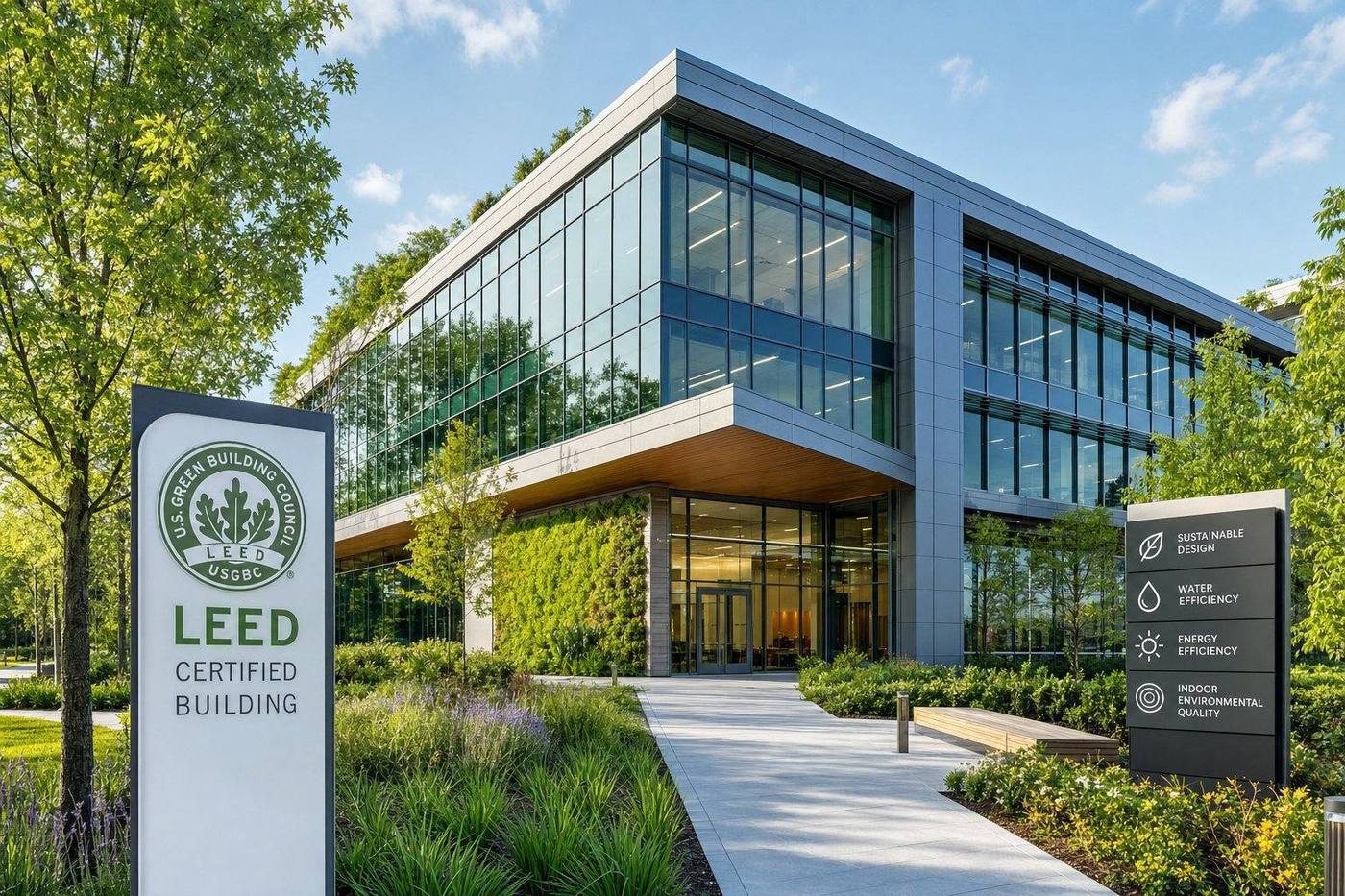
LEED certification is not earned by putting a green label on a janitorial closet. Facility teams must align products, procedures, purchasing, waste, indoor air quality, and records with the rating system and the building's operations. This guide translates the cleaning side of LEED into a usable program for offices, schools, healthcare-adjacent spaces, and mixed-use properties in Manhattan, Brooklyn, Queens, the Bronx, Westchester, Long Island, New Jersey, Connecticut, Pennsylvania, and Florida. GreenPoint Maintenance Services uses Green Seal certified products where appropriate, documented training, fixed pricing, and JaniTrack verification so a manager can show what happened. Call GreenPoint at 347-332-9348 to schedule a LEED-focused walkthrough.
What LEED cleaning actually covers
The U.S. Green Building Council's LEED framework evaluates more than visible cleanliness. Depending on the version and certification path, operations teams may need evidence for green cleaning products, sustainable equipment, staff training, ongoing performance, waste diversion, and indoor environmental quality. GreenPoint begins with the exact rating system and credit language in the project file, then builds a cleaning matrix that names the approved product, location, frequency, dilution, equipment, and responsible role. That prevents a facility from collecting irrelevant certificates while missing the record a reviewer requests.
A facility may also have several certification goals at once. An office near Bryant Park, a school in Queens, or a mixed-use tower in Jersey City can require daily cleaning plus periodic floor care, construction dust response, and tenant education. GreenPoint separates recurring service from project work and can provide a fixed-price proposal with no hourly billing and no hidden fees. For a baseline discussion, call 347-332-9348 or email info@greenpointms.com.
Select products by documented performance, not marketing language
A credible green cleaning program keeps a product register. It identifies the manufacturer, product name, certification or compliance basis, dilution, intended surface, SDS location, and whether the product is used routinely or only for a special condition. GreenPoint commonly evaluates Green Seal certified products and other recognized criteria, but the correct selection still depends on soil load, material compatibility, dwell time, and the building's approved list. A disinfectant claim is not interchangeable with a general cleaner claim, and a fragrance-free product is not automatically a safer process.
The same discipline applies to paper products, liners, microfiber, vacuums, and floor machines. Color-coded microfiber reduces cross-use, while HEPA-filtered equipment can support particulate control when maintained correctly. GreenPoint can cross-reference the chemical plan with [our EPA disinfectant registration guide](/blog/epa-disinfectant-registration-guide/) and [our green cleaning commercial buildings guide](/blog/green-cleaning-commercial-buildings-guide/). JaniTrack can attach product and task notes so an auditor sees the operating method rather than a vague promise that the site is green.
Create a LEED-ready cleaning policy and training file
The policy should say who approves products, how staff are trained, how dilution is controlled, how equipment is maintained, how occupants report concerns, and how the program is reviewed. A one-page slogan is not enough. GreenPoint can supply a scope matrix, training topics, inspection forms, chemical inventory, SDS access instructions, and escalation contacts. OSHA's Hazard Communication Standard, 29 CFR 1910.1200, remains a baseline for labels, SDS access, and employee information even when a LEED project adds more sustainability requirements.
Training should be practical and role-based. A cleaner needs to know which cloth is used on which zone, how to avoid over-wetting resilient flooring, how to handle a spill, and where to report a damaged dispenser. A supervisor needs to inspect, coach, record, and close corrective action. A tenant contact needs a simple route for reporting odor or supply issues. GreenPoint documents those roles in JaniTrack and can schedule refreshers after a product, floor finish, or building-use change. Call 347-332-9348 for a sample training outline.
Manage indoor air quality during cleaning
Cleaning can improve indoor air quality, but a poorly managed process can temporarily add odor, moisture, or airborne dust. GreenPoint plans vacuum maintenance, chemical dilution, ventilation coordination, microfiber use, and waste removal as one system. Service timing matters in a Midtown tower with packed elevators, a Bronx school with morning arrival, or a Stamford office with limited HVAC run time. The team can schedule high-odor or higher-moisture work when the building engineer approves the ventilation window.
The program should also address source control. Food waste, damp mop heads, blocked filters, construction dust, and fragranced products can each create a complaint that is incorrectly blamed on cleaning. GreenPoint's [indoor air quality commercial cleaning guide](/blog/indoor-air-quality-commercial-cleaning/) explains how to separate these causes. Supervisor notes, occupancy context, and JaniTrack timestamps help the manager see whether a concern followed a task, a delivery, a weather event, or a building-system change.
Make waste and purchasing evidence easy to audit
LEED-related waste work succeeds when the building's streams are clear and the collection point is usable. GreenPoint can map landfill, recycling, organics, confidential paper, e-waste, and special waste routes, then align liners, labels, carts, and pickup timing. A facility near Fulton Center, Atlantic Terminal, Newark Penn, Stamford Station, or Center City Philadelphia may need a dock and elevator plan to keep sorted material from being mixed during removal. In Florida, storm preparation and humidity can change the holding-time risk for organics and cardboard.
Keep records in a monthly folder or dashboard: product purchases, equipment maintenance, training attendance, inspection scores, waste observations, corrective actions, and approved changes. GreenPoint does not claim that a janitorial contractor alone guarantees a LEED credit; the owner and project team control the certification submission. The contractor's value is reliable evidence and consistent execution. GreenPoint's 98% client retention and MBE/MWBE certifications give procurement teams additional proof that the vendor is established and accountable.
Set frequencies and budgets that protect the credit
A green program still has to clean the building. Daily service should prioritize entries, restrooms, kitchens, high-touch points, and visible waste; lower-traffic offices can follow an agreed weekly frequency. Floor finish, carpet extraction, high dusting, and detail work belong on a periodic calendar, not in an unspoken expectation. GreenPoint uses cleanable square footage, occupancy, access, finish, and risk to estimate labor; a standard office may plan around 3,000 to 5,000 cleanable square feet per labor hour, while dense or high-touch areas need a lower production assumption.
Budget transparency supports certification decisions. A fixed price with a documented change order is easier to manage than an invoice that grows because a cleaner spent extra time on an unspecified task. GreenPoint can quote recurring service, day porter coverage, periodic floor care, and post-construction cleaning as separate line items. To compare true cost, use [our calculating true cleaning cost TCO guide](/blog/calculating-true-cleaning-cost-tco/) and schedule a walkthrough at 347-332-9348.
Verify LEED support with JaniTrack and inspection data
JaniTrack can connect the day-to-day service record to the sustainability file: timestamped GPS-tagged photos, completion status, room-level notes, supervisor inspections, and corrective actions. Optional ATP testing may help establish a baseline for selected touchpoints, but it should not be presented as a LEED score or as a substitute for approved procedure. The useful question is whether the process is consistent, documented, and improved when results fall below the agreed target.
GreenPoint's review cadence can be weekly for active issues and monthly for program trends. Managers can see missed tasks, repeat complaints, product substitutions, supply outages, and response times by floor. A quarterly review with the building engineer and sustainability lead keeps the cleaning scope aligned with occupancy, tenant changes, construction, and certification deadlines. Call 347-332-9348 when you need an audit-ready cleaning conversation.
A LEED cleaning file is strongest when it is easy for a non-cleaning reviewer to understand. GreenPoint can organize the program by month, floor, or credit-supporting activity, with a one-page index that points to the product register, training record, inspection result, waste note, and corrective action. Keep the current version visible and archive superseded products so the team can explain when a change occurred. This structure is useful in a Manhattan tower with many tenants, a school campus in Queens, or a New Jersey property preparing for a recertification review.
The owner should also define who owns occupant communication. GreenPoint can provide signs or short notices about recycling, restroom reporting, wet-floor controls, or temporary product odor, but the building team decides the approved voice and accessibility format. A clear message reduces contamination and duplicate service requests. During a walkthrough, GreenPoint reviews tenant density, operating hours, delivery routes, and certification deadlines; then it converts those facts into a schedule a supervisor can actually inspect. Call 347-332-9348 for a LEED documentation review before the next audit window.
The cleaning contractor should be ready to explain limits as well as strengths. GreenPoint can provide records for its scope, but building energy, water testing, waste hauling, and certification submissions may belong to other parties. A transparent responsibility matrix keeps the LEED team from over-crediting a janitorial record and helps everyone close the correct action. GreenPoint's role is disciplined execution with evidence that another reviewer can understand.
FAQ: LEED certification cleaning programs
Q: Does hiring a green cleaning company guarantee a LEED credit? A: No. LEED credits depend on the rating system, project documentation, and owner submission. GreenPoint supports the cleaning evidence and operating consistency; the project team remains responsible for certification decisions.
Q: What documents should a LEED cleaning contractor provide? A: Common records include a cleaning policy, product register, certifications or compliance documents, SDS access, training records, equipment maintenance, inspection results, waste observations, and corrective-action logs. The exact list should be matched to the project version and credit language.
Q: Are Green Seal products required for every LEED project? A: The project requirements determine which product criteria apply. GreenPoint evaluates Green Seal certified products where appropriate, confirms surface compatibility and performance, and records approved substitutions instead of making a blanket claim.
Q: Can GreenPoint support LEED buildings in New York, New Jersey, Connecticut, Pennsylvania, or Florida? A: Yes. GreenPoint serves those markets and can scope local access, weather, occupancy, and waste logistics from Manhattan and Queens to Jersey City, Stamford, Philadelphia, and South Florida. Call 347-332-9348 for a walkthrough.
Q: How do we prove that cleaning happened? A: GreenPoint can use JaniTrack for timestamped GPS-tagged photos, task completion, inspections, and corrective actions, supported by monthly program records. That evidence is more useful than a generic green-cleaning statement.
Make your LEED cleaning program measurable. Call GreenPoint Maintenance Services at 347-332-9348 for a walkthrough, product register, and fixed-price operating plan. GreenPoint brings Green Seal certified options, OSHA-aligned training, JaniTrack verification, and a 98% client retention record.