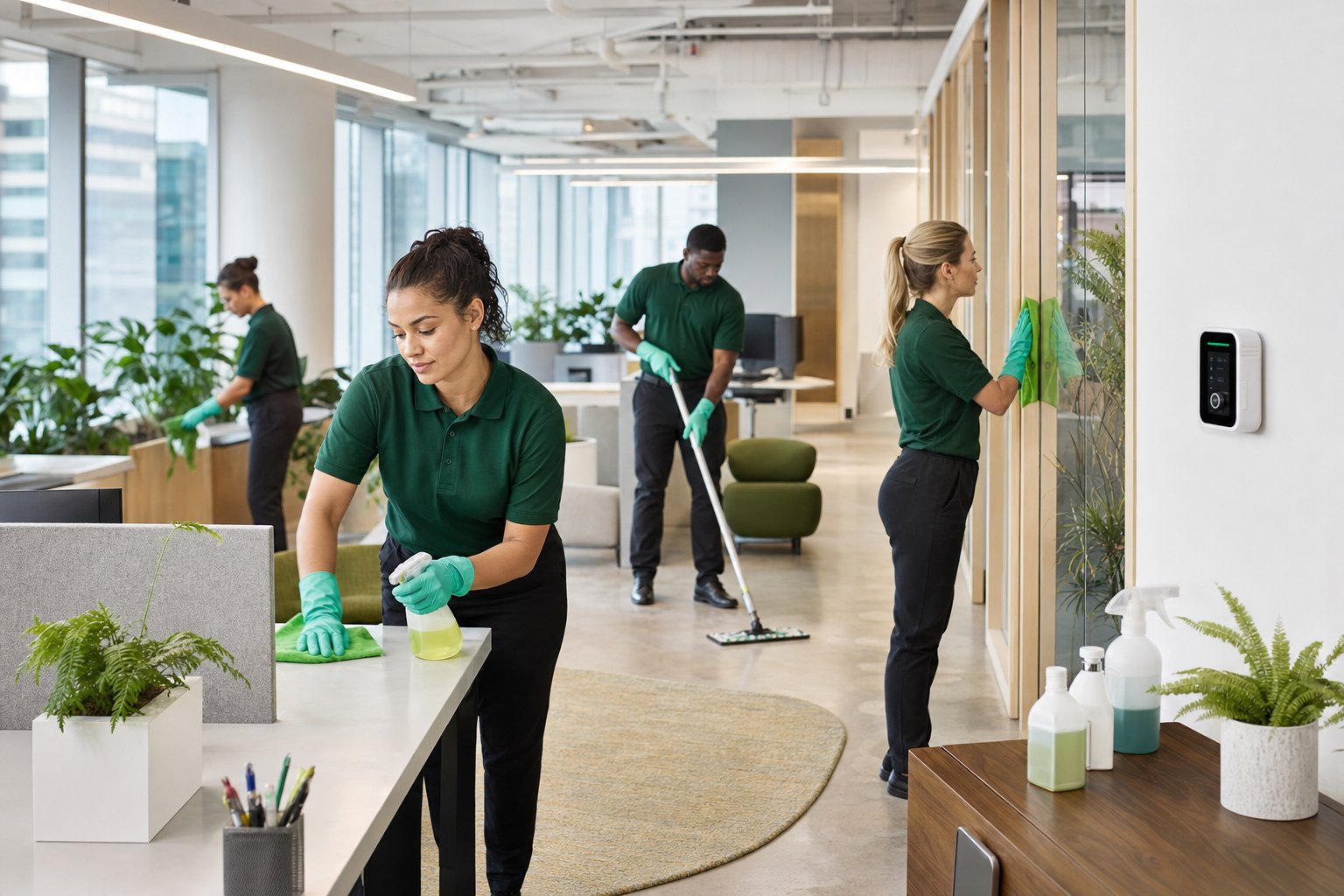
LEED and WELL buildings need a cleaning program that supports the building’s environmental and occupant-health goals without confusing janitorial work with HVAC engineering. A high-rise near Bryant Park, a WELL-oriented workplace in Jersey City, and a campus in Westchester each have different entrances, ventilation schedules, materials, and occupancy patterns. GreenPoint Maintenance Services uses Green Seal certified products where appropriate, source-control routines, HEPA-capable equipment when specified, and JaniTrack verification. Call 347-332-9348 to schedule a walkthrough and receive fixed pricing with no hourly billing or hidden fees.
Cleaning’s role in LEED and WELL performance
Cleaning contributes to a healthier building through source control, dust removal, waste handling, product selection, and consistent maintenance. It does not by itself earn a certification point or guarantee an indoor-air result; the owner and project team must confirm the applicable LEED or WELL requirements. GreenPoint begins with the building’s target, current operating policies, floor plan, and product restrictions, then translates those requirements into tasks a supervisor can inspect.
A 100,000-square-foot office may have a polished lobby, dense tenant floors, fitness rooms, kitchens, showers, and loading areas. Each zone produces different soil and chemical needs. GreenPoint Maintenance Services can set an appearance level for public spaces, a dust-control standard for work areas, and a restocking cadence for wellness amenities. Schedule a walkthrough at 347-332-9348 so the cleaning scope supports the rating strategy instead of claiming what the janitorial team cannot control.
Low-emitting products and chemical controls
Product control starts with an approved inventory. GreenPoint lists the manufacturer, product function, certification or documented standard, dilution, surface compatibility, label contact time, storage location, and substitution process. Green Seal certified products are used where suitable, while disinfectants or specialty treatments follow their own label and regulatory requirements. Workers never mix chemicals or decant concentrate into an unlabeled bottle. OSHA’s [Hazard Communication Standard](https://www.osha.gov/hazcom) supports labels, training, and accessible SDS information.
The goal is lower unnecessary exposure, not a closet full of marketing claims. A neutral floor cleaner used at the wrong concentration can leave residue; an air freshener can add odor and volatile compounds without solving the source. GreenPoint can eliminate unnecessary fragrance, schedule odor-producing tasks after hours, and report approved-product exceptions in JaniTrack. See [green cleaning for commercial buildings](/blog/green-cleaning-commercial-buildings-guide/) and call 347-332-9348 for an inventory review.
Indoor air quality: source control before fragrance
Good janitorial support for indoor air quality begins with removing sources: dust at entries, overflowing waste, moisture, tracked soil, and residue on floors. GreenPoint uses a high-to-low sequence, compatible microfiber, careful waste closure, and vacuum equipment selected for the surface and building policy. HVAC filters, outdoor-air rates, pressure relationships, and mold remediation require qualified building or environmental professionals; a cleaner should report visible conditions rather than promise an air-quality certification.
Local conditions matter. Salt and rain enter through Midtown and Downtown Manhattan lobbies, pollen can collect in Queens and Long Island during spring, and construction dust may travel through shared corridors in Brooklyn or Jersey City. GreenPoint can increase mat care, add vestibule checks, and coordinate work with ventilation schedules. The [indoor air quality commercial cleaning guide](/blog/indoor-air-quality-commercial-cleaning/) gives facility managers a framework, while 347-332-9348 starts a site-specific assessment.
Floor and carpet care for sustainable operations
Floor care affects both appearance and life-cycle cost. Abrasive grit can shorten finish life, while excessive stripping adds labor, chemical, water, and downtime. GreenPoint removes soil at the entry, uses a maintenance schedule matched to floor material, and chooses low-moisture carpet methods when drying time matters. The scope should identify VCT, stone, wood, resilient flooring, carpet tile, mats, and thresholds rather than placing every surface under one generic “floor clean” line.
A building manager can track square footage and frequency to understand the true resource demand. For example, a 25,000-square-foot tenant floor with 10% carpet and high visitor traffic may need more entrance vacuuming and mat extraction than monthly restorative work. Review [VCT floor care and strip-seal-wax guidance](/blog/vct-floor-care-strip-seal-wax-guide/) and request a fixed-price schedule from GreenPoint at 347-332-9348.
Waste, recycling, and back-of-house routing
Sustainable operations fail when waste and recycling are mixed at the point of collection. A cleaning scope should name streams, liners, compactor or loading-room rules, cardboard handling, food waste, e-waste boundaries, and contamination reporting. GreenPoint maps waste rooms, freight elevators, security checkpoints, and tenant collection stations, then trains crews not to guess about regulated or confidential material. The building owner remains responsible for its waste vendor and local disposal rules.
A Manhattan tower may require a timed loading-dock route, while a Queens mixed-use site may share a waste room with retail. A school or community facility may need a different approach to food and program waste. GreenPoint can record overflow, contamination, or blocked access as JaniTrack exceptions and notify the facility lead. Call 347-332-9348 when a tenant fit-out or new recycling stream changes the route, and review [facility cleaning audit checklist](/blog/cleaning-audit-checklist-facility-managers/).
Occupant wellness areas and high-touch service
WELL-oriented spaces often add kitchens, hydration stations, fitness rooms, showers, quiet rooms, and shared collaboration areas. These spaces need traffic-based frequencies, touchpoint lists, moisture control, and careful product storage. GreenPoint uses separate tools for restrooms and kitchens, cleans faucet levers and appliance handles, checks dispensers, and reports conditions such as standing water or damaged caulk. The manager should set whether the vendor handles food-contact surfaces or whether staff sanitize them before use.
High-touch work should be documented but not overstated. A completed task means the approved surface was serviced according to the scope; it does not mean the building is sterile or that illness transmission is impossible. JaniTrack can show timestamped completion, approved photos, and exceptions, while ATP testing can provide trend data on selected nonporous surfaces. GreenPoint’s 98% client retention comes from using evidence to adjust service. Contact 347-332-9348 for a wellness-space walkthrough.
Construction, renovations, and building handoffs
Renovation dust can undermine an otherwise careful green-cleaning program. Before a tenant build-out or capital project, define containment, pressure and access responsibilities, final-clean phases, debris removal, and the handoff from contractor to janitorial team. GreenPoint can clean approved finished surfaces after construction, but the general contractor and building team remain responsible for hazardous materials, active trades, and construction controls. The [post-construction cleaning phases](/blog/post-construction-cleaning-phases-explained/) guide helps separate rough, light, and final cleaning.
A practical handoff includes a punch list, surface map, product restrictions, filter or HVAC coordination, and an agreed acceptance inspection. GreenPoint uses JaniTrack photos and notes for finished areas while avoiding tenant documents and equipment. In Manhattan, Brooklyn, and New Jersey buildings with tight freight windows, scheduling is part of the cost. Call GreenPoint at 347-332-9348 before the contractor’s final day so the cleaning team can price the actual sequence.
Reporting for sustainability and facility teams
A LEED or WELL-aligned program should produce a concise record: approved products, certification evidence, SDS access, training dates, inspections, complaints, corrective actions, waste exceptions, and periodic service completion. GreenPoint’s JaniTrack dashboard can connect these records to zones and timestamps. A monthly report should identify trends and decisions, not bury a manager in screenshots. GreenPoint can also provide a product change log when a manufacturer discontinues an item or a building revises its standard.
Ask vendors to state what they can prove and what they cannot. Cleaning records cannot certify ventilation, carbon-dioxide levels, water quality, or a building’s LEED/WELL status. They can show that the agreed source-control, product, floor, restroom, and waste tasks were performed. GreenPoint Maintenance Services serves NY, NJ, CT, PA, and FL, with MBE/MWBE and SAM.gov credentials. Call 347-332-9348 or email info@greenpointms.com for a walkthrough.
Implementation checklist for facility managers
Before service begins, confirm the square footage, room list, occupancy pattern, access windows, floor materials, restrooms, waste route, supply storage, emergency contacts, and the person who approves scope changes. A strong kickoff also records the baseline condition with approved photos, identifies restricted areas, and sets the inspection cadence. GreenPoint turns those facts into a route card and a JaniTrack checklist so a substitute cleaner can follow the same instructions as the regular crew. This preparation usually prevents more cost than it adds because the team avoids rework, duplicate products, and unclear handoffs.
Set a 30-day review rather than waiting for an annual renewal. The facility lead and GreenPoint supervisor can compare completed tasks, exceptions, complaints, supply use, and any seasonal or occupancy change. If the building adds a tenant, classroom, exam room, event schedule, or new floor finish, the scope can be revised before quality slips. GreenPoint offers fixed pricing for the agreed recurring program, and a manager can call 347-332-9348 or email info@greenpointms.com to schedule the walkthrough and document the next decision.
Keep the final scope accessible to the people who actually run the building: the property manager, security desk, maintenance lead, program director, and vendor supervisor. Each person should know the normal route, the escalation path, and which conditions require a pause. GreenPoint can review the scope in plain language at kickoff, then retain the approved version in the service record so changes are deliberate rather than passed along by memory.
That shared reference is especially valuable when occupancy, weather, or a renovation changes the normal route. A short written update is easier to audit than an informal hallway instruction. It also gives the next supervisor a reliable starting point when staff, rooms, or schedules change during the school year, and helps administrators explain exactly what was purchased to a board, owner, or procurement team. It keeps the first week focused on students rather than avoidable cleaning confusion.
Frequently asked questions
Can janitorial work guarantee LEED or WELL certification? No. GreenPoint can support documented cleaning, product, waste, and source-control practices, but the project team and owner determine certification eligibility and building-system performance.
Are all Green Seal products disinfectants? No. Certification and disinfectant registration are different questions. GreenPoint follows the product label and applicable EPA requirements, and identifies any necessary exception in the approved inventory.
Does green cleaning mean no chemicals? No. It means selecting and using appropriate products responsibly, controlling dilution and exposure, training staff, and avoiding unnecessary fragrance or overuse. GreenPoint uses Green Seal certified products where they fit the task.
How can a facility measure service quality? Use a task and inspection matrix, complaint and corrective-action log, product inventory, and JaniTrack timestamps or approved photos. ATP can trend selected surfaces but is not a sterility test.
How do I get a LEED or WELL cleaning quote? Call 347-332-9348 or email info@greenpointms.com with the building address, square footage, certification goal, floor types, amenities, and hours. GreenPoint will schedule a walkthrough and provide fixed pricing.
Support healthier, lower-waste building operations with GreenPoint Maintenance Services. Call 347-332-9348 for a walkthrough and fixed-price quote; GreenPoint brings Green Seal product controls, JaniTrack proof, and 98% client retention.