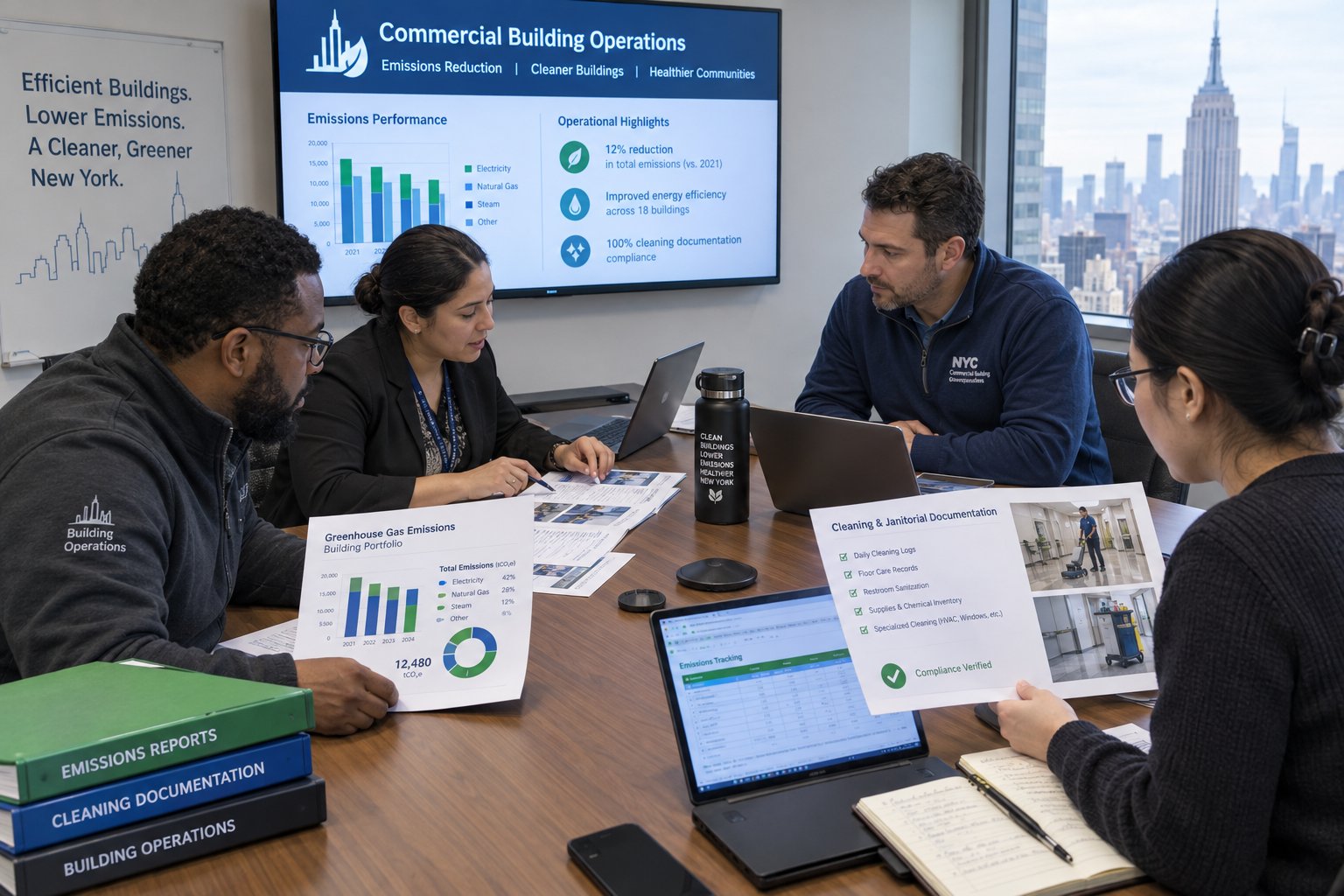
NYC Local Law 97 focuses on building emissions, but the work that supports compliance reaches far beyond an energy report. Cleaning, waste handling, filter changes, tenant communication, and contractor access all create operational evidence that a building team may need to retrieve later. For a 100,000-square-foot office in Midtown, Long Island City, Downtown Brooklyn, or the Bronx, a cleaning scope that says only “nightly janitorial service” does not tell an owner who completed the work, when access was obtained, what exceptions occurred, or how waste and materials were managed. GreenPoint Maintenance Services helps facility teams turn routine service into organized, reviewable records without pretending that a janitorial vendor replaces an engineer, energy consultant, or licensed compliance professional.
What Local Law 97 Changes for Facility Operations
Local Law 97 is part of New York City’s building-emissions framework, so the primary compliance analysis belongs with the owner’s qualified engineer, energy manager, or sustainability consultant. The cleaning team still affects the operating picture. Inefficient equipment, blocked air returns, unmanaged waste rooms, overuse of consumables, and undocumented after-hours access can create cost, safety, and accountability problems that are visible during a broader building review. GreenPoint treats the law as an operations-coordination issue rather than marketing it as a simple cleaning certification.
A useful first step is to separate three records: energy and emissions records owned by the building team, maintenance records owned by engineering, and cleaning and waste records owned by the service provider. The separation prevents overclaiming while giving property managers a complete chain of evidence. A [NYC local building maintenance guide](/blog/nyc-local-law-building-maintenance/) can sit beside the emissions consultant’s work plan, while the cleaning contract defines exactly which observations GreenPoint will record and which decisions must be escalated.
Why Cleaning Records Matter to Building Teams
Cleaning records help explain how occupied spaces are operated. A timestamped service log can show when loading docks, mechanical-adjacent corridors, tenant kitchens, recycling rooms, and public areas were serviced. It can also document exceptions such as an inaccessible room, a leaking compactor, a blocked vent, or a spill that required a work-order handoff. These details do not calculate a building’s emissions, but they help the property team identify recurring operational friction before it becomes a complaint, inspection issue, or avoidable service call.
The record should be specific enough to be useful and restrained enough to be credible. GreenPoint recommends recording location, task, date, assigned team, exception, corrective action, and reviewer. Avoid vague phrases such as “building complete” when the building has 40 floors and multiple tenant zones. For a 25,000-square-foot floor, a manager should be able to see whether restrooms, pantry points, elevators, waste staging, and high-traffic paths were completed without searching through paper sheets.
Map the Operations That Intersect With Sustainability
Start with the areas where cleaning and building performance overlap: waste rooms, loading docks, recycling stations, tenant breakrooms, restrooms, storage closets, and routes near mechanical spaces. The map should identify square footage, access windows, floor finishes, waste streams, chemical storage, and any restrictions imposed by tenants or the building engineer. GreenPoint can use a walkthrough to build a zone-based scope instead of applying one generic frequency to every floor.
A practical benchmark is to divide a 100,000-square-foot office into public areas, standard workpoints, high-touch amenities, service corridors, and back-of-house zones. Public lobbies and restroom banks may need daily or multi-pass attention, while low-occupancy storage may need a lower frequency. This approach supports sensible labor planning: a 6-person evening team might complete a standard office program in a defined window, while a high-rise with 2,000 occupants may need a day porter, dedicated waste runner, or additional restroom rounds.
NYC Neighborhood and Access Realities
Service plans must reflect the building’s neighborhood and delivery pattern. A Midtown tower near Grand Central has elevator reservations, security screening, and tight loading windows. A Chelsea gallery or Flatiron office may have freight restrictions and tenant events. Long Island City sites near Queens Plaza can have construction detours, while Downtown Brooklyn and DUMBO properties may manage heavy pedestrian traffic and limited curb space. Bronx and Staten Island facilities often have different parking, campus, and public-access patterns. These details influence arrival documentation, waste staging, and how a team responds to an exception.
GreenPoint also serves facilities in Westchester, Long Island, New Jersey, Connecticut, Pennsylvania, and Florida, where local rules and weather exposures differ. A tri-state program should not copy a Manhattan scope into a suburban campus without checking travel time, snow response, loading access, and vendor handoffs. Call 347-332-9348 to schedule a walkthrough that documents site-specific constraints before anyone promises a service frequency or price.
Build an Audit-Ready Cleaning and Waste Record
An audit-ready record is a repeatable set of fields, not a folder full of attractive photos. At minimum, capture the service date, time window, zone, task list, assigned crew, supervisor review, exception, and closure status. Add product or equipment information only when it matters to the scope. For waste rooms, record the observed condition, container or stream, contamination issue, and escalation path. For restrooms and high-touch areas, use task completion and inspection fields that match the contract rather than claiming that a photo proves every surface is clean.
JaniTrack gives GreenPoint a practical way to organize timestamped GPS-tagged photos, selected ATP testing, checklist data, and a live dashboard. The system should be configured to respect tenant privacy, security policies, and no-photography areas. GreenPoint Maintenance Services can provide a monthly exception summary that highlights missed access, repeat defects, supply shortages, and corrective actions. That summary is more useful to a property manager than a large unfiltered image folder.
Budget the Program Without Confusing Cleaning With Engineering
Cleaning budgets should be fixed to a measurable scope. Standard office janitorial programs commonly fall around $0.07 to $0.18 per square foot per service visit depending on frequency, occupancy, restrooms, floor types, and documentation requirements. A 50,000-square-foot office serviced five nights per week therefore needs a real labor and access analysis; multiplying a low headline rate by square footage can miss day-porter coverage, periodic floor care, consumables, and special access costs. GreenPoint uses fixed pricing with no hourly billing and no hidden fees so the owner can compare like with like.
Sustainability-related work may add periodic tasks such as waste-room detail cleaning, recycling-area inspections, green product documentation, and filter or supply coordination. Those tasks should be priced as line items with an owner, frequency, and proof method. For context, Green Seal certified products can support a building’s environmental goals, but product selection alone does not demonstrate Local Law 97 compliance. Ask the engineer about emissions; ask GreenPoint about the service record, staffing plan, and quality assurance.
Coordinate Tenants, Engineers, and Contractors
A building’s emissions strategy fails operationally when each vendor keeps a separate version of reality. Establish one contact for building engineering, one for property management, and one for cleaning escalation. Share access rules, restricted rooms, emergency numbers, waste boundaries, and photo policies. Schedule a quarterly review of repeat exceptions. In a school or public facility, coordinate with the NYC DOE or agency representative; in a medical office, coordinate with the practice administrator and infection-prevention contact. OSHA hazard communication, SDS access, and safe chemical storage remain separate requirements that still belong in the vendor onboarding checklist.
GreenPoint can bring a concise service review to that meeting: completed visits, exceptions by zone, recurring supply or access issues, ATP trend data where appropriate, and recommendations for the next quarter. The manager should not need to read every nightly note. A good dashboard identifies the handful of issues that could affect tenant satisfaction, safety, asset life, or the building’s broader operating plan.
A 90-Day Documentation Plan for Building Teams
Days 1–30: walk every cleaning zone, identify access and waste points, inventory floor types and restrooms, collect current scopes and schedules, and define the fields that matter. Days 31–60: pilot the revised checklists on one floor or one property, review exceptions weekly, and train supervisors on escalation. Days 61–90: compare planned versus completed work, close recurring gaps, and set a quarterly review cadence. This staged approach is less disruptive than changing every vendor process at once.
The plan also creates a clean decision point. If the building team needs energy modeling, commissioning, or emissions calculations, hire the appropriate professional. If the team needs dependable cleaning, photo evidence, green-product records, and transparent pricing, ask GreenPoint Maintenance Services for a facility walkthrough. A documented scope protects the owner, the manager, and the cleaning crew because every party can see what was promised.
Implementation note: keep the cleaning record operational. A manager should be able to compare the planned frequency with the actual completed route, identify an exception owner, and close the issue without asking the crew to recreate events from memory. This discipline also makes vendor transitions easier because the next supervisor can understand the building from the same zone map. It gives owners a defensible operating history without implying that a janitorial record is an engineering calculation. Keep ownership clear.
Manager checklist: confirm the service window, access contact, approved products, safety controls, exception owner, and review date before work starts. During the first month, compare the planned scope with actual labor, occupant feedback, supply use, and repeat exceptions. If the building changes—new tenant, renovation, event calendar, floor finish, or operating hours—update the zone map and quote rather than letting the crew absorb new work informally. This small governance step keeps a local cleaning program consistent across multiple shifts and properties.
A clear handoff is also a local-service advantage. The building manager knows which GreenPoint supervisor is responsible, the crew knows which areas are priority, and occupants receive one consistent answer when conditions change. Keep phone, email, after-hours access, and emergency escalation details with the scope so the program remains usable after a holiday, storm, event, or staffing change.
At the end of each review, retain the decision, not just the complaint. Note whether the team changed a frequency, added a supply, repaired an access problem, retrained an employee, or referred the issue to another contractor. That short record lets GreenPoint and the client measure improvement over time and keeps the next walkthrough focused on facts, budget, and occupant needs.
Before the program starts, ask who can approve a product change, who can release a room, who receives an incident report, and who can authorize an added visit. Clear answers prevent a cleaner from making a safety decision alone and prevent a manager from assuming that a technology purchase solves a process gap. GreenPoint documents these handoffs in the scope and reviews them with the site contact.
Frequently Asked Questions
Does a cleaning company calculate Local Law 97 emissions? No. GreenPoint can document cleaning, waste, access, and operational exceptions, but the owner should use a qualified engineer or energy professional for emissions calculations and compliance advice.
What should a NYC cleaning log include? Record the date, time window, zone, tasks, assigned team, supervisor review, exceptions, corrective action, and closure status. Add photos only where site policy permits.
Can JaniTrack support sustainability documentation? Yes. JaniTrack can organize timestamped GPS-tagged photos, checklist completion, selected ATP testing, and a live dashboard. The configuration should respect privacy, security, and no-photography rules.
How much does commercial cleaning cost in NYC? Many standard office programs land around $0.07–$0.18 per square foot per service visit, but occupancy, restrooms, frequency, floor care, access, and reporting can move the price substantially.
How do I schedule a Local Law 97 operations walkthrough? Call 347-332-9348 or email info@greenpointms.com. GreenPoint Maintenance Services will map the facility and separate cleaning deliverables from engineering or legal responsibilities.
Call GreenPoint Maintenance Services at 347-332-9348 or email info@greenpointms.com to schedule a facility walkthrough and fixed-price quote. GreenPoint combines trained local teams with JaniTrack verification, including timestamped GPS-tagged photos, supervisor checks, and a live dashboard. The proof point is a 98% client retention rate across commercial programs.