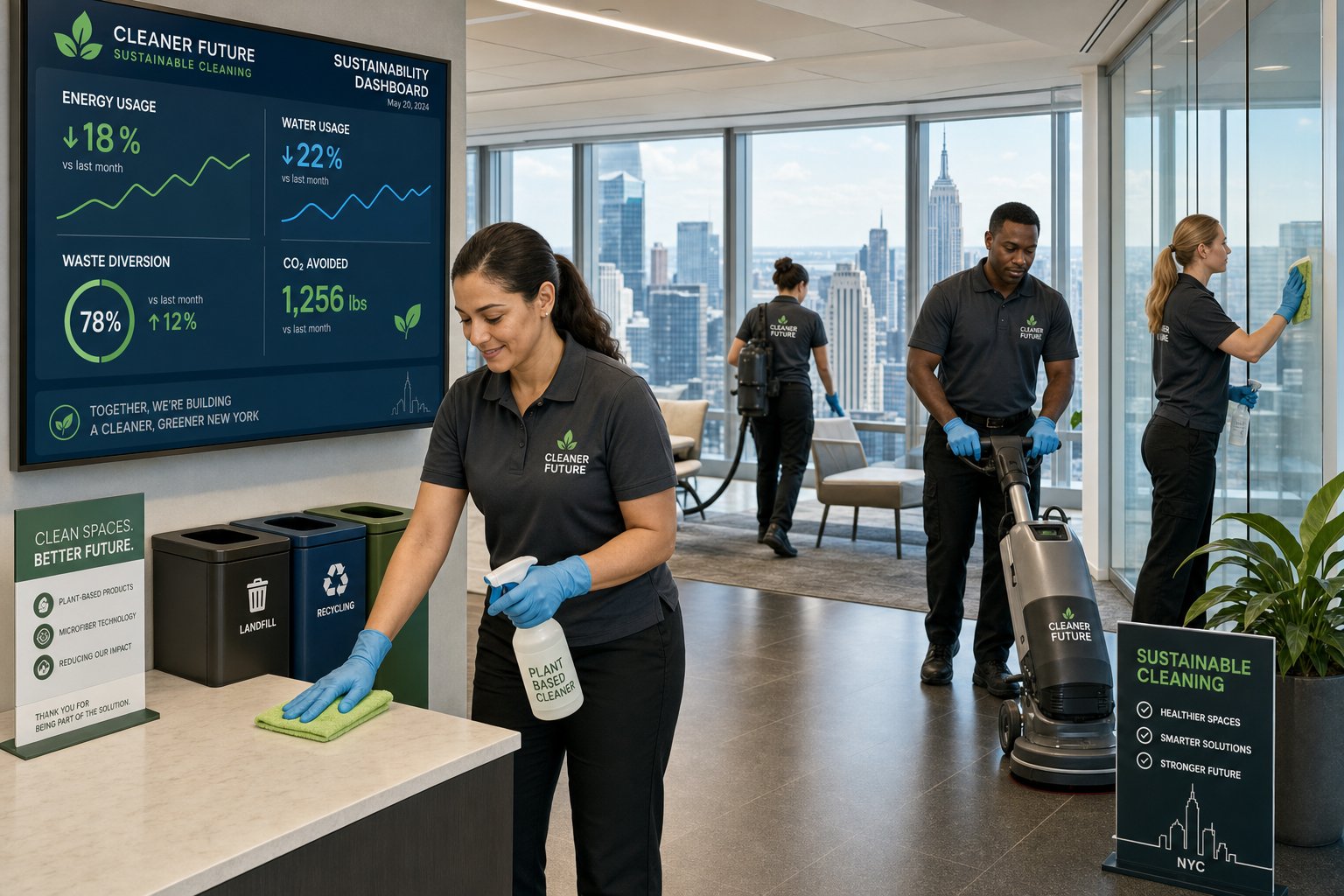
NYC Local Law 97 is primarily an emissions law, but building operations teams should not overlook the role of commercial cleaning in a broader sustainability and tenant-comfort program. A Manhattan office tower, a Bronx multifamily property, and a Brooklyn mixed-use building all need energy and carbon decisions led by qualified engineers and building owners; cleaning cannot substitute for an emissions plan. It can, however, support waste controls, indoor air quality, product documentation, floor-life extension, and reliable operational records. GreenPoint Maintenance Services combines Green Seal certified products, JaniTrack verification, and fixed pricing. Call 347-332-9348 to schedule a building walkthrough.
What Local Law 97 means for cleaning teams
Local Law 97 establishes emissions limits for covered buildings and phases in stricter requirements over time. Building owners should confirm applicability, reporting, deadlines, and penalties with NYC Department of Buildings guidance and qualified energy professionals. A janitorial provider should not promise compliance through cleaning alone. GreenPoint’s role is operational support: use products and methods that align with the building’s sustainability policy, reduce avoidable waste, maintain filters and surfaces as specified, and document work so facilities leaders can connect cleaning activity to the wider plan.
This distinction matters in vendor selection. A company that says “green cleaning equals Local Law 97 compliance” is oversimplifying a technical regulation. GreenPoint Maintenance Services explains what the cleaning contract can and cannot cover, then writes measurable tasks around products, dilution, waste streams, equipment care, and tenant communication. Call 347-332-9348 for a walkthrough that includes the building engineer or sustainability lead.
Manhattan, Bronx, Brooklyn, and Queens operating context
Local logistics affect sustainability outcomes. A Midtown tower may have freight-elevator windows and high tenant density; a Lower Manhattan building may coordinate waste rooms with security; a Bronx property may have school or community traffic; and a Queens mixed-use site may share loading with retail. GreenPoint maps service elevators, waste rooms, tenant access, recycling stations, and equipment storage so the route reduces avoidable travel and contamination rather than merely adding a “green” product to the closet.
Weather and transit soil also shape maintenance. Salt, rain, pollen, and construction dust can shorten floor finish life and increase particulate load at entrances. A planned mat-care and dust-control program can reduce abrasive soil before it spreads. GreenPoint can schedule pre-opening checks or event resets around occupancy, and facilities teams can call 347-332-9348 when a tenant move, renovation, or new waste stream changes the route.
Green Seal products, dilution, and chemical inventory
GreenPoint uses Green Seal certified products where they are appropriate, while following every label for dilution, contact time, ventilation, and personal protective equipment. Sustainability is not achieved by overusing concentrate or switching products without training. A building should maintain an approved chemical list, SDS access, storage rules, and a process for removing expired or unapproved products. OSHA’s [Hazard Communication Standard](https://www.osha.gov/hazcom) supports clear labels, training, and accessible safety information.
A useful contract identifies who buys chemicals, how dispensers are calibrated, how microfiber is laundered, and how products are kept out of tenant food areas. GreenPoint can report approved products and usage exceptions to the facility lead and use color-coded systems to reduce cross-contamination. Fixed pricing, no hourly billing, and no hidden fees help a property budget the recurring program, while special restoration products are scoped separately. Call 347-332-9348 for an inventory review.
Indoor air quality and source control
Cleaning supports indoor air quality through source control, dust removal, and careful product use, but HVAC design and ventilation remain building-system responsibilities. GreenPoint can remove settled dust from approved ledges, vacuum with appropriate filtration, clean return grilles when included, and schedule odor-producing work after hours. The [indoor air quality and commercial cleaning](/blog/indoor-air-quality-commercial-cleaning/) guide describes how product VOCs, particulate matter, and cleaning methods interact.
Building teams should set measurable expectations: no visible dust on designated surfaces, no strong residual odor after reentry time, clean filters or grilles when assigned, and documented exceptions where access is blocked. GreenPoint can coordinate with engineers when a tenant reports odor or dust, but the cleaning record should not be presented as an IAQ certification. JaniTrack notes and photos of approved areas give the facilities lead a reliable timeline.
Waste, recycling, and tenant-facing routines
A janitorial program can support waste-diversion goals only when streams are clearly labeled and the building’s hauler rules are understood. GreenPoint can collect approved paper, cardboard, compost, landfill, and e-waste staging according to the property’s instructions, but cleaners should not guess when a tenant places contaminated or unknown material in a recycling bin. The scope identifies pickup points, contamination escalation, compactor rules, and the person responsible for reporting weight or diversion data.
Tenant communication is part of the control. Signs near kitchens, copy rooms, and loading areas should explain what belongs in each stream and how to report an overflow. GreenPoint can document a missed pickup or contaminated bin in JaniTrack and propose a frequency adjustment after repeated observations. The [green cleaning commercial buildings guide](/blog/green-cleaning-commercial-buildings-guide/) offers a broader framework. Call 347-332-9348 when a building adds compost or a new tenant amenity.
Floor care and asset life
Extending the life of flooring can support a building’s sustainability and capital-planning goals. Daily dust removal reduces abrasive grit; correct neutral cleaning limits residue; entrance mats capture soil; and scheduled recoating can delay full replacement. GreenPoint builds a floor plan by material—carpet, VCT, stone, concrete, or resilient tile—because a single chemical or machine setting can damage one surface while cleaning another. The [VCT floor-care strip, seal, and wax guide](/blog/vct-floor-care-strip-seal-wax-guide/) explains why periodic maintenance should be planned rather than reactive.
A 50,000-square-foot office tower may save disruption by using low-moisture carpet methods and zone-based floor care during tenant off-hours. The right benchmark is not simply the lowest per-square-foot price; it is cost per useful year of asset life, occupant disruption, and appearance level. GreenPoint can schedule work around elevators, lobby traffic, and tenant events and provide a quote at 347-332-9348.
JaniTrack records for sustainability operations
A sustainability program needs evidence that can be reviewed month after month. JaniTrack captures task completion, timestamps, GPS-tagged photos of approved zones, notes, exceptions, and selected ATP readings. GreenPoint can use those records to show that a recycling room was serviced, a lobby was checked, or a floor-care task was completed. The dashboard is not an emissions ledger, but it creates an operational record that complements engineering and utility data.
Trend review is where the value appears. Repeated waste overflow may justify a larger cart or pickup frequency; recurring entrance soil may call for better mat placement; high ATP results on a pantry touchpoint may justify a midday check. GreenPoint’s 98% client retention reflects a habit of reviewing evidence and making scoped adjustments. See [digital cleaning verification systems](/blog/digital-cleaning-verification-systems/) for more on measurable service.
Local requirements, LEED, and building policies
Local Law 97 should be considered alongside the building’s energy audit, tenant guidelines, waste rules, LEED or WELL commitments, and any NYC Department of Buildings filings. Cleaning vendors should follow the property’s documented requirements and avoid claiming that a product certificate alone earns a certification point. GreenPoint can provide product lists, training records, service logs, and scope language for the facilities team to review with its sustainability consultant.
A building may also have a green lease that requires low-emitting products, recycling practices, or reporting. GreenPoint can align the route to those requirements and identify exceptions, but the owner remains responsible for the legal compliance program. The [cleaning for LEED-certified buildings](/blog/cleaning-for-leed-certified-buildings/) guide helps turn broad sustainability language into operational questions. Call 347-332-9348 to map requirements before a vendor change.
Budgeting and contractor selection
Sustainable cleaning pricing depends on area, traffic, hours, floor mix, waste streams, product requirements, documentation, and periodic work. An inexpensive quote can become costly if it relies on over-diluted chemicals, ignores floor maintenance, or leaves the building team to chase missed tasks. GreenPoint provides fixed pricing with no hourly billing or hidden fees and separates recurring janitorial, periodic floor care, consumables, and approved sustainability reporting. The [commercial cleaning cost per square foot](/blog/commercial-cleaning-cost-per-square-foot/) article gives benchmark context, but the building plan must be site-specific.
GreenPoint Maintenance Services is MBE/MWBE certified in New York programs, registered in SAM.gov, and serves NY, NJ, CT, PA, and FL. Ask the vendor for its approved product list, SDS process, waste-boundary policy, equipment maintenance plan, absence coverage, and proof-of-service method. Start with [questions to ask a commercial cleaning company](/blog/questions-to-ask-commercial-cleaning-company/) and call 347-332-9348 for a walkthrough with the property manager and engineer.
Frequently asked questions
Does cleaning make a building compliant with Local Law 97? No. Local Law 97 compliance involves building applicability, emissions calculations, reporting, and technical measures led by the owner and qualified professionals. Cleaning can support related operations such as product controls, waste, dust, and documentation.
Are Green Seal products required by Local Law 97? Local Law 97 is not simply a product-certification rule. GreenPoint uses Green Seal certified products where appropriate and aligns the scope with the building’s sustainability, LEED, WELL, and tenant policies.
Can JaniTrack report carbon emissions? JaniTrack documents cleaning tasks, timestamps, approved-area photos, notes, exceptions, and selected ATP trends. It is an operational verification system, not an energy meter or emissions-calculation platform.
How can cleaning support indoor air quality? Source control, careful dust removal, suitable filtration, correct product use, and adequate reentry time can support comfort. HVAC design and ventilation remain building-system responsibilities and should be reviewed by qualified professionals.
How do NYC building teams get a quote? Call 347-332-9348 or email info@greenpointms.com. GreenPoint will schedule a walkthrough with facilities and sustainability stakeholders and provide a fixed-price scope with no hourly billing or hidden fees.
Support the building’s sustainability plan with measurable operations. Call GreenPoint Maintenance Services at 347-332-9348 for a Local Law 97-aware walkthrough and fixed-price quote backed by Green Seal products, JaniTrack proof, and 98% client retention.