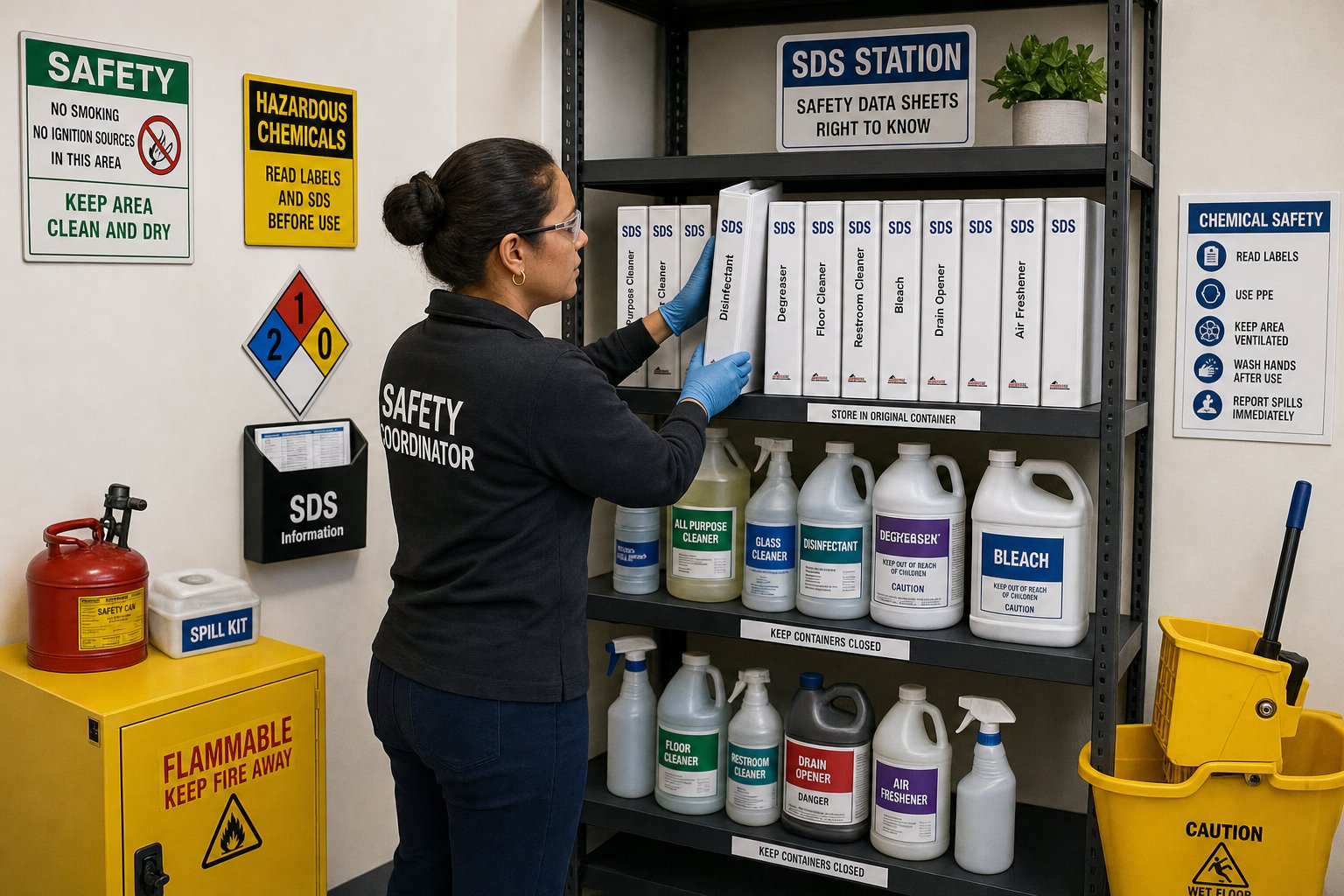
OSHA SDS controls are the foundation of a safe commercial cleaning program. A property manager in Midtown Manhattan, the Bronx, Brooklyn, Queens, Staten Island, Westchester, Long Island, New Jersey, Connecticut, or Pennsylvania should be able to answer four questions: what chemicals are onsite, where is each Safety Data Sheet, who is trained, and what happens during an exposure or spill? GreenPoint Maintenance Services Corp maintains labeled chemical inventories, trains assigned and relief staff, and uses StockPoint to document inspections and corrective actions. This guide explains how to build a defensible process for offices, schools, healthcare facilities, warehouses, and government buildings. Call 844-814-0810 to schedule a walkthrough.
Know what OSHA Hazard Communication requires
OSHA’s Hazard Communication Standard, 29 CFR 1910.1200, centers on labels, Safety Data Sheets, employee information and training, and a written hazard communication program. A cleaning vendor and building owner may each have responsibilities depending on who supplies, stores, and directs the chemical. GreenPoint works with the facility to identify the designated employer, site contact, product list, storage location, and training record. The [OSHA cleaning chemical safety, GHS and SDS](/blog/osha-cleaning-chemical-safety-ghs-sds/) guide is a useful companion for managers reviewing the basics.
The goal is not a binder that nobody opens. A cleaner should recognize a product, understand the hazard pictograms and signal words, find the current SDS, select PPE, follow dilution and ventilation directions, and report a reaction. GreenPoint supervisor briefings use the actual products on the account and repeat the rules for absence coverage.
Build a room-by-room chemical inventory
List every product by manufacturer, product name, identifier or SKU, use, concentration, container size, storage location, and owner. Include restroom cleaner, glass cleaner, neutral floor cleaner, degreaser, disinfectant, carpet extractor solution, hand soap, and any specialty product. The inventory should identify concentrates separately from ready-to-use bottles and should show whether a product is supplied by the cleaning contractor, tenant, school, laboratory, or facilities department.
A 100,000-square-foot office might have a main janitorial closet plus satellite closets on five floors; a school may have science, kitchen, custodial, and athletic areas; a hospital may add clinical products outside the janitorial scope. GreenPoint maps these locations during a walkthrough and uses color-coded labels and locked storage where the building requires it. Call 844-814-0810 if the current inventory is a spreadsheet that does not match the closets.
Keep the SDS accessible and current
Every hazardous chemical in the work area needs a current SDS accessible to employees during their shift. Electronic access can work if cleaners have reliable devices, connectivity, and training; a physical backup is useful when a building loses power or a phone cannot be used. GreenPoint identifies the access point in onboarding, checks for missing sheets, and records a corrective action rather than assuming a vendor portal is enough. The 16-section SDS format makes it easier to find hazards, first aid, fire-fighting, spill response, handling and storage, exposure controls, and disposal information.
Review the list at mobilization, after a product change, during a monthly closet inspection, and at least annually. A distributor substitution or reformulated product should trigger a new SDS check. The facility should also decide how a cleaner contacts the supervisor, security desk, EHS lead, and emergency services after an exposure. Keep emergency directions visible without replacing the official SDS.
Train cleaners on labels, dilution, and PPE
Training should use the exact bottle and dispenser a cleaner will handle. Cover pictograms, signal words, routes of exposure, gloves and eye protection, ventilation, dilution equipment, contact time, incompatibilities, spill response, and hand hygiene. GreenPoint never permits unlabeled secondary containers or chemical mixing, and our supervisors check that a spray bottle matches its label. A relief cleaner should receive the same site-specific briefing before entering the closet, not learn by copying a coworker.
OSHA rules are only one part of the plan. The facility may have local fire-code storage limits, landlord rules, school or healthcare restrictions, and product approvals for sensitive surfaces. In New York City, review the building’s approved storage plan and fire-safety procedures; in NJ, CT, and PA, coordinate with the applicable owner, fire official, and workplace program. GreenPoint documents the client’s local requirements rather than giving a one-size-fits-all answer.
Design a safe storage and transport route
Store products in the designated, ventilated area away from food, patient supplies, student materials, heat, ignition sources, and incompatible chemicals. Keep caps closed, containers upright, labels legible, and carts attended in public areas. A 10-minute end-of-shift cart check can catch a loose cap or missing label before a spill. GreenPoint uses secondary containment where required and trains staff to move concentrates with the right PPE and equipment.
Map the route from closet to work area so a cleaner does not carry open containers through a lobby, subway-connected entrance, cafeteria, or patient waiting room. For a building near Grand Central, Penn Station, Newark Penn, Stamford station, or SEPTA corridors, arrival and elevator controls may affect the route. A walkthrough at 844-814-0810 can include security, facilities, EHS, and the account supervisor.
Plan spill, exposure, and emergency escalation
The service agreement should state who isolates an area, who calls security or emergency services, which spill kit is available, and when a trained responder—not a routine cleaner—takes over. GreenPoint teaches cleaners to stop, warn others, secure the area, use only approved PPE and response materials, and report the product and exposure facts without guessing. For a splash to eyes or skin, follow the SDS first-aid instructions and the employer’s medical-response plan. Never send a cleaner back into an unknown spill because a customer wants the hallway reopened.
Log the location, time, product, people notified, immediate control, and follow-up owner. StockPoint can record the operational exception without storing unnecessary medical details. Review repeat spills for root causes such as a leaking dispenser, overcrowded closet, poor cart design, or a tenant storing incompatible products beside janitorial supplies.
Inspect the program and prove corrective action
A chemical-safety audit can be simple and repeatable: compare the closet to the inventory, inspect labels, confirm SDS access, check PPE, verify segregation and secondary containment, review training dates, and sample a cart. GreenPoint performs supervisor inspections and can track pass rate, missing-SDS count, unlabeled-container count, open spill actions, and relief-worker training. The [digital cleaning verification systems](/blog/digital-cleaning-verification-systems/) guide explains how digital records can support accountability without replacing a real inspection.
Set a corrective-action deadline based on risk. A missing label or unknown bottle should be removed from service immediately; a filing error may have a shorter administrative deadline. GreenPoint records the fix, the person responsible, and the closure date. ATP testing and appearance checks may help assess cleaning outcomes, but neither replaces OSHA chemical controls.
Put inventory duties into the contract
Procurement should ask who purchases products, approves substitutions, keeps SDS records, trains workers, supplies PPE, performs monthly inspections, and pays for spill response. GreenPoint Maintenance Services provides fixed pricing with no hourly billing and no hidden fees, and the proposal lists chemicals, consumables, storage assumptions, periodic work, and exclusions. MBE/MWBE certifications, SAM.gov registration, Green Seal options, and 98% client retention are useful credentials, but the contract must still name the operational owners.
For a school, medical practice, warehouse, or government office, add rules for student or patient access, food areas, regulated waste, floor finishes, loading docks, and public complaints. GreenPoint can email info@greenpointms.com or call 844-814-0810 to schedule a no-obligation walkthrough with the people who actually open the closets and supervise the route.
Launch with a 30-day safety baseline
GreenPoint’s mobilization checklist records the chemical inventory, SDS location, approved product list, labels, PPE, storage, cart route, spill contacts, training roster, and inspection calendar. During week one, the supervisor observes technique and corrects dilution or labeling issues. At day 14, the client reviews open actions and any product substitutions; at day 30, the team confirms that the inventory, SDS files, and actual closets still match.
For multi-site accounts across New York, New Jersey, Connecticut, Pennsylvania, and Florida, use one core standard with local annexes. GreenPoint Maintenance Services can provide a common audit form and StockPoint dashboard while preserving each property’s fire, landlord, healthcare, school, and security requirements. Reopen the review when a building is renovated, a product is changed, or the cleaning scope expands.
A current SDS file is necessary but not sufficient. The cleaner must be able to connect the sheet to the bottle, the bottle to the task, and the task to a safe storage and response procedure. GreenPoint supervisors check that chain in the actual closet and cart, then record any correction in StockPoint. Managers should invite EHS, security, facilities, and procurement to the walkthrough so responsibility is clear. Call 844-814-0810 when the inventory has drifted from the building’s real operations.
GreenPoint’s fixed-price proposals state the supplies, training, inspection, and response assumptions with no hidden fees. Our Green Seal certified product options can support a sustainability policy, but the label, SDS, PPE, and storage rules still apply. Email info@greenpointms.com for a written scope and ask for a sample safety inspection report before award.
FAQ: practical answers for facility and procurement leaders
What is an SDS in commercial cleaning? A Safety Data Sheet explains a chemical’s hazards, first aid, fire response, spill response, handling, storage, exposure controls, and other information in the standardized 16-section format. GreenPoint keeps current SDS access tied to the products actually used at the facility.
How often should a cleaning chemical inventory be reviewed? Review it at mobilization, after any product or formulation change, during monthly closet inspections, and at least annually. GreenPoint also checks satellite closets and relief-worker carts so the list matches real conditions.
Can cleaners pour concentrate into a spray bottle? Only when the facility’s approved process provides the correct dilution equipment, label, PPE, and training. Unlabeled secondary containers and chemical mixing are not acceptable. GreenPoint verifies labels and dilution during supervisor inspections.
Who handles a hazardous spill in a commercial building? The building’s emergency plan and the product SDS determine the response. Routine cleaners should stop, secure, notify, and escalate an unknown or unsafe spill to trained responders. GreenPoint documents the operational exception and does not ask staff to improvise.
How do I get an OSHA-compliant cleaning safety quote? Call GreenPoint Maintenance Services at 844-814-0810 or email info@greenpointms.com. We will review products, closets, access, PPE, training, local fire-safety requirements, inspection cadence, and response procedures before providing fixed pricing.
GreenPoint Maintenance Services Corp can organize a safer chemical inventory and SDS program with a no-obligation walkthrough. Call GreenPoint at 844-814-0810 or email info@greenpointms.com for fixed pricing, labeled-product controls, StockPoint inspections, and a janitorial safety scope built around OSHA Hazard Communication responsibilities.